
Short Answer
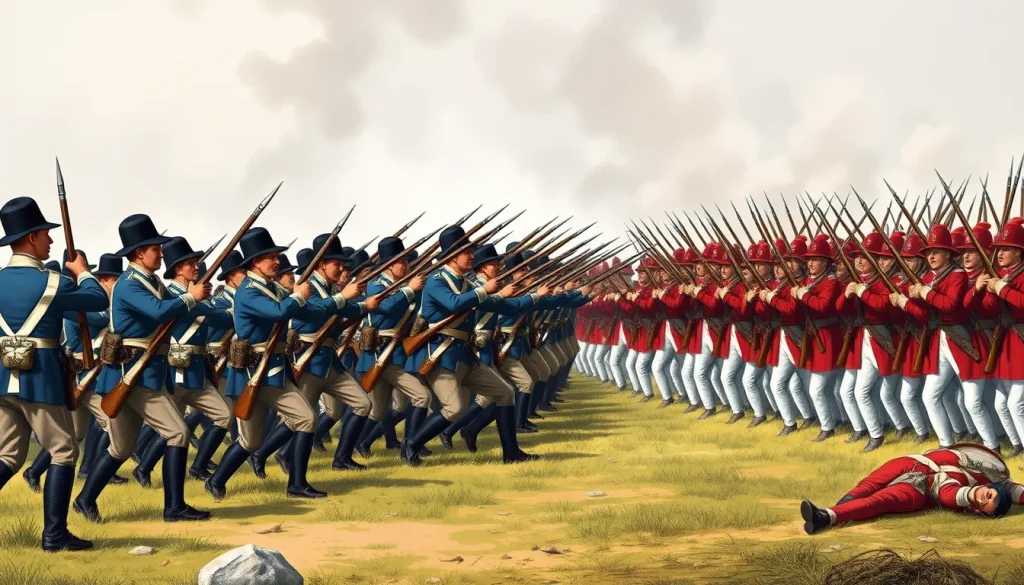
This article examines the role of the bayonet and the practice of close combat—hand-to-hand fighting with bayonets, swords, and musket butts—in the land and amphibious operations of the War of 1812 (1812–1815). The bayonet was the standard shock weapon of infantry tactics in the age of the flintlock musket, and its use shaped the outcome of major engagements such as the Battle of Stoney Creek (June 1813) and the Battle of Lundy’s Lane (July 1814), as well as countless smaller skirmishes along the Canada–United States frontier. Because close combat is often described in official reports and later remembered in patriotic narratives, this article distinguishes reliable contemporary evidence, including archaeological and experimental findings, from later historical interpretation.
Historical Context
In the early nineteenth century, European and North American armies fought according to a common tactical system rooted in the discipline of the line. The standard infantry arm was a smoothbore flintlock musket, such as the British Land Pattern musket (the “Brown Bess”) or its American counterpart, the Springfield Model 1795. These weapons were slow to load—an experienced soldier might manage two or three rounds per minute—and inaccurate beyond roughly 100 yards; their practical effectiveness depended on massed volleys fired from close order. Because firepower alone rarely decided an engagement against a determined opponent, infantry doctrine emphasized the bayonet charge, a coordinated advance in close formation intended to break the enemy’s morale and drive him from the field. The charge was as much a psychological weapon as a physical one, and well-disciplined troops were expected to withstand enemy fire and close with cold steel.
Conditions in North America differed markedly from the open battlefields of Europe. Much of the war was fought along the Niagara River, the upper Great Lakes, and in the forests of the Old Northwest and Upper Canada, where dense woods, small numbers, and the presence of Indigenous allies and Canadian militia complicated the use of large linear formations. American volunteer militia, although often brave, lacked the drill and discipline of regulars; the United States Army was small and its officer corps had aged considerably since the Revolution. British regulars, many of them veterans of the Napoleonic Wars in Europe, were among the most experienced troops in the world, and they were supported by Canadian fencibles, militia, and Indigenous warriors who fought in their own styles. These differences shaped how, when, and where close combat occurred.
What Happened
Close combat with the bayonet occurred at several decisive points in the war, most notably on the Niagara frontier. The United States launched repeated invasions of Upper Canada, and the land campaigns of 1812–1814 saw a series of actions in which hand-to-hand fighting proved decisive or particularly destructive.
On the night of 6 June 1813, a British force of about 700 regulars under Lieutenant Colonel John Harvey attacked the much larger American encampment at Stoney Creek, near present-day Hamilton, Ontario. The attack was a surprise raid carried out in darkness and confusion; fighting became so disordered that soldiers struggled to distinguish friend from foe. Primary accounts describe the battle as chaotic, with troops in close contact. Afterward, the dead were buried in a mass grave on the battlefield. Archaeological excavation of this grave—the Smith’s Knoll collection—revealed sharp force injuries consistent with bayonet and sword wounds, confirming that close combat caused fatalities at Stoney Creek (Lockau et al., 2013).
The American army that returned to the Niagara in 1814 was a different force. Under the guidance of Brigadier General Winfield Scott, the regular units drilled during the winter of 1813–1814 following the principles of European drill, and at the Battle of Chippawa on 5 July 1814, a brigade of American regulars withstood a British advance and then went on the offensive, an engagement conducted largely in open order with volley fire and a final bayonet push. The battle demonstrated that drilled American infantry could meet British regulars on equal terms.
The bloodiest engagement of the war came at the Battle of Lundy’s Lane on 25 July 1814, fought near Niagara Falls in the dark. Both sides committed nearly their full forces, with combined casualties exceeding 1,700 men. The most celebrated episode was the charge of Colonel James Miller’s 21st US Infantry up the ridge to capture the British artillery; when asked if he could take the hill, Miller replied with a pledge to make the attempt—”I’ll try, sir”—a phrase later adopted as the regimental motto. In the darkness, units intermingled, commanders lost control, and men fought hand-to-hand with bayonets, gun butts, and swords. Historian Jon Latimer described Lundy’s Lane as “the most ferociously contested engagement of the war,” comparing its ferocity to battles of the Peninsular War. Both army commanders—Scott and his superior, Major General Jacob Brown—were wounded, as was British Lieutenant General Gordon Drummond, yet the fighting continued past midnight until the Americans withdrew.
Close combat also occurred at the Siege of Fort Erie later that summer and in smaller skirmishes and raids. On the frontier posts along the Mississippi and Illinois territories, the regular infantry relied on muskets, knives, tomahawks, and muskets used as clubs, where the formal bayonet charge of European warfare was rarely employed. An excavated model 1808 socket bayonet from Fort Johnson/Cantonment Davis near Warsaw, Illinois, illustrates this reality: the artifact’s context suggests it was left behind when the post was abandoned, and archaeologists note that bayonets on the western frontier were often used as camp tools such as tent stakes or roasting spits rather than as weapons (ISAS Field Notes, 2018).
At the Battle of Plattsburgh Bay on Lake Champlain (11 September 1814), the decisive action was naval. The small arms recovered from the lakebed by the Lake Champlain Maritime Museum include muskets, pistols, and cutlasses, showing that British and American sailors and marines expected close-quarters combat during boarding actions, even if the battle was ultimately decided by gunfire (Parody, 2020).
Why It Matters
The immediate consequences of bayonet fighting were measured in casualties and the outcomes of the major campaigns. The American invasions of Canada ended in retreat after Lundy’s Lane, and the British counteroffensive, though it failed to re-capture Fort Erie, confirmed the strategic stalemate that would lead to the Treaty of Ghent in December 1814. In the longer run, the war proved a critical school for the United States Army. The drilling of Winfield Scott’s brigade and the professional performance of infantry at Chippawa and Lundy’s Lane demonstrated that American regulars could fight on European terms, and the post-war era saw the adoption of standardized drill regulations and the establishment of a serious military education at West Point. The bayonet charge became a symbol of courage and determination in the national memory, even as later historians debated its practical effectiveness.
The war’s close combat also offers a window onto the experience of the soldiers themselves. The bones of the men buried at Stoney Creek, the discarded bayonet of a frontier infantryman, and the cutlasses and muskets jettisoned from a captured brig all speak to the physical, brutal reality of hand-to-hand fighting in an era when soldiers were expected to endure the shock of battle with fixed steel.
Definition
A bayonet is a blade that attaches to the muzzle of a musket or rifle, turning the firearm into a short pike for close combat. The socket bayonet, which slides over the barrel and locks in place, leaves the bore unobstructed and was the standard type of the Napoleonic era. Close combat in the War of 1812 encompassed not only bayonet thrusts but also hand-to-hand fighting with swords, pistols, musket butts, knives, tomahawks, and fists, all of which occurred at ranges measured in feet rather than yards.
Background
The bayonet evolved in the seventeenth century, eventually replacing the pike as the infantryman’s close-quarters weapon. By the end of the eighteenth century, the triangular socket bayonet was standard in European armies, attached to smoothbore muskets such as the British Brown Bess and the U.S. Springfield Model 1795. The first regulation of U.S. accoutrements, the Model 1808 bayonet, remained in service until 1828 (ISAS Field Notes). The tactical role of the bayonet was codified in drill manuals, including Baron von Steuben’s “Regulations for the Order and Discipline of the Troops of the United States,” which remained influential into the war, and in the British Army’s 1792 drill regulations, which emphasized the power of the charge.
How It Worked
In linear tactics, the infantry delivered a volley of musket fire and then, on command, advanced with the bayonet. The charge was intended to be delivered at a steady pace, with discipline, so that the threat of cold steel broke the enemy’s nerve before physical contact was made. Against well-drilled troops, the charge could be met with a counter-charge, and the result was a chaotic, violent mêlée. In North American conditions—wooded terrain, fortified camps, night attacks—the choreographed charge of the drill ground was often impossible, and close combat degenerated into individual fights using bayonets, clubbed muskets, knives, and hatchets. Soldiers also used bayonets routinely as camp tools: tent stakes, cooking spits, and candle holders, which explains why a bayonet from Cantonment Davis was simply left behind (ISAS Field Notes).
Competing Viewpoints
Historians disagree about how often bayonet charges actually resulted in hand-to-hand contact. Some argue that, on the open battlefields of Europe and the Niagara, firepower was usually sufficient to break an attack and that the bayonet charge was more a psychological gesture than a practical weapon. Others, pointing to the casualty patterns at Stoney Creek and Lundy’s Lane, maintain that close combat was a real and often decisive part of the fighting. The archaeological evidence from Stoney Creek, where sharp force injuries to ribs and a lower leg were identified as bayonet and sword wounds, supports the view that at least some soldiers died by cold steel; experimental replication, using period replicas of a sword and a triangular socket bayonet, showed that the rib lesions matched bayonet wounds and the lower leg wound matched a sword blow (Lockau et al., 2013). At the same time, the absence of such injuries in other documented cases, and the common use of bayonets as tools on the frontier, cautions against generalizing from a single battlefield.
Role in the War of 1812
The bayonet mattered most on the Niagara frontier, where the opposing armies were large enough and the ground open enough for European-style linear tactics. The battles at Chippawa and Lundy’s Lane were decided, or nearly so, by infantry volleys and bayonet assaults. The night attack at Stoney Creek succeeded precisely because the British used the bayonet and the shock of surprise, rather than prolonged fire, to disorganize the American camp. In the interior and the northwest, the formal bayonet charge was less common; skirmishing, ambush, and the use of knives, hatchets, and clubbed muskets were more practical. Close combat also played a role at sea, where boarding actions made use of pistols, cutlasses, and muskets with bayonets, as the small arms collection from Plattsburgh Bay demonstrates.
Consequences and Historical Interpretation
The War of 1812 marked the last time that the United States Army employed the smoothbore musket and socket bayonet as its standard infantry equipment; by the time of the Mexican-American War, although the musket remained in use, improvements in firepower and the adoption of more flexible tactics began to reduce the centrality of the bayonet charge. In historical memory, the war’s close combat became a source of national pride and regret. The performance of Scott’s drilled regulars at Chippawa and the courage displayed at Lundy’s Lane—especially the action of Miller’s 21st Infantry—were used to argue that American troops had earned their place beside the best European soldiers. The war also accelerated the professionalization of the U.S. officer corps, with drill manuals and West Point education drawing directly on the lessons of the Niagara campaign. Later historians, however, have cautioned against romanticizing the bayonet charge, noting that most casualties in the war were inflicted by artillery and musket fire, and that close combat was exceptional rather than routine, even if it was disproportionately decisive when it occurred.
Primary Sources
Contemporary evidence for the use of bayonets and close combat in the War of 1812 comes from both written records and physical artifacts. Official reports of the major battles—such as Major General Jacob Brown’s reports after Chippawa and Lundy’s Lane, and British Lieutenant General Gordon Drummond’s accounts—are preserved in the National Archives of the United States and the United Kingdom, though they were written to present actions in the most favorable light and often omit or exaggerate losses. Eyewitness accounts by soldiers and civilians, some published in contemporary newspapers such as the Niles’ Weekly Register, provide vivid descriptions of hand-to-hand fighting. The principal limitation of these written sources is their inherent bias; official returns of casualties were often manipulated, as at Stoney Creek, where official figures for American dead were far lower than eyewitness recollections (Lockau et al., 2013).
Material evidence offers a different kind of testimony. The Smith’s Knoll skeletal collection from the Stoney Creek mass grave has been studied with bioarchaeological methods; the sharp force injuries, compared with experimental lesions produced by replica swords and triangular socket bayonets, provide direct evidence of perimortem trauma from close combat (Lockau et al., 2013). The excavated Model 1808 socket bayonet from Fort Johnson/Cantonment Davis, described in the Illinois State Archaeological Survey field notes, is a primary example of the standard U.S. bayonet and its secondary uses as a camp tool. The small arms artifacts recovered from the bed of Lake Champlain at Plattsburgh Bay, now in the Lake Champlain Maritime Museum, include muskets, pistols, and cutlasses that illustrate the equipment of naval close combat (Parody, 2020). Each of these sources must be interpreted with care: archaeological remains are fragmentary, artifact contexts are not always securely dated, and experimental replication depends on assumptions about the weapons used.
Further Reading
- Donald R. Hickey, The War of 1812: A Forgotten Conflict (University of Illinois Press, 1989; rev. ed. 2012).
- Jon Latimer, 1812: War with America (Harvard University Press, 2007).
- American Battlefield Trust, “Equipment in the War of 1812,” updated 9 July 2024. https://www.battlefields.org/learn/articles/equipment-war-1812.
- Laura Lockau et al., “Bioarchaeological investigation of sharp force injuries to the ribs and lower leg from the battle of Stoney Creek in the War of 1812,” Anthropological Science, 2013. doi:10.1537/ase.130913.
- Mason Arthur Parody, “Small Arms Artifacts from the Battle of Plattsburgh Bay,” MA thesis, Texas A&M University, 2020. https://hdl.handle.net/1969.1/191812.
- Illinois State Archaeological Survey, “War of 1812 American socket bayonet,” ISAS Field Notes, 9 August 2018. https://blogs.illinois.edu/view/7923/437941937.
References
- Lockau, L., Dragomir, A.-M., Gilmour, R. J., Mant, M., and Brickley, M. B., “Bioarchaeological investigation of sharp force injuries to the ribs and lower leg from the battle of Stoney Creek in the War of 1812,” Anthropological Science, 2013. doi:10.1537/ase.130913.
- Patton, A., “War of 1812 American socket bayonet,” ISAS Field Notes, 9 August 2018. https://blogs.illinois.edu/view/7923/437941937.
- American Battlefield Trust, “Equipment in the War of 1812,” updated 9 July 2024. https://www.battlefields.org/learn/articles/equipment-war-1812.
- “Battle of Lundy’s Lane – War of 1812,” The War of 1812 Reference, accessed 2025. https://thewarof1812.org/battles/battle-of-lundys-lane/.
- Parody, M. A., “Small Arms Artifacts from the Battle of Plattsburgh Bay,” MA thesis, Texas A&M University, 2020. https://hdl.handle.net/1969.1/191812.
FAQ
How important was the bayonet in the War of 1812?
The bayonet was essential in a tactical system built around the smoothbore musket, since firepower alone rarely broke a determined enemy. Bayonet charges and hand-to-hand fighting proved decisive at Stoney Creek, Chippawa, and Lundy's Lane, though many actions were decided by artillery and musketry rather than cold steel.
What kind of bayonet was used by American soldiers?
American infantry used the Model 1808 socket bayonet, the first standard U.S. regulation bayonet, which mounted on the Springfield Model 1795 flintlock musket. The bayonet remained in service until 1828.
What does archaeology tell us about close combat in the war?
Excavation of the Smith's Knoll mass grave at Stoney Creek revealed perimortem sharp-force injuries to ribs and a lower leg; experimental replication with period replicas of a sword and socket bayonet indicated that the rib lesions were bayonet wounds and the leg wound was a sword slash, providing direct evidence of hand-to-hand combat (Lockau et al., 2013).




Leave a Reply