Short Answer
The Burning of Washington on August 24–25, 1814, was a British military operation during the War of 1812 in which a force under Major General Robert Ross and Rear Admiral George Cockburn captured the U.S. capital and set fire to its principal public buildings. This event, part of the Chesapeake campaign, remains the only time a foreign power has occupied and burned Washington, D.C., and it had profound psychological and political effects on the United States.
Historical Context
By 1814, the War of 1812 had reached a stalemate, with American invasions of Canada largely repulsed. In April 1813, American troops burned the parliament buildings at York (present-day Toronto), the capital of Upper Canada, and later destroyed the town of Newark (Niagara-on-the-Lake) in December 1813, leaving hundreds of civilians homeless. These acts of destruction against Canadian civilians and government property fueled British demands for retaliation. The abdication of Napoleon in April 1814 freed thousands of experienced British regulars from the Peninsular War for service in North America. Vice Admiral Sir Alexander Cochrane, commanding the Royal Navy in the Atlantic, planned a series of coastal raids to divert American forces from Canada and to strike at American morale. Rear Admiral George Cockburn, who had raided the Chesapeake for months, identified Washington as a target because it was lightly defended and symbolically significant.
The American capital, established only a dozen years earlier, was a town of fewer than 8,000 residents with no fortifications or military importance. The Madison administration had neglected its defense, relying on militia that were poorly trained and commanded. Secretary of State James Monroe personally reconnoitered British movements but received little support from the War Department. As British forces landed in Maryland in August 1814, the city braced for invasion.
What Happened
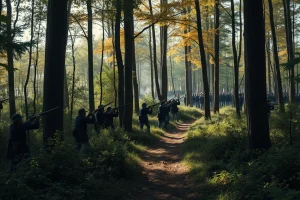
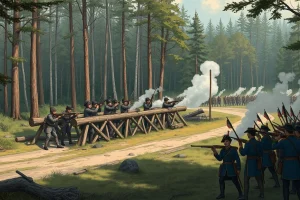
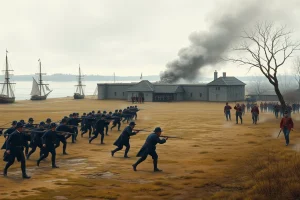
On August 19, 1814, about 4,500 British regulars landed at Benedict, Maryland, on the Patuxent River. They marched northwest, weakened by heat but unopposed until they reached Bladensburg, seven miles from Washington, on August 24. There, an American force of roughly 6,000–7,000 men, mostly militia under Brigadier General William H. Winder, tried to block the road. In the Battle of Bladensburg, the British used Congreve rockets and disciplined infantry to break the American lines, sending the militia fleeing in disorder. President James Madison, who had watched the battle, barely escaped capture.
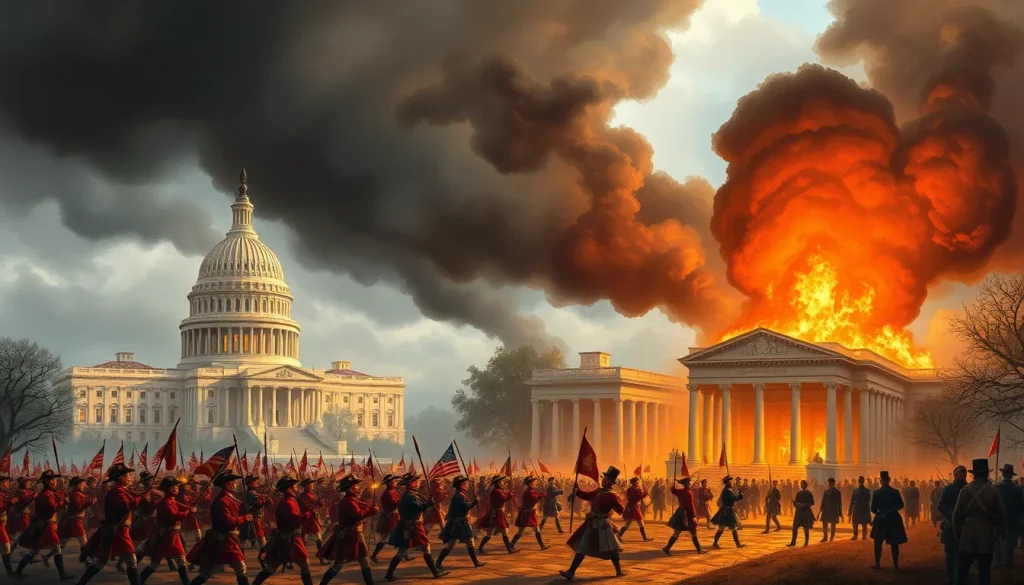
With the route open, British troops entered Washington that evening. The city was largely deserted; government officials had fled, and Dolley Madison supervised the removal of valuables, including the Gilbert Stuart portrait of George Washington, before leaving the President’s House. The British found the mansion’s dinner table set and reportedly ate the meal. Following orders from Ross to destroy public buildings, they set fire to the Capitol, the President’s House, the Treasury, the War and State Departments, the Arsenal, the Navy Yard, and a ropewalk. Private property was generally spared, though some homes near the fires were damaged. At Greenleaf Point, a magazine explosion killed about thirty British soldiers when a detachment investigating the site ignited gunpowder. A violent thunderstorm on the evening of August 25 extinguished some flames and hastened the British withdrawal. By nightfall, they marched back to their ships, leaving Washington in ruins.
Why It Matters
The burning of Washington was a strategic and psychological blow against the United States. It exposed the vulnerability of the young republic and humiliated President Madison and the Democratic-Republican war party. Federalists, who opposed the war, gained political ground, and the Hartford Convention in December 1814 voiced New England’s grievances. The event also stoked American defiance, contributing to the successful defense of Baltimore in September 1814 and the writing of the national anthem at Fort McHenry. In the longer term, it became a powerful symbol of resilience; the President’s House was rebuilt and painted white, giving rise to the name “White House.” Historians emphasize that the burning was retaliation for American destruction in Canada, particularly the burning of York and Newark, and that British commanders deliberately limited destruction to public property, sparing private citizens.
Prelude
The British plan to attack Washington originated in the summer of 1814 as part of a broader Chesapeake campaign. After Napoleon’s defeat, Vice Admiral Cochrane dispatched a squadron under Rear Admiral Cockburn to raid the Chesapeake Bay. Cockburn, who had earlier burned towns and destroyed American ships, knew the region well and advocated for a strike at the capital. Major General Robert Ross, an experienced Peninsular War commander, was chosen to lead the land force. The expedition assembled at Bermuda and arrived in the Chesapeake in August, landing at Benedict on the Patuxent. The Americans, misled by vague intelligence, did not know whether Washington, Baltimore, or Annapolis was the target. A hasty American defense at Bladensburg failed, paving the way for the British march into Washington.
Forces and Commanders
British and Allied Forces: Approximately 4,500 regulars, veterans of the Peninsular War, commanded by Major General Robert Ross, with Rear Admiral George Cockburn supervising naval support and coordination. The force included infantry, light troops, and a few artillery pieces (three small cannons) and rockets.
American Forces: Roughly 6,000–7,000 men, mostly militia, under Brigadier General William H. Winder, with additional militia contingents led by Commodore Joshua Barney (naval artillery) and other officers. President James Madison and Secretary of State James Monroe were present at the front but had no formal command. The American forces suffered from poor training, low morale, and inadequate leadership.
Battlefield and Map Context
The battlefield at Bladensburg, Maryland, lies along the Eastern Branch (now Anacostia River) and the main road from the Patuxent to Washington. The American line was positioned on high ground overlooking a bridge, with artillery placed to cover the crossing. The British advanced with columns and used rockets to break the American left. After the rout, the British marched along the Bladensburg Road (modern Maryland Route 450) into the capital, crossing the Potomac River at the site of the present-day Navy Yard Bridge. Washington itself was laid out according to Pierre L’Enfant’s plan, with public buildings grouped around the Capitol and President’s House. The British burned the primary federal buildings but left most private structures, including churches and residences, intact.
Battle Chronology
August 19: British land at Benedict, Maryland. August 20–23: British march north, skirmish with American militia detachments; Americans retreat. August 24, morning: British approach Bladensburg; American forces under Winder deploy. August 24, midday: Battle of Bladensburg ends in American rout; President Madison and cabinet flee. August 24, evening: British enter Washington; set fire to Capitol, President’s House, Treasury, War Office, Navy Yard, and other public structures. August 25: Thunderstorm hits; British withdraw overnight, marching back to Benedict. British reembark by August 26.
Casualties and Losses
British: Approximately 30 killed, most from the accidental explosion at Greenleaf Point; a few casualties from the Battle of Bladensburg. No British soldiers were lost to American resistance in Washington itself. American: Militia casualties at Bladensburg were light, perhaps fewer than 100 killed and wounded, but the loss of public property was enormous. Estimates of property damage exceeded one million dollars (1814 value), including the Capitol with its Library of Congress, the President’s House, and thousands of government documents. The burning was a political and psychological loss greater than any military defeat.
Result
The British achieved a tactical victory, capturing and burning the enemy capital with minimal loss. They deliberately limited destruction to public buildings and left private homes intact. However, they did not stay or attempt to occupy Washington, withdrawing after about 24 hours. Strategically, the raid forced the Americans to divert troops to defend the coast and embarrassed the Madison administration, but it did not end the war or force the United States to make peace. The subsequent failure to capture Baltimore demonstrated the limits of such raids.
Strategic Consequences
The burning of Washington had several strategic effects. It convinced American leaders of the need for better coastal defense and led to the fortification of Baltimore. It strengthened the Federalist anti-war movement, culminating in the Hartford Convention, though it also sparked national patriotic fury that boosted enlistments. The raid did not significantly affect the peace negotiations at Ghent, but the British delegation used it to press for territorial concessions, which American negotiators rejected. The event shaped American memory and identity, cementing the narrative of British aggression even though it was retaliation for American actions in Canada.
Primary Accounts
Several contemporary accounts survive. George Robert Gleig, a British lieutenant who participated, wrote a memoir titled A Narrative of the Campaigns of the British Army at Washington and New Orleans (1821) that describes the burning. Dolley Madison’s letters to her sister, written during the evacuation, are a prominent American eyewitness account. British official reports, including Ross’s dispatch to Lord Bathurst, list the buildings burned. Some American residents, such as lawyer James Scott and Mayor Robert Brent, left written accounts of the occupation. These sources generally agree on the main events but differ in tone and detail, especially regarding the British claim that they were fired upon first, which British accounts use to justify the burning.
Battlefield Today
Modern Washington, D.C., retains no original structures from the burning; the Capitol and President’s House (now the White House) were rebuilt and expanded extensively. The Bladensburg battlefield is now a residential and commercial area, with a small park (Carter Barron Amphitheatre) marking a portion of the action. The Navy Yard and Greenleaf Point have been redeveloped. Several memorials and plaques commemorate the event, including a marker at the White House and a statue of Dolley Madison saving the portrait at the National Portrait Gallery. The Library of Congress has a collection of contemporary prints and documents related to the burning.
Primary Sources
Key primary sources include:
- A Narrative of the Campaigns of the British Army at Washington and New Orleans by George Robert Gleig (1821) – a British soldier’s detailed account.
- Correspondence of First Lady Dolley Madison, particularly her letter to her sister on August 24, 1814, describing the escape and salvaging of valuables.
- Official report of Major General Robert Ross to Secretary of State Lord Bathurst, August 30, 1814, listing the destroyed buildings and justifying the action as retaliation.
- American administrative documents and letters, such as those of Commodore Thomas Tingey concerning the burning of the Navy Yard.
- Contemporary newspaper reports and illustrations, including a wood engraving titled “The Taking of the City of Washington in America” published in London in October 1814 (Library of Congress).
These sources must be read critically; British accounts emphasize American duplicity and restraint toward private property, while American accounts stress wanton destruction.
Further Reading
- Hickey, Donald R. The War of 1812: A Forgotten Conflict. University of Illinois Press, 1989.
- Lord, Walter. The Dawn’s Early Light. W.W. Norton, 1972.
- Jennings, Francis. An Inland Sea: The World of the Six Nations and the War of 1812. Princeton University Press, 1993.
- National Park Service. “Complete the destruction of the public buildings with the least possible delay.” NPS.gov. Accessed 2024.
- Library of Congress. “The taking of the city of Washington in America.” LOC.gov.
References
- National Park Service. “Complete the destruction of the public buildings with the least possible delay.” https://www.nps.gov/articles/burning-the-capital.htm
- “The Burning of Washington – War of 1812.” https://thewarof1812.org/battles/the-burning-of-washington/
- Library of Congress. “The taking of the city of Washington in America.” https://www.loc.gov/item/96510111/
- Lindsay, James M. “The 1814 British Sack of Washington.” Council on Foreign Relations. https://www.cfr.org/articles/the-1814-british-sack-of-washington
- World History Encyclopedia. “Burning of Washington.” https://www.worldhistory.org/article/2631/burning-of-washington/
FAQ
Why did the British burn Washington in 1814?
The burning was retaliation for American destruction of the parliament buildings at York (Toronto) and the town of Newark (Niagara-on-the-Lake). The British also sought to demoralize the Americans and divert forces from Canada.
Did the British burn private homes in Washington?
Generally no. British commanders ordered destruction only of public buildings and property. Some private homes caught fire accidentally from burning buildings, but they were not deliberately targeted.
What did Dolley Madison save from the White House?
She supervised the removal of the Gilbert Stuart portrait of George Washington, along with silver and other valuables, before fleeing just ahead of the British arrival.

Leave a Reply