
Short Answer
The Battle of Plattsburgh, fought on 11 September 1814 on and around Lake Champlain in northern New York, was the largest engagement of the War of 1812. It pitted a British invasion force of approximately 10,000 troops—the most powerful army assembled by either side during the war—against an American force of about 4,500 soldiers and a hastily prepared naval squadron. The battle ended in a decisive American victory that thwarted a major British invasion from Canada and significantly strengthened the United States’ hand in peace negotiations.
Historical Context
In April 1814, the abdication of Napoleon Bonaparte freed Britain from the Napoleonic Wars in Europe, allowing it to send veteran infantry regiments to North America. These were seasoned troops who had fought under the Duke of Wellington in the Peninsular War, and their arrival in the summer of 1814 shifted the military balance in North America. Sir George Prévost, the British Governor General and commander-in-chief in Canada, chose to advance down the Lake Champlain corridor—a historic invasion route connecting Montreal to New York. The British aimed to sever New England from the rest of the United States and force a favorable peace settlement. Control of Lake Champlain was essential for both supply and military operations, making naval supremacy on the lake a critical objective. American forces, meanwhile, had been preparing defenses along the border, with Master Commandant Thomas Macdonough building a naval squadron and Brigadier General Alexander Macomb commanding the land forces at Plattsburgh.
What Happened
By early September 1814, Prévost’s invading army had advanced to Plattsburgh, where Macomb’s outnumbered regulars and militia were entrenched. On the morning of 11 September, the British naval squadron under Captain George Downie sailed into Plattsburgh Bay, where Macdonough had anchored his ships with innovative spring cables. The naval engagement began at close range, with Macdonough’s meticulously positioned squadron able to rotate and deliver fresh broadsides. Early in the action, Captain Downie was killed, and the British flagship Confiance was severely damaged. After two and a half hours, the British ships were forced to strike their colors. Prévost, witnessing the naval defeat, ordered the army to retreat back to Canada, abandoning the invasion. The American land forces played a supporting role, repelling skirmishes and securing the flanks, but the battle was decided on the water.
Why It Matters
The Battle of Plattsburgh was the largest battle of the War of 1812 in terms of the scale of the British invasion force and the strategic stakes. It ended the last major British offensive of the war, prevented the occupation of northern New York, and secured the American frontier against further large-scale attacks. The victory, along with the defense of Baltimore and Macdonough’s naval success, strengthened American negotiators at Ghent, who were already discussing terms. Although the Treaty of Ghent returned territory to prewar status, the American performance at Plattsburgh helped counter British territorial demands and contributed to a peace settlement that recognized no American territorial losses. Historians consider the battle a decisive American victory that ensured the war ended on terms favorable to the United States.
Prelude
In the summer of 1814, Britain redirected veteran regiments from Europe to Canada, intending to launch a decisive blow. Prévost assembled a force of about 10,000 troops, including the 3rd, 5th, 27th, 39th, 58th, 76th, and 88th Regiments of Foot—many of them veterans of Badajoz, Salamanca, and Vitoria. He moved down the Richelieu River and Lake Champlain, aiming to capture Plattsburgh and then move toward the Hudson River. Meanwhile, Macdonough had built a naval squadron at Vergennes, Vermont, and Macomb had fortified Plattsburgh with earthworks and redoubts. Prévost, however, was reluctant to attack without naval support on the lake, and his relationship with naval commander Downie was strained. The British navy, though newly constructed, was less experienced than Macdonough’s force, which included veterans of the Barbary Wars.
Forces and Commanders
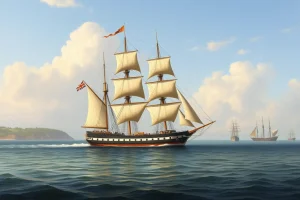
The British land force, commanded by Lieutenant General Sir George Prévost, comprised approximately 10,000 troops, including the 3rd, 5th, 27th, 39th, 58th, 76th, and 88th Regiments of Foot, plus artillery and engineers. The naval squadron, under Captain George Downie, included the frigates Confiance (37 guns) and Linnet (16 guns), the sloops Chubb and Finch, and 12 gunboats. American land forces, commanded by Brigadier General Alexander Macomb, numbered about 1,700 regulars and 2,500 militia. The American naval squadron, commanded by Master Commandant Thomas Macdonough, consisted of the corvette Saratoga (26 guns), the brig Eagle (20), the schooner Ticonderoga (17), the sloop Preble (7), and 10 gunboats. Macdonough anchored his ships in Plattsburgh Bay with kedge anchors and spring lines, which allowed him to rotate his vessels to bring fresh broadsides to bear.
Battlefield and Map Context
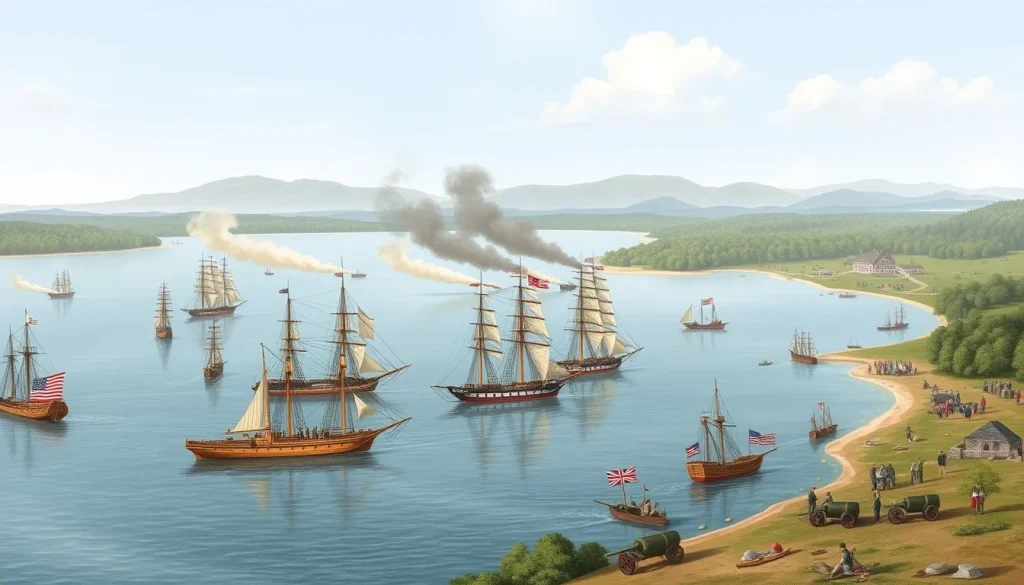
The battle took place on Lake Champlain near the town of Plattsburgh, New York, which sits at the mouth of the Saranac River on the western shore of the lake. The American fleet anchored in a line across Plattsburgh Bay, with Cumberland Head to the north and the lake’s entrance to the east. The British ships had to round Cumberland Head and enter the bay, exposing themselves to close-range American fire. The land engagements occurred along the Saranac River, where Macomb’s forces had built fortified positions on the south bank. The terrain—wooded hills, the river, and the lake—made defense easier for the Americans. The modern site is in Clinton County, New York, near the city of Plattsburgh, with the battlefield and naval anchorage now commemorated by the Plattsburgh Memorial State Historic Site.
Battle Chronology
At 9:00 a.m. on 11 September, British ships were sighted rounding Cumberland Head. Downie’s squadron advanced toward the American line, while Prévost’s army began artillery bombardment and probing attacks on the river crossings. At around 10:00 a.m., the naval duel opened when the British fired the first broadside. Macdonough’s ships were heavily outgunned in the initial exchange, with the Saratoga suffering significant damage. Early in the action, a shot struck and killed Captain Downie. The British flagship Confiance became badly damaged, and her main deck was swept by American fire. Macdonough used his spring cables to turn the Saratoga to bring fresh guns into action, and the Eagle also rotated to deliver effective fire. By 2:00 p.m., the British ships, with their casualties mounting and command disrupted, began striking their colors. Prévost, seeing the fleet defeated, ordered the army to retreat northward, abandoning the siege.
Casualties and Losses
British naval casualties numbered approximately 170 killed, including Captain Downie, and about 220 wounded; four ships were captured. The British army suffered around 200 casualties in the skirmishes and desertions during the retreat. American naval casualties were about 100 killed and 120 wounded; land forces suffered roughly 115 killed and 130 wounded. The loss of the British squadron and the retreat of the army were a severe strategic and morale blow.
Result
The Battle of Plattsburgh was an unqualified American victory. The British naval squadron was either captured or destroyed, and the army retreated to Canada, effectively ending the British invasion of northern New York. The victory was due to Macdonough’s tactical innovation in anchoring with spring lines, which allowed the American ships to outmaneuver the British despite being individually weaker. The American land defense under Macomb also successfully held against British probing attacks. The result was a decisive American control of Lake Champlain for the remainder of the war.
Strategic Consequences
The victory at Plattsburgh, combined with the American defense of Baltimore (September 1814), strengthened the U.S. bargaining position at Ghent. The British government, already weary of the war, saw that further large-scale invasions were unlikely to succeed, which contributed to the signing of the Treaty of Ghent on 24 December 1814, which essentially restored prewar boundaries. The battle also secured the northern frontier for the United States and prevented the potential dismemberment of the Union. For Britain, the defeat was a humiliating end to the largest campaign of the war, and it led to the recall of Sir George Prévost, who faced a court of inquiry into his conduct.
Primary Accounts
Primary accounts include Thomas Macdonough’s official report to the Secretary of the Navy (September 11, 1814), which summarized the action and his tactical dispositions. Sir George Prévost’s dispatch to London (September 11, 1814) attempted to justify the retreat, blaming the naval defeat. British naval officers’ logs and letters from participants provide additional detail. Alexander Macomb’s after-action report to the War Department describes the land defense. These accounts, while accurate on chronology, differ in interpretation, particularly on the decision to retreat.
Battlefield Today
The Plattsburgh Memorial State Historic Site preserves a portion of the battlefield and features a monument commemorating the American victory. The lake and surrounding area remain largely undeveloped, and the bay where Macdonough anchored is marked by interpretive signs. The site includes a museum with artifacts and exhibits on the battle, and it is a stop on the North Country National Scenic Trail. The battlefield is not a National Park Service unit, but it is listed on the National Register of Historic Places.
Primary Sources
The most important primary sources for the Battle of Plattsburgh are the official reports of Thomas Macdonough and Alexander Macomb to the Navy and War Departments (both dated 11 September 1814). Macdonough’s report is particularly detailed, describing his anchoring system and the engagement. Sir George Prévost’s report to Lord Bathurst (11 September 1814) explains his retreat and blames the navy. Additionally, several letters from British officers involved in the battle, including Captain Downie’s correspondence before the battle, are held in British archives. These sources are biased by each author’s perspective: Macdonough sought to highlight his tactical skill, while Prévost aimed to deflect blame. For a modern transcription and analysis, see the published collections of the Naval War of 1812: A Documentary History (Navy Department) and the Canadian War Museum’s resources.
Further Reading
- Hickey, Donald R. The War of 1812: A Forgotten Conflict. University of Illinois Press, 1989.
- Lambert, Andrew. The Challenge: Britain Against America in the Naval War of 1812. Faber & Faber, 2012.
- Latimer, Jon. 1812: War with America. Harvard University Press, 2007.
- Berton, Pierre. Flames Across the Border. McClelland & Stewart, 1981.
References
- “Battle of Plattsburgh – War of 1812.” The War of 1812 Organization. https://thewarof1812.org/battles/battle-of-plattsburgh/.
- “The Battle of Lake Erie – Perry’s Victory & International Peace Memorial.” National Park Service. https://nps.gov/pevi/learn/historyculture/battle_erie_detail.htm.
- “Battle of Lake Erie – War of 1812.” The War of 1812 Organization. https://thewarof1812.org/battles/battle-of-lake-erie/.
- Hickey, Donald R. The War of 1812: A Forgotten Conflict. University of Illinois Press, 1989.
FAQ
Why was the Battle of Plattsburgh the largest battle of the War of 1812?
It involved the largest British army of the conflict—about 10,000 troops—plus a naval squadron, making it the largest single engagement in terms of combined land and naval forces.
What made Macdonough's naval strategy successful?
He anchored his ships with kedge anchors and spring lines, allowing him to rotate each vessel to deliver fresh broadsides without sailing, which neutralized the British advantage in long guns.
How did the battle affect the peace negotiations?
The American victory, along with the defense of Baltimore, strengthened the American position at Ghent, contributing to a treaty that returned to prewar status rather than allowing British territorial gains.
Leave a Reply