
Short Answer
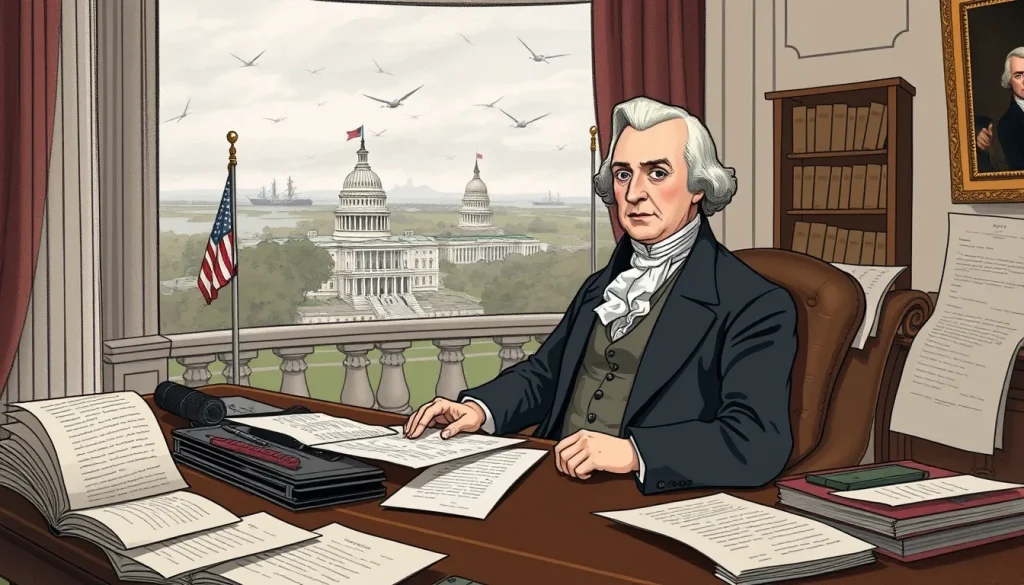
The Papers of James Madison, a comprehensive multi-volume documentary edition, constitutes one of the most important primary source collections for studying the War of 1812. Compiled from the correspondence, messages, and official documents of the fourth U.S. president, the edition’s Presidential Series covers Madison’s entire tenure from 1809 to 1817, including the war years. These papers provide firsthand insight into the political, military, and diplomatic decisions made by Madison as he led the United States through its first major conflict under the Federal Constitution.
Historical Context
James Madison became president in 1809 after serving as Thomas Jefferson’s Secretary of State. The United States faced severe trade restrictions and maritime grievances against Great Britain, including impressment, illegal blockades, and the Orders in Council. Diplomatic efforts failed in the years before the war. Madison, a Virginia Republican and architect of the Constitution, was not a military man but believed war was sometimes necessary to defend national sovereignty and republican principles. The War of 1812 arose from a combination of maritime disputes, fears of British influence over Indigenous nations in the Northwest, and pressure from a younger cohort of War Hawks in Congress. The Papers of James Madison capture these tensions through his letters, cabinet deliberations, and communications with Congress.
What Happened
The Papers document the entire trajectory of the War of 1812 from an American executive perspective. Madison’s special message to Congress on June 1, 1812 detailed the violations of neutral rights and British provocations, leading Congress to declare war on June 18. The war began with American invasions of Canada, which quickly faltered. Madison’s correspondence reveals his frustrations with General William Hull’s surrender at Detroit in August 1812, the failures of General Henry Dearborn on the Niagara frontier, and General William Henry Harrison’s inability to secure the Northwest. The papers also cover naval victories, such as the USS Constitution’s success, and the economic hardships of the British blockade. On the diplomatic front, Madison received reports from envoys Jonathan Russell and Joel Barlow, including Barlow’s death in Poland. By 1814, the American peace commissioners negotiated the Treaty of Ghent, which Madison received and submitted to the Senate. The Papers chronicle the political struggles at home, including Federalist opposition, the 1812 election, and the resignation of cabinet members.
Why It Matters
The Papers of James Madison are indispensable for historians because they offer a unique window into the presidency during the War of 1812. They reveal Madison’s constitutional thinking, his management of a fractious cabinet, his struggles with military leadership, and his efforts to balance civil liberties with wartime necessities. The documentation also demonstrates the partisan nature of American political life during the conflict. Historians have used these papers to reassess Madison’s leadership, moving beyond the initial perception of him as an inept war president. The papers show that he consciously avoided using federal power to repress dissent, even when Federalists threatened secession. The edition’s detailed annotations provide crucial context for understanding the war’s causes, events, and legacy.
Publication History
The Papers of James Madison is a long-running documentary editing project based at the University of Virginia. The first volumes appeared in the 1960s under the editorship of William T. Hutchinson and William M. E. Rachal, initially published by the University of Chicago Press. Later volumes have been issued by the University of Virginia Press. The edition is divided into four series: Congressional Series, Secretary of State Series, Presidential Series, and Retirement Series. The Presidential Series, which begins with Madison’s inauguration in 1809, is most relevant to the War of 1812. Volume 5 of the Presidential Series, covering 10 July 1812 to 7 February 1813, was published in 2004 and edited by J. C. A. Stagg, Martha J. King, and colleagues.
Author
The primary author of the papers is James Madison himself (1751–1836), the fourth president of the United States. However, the published edition is a collaborative effort by a team of historians and editors who transcribe, annotate, and contextualize his documents. Key editors of the Presidential Series include J. C. A. Stagg, an expert on Madison and the War of 1812, and co-editors such as Martha J. King, Ellen J. Barber, Angela Kreider, and Jewel L. Spangler. Their work ensures the accuracy and interpretative value of the edition.
Historical Setting
The Presidential Series covers the years 1809 to 1817, a period defined by European conflicts, American expansion, and the War of 1812. The war years (1812–1815) form the core of these volumes. The documents reflect the political environment of the early republic, with strong Federalist opposition, Republican party unity, and debates over executive authority. The setting also includes the broader Atlantic world, as Madison corresponded with diplomats and foreign ministers while Napoleon’s wars raged in Europe. Indigenous peoples and frontier battles appear prominently, especially in the Northwest and Southwest.
Main Arguments
As a documentary edition, the main argument is that Madison’s papers are essential primary sources for understanding the early American republic and presidential leadership. The editors, through their annotations and selection, emphasize that Madison was a thoughtful and engaged war president. The papers demonstrate that Madison took the war seriously, tried to strengthen the army and navy, and sought diplomatic solutions even while fighting. The edition implicitly argues against the notion that Madison was a passive or weak leader, revealing instead his active management of military and diplomatic affairs.
Key Concepts
Key concepts include the constitutional limits of executive power during wartime, the relationship between civil and military authority, federalism and state militias, and the importance of diplomacy and trade. The papers also illustrate concepts of neutral rights, impressment, and the Orders in Council. For the war itself, the papers highlight the challenges of military command, logistics, and internal dissent.
Reception
The Papers of James Madison have been acclaimed by historians as a model of documentary editing. Reviewers have praised the thorough annotation and the editorial board’s efforts to provide accurate texts. The National Archives and the University of Virginia collaborated to make the papers freely accessible online through Founders Online. The reception among scholars is uniformly positive, with the series considered a foundational resource for studies of Madison and the War of 1812.
Influence
The edition has profoundly influenced modern scholarship on the War of 1812. Biographers of Madison, such as Ralph Ketcham and J.C.A. Stagg, have relied heavily on these papers. The published volumes have corrected earlier textual errors and provided a wealth of documentary evidence. They have also helped reshape interpretations of the war, moving from a view of American ineptitude to a more nuanced analysis of the limitations of early U.S. military institutions.
Editions
The Presidential Series volumes are the primary scholarly edition for the war years. Volume 5 (10 July 1812–7 February 1813) covers the early disasters and political battles. Subsequent volumes document the remainder of the war and the peace process. The University of Virginia Press publishes the print edition, while the digital version is available on Founders Online (founders.archives.gov) and through the University of Virginia Press’s digital platform.
Where to Read
The printed volumes are available in most research libraries. The digital texts are free on Founders Online, a joint project of the National Archives and the University of Virginia. The Miller Center at the University of Virginia also provides a transcription of Madison’s June 1, 1812 war message. For researchers, the Library of Congress and the National Archives hold many of Madison’s original manuscripts.
Primary Sources
The most important primary sources within the Papers of James Madison for the War of 1812 include Madison’s special message to Congress on June 1, 1812, which is the official request for a declaration of war. This message lists impressment, illegal blockades, Orders in Council, and British encouragement of Indian warfare as the main grievances. Other key documents include Madison’s letters to Secretary of War William Eustis, General William Hull, and General Henry Dearborn, which reveal his strategic thinking and frustrations. His correspondence with Thomas Jefferson and James Monroe provides insight into his personal and political views. The papers also contain cabinet meeting notes, reports from diplomats like Jonathan Russell and Joel Barlow, and instructions to peace commissioners at Ghent. Each document contributes a distinct perspective, but all are filtered through Madison’s executive role and the political context of the era. Bias is inherent, as Madison sought to justify his decisions and manage public perception.
Further Reading
- Stagg, J.C.A., et al., eds. The Papers of James Madison, Presidential Series. Charlottesville: University of Virginia Press.
- Stagg, J.C.A. Mr. Madison’s War: Politics, Diplomacy, and Warfare in the Early American Republic, 1783–1830. Princeton: Princeton University Press, 1983.
- Ketcham, Ralph. James Madison: A Biography. Charlottesville: University of Virginia Press, 1990.
- Hickey, Donald R. The War of 1812: A Forgotten Conflict. Urbana: University of Illinois Press, 1989.
- Founders Online – National Archives.
References
- “The Papers of James Madison: 10 July 1812–7 February 1813.” University of Virginia Press. https://upress.virginia.edu/title/2865/.
- “The Papers of James Madison.” National Archives. https://www.archives.gov/nhprc/projects/catalog/james-madison.
- “The Papers of James Madison: 3 November 1810–4 November 1811.” University of Virginia Press. https://upress.virginia.edu/title/2875/.
- “June 1, 1812: Special Message to Congress on the Foreign Policy Crisis.” Miller Center, University of Virginia. https://millercenter.org/the-presidency/presidential-speeches/june-1-1812-special-message-congress-foreign-policy-crisis-war.
- Burstein, Andrew, and Nancy Isenberg. “Defining a national system: Madison, party politics and the road to war.” National Park Service. https://www.nps.gov/articles/defining-a-national-system.htm.
FAQ
What is the Papers of James Madison?
The Papers of James Madison is a comprehensive documentary edition of the correspondence, messages, and other papers of the fourth U.S. president. It is divided into multiple series, with the Presidential Series covering his time in office, including the War of 1812.
How do the Madison Papers help historians study the War of 1812?
The papers provide firsthand accounts of presidential decision-making, military strategies, diplomatic efforts, and political conflicts. They offer detailed evidence of Madison's leadership and the challenges he faced, making them a central primary source for the war's history.
Are the Madison Papers available online?
Yes, the papers are available through Founders Online, a free resource maintained by the National Archives and the University of Virginia. The printed volumes are also held in research libraries.



Leave a Reply