Short Answer
The American forces at the Battle of New Orleans comprised a mixed army of regular troops, militia, volunteers, free men of color, Native Americans, and local combatants under Major General Andrew Jackson. Fought on January 8, 1815, at Chalmette Plantation south of New Orleans, the battle was the climactic engagement of the Gulf Coast campaign in the War of 1812. The American victory, achieved with comparatively few losses, repelled a British invasion force and helped secure the Mississippi Valley.
Historical Context
After Napoleon’s defeat in spring 1814, Britain redirected veteran troops to North America. A planned offensive included an expedition against New Orleans, the gateway to the Mississippi. In November 1814, Jackson, who had defeated the Creek at Horseshoe Bend, moved to defend the city. He arrived December 1, just as the British fleet approached. The fall of the American gunboat flotilla on Lake Borgne on December 14 left the British free to land. By December 23, British troops were encamped on the Villere Plantation, nine miles from New Orleans.
What Happened
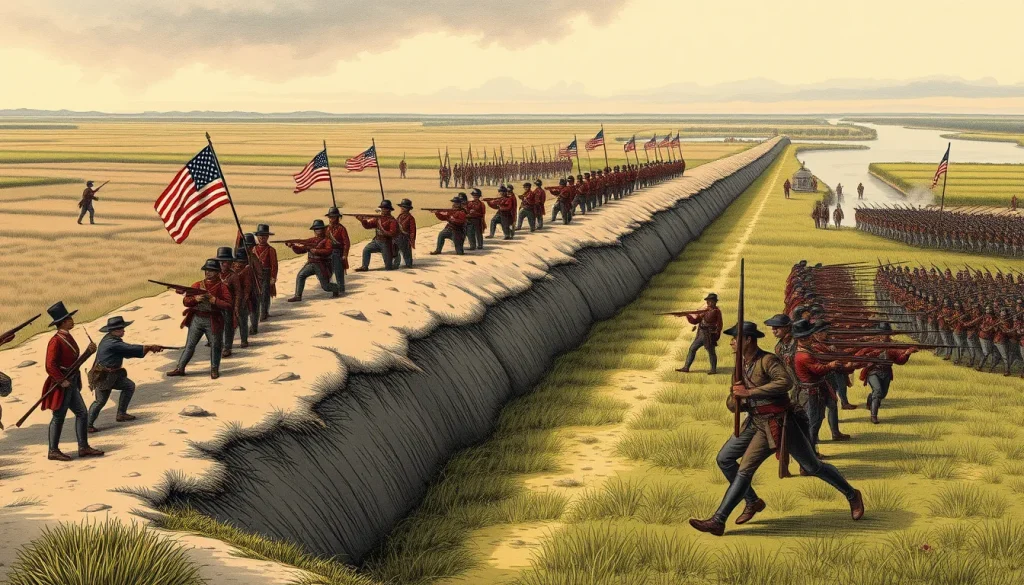
Jackson, informed of the landing, launched a nighttime attack on December 23, which surprised the British and bought time. He then withdrew to the Rodriguez Canal near Chalmette and constructed a fortified line, later known as Line Jackson. After skirmishes and an artillery duel on New Year’s Day, the British under Lt. Gen. Edward Pakenham launched a frontal assault on January 8. The main attack against Line Jackson failed catastrophically, while a secondary effort on the west bank succeeded briefly but was not exploited. The British withdrew and re-embarked.
Why It Matters
The American victory at New Orleans was a significant morale boost and cemented Jackson’s reputation as a national hero. Although the Treaty of Ghent had been signed on December 24, 1814, news had not reached the combatants, so the battle occurred after the war was technically over. The victory shaped American memory of the war and fueled westward expansion. It also demonstrated the effectiveness of a composite American force.
Prelude
From December 14 to January 8, Jackson’s forces prepared defenses. The loss of the gunboats allowed British landing. Jackson declared martial law, gathered troops, and accepted the services of Jean Lafitte’s Baratarians. He positioned his line along the Rodriguez Canal.
Forces and Commanders
Jackson commanded approximately 4,698 men on the left bank, plus additional troops on the right bank. The force included:
- Tennessee militia under Major General William Carroll and Brigadier General John Coffee
- Kentucky militia under Brigadier General John Adair
- Louisiana militia under Major General Jacques Villeré
- Regular army units: 7th U.S. Infantry and 44th U.S. Infantry, U.S. Marines
- Artillery under Lt. Col. William MacRea
- Cavalry including Mississippi Dragoons
- Baratarian privateers under Jean Lafitte
- Free men of color units under Major Pierre Lacoste and Major Louis Daquin
- Choctaw warriors
Artillery was commanded by Lt. Col. William MacRea. The navy contributed the sloop USS Louisiana and the schooner USS Carolina, and gunboats.
Battlefield and Map Context
The battlefield lay on the east bank of the Mississippi River, about six miles below New Orleans. Jackson’s line stretched from the river to an impassable swamp, about three-quarters of a mile. The Rodriguez Canal, a dry millrace, was deepened and served as a ditch in front of the earth rampart. The terrain was mostly open fields, with marshy ground to the east.
Battle Chronology
On January 8, at about 6:20 a.m., the British advanced. The main column under Pakenham moved toward Jackson’s center, while a column under Colonel Rennie attacked along the river. American artillery and rifle fire decimated the British, and Pakenham was killed. Rennie was also killed. The attack collapsed within about twenty minutes. The west bank assault captured a battery but was withdrawn.
Casualties and Losses
American casualties were relatively light: 13 killed, 39 wounded, 19 missing or captured, for a total of 71. British losses were approximately 2,000 killed, wounded, or captured.
Result
A decisive American victory. The British withdrew on January 18 and sailed away.
Strategic Consequences
The victory did not change the war’s outcome, since peace had already been signed, but it secured Louisiana and the Mississippi. It also elevated Jackson to national prominence and reinforced American claims to the region.
Primary Accounts
Key American primary sources include Jackson’s official report to Secretary of War James Monroe, and the casualty return compiled by Adjutant General Robert Butler on January 16, 1815. The engineer Arsène Lacarrière-Latour, who served on Jackson’s staff, later published a memoir. Naval officers’ letters and after-action reports also exist.
Battlefield Today
The Chalmette Battlefield is now part of Jean Lafitte National Historical Park and Preserve, administered by the National Park Service. The site includes the Jackson monument, the Chalmette National Cemetery, and interpretive trails.
Primary Sources
Several contemporary documents provide firsthand accounts of the American forces. Jackson’s report to Monroe details the battle and its outcome. The casualty return gives precise figures. Latour’s Historical Memoir of the War in West Florida and Louisiana in 1814–15 (1816) is an important account. Letters from officers such as Commodore Daniel Patterson and Major General Carroll exist in archives. These sources must be evaluated for bias and context.
Further Reading
- Matthew B. Dale, The Staff Ride Handbook for the Battles of New Orleans, 23 December 1814–8 January 1815 (Combat Studies Institute Press, 2015).
- Donald R. Hickey, The War of 1812: A Forgotten Conflict (University of Illinois Press, 1989).
- Robert V. Remini, The Battle of New Orleans (Penguin, 1999).
- Arsène Lacarrière-Latour, Historical Memoir of the War in West Florida and Louisiana in 1814–15 (1816; reprint).
- American Battlefield Trust, Battle of New Orleans: The Last Battle of the War of 1812.
References
- Wikipedia, Battle of New Orleans order of battle: American, https://en.wikipedia.org/wiki/New_Orleans_American_order_of_battle
- American Battlefield Trust, Battle of New Orleans: The Last Battle of the War of 1812, https://www.battlefields.org/learn/articles/battle-new-orleans-last-battle-war-1812
- Army Historical Foundation, E Pluribus, Unum: The American Battle Line at New Orleans, 8 January 1815, https://armyhistory.org/e-pluribus-unum-the-american-battle-line-at-new-orleans-8-january-1815/
- Combat Studies Institute, Staff Ride Handbook, https://www.govinfo.gov/content/pkg/GOVPUB-D110-PURL-gpo76777/pdf/GOVPUB-D110-PURL-gpo76777.pdf
- History.com, Battle of New Orleans, https://www.history.com/articles/battle-of-new-orleans
FAQ
What units made up the American forces at the Battle of New Orleans?
The force included Tennessee and Kentucky militia, Louisiana militia, U.S. Regulars, Marines, naval personnel, free men of color, Choctaw warriors, and Baratarian artillerists.
How many American soldiers were at the Battle of New Orleans?
Approximately 4,700 on the east bank with additional units on the west bank and navy vessels.
Why did the American forces win decisively?
The defensive position behind the Rodriguez Canal, superior artillery, and effective firing by militia and regulars combined with a poorly coordinated British frontal assault.



Leave a Reply