Short Answer
During the War of 1812, British forces carried out multiple amphibious invasions of U.S. territory, the most famous being the Chesapeake Campaign of 1814, which culminated in the capture and burning of Washington, D.C. While the conflict’s primary land battles occurred along the Canadian border and the war at sea drew international attention, British expeditions deliberately struck the American seaboard to pressure the U.S. government and divert military resources. This article examines the nature, scope, and historical interpretation of these British invasions.
Historical Context
The War of 1812 began in June 1812 amid disputes over impressment, trade restrictions, and British support of Indigenous confederacies in the Old Northwest. For the first two years, Britain’s military resources were largely tied up in Europe against Napoleon, forcing the British in North America to adopt a defensive posture in Canada. However, after Napoleon’s abdication in April 1814, Britain was able to send battle-hardened veterans and additional naval squadrons to the Americas.
Vice-Admiral Alexander Cochrane, commander-in-chief of the Royal Navy’s North America and West Indies Station, planned to take the war to the American coast. He wanted to capture or destroy major coastal cities to force the U.S. to divert troops from Canada and to weaken American morale. Rear-Admiral George Cockburn, who had spent months raiding the Chesapeake Bay region, advocated striking the capital, Washington, because of its symbolic importance and weak defenses. The British also sought retaliation for U.S. destruction of public buildings and private property in Upper Canada, notably the burning of York (now Toronto) in 1813 and raids on Port Dover in 1814.
What Happened
In mid-August 1814, a British force of approximately 4,500 soldiers and marines under Major-General Robert Ross landed at Benedict, Maryland, on the Patuxent River. Accompanied by Cockburn, the troops marched overland toward Washington. On August 24, they confronted a larger American force at Bladensburg, Maryland. The American militia and regulars, commanded by Brigadier General William H. Winder, were quickly routed, suffering a humiliating defeat that became known as the “Bladensburg Races.”
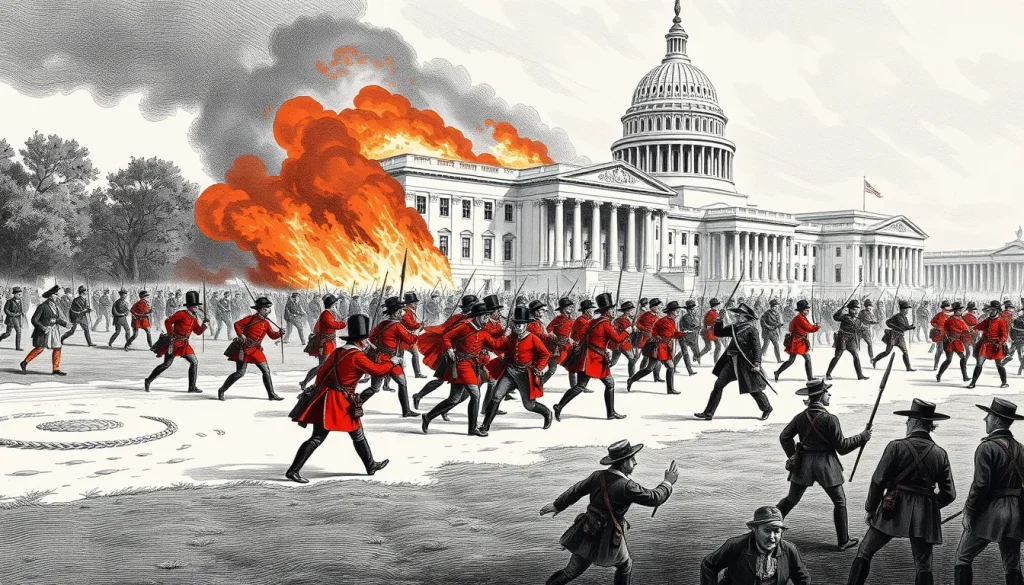
The British then entered Washington that evening. They set fire to the U.S. Capitol, the President’s Mansion (White House), and other public buildings, including the Library of Congress and the Washington Navy Yard. President James Madison and his cabinet had fled the city. Before the British could complete the destruction, a severe thunderstorm extinguished many fires. The British occupied Washington for about 26 hours before withdrawng.
Simultaneously, a British naval squadron under Captain James A. Gordon ascended the Potomac River, bombarding Fort Washington and capturing Alexandria, Virginia. After the successful raid on Washington, Cochrane and Ross turned toward Baltimore in September 1814. The land army was halted at the Battle of North Point, and the naval bombardment of Fort McHenry failed to force the harbor’s surrender, ending the immediate threat to Baltimore.
Why It Matters
The British invasions of 1814, particularly the burning of Washington, were the only times a foreign power captured the U.S. capital after the Revolutionary War. Although the raids caused limited military destruction and did not change the strategic stalemate, they had a profound psychological impact on the American public. The burning of Washington was seen as a national humiliation, yet it also galvanized resolve. In Baltimore, the successful defense of Fort McHenry inspired Francis Scott Key to write “The Star-Spangled Banner.” Strategically, the British expeditions did force the United States to divert troops from the Canadian frontier, but they also strengthened American determination to continue the war. The Treaty of Ghent, signed on December 24, 1814, restored the pre-war status quo without addressing the issues that had caused the war, and both sides later viewed the conflict as a costly draw.
Definition
In the context of the War of 1812, a British “invasion” refers to deliberate, military expeditions sent to occupy or attack U.S. sovereign soil. These were not attempts to permanently conquer territory, but rather large-scale raids designed to achieve strategic and psychological goals. The Chesapeake Campaign, including the capture of Washington, stands as the clearest example of a foreign invasion of the United States during the war.
Background
Before 1814, British efforts in North America centered on defending Canada, supporting Indigenous allies, and enforcing a naval blockade. The British high command had avoided large-scale land operations inside U.S. borders because of limited troops. After Napoleon’s defeat, Britain had the resources to launch offensive operations along the American coast, partly to retaliate for earlier U.S. attacks on Canadian settlements and partly to draw American troops away from Canada.
How It Worked
British invasions were typically launched by naval forces sailing into Chesapeake Bay or other rivers, then landing troops and marines at undefended points. The army would then march inland, often meeting little organized resistance because American defenses were poorly coordinated. The burning of Washington was carried out by small parties ordered to destroy public property, while private homes and businesses were generally spared by Ross’s orders. The Potomac expedition showed the Royal Navy’s ability to move heavy warships far upriver, using bomb vessels and rocket ships to bombard fixed defenses.
Competing Viewpoints
Historians debate whether the British operations constituted a full-scale “invasion” or merely punitive raids. Some scholars emphasize that the British made no attempt to hold territory and withdrew quickly, suggesting they were raids with limited strategic objectives. Others argue that the scale and impact of the Chesapeake campaign—especially the burning of the capital—merit the label “invasion,” as it involved a temporary occupation of the enemy’s seat of government. American contemporaries often characterized the events as an invasion and outrage, while British accounts, especially from Cockburn and Ross, described them as justified retaliation. Later historians, such as John Lewis Gaddis, compare the attack to Pearl Harbor or 9/11 in terms of surprise and psychological shock, though with fewer casualties.
Role in the War of 1812
The British invasions of 1814 aimed to force the United States to divert troops from the Canadian frontier and to weaken American morale. The attack on Washington, while small in scale, succeeded in creating significant alarm and confusion among U.S. officials. However, the failure at Baltimore and the subsequent British withdrawal allowed the U.S. to claim a defensive victory. The invasions also influenced peace negotiations at Ghent, where British negotiators sometimes cited the burning of Washington as a bargaining point, though the final treaty restored all conquered territory.
Consequences and Historical Interpretation
The immediate consequence of the British invasions was the destruction of public buildings and the temporary flight of the U.S. government. The longer-term effects were largely symbolic: the burning of Washington became a rallying point for American nationalism and an enduring memory of foreign aggression. The successful defense of Fort McHenry became enshrined in the national anthem. Historians largely agree that the invasions did not alter the war’s outcome; the Treaty of Ghent returned the status quo. But the invasions highlighted the weakness of American coastal defenses and contributed to later improvements in military planning and intelligence.
Primary Sources
Several contemporary documents illuminate the British invasions. Vice-Admiral Cochrane’s orders to Rear-Admiral Cockburn, dated July 18, 1814, directed destruction of towns and districts to “deter the enemy from a repetition of similar outrages,” reflecting the retaliation motive. General Ross’s official report described the march, the battle at Bladensburg, and the burning of Washington, defending the destruction as limited to public property. President James Madison’s subsequent message to Congress recounted the invasion and called for measures to strengthen national defenses. Additionally, American participant and observer accounts, such as Secretary of State James Monroe’s letters during the campaign, provide on-the-ground perspective. The primary sources are available in the Library of Congress, the National Archives, and the Naval Historical Center.
Further Reading
- Weber, William T. “The British Capture of Washington, DC, 1814.” Studies in Intelligence, CIA, 2014. Available at https://www.cia.gov/resources/csi/static/British-Capture-Washington-DC.pdf.
- Muller, Charles G. “Fabulous Potomac Passage.” U.S. Naval Institute Proceedings, May 1964. Available at https://www.usni.org/magazines/proceedings/1964/may/fabulous-potomac-passage.
- “Burning of Washington.” World History Encyclopedia, 2024. Available at https://www.worldhistory.org/article/2631/burning-of-washington/.
- “The Birth of the Star-Spangled Banner.” Council on Foreign Relations, 2026. Available at https://www.cfr.org/articles/the-birth-of-the-star-spangled-banner.
- “Burning of Washington.” Wikipedia, The Free Encyclopedia, accessed 2025. Available at https://en.wikipedia.org/wiki/Burning_of_Washington.
References
- Weber, William T. “The British Capture of Washington, DC, 1814.” Studies in Intelligence, CIA, 2014.
- Muller, Charles G. “Fabulous Potomac Passage.” U.S. Naval Institute Proceedings, May 1964.
- “Burning of Washington.” World History Encyclopedia, 2024.
- “The Birth of the Star-Spangled Banner.” Council on Foreign Relations, 2026.
- “Burning of Washington.” Wikipedia, accessed 2025.
FAQ
Did Britain actually invade the United States during the War of 1812?
Yes, British forces launched several amphibious invasions of U.S. territory along the Atlantic coast, most notably in August 1814 when they captured and burned Washington, D.C. They also attacked Baltimore, Maryland, and Alexandria, Virginia.
Why did Britain burn Washington's public buildings?
The destruction was intended partly as retaliation for U.S. burning of public buildings in York (Toronto) and private property in Upper Canada, and partly to weaken American morale and force the U.S. to divert troops from Canada.
Did the British invasions change the outcome of the war?
No, the invasions did not alter the final outcome. The Treaty of Ghent restored the pre-war status quo, and neither side gained or lost territory. However, the burning of Washington had a lasting symbolic impact and boosted American resolve.



Leave a Reply