
Short Answer
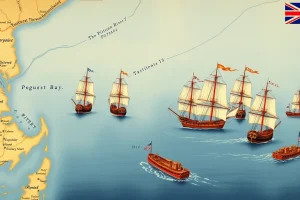
The Chesapeake Bay, the largest estuary in the United States, was a strategically vital region during the War of 1812. It was the site of a sustained British blockade, numerous raids, and a major campaign in 1814 that included the burning of Washington, D.C., and the attack on Baltimore. This campaign shaped American national memory through the defense of Fort McHenry and the writing of the Star-Spangled Banner.
Historical Context
In 1812, the United States declared war on Great Britain amid disputes over impressment, trade restrictions, and British support of Indigenous resistance on the frontier. Britain, then engaged in the Napoleonic Wars, initially had limited forces in North America. To pressure the United States and divert American troops from Canada, the British government selected the Chesapeake Bay as a focus for offensive operations. The region was home to important ports, the national capital at Washington, D.C., and a thriving agricultural economy dependent on slave labor. The bay’s extensive network of navigable waters made it both a commercial artery and a vulnerable frontier. British warships arrived in February 1813 and maintained a naval presence until 1815.
What Happened
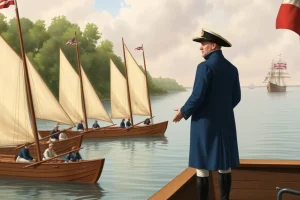
The British campaign in the Chesapeake unfolded in two phases. In 1813, under Admiral Sir John Borlase Warren and Rear Admiral George Cockburn, the Royal Navy imposed a blockade, closing the bay to American shipping and conducting raids on coastal towns. Attacks included an assault on Havre de Grace in May 1813 and the burning of villages in the upper bay. The British also exploited the region’s reliance on enslaved labor, offering freedom to enslaved people who escaped to British lines. An estimated 4,000 enslaved individuals were liberated, several hundred of whom formed the Colonial Marines, a British military unit.
In 1814, after Napoleon’s abdication, Britain dispatched thousands of veteran troops to North America. The Chesapeake became the focus of a three-pronged strategy aimed at the seat of government and the privateer haven of Baltimore. In August, British forces landed at Benedict, Maryland, and marched overland, defeating American militia at the Battle of Bladensburg on August 24. That evening, British troops entered Washington and burned public buildings, including the Capitol and the White House. President Madison and his cabinet fled, while Dolley Madison arranged the removal of the Gilbert Stuart portrait of George Washington.
Following the occupation of Washington, a British squadron moved up the Potomac, forcing the surrender of Alexandria, Virginia, and seizing goods. Meanwhile, American forces prepared to defend Baltimore. On September 12, British troops landed at North Point and were met by American militia. The following day, the Royal Navy bombarded Fort McHenry for nearly 25 hours. The failure to reduce the fort and the American resistance led to the British withdrawal, saving Baltimore.
Why It Matters
The Chesapeake campaign had profound immediate and long-term consequences. Militarily, it exposed American unpreparedness but also demonstrated the resilience of local militia and the importance of fortifications. The successful defense of Baltimore and Fort McHenry restored national pride after the humiliation of Washington’s burning. The sight of the American flag over Fort McHenry inspired Francis Scott Key to write “The Star-Spangled Banner,” which later became the U.S. national anthem. The campaign also influenced the peace negotiations, leading to the Treaty of Ghent, which restored pre-war borders. Historians interpret the Chesapeake theater as a turning point where American identity and resolve were solidified, despite the war’s inconclusive outcome.
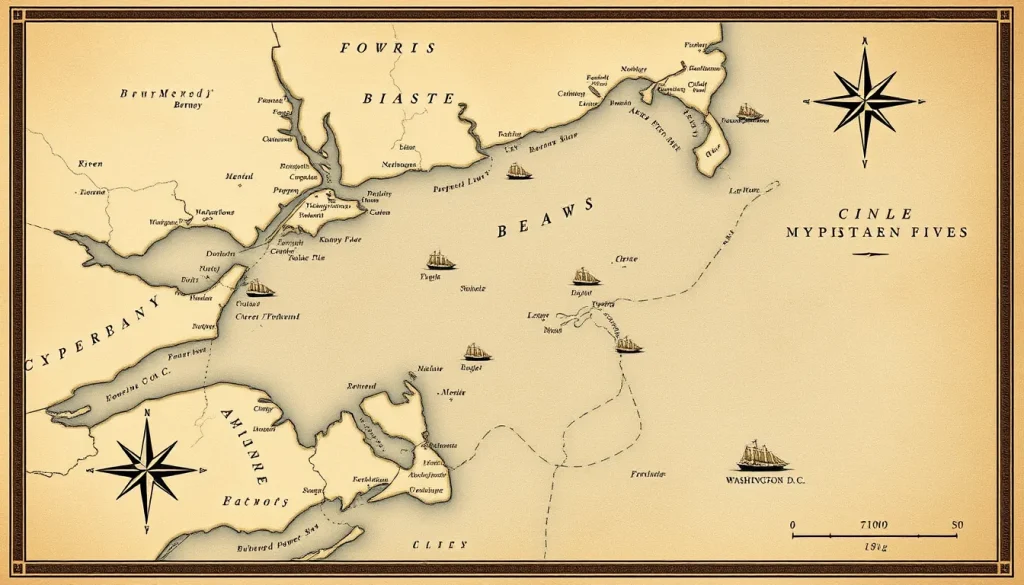
Historical Map Context
Maps from the period, such as the 1819 “Survey of the River Patapsco and part of Chesapeake Bay” by Lewis Brantz and Fielding Lucas Jr., document the geography that shaped military movements. The bay’s deep-water channels, rivers, and tributaries (such as the Patuxent, Potomac, and Patapsco) determined landing sites and approach routes. Contemporary British and American maps reveal the strategic importance of controlling waterways to move troops and supplies.
Modern Location
The Chesapeake Bay spans about 200 miles, bordered by Maryland and Virginia, with Washington, D.C., and Baltimore on its shores. The bay’s modern coastline includes numerous sites associated with the War of 1812, many preserved as national parks, trails, and museums.
Events at the Site
Key events include the 1813 blockade, the attack on Havre de Grace, the Battles of St. Leonard Creek in 1814, the Battle of Bladensburg, the burning of Washington, the occupation of Alexandria, and the Battle of North Point and the bombardment of Fort McHenry. The British also raided towns in Southern Maryland and tidewater Virginia, seeking to disrupt American trade and agriculture.
Associated People
Important participants included British Admirals John Borlase Warren and George Cockburn; American President James Madison and First Lady Dolley Madison; U.S. Navy Captain Joshua Barney, who commanded the Chesapeake Flotilla; and Francis Scott Key, who witnessed the bombardment of Fort McHenry. Enslaved individuals, many of whom joined the British as Colonial Marines, also played a significant role.
Surviving Monuments and Site
Fort McHenry National Monument and Historic Shrine is the most famous surviving site. The Star-Spangled Banner National Historic Trail connects historic sites in Maryland, Virginia, and Washington, D.C. Other sites include Bladensburg Waterfront Park, Point Lookout State Park, and interpretive centers such as the Jefferson Patterson Park and Museum. Many locations retain monuments, markers, and historical signage.
Primary Sources
Primary sources include British and American official correspondence, military orders, and personal accounts. The U.S. National Archives holds the American State Papers and naval records. The Library of Congress houses maps and the original manuscript of Francis Scott Key’s poem. The National Park Service provides curated documents and interpretations. Limitations include the partisan perspectives of officials and the scarcity of direct accounts from enslaved people.
Further Reading
- The Chesapeake Campaign 1813–1814 by Charles P. Neimeyer, U.S. Army Center of Military History, 2014.
- National Park Service, “War in the Chesapeake” and “1814 Chesapeake Campaign” (online resources).
- Maryland State Archives, “Maryland in the War of 1812” (online chronology).
- Donald R. Hickey, The War of 1812: A Forgotten Conflict, University of Illinois Press.
- Walter Lord, The Dawn’s Early Light, W.W. Norton.
References
- National Park Service, “War in the Chesapeake,” Star-Spangled Banner National Historic Trail, https://www.nps.gov/stsp/learn/historyculture/chesapeake-at-war.htm.
- National Park Service, “1814 Chesapeake Campaign,” Star-Spangled Banner National Historic Trail, https://nps.gov/stsp/learn/historyculture/1814-chesapeake-campaign.htm.
- Charles P. Neimeyer, The Chesapeake Campaign 1813–1814 (U.S. Army Center of Military History, 2014).
- Maryland State Archives, “Maryland in the War of 1812,” https://msa.maryland.gov/msa/mdmanual/01glance/chron/html/war1812.html.
FAQ
Why did the British attack the Chesapeake Bay?
The British targeted the Chesapeake to disrupt American trade, force the U.S. to divert troops from Canada, and strike at the seat of government and a center of privateering. The region's navigable waters allowed easy access for raids and attacks.
What was the significance of the Battle of Baltimore?
The American victory at Baltimore, particularly the successful defense of Fort McHenry, lifted morale after the burning of Washington. It also inspired Francis Scott Key to write 'The Star-Spangled Banner,' which later became the U.S. national anthem.
How did enslaved people in the Chesapeake seek freedom?
During British raids, thousands of enslaved people escaped and sought British protection. The British offered freedom, and several hundred joined the Colonial Marines, while others were resettled in British colonies like Canada and the West Indies.
Leave a Reply