Short Answer
Kingston, located at the eastern end of Lake Ontario and the head of the St. Lawrence River, was the most strategically important British military and naval centre in Upper Canada during the War of 1812. As the headquarters of the Provincial Marine and later the Royal Navy on Lake Ontario, the town hosted major shipbuilding operations, served as a crucial supply depot for the western posts, and withstood only a single direct American attack in November 1812. Its defences and naval power helped secure British control over the lake and the vital communication route to Montreal.
Historical Context
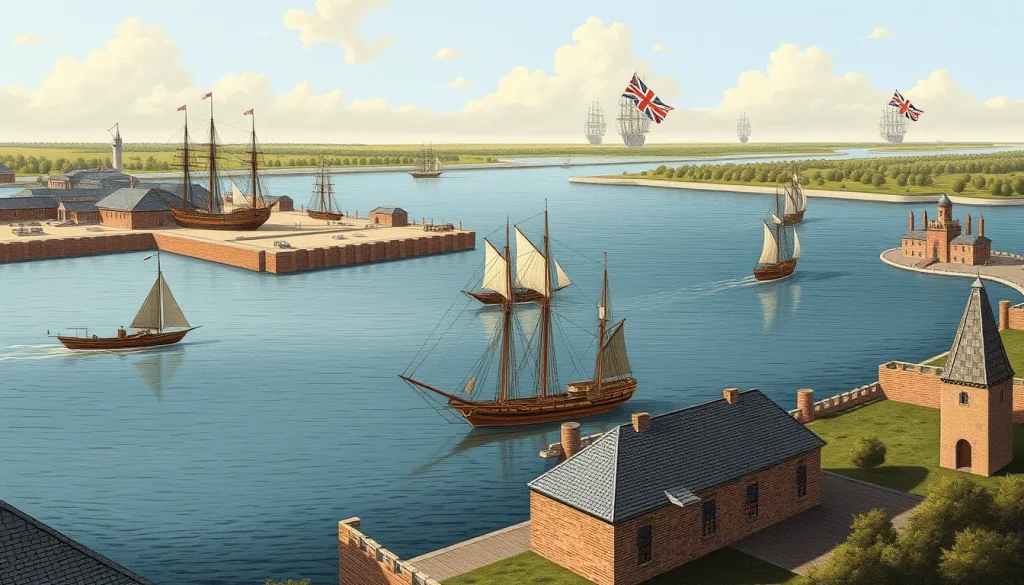
During the decades before 1812, Kingston had grown from a Loyalist settlement into a modest garrison town, with its harbour guarded by Fort Henry and a small naval yard at Point Frederick. When war was declared by the United States on June 18, 1812, the British possessed only four armed vessels on Lake Ontario, all belonging to the Provincial Marine, while the Americans began constructing a more powerful fleet at Sackets Harbour, New York. Kingston’s location—at the junction of the Great Lakes and the St. Lawrence—made it the natural base from which the British could project naval power across the lake and move troops and supplies to the Niagara frontier and the west. The town also served as a refuge for Loyalists and a focal point for military construction, as its residents and military engineers erected blockhouses, batteries, and fortifications to protect the naval yard and harbour from possible American invasions.
What Happened
In the months following the outbreak of war, Kingston became a beehive of activity. Major General Isaac Brock visited the town to organize defensive forces and strengthen the militia, while construction began on a series of blockhouses extending along the St. Lawrence. The British reinforced the small naval squadron at Kingston by adding vessels built locally, including the Royal George, a 22-gun corvette that soon became the largest warship on the lake.
The first and only significant American attack on Kingston came on November 10, 1812, when Commodore Isaac Chauncey led a squadron of seven vessels into Kingston harbour with the intention of destroying the Royal George. After an exchange of cannon fire that lasted several hours, the American squadron withdrew to Sackets Harbour, having captured two British schooners but inflicting little damage. The Kingston Gazette reported that one man was killed aboard the Royal George and that the enemy “hauled their wind and anchored under the four mile Point, having done no other mischief.” The attack demonstrated Kingston’s vulnerability but also its ability to repel a naval assault.
From 1813 onward, Kingston’s role shifted increasingly to shipbuilding and naval maintenance. When Sir James Yeo arrived in May 1813 to take command of the Royal Navy on the lakes, he found a yard capable of producing warships at an impressive rate. The navy yard at Point Frederick launched vessels such as the General Wolfe (32 guns), Earl of Moira (16 guns), and the Prince Regent (56 guns) and Princess Charlotte (42 guns) in 1814. The most famous product of Kingston’s shipyards was HMS St. Lawrence, a 112-gun first-rate launched in September 1814, the largest warship ever built on the Great Lakes. The St. Lawrence never fired her guns in combat; instead, she served as a transport and symbol of British naval supremacy until the war ended.
Kingston also served as the staging point for offensive operations, most notably the failed attack on Sackets Harbour on May 29, 1813. The expedition, commanded by Sir George Prevost and Sir James Yeo, sailed from Kingston and landed troops near the American naval base, but hesitation by Prevost allowed the Americans to reinforce their defenses, resulting in a British withdrawal after heavy losses.
Why It Matters
Kingston’s importance in the War of 1812 lay less in its direct combat role than in its function as the chief naval yard and supply base for British forces on Lake Ontario. Without Kingston’s shipbuilding capacity and secure harbour, the Royal Navy could not have maintained control of the lake, which in turn shielded the St. Lawrence corridor and protected Upper Canada from invasion. The American failure to systematically attack Kingston—despite its obvious strategic value—has been attributed by historians such as George Stanley to a lack of American offensive planning and to British delaying tactics. Kingston’s shipbuilding race with Sackets Harbour also had a broader impact, influencing the naval arms race that ultimately led to the Rush-Bagot Agreement of 1817, which demilitarized the Great Lakes.
After the war, Kingston remained a military and naval centre, and its fortifications were expanded in the 1820s–30s. The historical memory of Kingston’s role has been preserved through the archaeological investigation of the naval dockyard at Point Frederick, now part of the Royal Military College of Canada, and through public history sites such as Fort Henry.
Historical Map Context
During the war, Kingston occupied the site of present-day downtown Kingston, Ontario, on the north shore of Lake Ontario at the mouth of the Cataraqui River. The military and naval installations were concentrated on Point Frederick (east of the town), Point Henry, and at the harbour entrance. Maps from the period, such as the 1816 plan showing government buildings and fortifications, illustrate the town’s defensive layout, with batteries covering the approaches and a naval yard enclosed on the peninsula.
Modern Location
Today, the former naval base and dockyard occupy the grounds of the Royal Military College of Canada, still located on Point Frederick in Kingston, Ontario. The city retains many period structures, but the wartime naval installations are largely archaeological. Fort Henry, rebuilt in the 1830s, stands as a prominent monument overlooking the harbour.
Events at the Site
Key events include the American naval attack of November 10, 1812; the launching of numerous warships, including the St. Lawrence in 1814; and the staging of the expedition against Sackets Harbour in 1813. The dockyard also served as a hospital and supply depot, with hundreds of workmen and sailors living on Point Frederick during the war.
Associated People
Commodore Isaac Chauncey led the American attack on Kingston in 1812. Sir James Yeo commanded the Royal Navy on the lakes from Kingston from 1813 onward. Major General Sir Isaac Brock visited Kingston to organize defenses in 1812, and Sir George Prevost led the 1813 Sackets Harbour expedition. The naval yard was overseen by captains of the Provincial Marine and later Royal Navy, including Captain Robert Barclay and others.
Surviving Monuments and Site
The Royal Military College of Canada preserves the archaeological remains of the naval dockyard, including the footprint of the hospital, blockhouse, and guardhouse, now commemorated by interpretive panels. Fort Henry National Historic Site, rebuilt on its original hilltop, interprets the town’s defensive history. The Kingston Fortifications National Historic Site and the naval dockyard’s designation as a National Historic Site recognize the wartime heritage. A small monument near the harbour marks the location of the 1812 attack.
Primary Sources
The most direct contemporary account of the November 1812 attack is the Kingston Gazette of 17 November 1812, which describes the American squadron’s approach, the exchange of fire, and the withdrawal. The letter of Thomas Jefferson to William Duane (August 1812) reveals American expectations of conquering Canada, but is more general. The British naval correspondence preserved in Admiralty records (e.g., ADM 1/2736) documents the Royal Navy’s command decisions and shipbuilding efforts. The archives at Queen’s University hold period newspapers, letters, and maps, including a 1816 plan of Kingston’s defences. A limitation of these sources is that they are British or American in origin, and often emphasize military viewpoints; Indigenous perspectives are not directly captured in the records.
Further Reading
- Osborne, Brian S. “Kingston.” The Canadian Encyclopedia, 2012. thecanadianencyclopedia.ca
- Queen’s University Archives. “Direct Contact with War” and “Ships & Supplies: Kingston as a Naval Base.” archives.queensu.ca/exhibits/war-1812
- Bazely, Susan M. “Provincial Marine to Royal Navy: Archaeological Evidence of the War of 1812 at Kingston’s Naval Dockyard.” Northeast Historical Archaeology 44 (2015).
- Stanley, George F.G. A Short History of Kingston as a Military and Naval Centre. Kingston: Queen’s University, 1950.
References
- Queen’s University Archives. “Direct Contact with War.” Accessed 2025. https://archives.queensu.ca/exhibits/war-1812/direct-contact-war
- Queen’s University Archives. “Ships & Supplies: Kingston as a Naval Base.” Accessed 2025. https://archives.queensu.ca/exhibits/war-1812/ships-supplies-kingston-naval-base
- Queen’s University Archives. “Causes of the War.” Accessed 2025. https://archives.queensu.ca/exhibits/war-1812/causes-war
- Bazely, Susan M. “Provincial Marine to Royal Navy: Archaeological Evidence of the War of 1812 at Kingston’s Naval Dockyard.” Northeast Historical Archaeology 44 (2015).
- Osborne, Brian S. “Kingston.” The Canadian Encyclopedia. Accessed 2025. https://thecanadianencyclopedia.ca/index.php/en/article/kingston
- Stanley, George F.G. A Short History of Kingston as a Military and Naval Centre. Kingston: Queen’s University, 1950.
FAQ
Did Kingston ever fall to the Americans?
No. The only direct attack, in November 1812, was repelled. The Americans never attempted a full-scale invasion of Kingston.
Why was Kingston important to the British?
Kingston was the main British naval base on Lake Ontario, providing shipbuilding, supplies, and a secure harbor to support operations against American forces.
What happened to HMS St. Lawrence?
Launched in September 1814, the 112-gun ship never fired her guns in battle. After the war she was used as a transport and eventually sank in Kingston Harbour in 1831.

Leave a Reply