Short Answer
The congressional debates before the War of 1812 represent the first time the United States considered a formal declaration of war under its Constitution, culminating in the closest vote for any of America’s declared wars. For nearly six months, from President James Madison’s message to Congress on November 5, 1811, to the declaration of war on June 18, 1812, lawmakers argued over maritime rights, British impressment, the Orders in Council, and the relationship between frontier conflicts and British influence among Indigenous nations. The debates exposed deep sectional and partisan divisions that shaped the war’s conduct and its political aftermath.
Historical Context
After the end of the Revolutionary War, the United States sought to remain neutral in the European wars between Britain and France. However, both belligerents interfered with American trade. Britain’s Orders in Council (1807) blockaded European ports under French control and required neutral ships to obtain licenses. The Royal Navy also impressed American sailors, claiming they were British deserters. In addition, the British in Canada maintained connections with Indigenous nations in the Ohio Valley and Great Lakes region, where tensions were rising under the leadership of Tecumseh and the Prophet. Thomas Jefferson’s embargo (1807-1809) and the subsequent Non-Intercourse Act failed to force Britain to change its policies. By 1811, a new, younger group of congressmen, later called the War Hawks, demanded more forceful measures.
What Happened
President Madison, in his Third Annual Message to Congress on November 5, 1811, detailed British aggressions and called for preparations for war, including an increase in regular troops and militia. He cited the continuing impressment of American sailors, the enforcement of the Orders in Council, and “savage warfare” on the frontier. The House Committee on Foreign Affairs, chaired by Peter B. Porter of New York, issued a report on November 29, 1811, that enumerated grievances and recommended military preparations. The report became known as the “War Manifesto.”
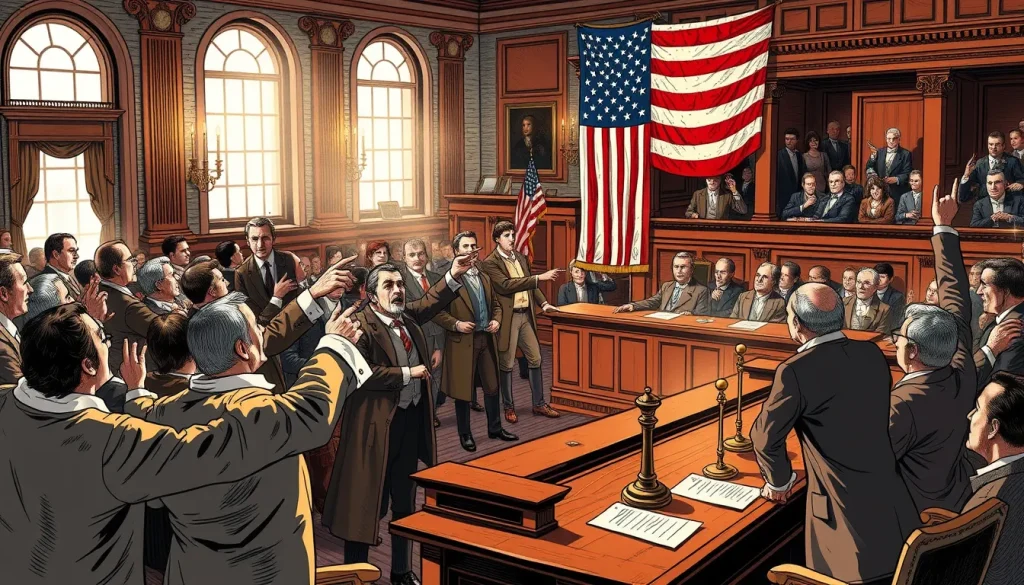
Over the following months, Congress engaged in a sustained debate. Felix Grundy of Tennessee argued that the nation’s rights were at stake and that war could drive the British from North America, with benefits including the acquisition of Canada. Henry Clay of Kentucky, the Speaker of the House, insisted that peace would cost the nation its honor and commerce. John C. Calhoun of South Carolina declared that protection and patriotism were reciprocal. On the other side, Representative John Randolph of Virginia denounced the proposed war as a venture for territorial expansion, mockingly saying “Canada! Canada! Canada!” Federalists, particularly from New England, opposed the war on economic and constitutional grounds. Samuel Taggart of Massachusetts warned that it would ruin commerce.
On June 1, 1812, Madison sent his formal war message to Congress, citing impressment, the Orders in Council, and the incitement of Indian attacks. The House voted 79-49 for a declaration of war on June 4, 1812, and the Senate voted 19-13 on June 18, 1812. Madison signed the declaration the same day. The vote fell strictly along partisan lines: all Republicans supported it, while every Federalist opposed it.
Why It Matters
The debates set a precedent for how the United States deliberates going to war. The closeness of the votes and the deep sectionalism revealed that the nation was not unified. The term “Mr. Madison’s War,” coined by critics like Federalist John Lowell Jr., reflected the partisan character of the conflict. The decision to invade Canada as a means to pressure Britain shaped the military campaigns of 1812-1814. The debates also raised enduring questions about the balance of power between Congress and the President in matters of war.
Definition
The congressional debates before the War of 1812 refer to the legislative discussions, committee reports, and votes in the 12th Congress (1811-1812) that led to the declaration of war against Great Britain. They are recorded primarily in the Annals of Congress.
Background
Following years of economic sanctions and diplomatic failures, the United States faced a choice between submission to British maritime policies or armed resistance. Britain’s refusal to repeal the Orders in Council until after the war, combined with impressment and border conflicts, created a sense of national humiliation. The War Hawks, mostly from the South and West, saw war as a way to defend republican honor, expand territory, and end British influence among Indigenous nations.
How It Worked
The declaration of war process followed the Constitution’s Article I, Section 8, which grants Congress the power to declare war. The President recommended, but Congress decided. The House Foreign Relations Committee produced a formal report, debates occurred on the floor, and votes were taken in each chamber. The final bill was a simple resolution declaring war. The process was lengthy and exposed deep disagreements.
Competing Viewpoints
Supporters of war argued that the United States had exhausted peaceful means. Felix Grundy stressed the right to export American products and the need to stop British support for “savage warfare.” Henry Clay focused on national honor and commercial interests. They also saw an opportunity to annex Canada. Opponents like John Randolph warned that the war was a “war of conquest” that would strengthen northern political power. Federalists argued that the war would ruin New England trade and that impressment was a lesser evil than war. There were also regional differences: the South and West were more bellicose, while New England was more cautious.
Role in the War of 1812
The debates directly led to the declaration and its objectives. The War Hawks’ desire to conquer Canada became a central military strategy, though it proved unsuccessful. The war also became a partisan issue, with Federalists opposing the conflict and sometimes actively obstructing the war effort. The debates set the stage for the military campaigns and the political controversies that followed.
Consequences and Historical Interpretation
Historians generally view the congressional debates as a critical episode in the rise of American nationalism and the development of a distinct American identity. The term “Mr. Madison’s War” persists in scholarship as shorthand for the conflict’s controversial nature. The debates also illustrate the challenges of republican governance in a time of external threat. The narrow vote demonstrated that even a declaration of war could be a deeply contentious political act. The war itself, though inconclusive, led to a new sense of national confidence and the “Era of Good Feelings.”
Primary Sources
The most important primary sources include President James Madison’s Third Annual Message to Congress (November 5, 1811) and his war message (June 1, 1812). The House Foreign Relations Committee’s “War Manifesto” (June 3, 1812) is preserved in the National Archives (RG 233). Speeches from the debates are recorded in the Annals of Congress, including those by Felix Grundy, John Randolph, Henry Clay, John C. Calhoun, and Samuel Taggart. Federalist critiques are found in pamphlets like John Lowell Jr.’s Mr. Madison’s War (1812). These documents vary in bias and must be read with attention to their partisan purposes.
Further Reading
- Bickham, Troy. The Weight of Vengeance: The United States, the British Empire, and the War of 1812. Oxford University Press, 2012.
- Hickey, Donald R. The War of 1812: A Forgotten Conflict. University of Illinois Press, 1989.
- Taylor, Alan. The Civil War of 1812: American Citizens, British Subjects, Irish Rebels, & Indian Allies. Alfred A. Knopf, 2010.
- National Archives. “1812: Congress’s First Declaration of War Under the Constitution.” https://www.archives.gov/legislative/resources/education/1812
References
- Annals of Congress, 12th Congress, 1st Session (Washington: GPO, 1853).
- National Archives, “1812: Congress’s First Declaration of War Under the Constitution,” National Archives and Records Administration, accessed 2025, https://www.archives.gov/legislative/resources/education/1812.
- UCL Department of History, “The Debate over War in Congress, 1811,” accessed 2025, https://www.ucl.ac.uk/USHistory/Building/docs/1812.htm.
- National Park Service, “Summer 1812: Congress stages fiery debates over whether to declare war on Britain,” accessed 2025, https://www.nps.gov/articles/mr-madison-s-war.htm.
- American Yawp Reader, “Congress Debates Going to War, 1811,” accessed 2025, https://www.americanyawp.com/reader/the-early-republic/debate-over-the-war-of-1812-1811/.
FAQ
What were the main reasons for declaring war in 1812?
Congressional supporters of war cited British impressment of American sailors, the enforcement of the Orders in Council that restricted neutral trade, and British support for Indigenous attacks on the frontier. They also argued that war was necessary to protect national honor and sovereignty.
Why did some members of Congress oppose the war?
Opponents, particularly Federalists from New England, argued that war would ruin commerce and that impressment was a lesser abuse than the economic costs of conflict. John Randolph and others warned that the war was really a scheme for territorial expansion into Canada.
How close was the vote to declare war?
The House passed the declaration on June 4, 1812, by a vote of 79 to 49, and the Senate approved it on June 18, 1812, by 19 to 13. It remains the closest vote for any declared war in U.S. history.


Leave a Reply