Short Answer
The Hartford Convention, held from December 15, 1814, to January 4, 1815, in Hartford, Connecticut, was a gathering of twenty-six New England Federalists convened to address grievances against the Democratic-Republican administration during the War of 1812. Its final report, which proposed constitutional amendments but rejected secession, arrived in Washington after the Treaty of Ghent and the Battle of New Orleans, making the convention appear treasonous and politically damaging. This article examines whether the Hartford Convention destroyed the Federalist Party, weighing immediate consequences against longer-term factors.
Historical Context
The Federalist Party, dominant in New England, had opposed Jefferson’s Embargo Act of 1807 and Madison’s drift toward war with Britain. The War of 1812 devastated New England’s maritime commerce, while the federal government, controlled by Southern Democratic-Republicans, seemed indifferent to Northern interests. The Louisiana Purchase (1803) threatened to dilute Federalist influence with new Western states, and the Twelfth Amendment (1804) reduced the chance of a Federalist president. By 1814, British naval blockades, trade restrictions, and the threat of conscription intensified New England’s sense of isolation. Federalist governors refused to commit state militias to federal service, and radicals like Timothy Pickering and John Lowell floated ideas of secession or a separate peace. These tensions culminated in the call for a convention to coordinate resistance.
What Happened
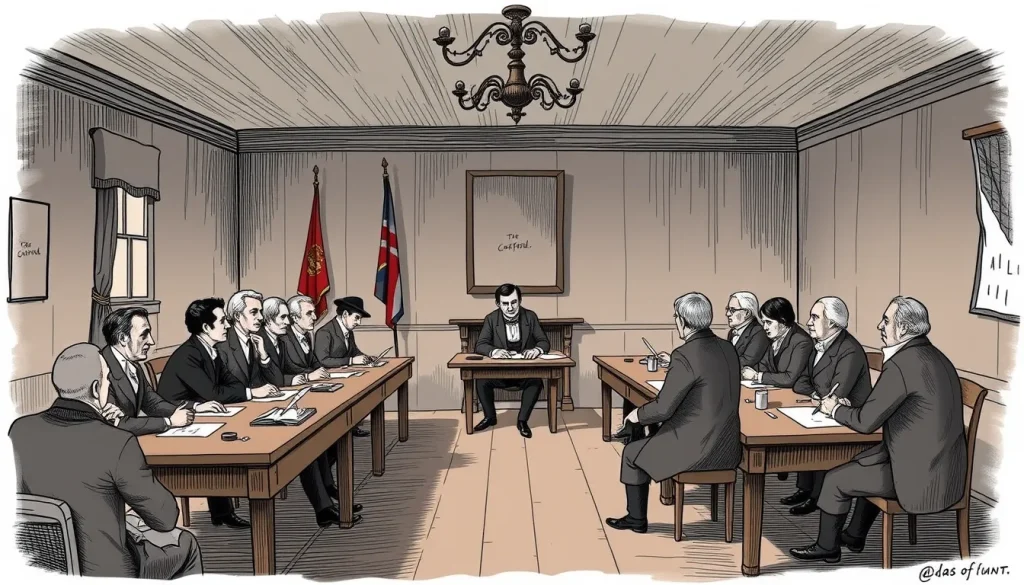
Massachusetts invited the other New England states to send delegates to Hartford. In December 1814, twenty-six men from Massachusetts, Connecticut, Rhode Island, Vermont, and New Hampshire assembled. The moderate faction, led by George Cabot (president) and Harrison Gray Otis, dominated. The convention met in secret, keeping no official journal of debates. After three weeks of deliberation, the delegates issued a report on January 4, 1815. It declared that the union of states was a compact and that states had a right to interpose against unconstitutional acts, but it explicitly rejected secession as a remedy. The report proposed seven constitutional amendments: (1) apportion representation based on free population rather than the three-fifths clause; (2) require a two-thirds congressional vote to admit new states; (3) prohibit trade embargoes longer than sixty days; (4) require a two-thirds vote to declare war; (5) prohibit naturalized citizens from holding federal office; (6) limit embargoes and commercial restrictions; and (7) permit a single term for the presidency and ban successive presidents from the same state. A committee was dispatched to present the report to President Madison. However, before they reached Washington, news of the Treaty of Ghent (signed December 24, 1814) and Andrew Jackson’s victory at New Orleans (January 8, 1815) undercut the convention’s urgency. The committee arrived to find the war over and public opinion turning against the Federalists.
Why It Matters
The Hartford Convention is significant because it became a symbol of disloyalty and sectionalism. Democratic-Republicans used it to paint Federalists as treasonous, even though the convention had rejected secession. The timing—coinciding with peace and victory—made the Federalists appear both obstructionist and unpatriotic. The party’s already declining fortunes collapsed; it never regained national competitiveness. Yet historians debate whether the convention itself destroyed the party or merely accelerated an inevitable decline. The convention also presaged later nullification and secession arguments, making it a touchstone in the history of states’ rights.
Definition
The Hartford Convention was a political meeting of New England Federalist delegates convened to protest the War of 1812 and propose constitutional changes to protect regional interests. It is often cited as a pivotal event in the decline of the Federalist Party.
Background
The convention grew out of long-standing Federalist frustration with Republican policies, including the embargoes, the Non-Intercourse Act, and the war itself. New England’s commercial economy suffered disproportionately, and Federalist leaders feared that Southern domination would permanently marginalize their region. The immediate catalyst was Madison’s request for a national draft and the federal government’s failure to defend New England from British raids. The call for a convention was issued by the Massachusetts legislature in October 1814.
How It Worked
Delegates were chosen by state legislatures, with moderates like Otis and Cabot steering the proceedings. The sessions were secret; no official record of debates was kept, though participants later published accounts. The convention produced a report that balanced protest with constitutionalism: it affirmed states’ rights to judge federal actions but stopped short of secession. The proposed amendments were intended to rebalance power in favor of New England and limit executive and commercial overreach.
Competing Viewpoints
Historians differ on the convention’s intent. One school, exemplified by David Hackett Fischer’s “The Myth of the Essex Junto,” argues that the supposed extremism of the convention was exaggerated by Republicans for propaganda. Another, represented by Dinah Mayo-Bobee, sees the convention as a genuine expression of Federalist discontent with real secessionist potential. The moderate leadership at Hartford rejected secession, but radical voices outside the convention had advocated it. The central question is whether the convention was a legitimate protest or a veiled threat to the Union.
Role in the War of 1812
The convention was a direct product of the War of 1812. It reflected New England’s opposition to a war that harmed its trade and seemed to serve only the South and West. Federalist governors had already obstructed military cooperation, and the convention was the highest-level political expression of that resistance. The war’s favorable conclusion, however, made the convention appear both unnecessary and unpatriotic.
Consequences and Historical Interpretation
The Hartford Convention’s immediate consequence was the political ruin of the Federalist Party. In the election of 1816, Republican candidate James Monroe decisively defeated Federalist Rufus King. The party’s influence in New England faded, and by the 1820s it had effectively dissolved. Yet, as some historians note, the party was already weakened by demographic changes and ideological rigidity. The convention accelerated the decline but did not create it. Moreover, the convention’s states’-rights arguments were later revived by Southern secessionists, giving it lasting historical significance.
Primary Sources
The most important primary source is the Report of the Hartford Convention (January 4, 1815), which outlines the grievances and proposed amendments. The convention’s secret journal was published in 1823. Letters and diaries of delegates, such as Harrison Gray Otis and George Cabot, provide insight into their motivations. Contemporary newspaper editorials from both Federalist and Republican papers capture public reaction. These sources are biased by their authors’ political affiliations, and the absence of an official debate record limits our knowledge of internal divisions.
Further Reading
- Banner, James M. To the Hartford Convention: The Federalists and the Origins of Party Politics in Massachusetts, 1789–1815. New York: Alfred A. Knopf, 1970.
- Morison, Samuel Eliot. Harrison Gray Otis, 1765–1848: The Urbane Federalist. Boston: Houghton Mifflin, 1969.
- Livermore, Shaw. The Twilight of Federalism: The Disintegration of the Federalist Party, 1815–1830. Princeton: Princeton University Press, 1962.
- Mayo-Bobee, Dinah. “Understanding the Essex Junto: Fear, Dissent, and Propaganda in the New Republic.” PhD diss., University of Tennessee, 2015.
References
- Center for the Study of Federalism. “Hartford Convention.” Accessed [current date]. https://federalism.org/encyclopedia/historical-figures/hartford-convention/.
- Bailey, Jeremy D. “The Hartford Convention.” Bill of Rights Institute. https://billofrightsinstitute.org/essays/the-hartford-convention/.
- Clark, Olive Kottke. “The Hartford Convention: Its Effect Upon the Federalist Party.” Master’s thesis, Loyola University Chicago, 1942.
- Brown, Julia. “‘A Spirit of Faction’: The Essex Junto and the Decline of the Federalist Party.” Armstrong Undergraduate Journal of History 9, no. 1 (2019). https://doi.org/10.20429/aujh.2019.090101.
- Lampi, Philip J. “The Federalist Party Resurgence, 1808–1816: Evidence from the New Nation Votes Database.” Journal of the Early Republic 33, no. 2 (2013): 255–281. https://doi.org/10.1353/jer.2013.0029.
FAQ
Did the Hartford Convention call for secession?
No, the final report explicitly rejected secession, though radical Federalists outside the convention had discussed it.
What constitutional amendments did the Hartford Convention propose?
It proposed amendments to require two-thirds votes for declarations of war and trade embargoes, limit embargoes to 60 days, change presidential election rules, and reduce Southern representation by repealing the three-fifths clause.
Why is the Hartford Convention considered a cause of the Federalist Party's decline?
Its timing during the war's successful conclusion made Federalists appear unpatriotic, and Democratic-Republicans used it as evidence of treason, undermining the party's legitimacy.



Leave a Reply