
Short Answer
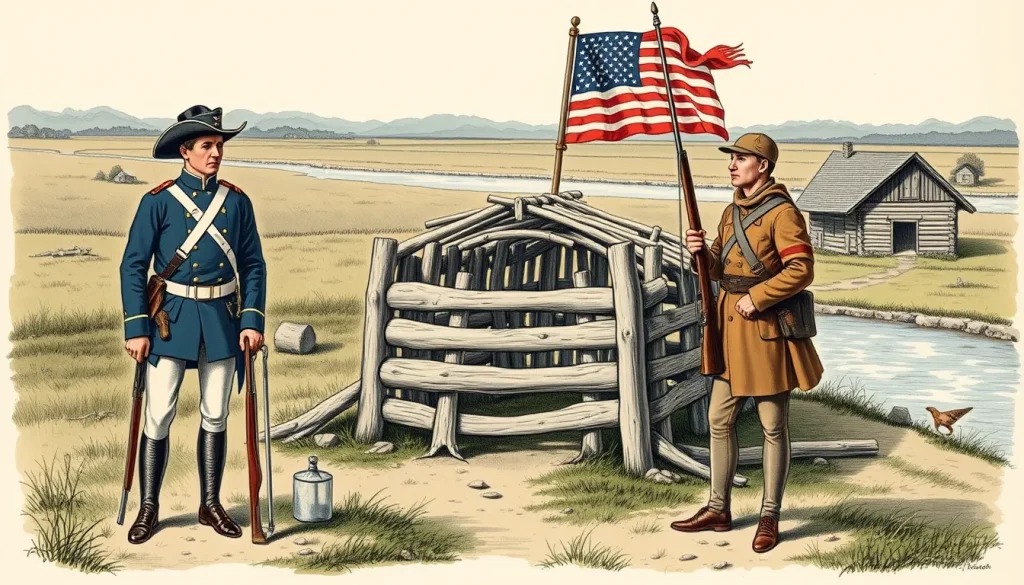
The War of 1812 (1812–1815) between the United States and Great Britain exposed fundamental tensions in how the American republic organized its defense. At the center of that tension was the contrast between the United States Regular Army—a small, underfunded professional force—and the state militias, citizen soldiers rooted in republican tradition that distrusted standing armies. This article compares the two institutions, evaluates their performance in the conflict, and considers the lessons that contemporaries and later historians drew from their strengths and failures.
Historical Context
The American Revolution left a deeply ingrained suspicion of standing armies, which many citizens associated with tyranny. The Constitution nevertheless allowed Congress to raise armies and to call forth the militia to execute federal law, suppress insurrections, and repel invasions, but it left militia organization partly in the hands of the states. The Militia Act of 1792 nominally required every able-bodied white male citizen aged 18 to 45 to enroll in his state militia, obtain a weapon, and train periodically. In practice, however, the system suffered from chronic underfunding, lax enforcement, and widespread public indifference to military discipline.
By 1812 the United States had a scattered Regular Army of about 11,744 officers and men, far below an authorized strength of 35,600, with several thousand of those enlistments dating only from the additional force authorized in January 1812. The Navy, though small, was relatively professional. Politically, the country was sharply divided: Federalists in New England largely opposed the war, while Republican war hawks from the West and South demanded conflict with Britain. Because the Regular Army was too small to mount a major invasion of Canada, President James Madison and his administration inevitably had to rely on the state militias.
What Happened
The U.S. Army in 1812 consisted of a few infantry and rifle regiments, one regiment each of dragoons and artillery, and a light artillery regiment whose horses had been sold in 1808 as a cost-saving measure. Command deficiencies compounded the problem: most senior officers were elderly Revolutionary veterans or political appointees, and junior officers often lacked training. When the war began, the administration planned simultaneous offensives against Montreal, the Niagara frontier, and Detroit—all of which failed in 1812.
In the western theater, Brigadier General William Hull led an American force, including Ohio militia, into Canada in July 1812, but his supply line was threatened and he surrendered Fort Detroit to British Major General Isaac Brock on August 16, 1812. At the Battle of Queenston Heights on October 13, 1812, American troops under New York militia Major General Stephen Van Rensselaer crossed the Niagara River and seized a position on the heights, but large numbers of militia refused to leave the American shore—a refusal remembered for decades as a symbol of militia unreliability. After the death of Brock, British reinforcements arrived and forced the Americans on the heights to surrender.
In 1813, American forces had mixed fortunes. William Henry Harrison, commanding the Army of the Northwest, used Kentucky militia and regulars to retake Detroit and defeat a British and Indigenous force at the Battle of the Thames on October 5, 1813. In the South, Andrew Jackson led Tennessee militia in brutal campaigns against the Creek Nation (the Creek War, 1813–1814), culminating in victory at Horseshoe Bend on March 27, 1814.
In August 1814, a British force landed in Maryland and marched on Washington, D.C. At the Battle of Bladensburg on August 24, 1814, a mixed force of Regular Army troops, District of Columbia militia, and Maryland militia broke and fled so quickly that the encounter was derisively called the “Bladensburg Races.” The British then burned the public buildings in Washington. Later that year, militia and regulars defended Baltimore (September 12–14, 1814) and New Orleans (January 8, 1815), where Andrew Jackson’s force, including Tennessee militia, Kentucky and Louisiana militia, regulars, and volunteers, won a decisive victory against a British invasion army.
Why It Matters
The war demonstrated both the severe limitations and the potential value of the American militia system. It also showed that a professionally led force, whether composed of regulars or properly disciplined militia, could hold its own against British regulars. The U.S. Regular Army emerged from the conflict more professional, better led, and more respected as the foundation of national defense. The debates about standing armies versus citizen soldiers did not end in 1815, but they shifted decisively in favor of a permanent professional army, while the militia system was reorganized in the post-war period along more realistic lines.
Definition
The Regular Army was the permanent, federally controlled professional military force, recruited, paid, and supplied by the U.S. government, with officers authorized by Congress and generally holding commissions for the duration of their service. The militia was a citizen army, organized by state governments, in which all free white male citizens of military age were by law enrolled, but which in practice served only for short activations and usually remained under state rather than federal command during the war.
Background
The militia system took its American form from English colonial precedents and was enshrined in law by the Militia Act of 1792. The act required enrollment of all able-bodied men and specified a minimal equipment standard, but it provided no mechanism for federal coercion, and states controlled training and appointment of officers. The Regular Army, by contrast, was a product of the constitutional clause giving Congress power to raise and support armies. Through the 1790s and early 1800s, Congress authorized various increases, but funding was never adequate, and in 1812 the army was still only a fraction of its paper establishment.
How It Worked
In practice, the militia operated as a locally organized force that could be called up by state governors or, formally, by the president in cases of invasion or insurrection. Many men appeared at rendezvous without weapons, uniforms, or equipment, and training was often perfunctory. Governor opposition was also an obstacle: several New England governors, especially in Massachusetts, refused to release their state militias for federal service or insisted on retaining command. When militia units did take the field, their short enlistments—often only 90 days—meant that lengthy campaigns were nearly impossible, and units frequently refused to cross international borders because they argued militia service was defensive only. Commanders therefore could not rely on them for sustained offensives.
Competing Viewpoints
Americans in 1812 held sharply different views about the value of the two forces. Republicans and many westerners regarded the militia as a safeguard against military tyranny, while Federalists and some military professionals, such as Alexander Hamilton before the war, doubted that untrained civilians could stand against professional soldiers. During the conflict, commanders like Stephen Van Rensselaer complained publicly about militia disobedience, while others, including William Henry Harrison, recognized that some militia units—especially those from Kentucky and Tennessee—fought with great courage and effectiveness. After the war, a House committee (including Harrison) reported that the militia system had been inadequately implemented and that citizens were naturally restless under military restraint, an observation that undermined the ideal of a citizen soldier.
Role in the War of 1812
The militia played a decisive, if inconsistent, role. It was essential to the frontier campaigns: Kentucky militia made up a large portion of Harrison’s forces at the Thames, and Tennessee militia formed the core of Jackson’s army in the Creek War and at New Orleans. It also failed repeatedly: at Detroit, the surrender of Hull’s army was hastened by low morale and militia desertion; at Queenston Heights, militia refused to cross the Niagara; at Bladensburg, militia broke and ran. Regular Army units, by contrast, consistently performed better by the end of the war, as demonstrated at Chippewa (July 5, 1814) and Lundy’s Lane (July 25, 1814), where disciplined regulars under Jacob Brown and Winfield Scott fought British regulars to a standstill.
Consequences and Historical Interpretation
The war’s outcome did not settle the militia debate, but it did shift the balance of opinion. The U.S. Army, having proven itself in the 1814 Niagara campaign and the 1815 defense of New Orleans, won new respect. Post-war legislation, including the reorganization of 1816, allowed for a larger regular army and a more realistic state militia system. Historians from the 20th century onward have generally agreed that the militia system was not truly implemented as the 1792 act intended; instead, militia units that performed well did so because of local leadership, prior combat experience, or the presence of professional regular officers. The 1818 thesis of historian Adam Franti argues that popular postwar stories about militia failure were politically motivated and that actual militia performance was far more complex than the “Bladensburg Races” stereotype allows.
Primary Sources
Relevant primary sources include the official dispatches and court-martial proceedings published in the American State Papers, Military Affairs (Vol. 1), notably Brigadier General William Hull’s report on the surrender of Detroit and Major General Stephen Van Rensselaer’s account of the Queenston Heights campaign. Also valuable are the published letters and reports of commanders such as William Henry Harrison and Andrew Jackson, collected in American State Papers, and the memoir of British soldier George Robert Gleig, A Subaltern in America (1833), which describes the Bladensburg and Baltimore operations from the British side. These sources are valuable for their operational detail, but they all carry biases: American commanders often blamed militia failure to deflect responsibility, while British authors emphasized British superiority.
Further Reading
- Donald R. Hickey, The War of 1812: A Forgotten Conflict (University of Illinois Press, 1989).
- J.C.A. Stagg, Mr. Madison’s War: Politics, Diplomacy, and Warfare in the Early American Republic, 1783–1830 (Princeton University Press, 1983).
- C. Edward Skeen, Citizen Soldiers in the War of 1812 (University Press of Kentucky, 1999).
- Robert L. Kerby, “The Militia System and the State Militias in the War of 1812,” Indiana Magazine of History 73 (June 1977).
- Adam Franti, “Our Renown is Not Yours: The American Militia in the War of 1812,” MA thesis, Eastern Michigan University, 2018.
- U.S. Army Center of Military History, The Campaign of 1812, CMH Pub 74–2 (2013).
References
- Steven J. Rauch, The Campaign of 1812, CMH Pub 74–2, U.S. Army Center of Military History, 2013. https://history.army.mil/Portals/143/Images/Publications/Publication%20By%20Title%20Images/C%20Pdf/CMH_Pub_74-2.pdf
- David and Jeanne T. Heidler, “America’s citizen soldiers: The better bargain of militias?” U.S. National Park Service. https://www.nps.gov/articles/americas-citizen-soldiers.htm
- Robert L. Kerby, “The Militia System and the State Militias in the War of 1812,” Indiana Magazine of History 73 (June 1977). http://scholarworks.iu.edu/journals/index.php/imh/article/view/9999/13709
- Adam Franti, “‘Our Renown is Not Yours’: The American militia in the War of 1812,” MA thesis, Eastern Michigan University, 2018. https://commons.emich.edu/cgi/viewcontent.cgi?article=2298&context=theses
- American Military History, Chapter 6: The War of 1812, Office of the Chief of Military History, United States Army. https://webdoc.sub.gwdg.de/ebook/p/2004/CMH/American%20Military%20History/www.army.mil/cmh-pg/books/AMH/AMH-06.htm
FAQ
What was the main difference between the Regular Army and the militia in the War of 1812?
The Regular Army was a small, federally funded professional force with full-time soldiers and officers who served by commission. The militia was a citizen force organized by each state, composed of ordinary residents who served part-time, had short enlistments, and were usually commanded by state governors rather than the federal government.
Why did militia refuse to fight at Queenston Heights?
At Queenston Heights (October 13, 1812), New York militia units refused to cross the Niagara River into Canada. Their refusal is often attributed to the belief that under the militia law they could not be compelled to serve outside the United States, as well as to low morale, fear, and, in some accounts, political opposition to the war.
Did militia ever fight well during the War of 1812?
Yes. Tennessee and Kentucky militia performed effectively in the Creek War, at the Battle of the Thames (1813), and, under Andrew Jackson's command, at the Battle of New Orleans (1815). Their success depended heavily on capable leadership and prior experience, conditions not always present.
How did the war affect the U.S. Regular Army?
The war exposed weaknesses in leadership and training, but by 1814 the Regular Army proved it could fight British regulars effectively, as at Chippewa and Lundy's Lane. After the war, Congress expanded and reorganized the army, and it became the recognized foundation of national defense.


Leave a Reply