
Short Answer
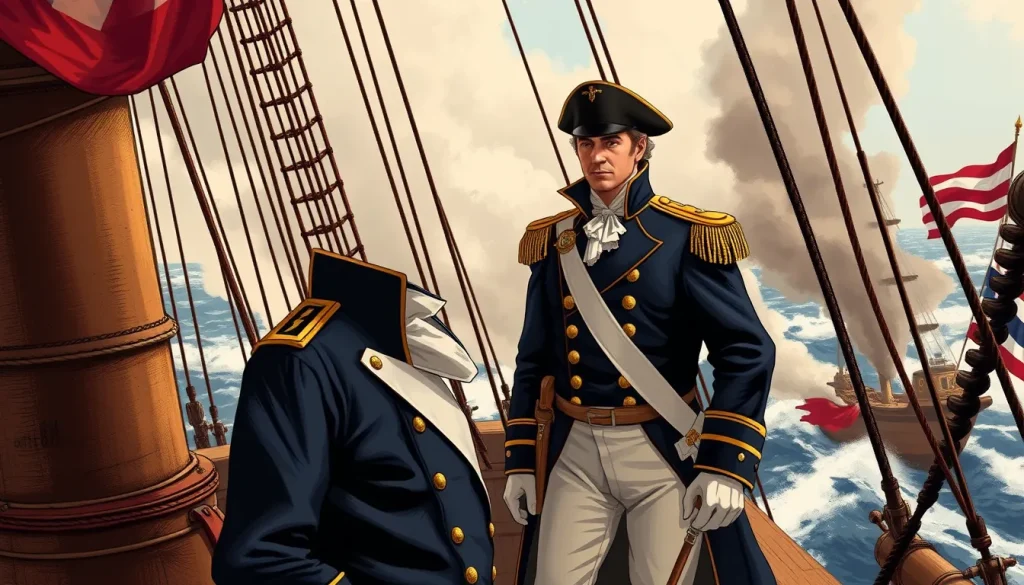
James Lawrence (October 1, 1781 – June 4, 1813) was an officer in the United States Navy who served during the Quasi-War, the First Barbary War, and the War of 1812. He commanded USS Chesapeake in a brief but fierce engagement against HMS Shannon off Boston in June 1813, during which he was mortally wounded. Lawrence’s reported last words, “Don’t give up the ship,” were subsequently memorialized by his friend Oliver Hazard Perry and became a lasting motto in American naval tradition.
Historical Context
The War of 1812 (1812–1815) pitted the United States against the United Kingdom, with naval warfare playing a central role. The Royal Navy dominated the seas and imposed a blockade on American ports, while the U.S. Navy, though small, achieved several notable single-ship victories early in the conflict, boosting American morale. Commanders on both sides were aware of the propagandistic value of such duels, and frigate actions were closely watched. Boston harbor was under blockade in 1813, and American captains were eager to break the blockade and score victories.
What Happened
Lawrence, newly promoted to captain, took command of the frigate USS Chesapeake at Boston in May 1813. On June 1, he sailed out to engage HMS Shannon, a well-trained and seasoned frigate under Captain Philip Broke. The two ships exchanged broadsides in a short, violent action. Within minutes, Chesapeake’s rigging and sails were shredded, leaving the ship unmanageable. Lawrence was struck by small-arms fire and mortally wounded; as he was carried below, he allegedly ordered, “Don’t give up the ship” or “Tell the men to fire faster! Don’t give up the ship.” The British boarding party then overwhelmed the American crew and captured Chesapeake. Lawrence died on June 4, 1813, while the prize was being taken to Halifax, Nova Scotia.
Why It Matters
The loss of Chesapeake was a setback for the American navy and morale, but the heroic last words attributed to Lawrence transformed him into a martyr. His friend Oliver Hazard Perry honored him by having a battle flag stitched with “DONT GIVE UP THE SHIP” (sic) and flew it during the triumphant Battle of Lake Erie in September 1813. The phrase became a rallying cry for the U.S. Navy and remains a core motto at the Naval Academy. The action also highlighted the importance of crew training and discipline, contrasting the seasoned Royal Navy crew with Lawrence’s largely inexperienced sailors.
Early Life
James Lawrence was born on October 1, 1781, in Burlington, New Jersey, to John and Martha Lawrence. His mother died when he was young, and his father, a Loyalist, fled to Canada during the American Revolution, leaving James to be raised by an aunt. He attended Woodbury Academy and briefly studied law before entering the U.S. Navy as a midshipman in 1798.
Role Before the War
During the Quasi-War with France (1798–1800), Lawrence served aboard USS Ganges and USS Adams in the Caribbean. He was commissioned a lieutenant in 1802 and served on USS Enterprise in the Mediterranean, taking part in attacks on Tripolitan craft. In 1804 he served as second-in-command during the expedition to destroy the captured frigate USS Philadelphia at Tripoli. He later commanded several vessels, including USS Vixen, USS Wasp, and USS Argus, and was promoted to master commandant in November 1810.
Role During the War
Lawrence took command of the sloop-of-war USS Hornet in 1811. With the outbreak of war in 1812, he cruised actively, capturing the British privateer Dolphin in July 1812. Later, Hornet blockaded HMS Bonne Citoyenne at Bahia, Brazil, and on February 24, 1813, captured and sank HMS Peacock, a significant victory that earned him a promotion to captain. He returned to the United States in March 1813 and was given command of the frigate Chesapeake, then preparing for sea in Boston.
Major Actions
Lawrence’s most notable achievements before his final battle were his successful cruise in USS Hornet, including the capture of the privateer Dolphin and the decisive defeat and sinking of HMS Peacock. His final action, the engagement with HMS Shannon on June 1, 1813, ended in defeat and his own death, but it immortalized his reported last words and his example of personal courage.
Contemporary Accounts
Accounts of Lawrence’s last words vary. Some reports state he said, “Don’t give up the ship. Fight her till she sinks,” while others attribute “Tell the men to fire faster! Don’t give up the ship.” The earliest printed accounts appeared in American and British newspapers following the battle. Captain Philip Broke’s official report to the Admiralty described the action and praised his own crew’s discipline. American accounts emphasized Lawrence’s bravery and the misfortune of having an inexperienced crew. These reports contributed to the legend of Lawrence’s final order, which was later popularized by Oliver Hazard Perry’s flag.
Later Life
Lawrence died from his wound on June 4, 1813, aboard HMS Shannon while en route to Halifax. He was initially buried with military honors at the Royal Navy base in Halifax, but his remains were reinterred in 1813 at Trinity Church Cemetery in New York City. He was survived by his wife, Julia Montaudevert Lawrence, and their two-year-old daughter, Mary Neill Lawrence. The U.S. Congress posthumously awarded him a Congressional Gold Medal and the Thanks of Congress.
Historical Legacy
Lawrence’s legacy is closely tied to the phrase “Don’t give up the ship,” which became a symbol of perseverance for the U.S. Navy. Oliver Hazard Perry flew a flag with these words during his victory on Lake Erie. Numerous places, including counties in Alabama, Arkansas, Illinois, and Indiana, and the city of Lawrence, Indiana, were named in his honor. The U.S. Navy has also honored him with ship names, including USS Lawrence and USS Duncan. His grave and the replica of Perry’s flag at the U.S. Naval Academy continue to connect the modern Navy to its War of 1812 heritage.
Primary Sources
The most relevant primary sources for the life and death of James Lawrence include his official correspondence and battle reports, held by the National Archives and Records Administration (NARA) and the Naval War of 1812 documentary edition. Captain Philip Broke’s after-action report, published in British newspapers and the London Gazette, provides a British perspective. The logbooks of USS Chesapeake and HMS Shannon offer operational details. Also important are Lawrence’s letters to his wife and family, which are preserved in private collections and published in naval history compilations. These sources must be used with caution because they were written for official or personal purposes and may contain bias or omissions.
Further Reading
- Roosevelt, Theodore. The Naval War of 1812. G.P. Putnam’s Sons, 1882.
- Toll, Ian W. Six Frigates: The Epic History of the Founding of the U.S. Navy. W.W. Norton, 2006.
- Dudley, William S., and Michael J. Crawford, eds. The Naval War of 1812: A Documentary History. Naval Historical Center, 1985–2002.
- Hickey, Donald R. The War of 1812: A Forgotten Conflict. University of Illinois Press, 1989.
References
- “James Lawrence.” Wikipedia, https://en.wikipedia.org/wiki/James_Lawrence. Accessed October 26, 2025.
- “James Lawrence.” National Park Service, https://www.nps.gov/people/james-lawrence.htm. Accessed October 26, 2025.
FAQ
What were James Lawrence's actual last words?
The exact wording is uncertain. Contemporary accounts suggest he said either 'Don't give up the ship. Fight her till she sinks' or 'Tell the men to fire faster! Don't give up the ship.' Both versions emphasize perseverance.
Why is James Lawrence important in the War of 1812?
Lawrence is significant for his earlier victories (capture of HMS Peacock) and his heroic death at the Chesapeake–Shannon engagement. His last words inspired Oliver Hazard Perry's battle flag and became a lasting U.S. Navy motto.
Where is James Lawrence buried?
He was initially buried in Halifax, Nova Scotia, with military honors, but his remains were later reinterred at Trinity Church Cemetery in New York City.


Leave a Reply