Short Answer
The Battle of Beaver Dams, fought on 24 June 1813 near present-day Thorold, Ontario, was a decisive engagement in which Indigenous forces—primarily Mohawk (Kanyen’kehà:ka) warriors—ambushed an American column advancing from Fort George. The victory prevented further American incursions into the Niagara Peninsula and underscored the critical role of Indigenous allies in the defence of British North America during the War of 1812.
Historical Context
By spring 1813, the war on the Niagara frontier had entered a volatile phase. American forces had captured Fort George on 27 May 1813, forcing British troops under Brigadier General John Vincent to retreat westward. After the British victory at the Battle of Stoney Creek on 6 June, the Americans remained in possession of Fort George but were confined to its immediate environs. In response, Lieutenant James FitzGibbon of the 49th Regiment formed a company of 48 picked men to conduct harassment operations from a forward post near Beaver Dams. The region was home to Indigenous communities allied with Britain, including Mohawk from the Grand River, and reinforcements from Kahnawake, Akwesasne, and Kanesatake in Lower Canada. These warriors had longstanding grievances against American expansion and were motivated to fight alongside the British. The Indian Department, with officers such as Captain Dominique Ducharme and Captain William Kerr, coordinated Indigenous participation. On 23 June, American Brigadier General John Boyd at Fort George ordered Lieutenant Colonel Charles G. Boerstler to take about 500 men and destroy FitzGibbon’s post. The stage was set for an encounter in which Indigenous forces would play the central combat role.
What Happened
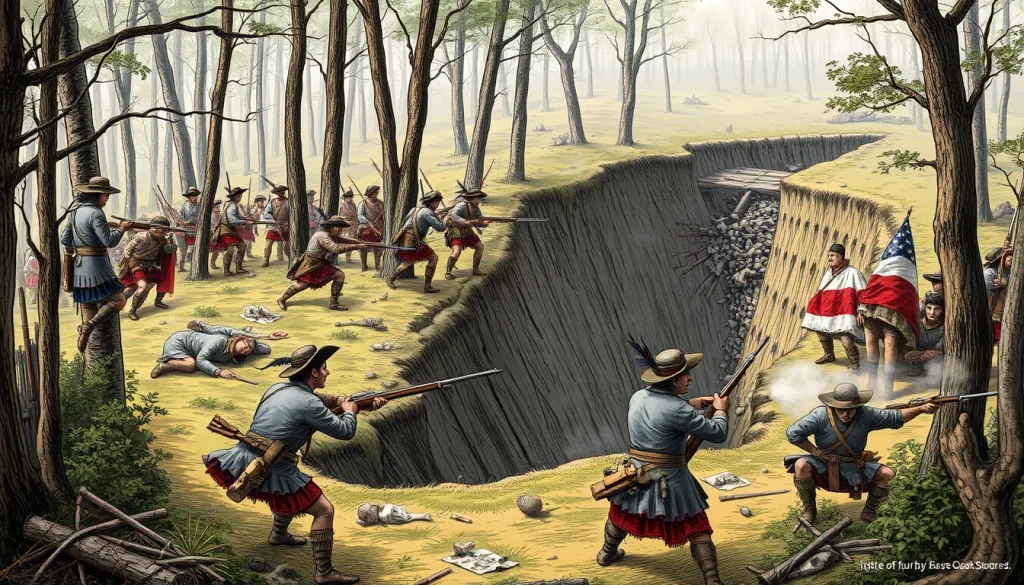
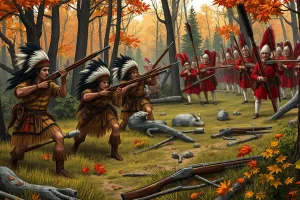
Boerstler’s column departed Fort George on the afternoon of 23 June, stopping overnight at Queenston. The next morning, 24 June, they resumed their march toward Beaver Dams. Indigenous scouts had tracked the American movement from the outset and alerted their warriors and the British. Laura Secord, a Queenston resident, also warned FitzGibbon after overhearing American plans, although her route and timing remain debated. As the Americans entered a wooded section of the trail near Beaver Dams, they were ambushed by a large force of Mohawk warriors. The ambush began around 9:00 a.m. and lasted about three hours. FitzGibbon arrived with his small company as the Americans sought to surrender. He persuaded Boerstler that a larger British force was nearby and that the warriors could not be easily restrained. A formal capitulation was arranged, and 512 Americans surrendered. Indigenous casualties were reported as 5 killed and 20–25 wounded by the Canadian Encyclopedia, while Veterans Affairs Canada gives 15 killed and 25 wounded. American losses were 25 killed and 50 wounded. The battle was essentially won by Indigenous warriors, with FitzGibbon’s role limited to receiving the surrender.
Why It Matters
The Battle of Beaver Dams had immediate strategic effects. It ended American attempts to venture beyond the immediate vicinity of Fort George and effectively secured the Niagara Peninsula for the British for the remainder of 1813. The defeat also contributed to the recall of American Major General Henry Dearborn from command. More significantly, the battle exemplifies the indispensable contribution of Indigenous forces to British success in the War of 1812. Yet the aftermath exposed deep inequalities: the Indigenous warriors who had fought the battle were denied the expected rewards of captured weapons and prisoner bounties, and the credit was largely given to FitzGibbon. John Norton, a Mohawk war chief, famously complained, “the Caughnawaga Indians fought the battle, the Mohawks or Six Nations got the plunder, and FitzGibbon got the credit.” This injustice shaped Indigenous memory and later historical debates about recognition and legacy.
Prelude
After the American capture of Fort George, British forces under Vincent retreated, but the victory at Stoney Creek allowed them to re-establish positions. FitzGibbon’s small detachment at Beaver Dams threatened American communications. American commanders, frustrated by FitzGibbon’s guerrilla tactics and the presence of Indigenous warriors, decided to eliminate the post. Boerstler’s force of approximately 500 men included the 14th U.S. Infantry and elements of other units. They marched late, and information about their mission leaked. Indigenous scouts observed their advance from Fort George, and messengers were sent to warn the British and Indigenous allies.
Forces and Commanders
The defending force at Beaver Dams consisted of Lieutenant James FitzGibbon’s company of the 49th Regiment, numbering about 48 men, augmented by local militia. The main combat force was Indigenous: around 300 Mohawk warriors from Kahnawake under Captain Dominique Ducharme, later joined by about 100 warriors from the Grand River under Captain William Kerr, and additional 60 Ojibwa from Rice Lake and Toronto. Overall, Indigenous warriors numbered roughly 460. The American force under Lieutenant Colonel Charles G. Boerstler comprised approximately 500 men, including the 14th and 6th Infantry, with two field guns.
Battlefield and Map Context
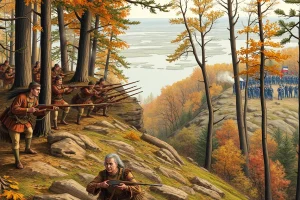
The engagement occurred at a place called Beaver Dams, near the head of Twelve Mile Creek, in the township of Thorold, Upper Canada (now Ontario). The specific ground was a heavily wooded ravine intersected by a road—the present-day intersection of Thorold Stone and Davis Roads. The dense beech woods and fencerows provided cover for the ambush. The site has since been commemorated as a National Historic Site, with the battlefield partially preserved in Battle of Beaverdams Park.
Battle Chronology
Boerstler’s column crossed from Fort George to Queenston on 23 June. At dawn on 24 June, they marched toward Beaver Dams. Indigenous scouts shadowed them and reported their approach. Around 9:00 a.m., Ducharme’s warriors opened fire on the American column’s rear and flanks from the woods and behind fence lines. The Americans formed defensive positions but could not see their attackers. For three hours, the warriors fired from cover, inflicting heavy casualties and keeping the Americans under constant pressure. FitzGibbon arrived around noon, and the Americans raised the white flag. After negotiations, Boerstler surrendered to FitzGibbon. By 3:00 p.m., the prisoners were being escorted away. The entire action lasted from morning to early afternoon.
Casualties and Losses
Reports of Indigenous casualties vary. The Canadian Encyclopedia states that 5 chiefs and warriors were killed and 20–25 wounded. Veterans Affairs Canada records 15 killed and 25 wounded. American losses are more consistently given: 25 killed, 50 wounded, and 512 captured, including Boerstler. FitzGibbon’s detachment suffered no known casualties. The discrepancy in Indigenous losses likely reflects differing records; the exact numbers may never be known.
Result
The battle was a clear British victory, achieved almost entirely by Indigenous warriors. The American column was compelled to surrender, and its commander was wounded and captured. The British gained control of the Niagara Peninsula for the rest of 1813. FitzGibbon received the surrender, but the tactical success was due to the ambush and sustained fire of the Indigenous forces.
Strategic Consequences
The Battle of Beaver Dams convinced American commanders that they could not safely move beyond the protection of Fort George. It effectively ended offensive operations on the Niagara frontier for 1813 and led to the dismissal of Major General Dearborn. The victory bolstered British morale and affirmed the value of Indigenous alliances. For Indigenous peoples, however, the aftermath was bitter: they received no prize money and only grudging recognition. The resentment contributed to tensions between Indigenous and British leadership and later affected Indigenous participation and trust.
Primary Accounts
Contemporary accounts include Lieutenant FitzGibbon’s official report to his superiors, in which he acknowledged the role of Indigenous warriors in terrifying the enemy, though he emphasized his own diplomacy. Mohawk leader John Norton left written accounts detailing the battle and criticizing the lack of credit given to Indigenous fighters. Captain Dominique Ducharme submitted reports on the Indigenous forces’ actions. American court-martial records and letters from Boerstler and others provide the American perspective. Laura Secord’s story is based on a memoir she wrote years later, with disputed details. These sources must be read with attention to their authorship and biases.
Battlefield Today
The Battle of Beaver Dams National Historic Site was designated in 1921. A cairn with a commemorative plaque was erected in 1923 and later moved to a new location. In 1976, the memorial was relocated to Battle of Beaverdams Park in Thorold, where it stands today. Also in the park is a stone monument from 1874 honoring American soldiers whose remains were discovered during construction of the third Welland Canal. The precise battlefield area is partly built over, but the park and interpretive panels allow visitors to understand the engagement.
Primary Sources
The most important contemporary documents include FitzGibbon’s report of 25 June 1813 to Colonel Harvey, which is held at Library and Archives Canada. This report describes the surrender and acknowledges the Indigenous role. Ducharme’s and Kerr’s reports to the Indian Department, also in LAC, provide Indigenous combat details. John Norton’s journal, published as The Journal of Major John Norton, offers an Indigenous perspective and criticizes British credit-taking. Laura Secord’s 1853 memoir is a crucial but later and self-serving account. The American side is documented in the official military returns and Boerstler’s testimony during his court of inquiry. These sources are available in archival collections or documentary editions such as Cruikshank’s Documentary History of the Campaign upon the Niagara Frontier.
Further Reading
- Ridler, Jason. “Battle of Beaver Dams.” The Canadian Encyclopedia, 2011, updated 2023.
- Dale, Ronald J. “Battle of Beaver Dams National Historic Site of Canada.” The Canadian Encyclopedia, 2011.
- Cruikshank, Ernest A. The Fight in the Beechwoods: A Study in Canadian History. Welland: Lundy’s Lane Historical Society, 1895.
- Norton, John. The Journal of Major John Norton. Edited by Carl F. Klinck and James J. Talman. Toronto: Champlain Society, 1970.
- Benn, Carl. The Iroquois in the War of 1812. Toronto: University of Toronto Press, 1998.
References
- Ridler, Jason. “Battle of Beaver Dams.” The Canadian Encyclopedia. https://thecanadianencyclopedia.ca/index.php/en/article/battle-of-beaver-dams.
- Dale, Ronald J. “Battle of Beaver Dams National Historic Site of Canada.” The Canadian Encyclopedia. https://thecanadianencyclopedia.ca/index.php/en/article/battle-of-beaver-dams-national-historic-site-of-canada.
- Veterans Affairs Canada. “Battle of Beaver Dams Memorial.” https://veterans.gc.ca/en/remembrance/memorials/canada/battle-beaver-dams-memorial.
- Cruikshank, Ernest A. “The Fight in the Beechwoods.” War of 1812 Bicentennial. http://www.warof1812-bicentennial.info/pamphlets/fightinthebeechwoods/fight-main.php.
- Norton, John. The Journal of Major John Norton. Champlain Society, 1970.
FAQ
Who actually won the Battle of Beaver Dams?
The battle was won by Indigenous Mohawk warriors, who ambushed and pinned down the American force, forcing it to surrender. British Lieutenant James FitzGibbon accepted the surrender but played a minor combat role.
Why were Indigenous forces not given credit for Beaver Dams?
FitzGibbon received most of the credit in official reports and popular memory, while Indigenous warriors were denied promised rewards such as plunder and prisoner bounties. This discrepancy was criticized by Mohawk leaders like John Norton.
What was the significance of the Battle of Beaver Dams?
The defeat prevented American forces from advancing into the Niagara Peninsula and secured British control of the region for the remainder of 1813, while demonstrating the critical role of Indigenous allies.


Leave a Reply