
Short Answer
The Treaty of Ghent, signed on December 24, 1814, formally ended the War of 1812 between the United States and Great Britain, but its provisions did not reach North America until nearly seven weeks later. The Atlantic crossing of the official treaty copy and the subsequent dissemination of the news across the American continent had profound consequences, including the infamous Battle of New Orleans fought after the peace was signed. This article examines the route, timing, and impact of the news of the Treaty of Ghent as it reached North America.
Historical Context
By late 1814, both the United States and Great Britain were weary of a war that had produced no clear victor. Negotiations began in August 1814 in the neutral city of Ghent (in modern Belgium), with American commissioners John Quincy Adams, James A. Bayard, Henry Clay, Jonathan Russell, and Albert Gallatin facing British delegates Admiral James Gambier, Henry Goulburn, and William Adams. The talks dragged on as each side jockeyed over territorial claims, maritime rights, and the status of Indigenous lands. The treaty was signed on Christmas Eve 1814, but it would only take effect after ratification by both governments.
Communication across the Atlantic in 1815 was slow and unpredictable. Sailing ships typically took from three to six weeks to cross the ocean, depending on winds and weather. The British government ratified the treaty on December 27, 1814, and dispatched a copy aboard a packet ship, while the American copy was carried by Henry Carroll, secretary to the American mission. The ship chosen was the Favorite, a British packet that departed from London with the ratified British copy and the American-ratified treaty on January 2, 1815.
What Happened
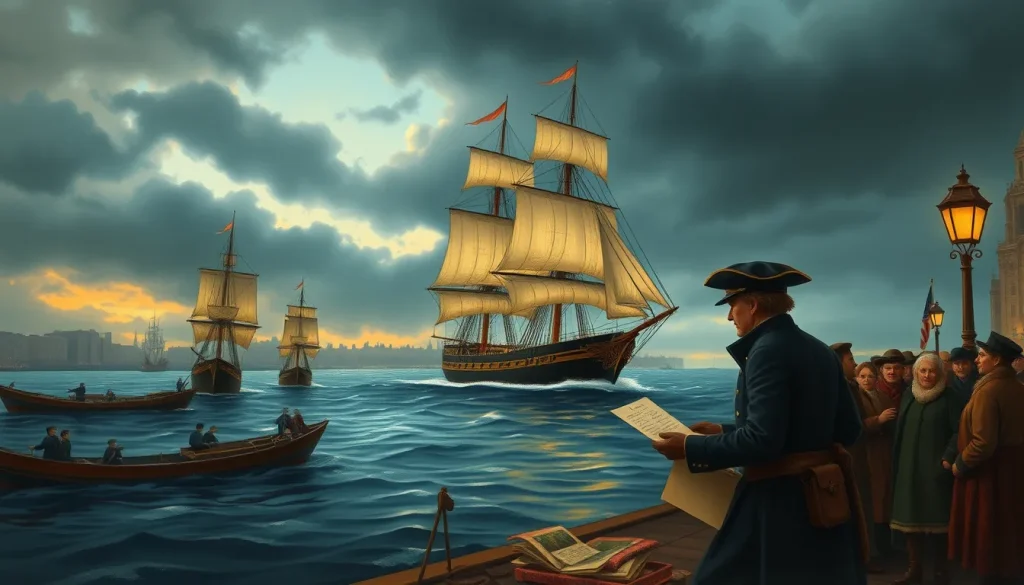
The Favorite encountered severe storms in the Atlantic and in the Chesapeake Bay, forcing it to divert to New York Harbor rather than its intended destination. It arrived at New York around 8:00 p.m. on February 11, 1815. The news of peace spread rapidly from there. Henry Carroll, who carried a copy of the treaty for the U.S. government, made no secret of his mission, and within hours word of peace had ignited celebration in New York. Express riders were sent in all directions, carrying the news to cities such as Boston, where a rider covered the distance in a record thirty-two hours, and to Washington, D.C.
The official copy of the treaty reached Washington on February 13, and President James Madison submitted it to the Senate on February 15. The Senate unanimously approved ratification on February 16, and Madison signed it that same day. The British had already ratified on December 27, so the exchange of ratifications took place in Washington on February 17, marking the official end of the war at 11:00 p.m. that night.
Meanwhile, on January 8, 1815, before news of the treaty had crossed the Atlantic, Major General Andrew Jackson’s forces defeated the British army at the Battle of New Orleans. This victory, achieved after the peace had been signed, would become the most celebrated American military triumph of the war, even though it had no bearing on the final treaty terms.
Why It Matters
The delayed arrival of the news meant that the Battle of New Orleans was fought after the war was officially over. This created a paradox where a battle that had no legal effect on the peace negotiations profoundly influenced American national memory. The victory boosted American morale and gave the impression that the United States had won the war, even though the Treaty of Ghent simply restored the pre-war status quo. The spread of news also triggered nationwide celebrations and reinforced a sense of national pride.
For Indigenous peoples, the consequences were more severe. Article IX of the treaty promised to restore to Native nations “all possessions, rights, and privileges” they had enjoyed in 1811, but this provision was never enforced by the United States. The slow dissemination of peace—and the fact that hostilities continued in some frontier areas for months—further undermined any hopes of a buffer state or protected territory. The war’s end, as communicated through the treaty, ultimately opened the door to aggressive American expansion westward, displacing Indigenous communities.
Definition
“How news of the Treaty of Ghent reached North America” refers to the physical and informational process by which the treaty text and the fact of its signing were transported across the Atlantic and distributed within the United States and British North America. This includes the diplomatic dispatch, the sea voyage, the arrival at a major port, and the subsequent telegraphic and newspaper dissemination throughout the continent.
Background
Transatlantic communication in the early nineteenth century depended entirely on sailing ships. Official dispatches were carried by naval vessels or packet ships, and there was no regular transatlantic mail service. The time required for a message to travel from Europe to North America varied widely—anywhere from three to eight weeks depending on winds, storms, and the ship’s route. The Treaty of Ghent’s negotiators were acutely aware of these delays; the treaty itself stipulated that hostilities would not cease until both governments had ratified and exchanged copies, which allowed for a window of continued conflict.
How It Worked
The practical mechanics began with the signing in Ghent on December 24, 1814. The British government ratified on December 27, and the American copy was entrusted to Henry Carroll, who boarded the British packet Favorite in London on January 2, 1815. The ship also carried the British instrument of ratification under the care of Anthony Baker, a British officer. The Favorite encountered severe weather, including storms in the Chesapeake Bay, and was forced to land at New York instead of its planned southern port. Carroll’s arrival was not secret; he openly announced the peace, and local citizens immediately began celebrating.
From New York, express riders carried the news to Boston, Philadelphia, and Washington. In Boston, a rider made the journey in thirty-two hours. Newspapers printed handbills and extra editions. By February 14, the official copy had reached Washington, and the Senate ratified on February 15 and 16. The exchange of ratifications took place in the capital on February 17, and thereafter orders were sent to military commanders to cease hostilities.
Competing Viewpoints
Historians have debated the significance of the delays. Some emphasize that the Battle of New Orleans, fought after the peace, was strategically meaningless and its heroism overshadowed the actual negotiated settlement. Others argue that the American victory at New Orleans, even though it came after the treaty’s signing, strengthened American bargaining position and national confidence. A third viewpoint focuses on the British domestic context: the British public was exhausted by the Napoleonic Wars, and the government’s decision to ratify quickly reflected a desire to end the conflict without further expense. The slow news also meant that some frontier posts, especially in the Great Lakes and Mississippi Valley, continued fighting for weeks, complicating the treaty’s implementation.
Role in the War of 1812
The news of the Treaty of Ghent directly ended the war by implementing the ratification process. Because the treaty stated that hostilities were to cease “as soon as this Treaty shall have been ratified by both parties,” the February 17 exchange of ratifications was the legal moment of peace. The delay in transmitting the news meant that the war’s last battle, New Orleans, occurred before the treaty took effect in law, but after it had been signed. This timing shaped how the war was remembered: Americans celebrated the victory at New Orleans as a triumph, while the treaty itself was often viewed as merely restoring the status quo.
Consequences and Historical Interpretation
The immediate consequence of the news reaching North America was the cessation of hostilities and the beginning of a long period of peace between the United States and Great Britain. The delay, however, had lasting interpretative consequences. The myth of a “second war of independence” was fueled by the New Orleans victory, obscuring the fact that the treaty settled none of the original causes of the war, such as impressment or neutral rights. Later historians, such as Donald Hickey, have argued that the war ended in a stalemate, with neither side gaining territory. The slow communication also underscored the logistical challenges of 19th-century diplomacy and set expectations for future transatlantic negotiations.
Primary Sources
Key primary sources include the treaty itself, held at the U.S. National Archives (Record Group 11). Henry Carroll’s account of the voyage aboard the Favorite is documented in his later correspondence. The diary of John Quincy Adams, one of the American commissioners, provides detail on the negotiations and the anticipation of ratification. Contemporary newspapers, such as the New York Evening Post and Boston Daily Advertiser, reported the arrival of the news and the celebrations. Additionally, British diplomatic correspondence in the National Archives (UK) records the dispatch of the treaty copy and the instructions given to Anthony Baker.
Further Reading
- Donald R. Hickey, The War of 1812: A Forgotten Conflict (University of Illinois Press, 1989).
- Donald R. Hickey, The War of 1812: A Short History (University of Illinois Press, 2012).
- American Battlefield Trust, “The Treaty of Ghent: Ending the War of 1812,” battlefields.org.
- National Park Service, “War’s End,” Star-Spangled Banner National Historic Trail, nps.gov.
- National Archives, “Treaty of Ghent (1814),” archives.gov.
References
- National Park Service, “War’s End,” Star-Spangled Banner National Historic Trail, https://www.nps.gov/stsp/learn/historyculture/war-s-end.htm.
- American Battlefield Trust, “The Treaty of Ghent: Ending the War of 1812,” https://www.battlefields.org/learn/articles/treaty-ghent-ending-war-1812.
- National Archives, “Treaty of Ghent (1814),” https://www.archives.gov/milestone-documents/treaty-of-ghent.
- Donald R. Hickey, The War of 1812: A Forgotten Conflict (University of Illinois Press, 1989), excerpt available at https://bookreadfree.com/30488/792140.
FAQ
Why did the news of the Treaty of Ghent take so long to reach North America?
The treaty was signed on December 24, 1814, but the only means of transatlantic communication was by sailing ship. The Favorite, carrying the ratified treaty, departed on January 2, 1815, and encountered storms that forced it to divert to New York, arriving on February 11. The voyage took about five weeks.
What effect did the delay have on the Battle of New Orleans?
The Battle of New Orleans was fought on January 8, 1815, after the treaty had been signed but before the news reached the combatants. The American victory there became a celebrated triumph, even though the treaty had already been signed, because neither side knew peace had been agreed.
How did the news spread after arriving in New York?
Immediate notification was sent via express riders to major cities. For example, a rider reached Boston in thirty-two hours. Newspapers printed handbills, and public celebrations broke out in cities across the United States. Official copies were delivered to Washington by February 14, leading to Senate ratification on February 16.



Leave a Reply