
Short Answer
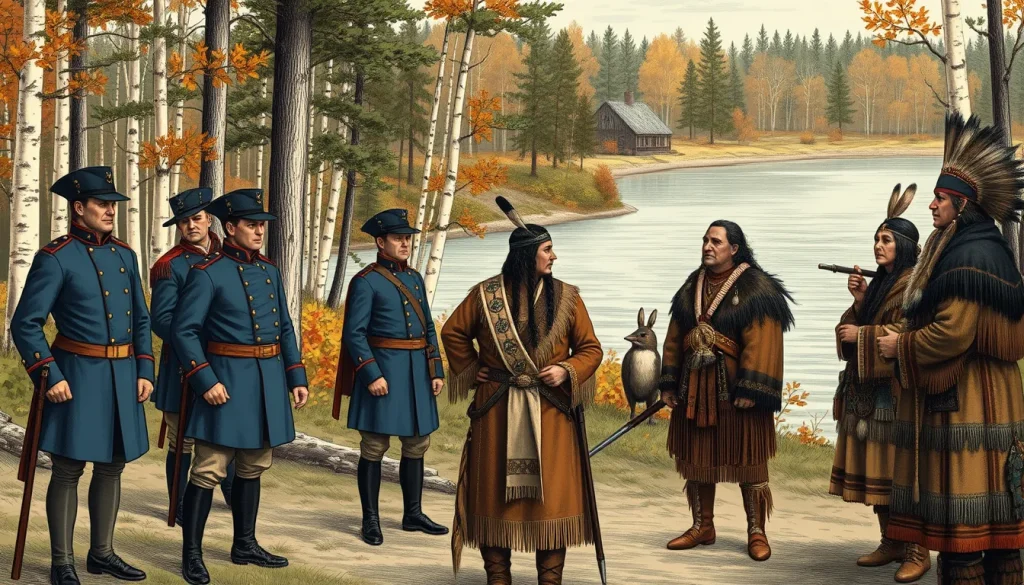
The War of 1812 (1812–1815) pitted the United States against Great Britain, but it also became a decisive conflict between the American republic and the Indigenous nations of the Old Northwest, the Great Lakes, and the American South. From 1812 to 1815, many Indigenous communities, most prominently the pan-Indian confederacy led by the Shawnee leader Tecumseh, allied with the British Empire to check American expansion, while others sought neutrality or fought alongside the United States. The war’s battles, treaties, and the collapse of Tecumseh’s movement fundamentally altered American–Indigenous relations, accelerating American westward expansion and laying the groundwork for the forced removals of the 1830s.
Historical Context
Relations between the United States and Indigenous peoples had deteriorated steadily since the Revolution. After defeating the British in 1783, the United States claimed the lands between the Appalachian Mountains and the Mississippi River, but these territories remained home to powerful Indigenous nations including the Shawnee, Delaware, Miami, Wyandot, Ottawa, Ojibwe (Chippewa), Potawatomi, and the Creek and Cherokee in the South. The Treaty of Greenville (1795), following General Anthony Wayne’s victory at Fallen Timbers, forced many Ohio Valley nations to cede much of present-day Ohio.
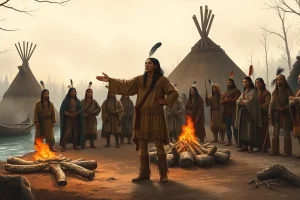
American policy under presidents Jefferson and Madison combined two approaches: “civilization” programs intended to acculturate Indigenous peoples to farming and private property, and relentless land purchases that shrank Native territories. Meanwhile, British Canada maintained the Indian Department and supplied posts like Fort Amherstburg (Malden) that gave British agents influence over Great Lakes communities. Beginning in 1805, the Shawnee prophet Tenskwatawa (the Prophet) and his brother Tecumseh built a pan-Indian spiritual and political movement calling for unity against American encroachment. At the Battle of Tippecanoe in November 1811, Governor William Henry Harrison of Indiana Territory destroyed Prophet’s Town, further radicalizing the movement as Congress prepared to declare war on Britain.
What Happened
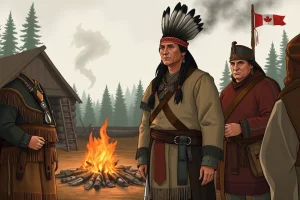
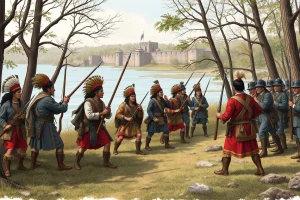
The formal declaration of war in June 1812 brought the conflict between American settlers and Indigenous nations into open warfare. On the northwestern frontier, Tecumseh’s confederacy allied openly with the British under Major-General Isaac Brock and later Brigadier-General Henry Procter. Warriors from many nations—Shawnee, Potawatomi, Ottawa, Ojibwe, Wyandot, and others—participated in the capture of Fort Detroit in August 1812, where Brock and Tecumseh’s strategy of deception forced General William Hull to surrender. The alliance also contributed to the defence of Canada against American invasions.
In 1813, fighting intensified. American forces suffered defeats at Frenchtown (the River Raisin Massacre) in January and were repulsed at Fort Meigs and Fort Stephenson, where Tecumseh’s warriors played significant roles. The American naval victory at the Battle of Lake Erie in September 1813 cut British supply lines and forced Procter and Tecumseh to retreat into Upper Canada. At the Battle of the Thames on October 5, 1813, American forces under Harrison defeated the retreating British-Indigenous force and Tecumseh was killed. His death destroyed the confederacy’s political coherence, although British–Indigenous cooperation continued in some regions.
In the South, the war became entangled with a Creek civil conflict. The Upper Creek (“Red Sticks”) faction, inspired by the same prophetic movement and supplied by the Spanish at Pensacola, attacked American settlements and their Indigenous rivals. Following the Fort Mims massacre in August 1813, Major-General Andrew Jackson led Tennessee militia and Creek and Cherokee allies against the Red Sticks. Jackson’s victory at the Battle of Horseshoe Bend on March 27, 1814 broke Red Stick power. In August 1814, Jackson dictated the Treaty of Fort Jackson, forcing the Creek nation—including the allies who had fought beside him—to cede some 23 million acres.
Not all Indigenous peoples sided with Britain. Among the Six Nations (Iroquois), the Oneida were largely pro-American while the Mohawk, led by figures like John Norton, fought for the British. In the West, some Cherokee, Choctaw, and Creek towns allied with the United States. Many communities attempted to hold to neutrality, viewing the war as a dispute between European powers over land and trade.
Why It Matters
The war’s end brought catastrophe for Indigenous allies of Britain. The Treaty of Ghent (December 24, 1814) required both sides to restore peace with Indigenous nations to the status of 1811 and to end hostilities against them, but Article IX was effectively ignored by the United States, which considered the Indigenous peoples defeated enemies. The British abandoned their allies in the peace process. Within a generation, the United States extended the reservation and removal system, culminating in the Indian Removal Act of 1830, under which eastern nations including the Cherokee, Choctaw, Creek, and Chickasaw were expelled west of the Mississippi on the Trail of Tears.
Historians emphasize that the War of 1812 was for Indigenous peoples a losing struggle to preserve sovereignty and homelands. The death of Tecumseh, the collapse of his confederacy, the loss of Creek lands, and the failure of the Treaty of Ghent to protect Native rights opened the gate to American expansion. Later memory differed: Americans celebrated the war as a “second independence,” while Indigenous nations remembered it as a series of broken promises and devastating defeats.
Definition
“American–Indigenous relations” here denotes the diplomatic, military, and social interactions between the United States government, its citizens, and the sovereign Indigenous nations of eastern North America during the War of 1812. The phrase covers treaty negotiations, wartime alliances, raids, trade, and the policies of cultural assimilation and land acquisition that shaped the conflict.
Background
The roots of wartime relations lay in the competition for land and trade. After 1783, the United States claimed the Northwest Territory and pursued cession treaties, while Britain’s colonies retained ties to Indigenous peoples through the Indian Department and the fur trade. Tecumseh and Tenskwatawa’s movement drew on older patterns of resistance, including Pontiac’s War (1763) and the confederacy that fought under Little Turtle in the 1790s. The inability of the United States to guarantee fair treatment of Native lands and the steady advance of settlers made war increasingly likely.
How It Worked
Indigenous diplomacy operated through councils, gift exchanges, and kinship ties. The British Indian Department, under officers like Colonel William Claus, distributed presents and provisions to hold alliances. The United States relied on Indian agents, government-run trading “factories,” and treaty councils. On the battlefield, Indigenous warriors served as scouts, raiders, and flanking forces, with their style of warfare influencing campaigns from Detroit to Lake Erie. Alliances were personal and contingent; warriors and chiefs negotiated their allegiances village by village.
Competing Viewpoints
American officials viewed Indigenous nations as obstacles to settlement and often as British pawns. Jefferson’s policies aimed at “civilization” and land purchases; wartime rhetoric in American newspapers characterized Native warriors as savage enemies. British officials and Canadian colonists generally viewed Indigenous allies as indispensable for the defence of Canada, though their commitments were conditioned by imperial priorities. Indigenous leaders held different visions: Tecumseh sought a united Indian confederacy with British support; other leaders hoped neutrality would preserve their communities; still others allied with the Americans to protect their own interests against rival nations.
Role in the War of 1812
Indigenous peoples shaped the war’s course decisively. Tecumseh’s warriors aided the capture of Detroit, fought at the sieges of Fort Meigs and Fort Stephenson, and fought alongside Procter at the Thames, where Tecumseh was killed. In the South, the Red Stick War merged with the war against Britain, leading to Jackson’s victory at Horseshoe Bend and the Treaty of Fort Jackson. On the Niagara frontier and in the upper Great Lakes, Indigenous warriors from the Six Nations and Great Lakes nations raided American settlements and supported Canadian militia. Indigenous participation extended to nearly every theatre and influenced American military strategy, manpower, and the character of frontier warfare.
Consequences and Historical Interpretation
The immediate consequences were the destruction of Tecumseh’s confederacy, the loss of vast Creek territory, and the British withdrawal of support for their Indigenous allies. Longer-term consequences included the acceleration of American westward expansion and the removal era of the 1830s. Historical interpretation has changed considerably. Nineteenth-century American histories largely ignored or condemned Indigenous participation; twentieth-century scholarship emphasized the agency and sovereignty of Native nations and the significance of the war for the fate of eastern peoples. Modern historians such as Alan Taylor and John Sugden emphasize that the war must be understood from Indigenous perspectives, as a last major attempt to halt American expansion.
Primary Sources
Tecumseh’s speeches before Governor Harrison at Vincennes (1810–1811) survive only through American transcriptions, limiting their reliability but still offering insight into his arguments against land sales. The papers of the British Indian Department, including reports and letters by officers such as Colonel Claus, document the British side of the alliance. William Henry Harrison’s and Andrew Jackson’s dispatches describe military operations and treaty negotiations from American viewpoints. The Treaty of Ghent, particularly Article IX, is a central document, promising the restoration of peace with the tribes though it was never honored. The Treaty of Fort Jackson (1814) records the forced cession of Creek lands. The journal of the Mohawk leader John Norton provides a rare Indigenous voice, though its perspective is that of an individual with deep British connections.
Further Reading
- Alan Taylor, The Civil War of 1812: American Citizens, British Subjects, Irish Rebels, & Indian Allies (Alfred A. Knopf, 2010)
- John Sugden, Tecumseh: A Life (Henry Holt, 1997)
- Robert S. Allen, His Majesty’s Indian Allies: British Indian Policy in the Defence of Canada, 1774–1815 (Dundurn Press, 1992)
- Carl Benn, The Iroquois in the War of 1812 (University of Toronto Press, 1998)
- Gregory Evans Dowd, A Spirited Resistance: The North American Indian Struggle for Unity, 1745–1815 (Johns Hopkins University Press, 1992)
References
- Alan Taylor, The Civil War of 1812 (Alfred A. Knopf, 2010).
- John Sugden, Tecumseh: A Life (Henry Holt, 1997).
- Robert S. Allen, His Majesty’s Indian Allies (Dundurn Press, 1992).
- Carl Benn, The Iroquois in the War of 1812 (University of Toronto Press, 1998).
- Gregory Evans Dowd, A Spirited Resistance (Johns Hopkins University Press, 1992).
- Treaty of Ghent, 1814 (Article IX), National Archives and Records Administration, https://www.archives.gov/milestone-documents/treaty-of-ghent.
FAQ
Why did Tecumseh and his confederacy side with the British?
Tecumseh saw the British as the only power capable of checking American expansion. He believed that a united Indigenous resistance, supported by Britain, could preserve Indigenous lands and sovereignty.
What did the Treaty of Ghent promise Indigenous peoples?
Article IX promised to end hostilities with the tribes and restore them to their 1811 status, but the United States disregarded the article and treated its military victories as granting it land rights.
How did the War of 1812 affect the future of eastern Indigenous nations?
The defeat of Tecumseh's confederacy and the Creek War, plus the U.S. ignoring Article IX, led to massive land cessions, the removal era, and the Indian Removal Act of 1830.
Leave a Reply