Short Answer
The phrase “We have met the enemy and they are ours” is one of the most famous military dispatches in American history. Written by Master Commandant Oliver Hazard Perry on September 10, 1813, it announced the decisive American naval victory over a British squadron on Lake Erie during the War of 1812. The line not only reported a tactical triumph but also became a lasting part of American language, later adapted into the environmental slogan “We have met the enemy and he is us.” This article examines the origin of the quote, its immediate context, and its varied meanings over time.
Historical Context
In the western theater of the War of 1812, control of Lake Erie was strategically vital. The lake served as a supply line for British forces and their Indigenous allies operating along the Detroit River and the Niagara frontier. At the war’s outset, the British held naval supremacy on the lake, which allowed them to capture Detroit in August 1812 and threaten American positions in Ohio and western Pennsylvania.
In the spring of 1813, American naval command on the lake was assigned to Oliver Hazard Perry, a 27-year-old Master Commandant. Perry established a shipyard at Presque Isle, Pennsylvania, and supervised the construction of a small fleet, including the brigs Lawrence and Niagara. By mid-summer, Perry’s flotilla was ready to cross a sandbar at the harbor entrance, a delicate operation that left his ships vulnerable to British attack. The British commander, Commander Robert Barclay, briefly blockaded the harbor but then withdrew for reasons that remain unclear, allowing Perry to get his ships onto the lake.
What Happened
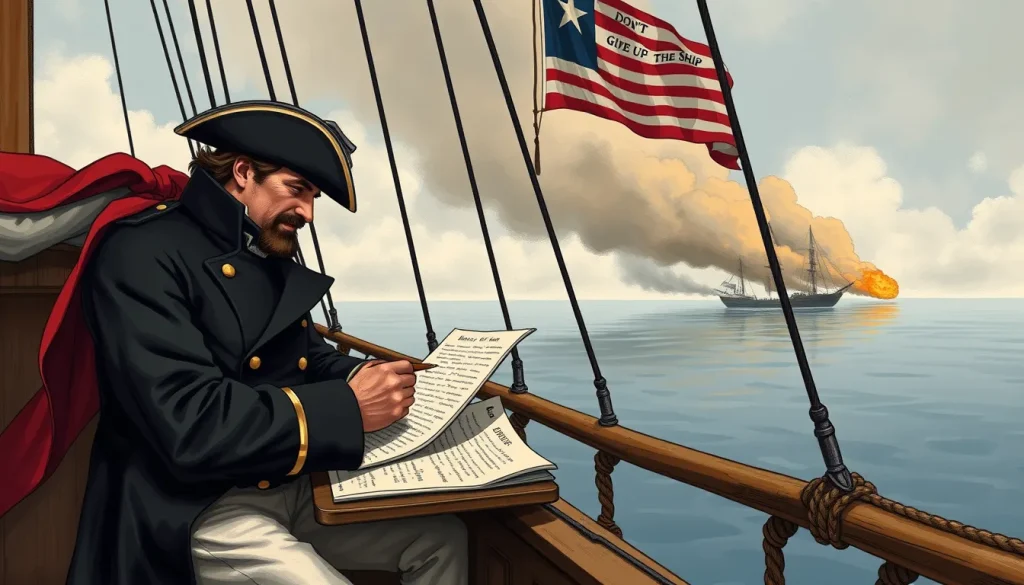
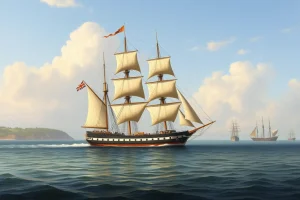
On September 10, 1813, Perry’s squadron met Barclay’s British squadron near Put-in-Bay, Ohio, on the western end of Lake Erie. The American fleet consisted of three brigs, five schooners, and one sloop; the British had two ships, two brigs, one schooner, and one sloop. Perry made the Lawrence his flagship, flying a blue flag with the words “Don’t Give Up the Ship.”
The battle was intense and confused. The Lawrence bore the brunt of the British fire and was heavily damaged, with most of her crew killed or wounded. Perry transferred to the Niagara in a small boat under fire, then resumed command and broke through the British line. The Niagara poured broadsides into two British ships, and after a two-hour fight, Barclay’s entire squadron surrendered—a rare occurrence in British naval history. Perry then wrote to Major General William Henry Harrison, who commanded American land forces in the region: “Dear Gen’l: We have met the enemy and they are ours, two ships, two brigs, one schooner and one sloop. Yours with great respect and esteem. H. Perry.” The dispatch was dated September 10, 1813.
Why It Matters
The victory gave the United States control of Lake Erie, permitting Harrison’s army to be transported across the lake and invade Upper Canada. The subsequent American victory at the Battle of the Thames in October 1813, in which Tecumseh was killed, ended the British threat in the Northwest and seriously weakened Tecumseh’s vision of a pan-Indian confederacy. The dispatch itself boosted American morale and became a celebrated example of concise military communication.
Beyond its immediate military effect, the phrase took on a life of its own. It was quoted, parodied, and adapted for various causes, most famously in the 1970 Earth Day poster by cartoonist Walt Kelly, which read “We have met the enemy and he is us.” That version reframed the original to suggest that humanity itself is the greatest threat to the environment. The continuing use of the line illustrates how a simple report of victory can evolve into a proverb of self-reflection.
Definition
“We have met the enemy and they are ours” is a direct quotation from Perry’s dispatch, reporting that the entire British naval force on Lake Erie had been captured. The word “enemy” here refers collectively to the British ships and crews, not to individuals; hence the plural pronoun “they” is grammatically consistent. Later adaptations, such as “he is us,” alter the pronoun to make the enemy an individual or an internal force, shifting the meaning from a military triumph to a statement about human nature.
Background
The phrase emerged from a specific military crisis. The American fleet was built from green timber in a frantic effort to contest British naval control of Lake Erie. Perry’s victory was due to superior gunpower and the bravery of his crew, but also to Barclay’s earlier decision to lift the blockade. The dispatch was sent to Harrison because Perry needed to inform the general that the lake was open for transporting troops. The wording is spare and factual, in keeping with contemporary naval correspondence.
How It Worked
As a historical document, the dispatch functioned as an official report. It was written hastily on a piece of paper, possibly using a pencil or ink, and was sent ashore via a boat. It reached Harrison, who passed its news along. The phrase’s power lies in its brevity and clarity: it states the fact of victory and enumerates the captured vessels. The use of “they” for a singular noun is a collective-noun construction common in English, though later grammarians sometimes misread it. The original wording was “they are ours,” but some later printings changed it to “he is ours” to avoid the singular-they issue, a practice noted by linguists.
Competing Viewpoints
Historians and linguists have debated the exact wording and punctuation of Perry’s note. Some early sources quote it as “We have met the enemy and they are ours,” while others alter the pronoun. The Language Log discussion points out that the phrase is often amended to “he is ours” due to prescriptive nervousness about singular “they.” Another interpretation treats “enemy” as a collective noun analogous to “team” or “committee,” for which plural pronouns are acceptable in English. There is no dispute about the core content: the message reported the capture of the British squadron. The cultural rephrasing by Walt Kelly—“We have met the enemy and he is us”—transforms the meaning entirely, turning a defeat of an external foe into a recognition of internal fault. This adaptation became far more famous in the late twentieth century than the original, leading many to misattribute the phrase to Kelly rather than Perry.
Role in the War of 1812
In the broader conflict, Perry’s dispatch marked a turning point in the western campaign. The loss of the British squadron forced General Henry Procter to retreat up the Thames River, a move that alienated Tecumseh and led to the Battle of the Thames. The American victory secured the Northwest frontier and allowed Harrison to retake Detroit. Without Perry’s success, the American campaign in Upper Canada would have been far more difficult. The dispatch itself was a military communiqué, not a public proclamation, but it quickly became known and was printed in newspapers, helping to shape public perception of the war.
Consequences and Historical Interpretation
Immediate consequences included the American occupation of the Great Lakes region and the death of Tecumseh, which shattered long-term plans for an Indigenous buffer state. Later historians have viewed the Battle of Lake Erie as one of the few decisive naval engagements of the war. The phrase’s cultural afterlife, however, extends far beyond the conflict. By the twentieth century, it had become a common idiom for acknowledging that one’s problems are self-inflicted. Walt Kelly’s Earth Day poster, created for the first Earth Day in 1970, and a 1971 comic strip, cemented the phrase’s environmental associations. Today, “We have met the enemy and he is us” is often quoted in discussions of environmental degradation, politics, and personal responsibility. The original, however, remains a testament to a pivotal moment in the War of 1812.
Primary Sources
The primary source is Perry’s original dispatch to Harrison, dated September 10, 1813. The letter is held in the collections of the William L. Clements Library at the University of Michigan. A transcription appears in many published works, including the Naval War of 1812: A Documentary History (Naval Historical Center, 1985). The exact wording is quoted in the Encyclopedia.com entry cited below. Another important contemporary source is the after-action report written by Perry to Secretary of the Navy William Jones, which provides more detail. These documents are subject to the limitations of any military report: they reflect the commander’s perspective and may overstate the decisiveness of their own actions. The original wording is not in dispute, but the punctuation and the exact use of “they” have been altered in various editions.
Further Reading
- William Jeffrey Welsh and David Curtis Skaggs, eds., War on the Great Lakes: Essays Commemorating the 175th Anniversary of the Battle of Lake Erie (Kent State University Press, 1991).
- David Curtis Skaggs, Oliver Hazard Perry: Honor, Courage, and Patriotism in the Early U.S. Navy (Naval Institute Press, 2006).
- U.S. Naval Historical Center, The Naval War of 1812: A Documentary History, Vol. 2 (1985).
- National Park Service, “We have met the enemy and they are ours” (article consulted 2025).
References
- National Park Service, “We have met the enemy and they are ours,” https://www.nps.gov/articles/met-the-enemy-4.htm (accessed 2025).
- Mark Liberman, “We’ve met the enemy, and that would be in the modal auxiliary, Bob,” Language Log, March 18, 2009, https://languagelog.ldc.upenn.edu/nll/?p=1245.
- “We have met the enemy, and they are ours,” Encyclopedia.com, https://www.encyclopedia.com/history/dictionaries-thesauruses-pictures-and-press-releases/we-have-met-enemy-and-they-are-ours.
- Ohio State University Libraries, “‘We Have Met the Enemy and He Is Us’,” Tales from the Vault, January 5, 2020, https://library.osu.edu/site/40stories/2020/01/05/we-have-met-the-enemy/.
FAQ
What was Perry's exact wording in the dispatch?
The commonly accepted wording is 'We have met the enemy and they are ours. Two ships, two brigs, one schooner and one sloop.' The pronoun 'they' refers to the enemy as a collective group.
Why did Walt Kelly change the quote to 'he is us'?
Walt Kelly adapted the phrase for an Earth Day poster in 1970 to emphasize that humanity itself is the enemy of the environment. His version changed 'they are ours' to 'he is us' to make the enemy an internal, self-inflicted force.
How did the Battle of Lake Erie affect the War of 1812?
The American victory gave the United States control of Lake Erie, allowing General Harrison's army to advance into Upper Canada. It led to the Battle of the Thames and the death of Tecumseh, ending the British threat in the Northwest.


Leave a Reply