
Short Answer
The Battle of York, fought on April 27, 1813, was an American victory that captured the capital of Upper Canada, York (present-day Toronto). A combined American land and naval force under Brigadier General Zebulon Pike and Commodore Isaac Chauncey defeated British, Canadian, and Ojibwe defenders commanded by Major General Roger Hale Sheaffe. Although the Americans seized the town and its fort, the battle came at a heavy cost—including Pike’s death—and yielded little strategic advantage in the broader War of 1812.
Historical Context
In the first months of the War of 1812, American attempts to invade Canada had failed. Control of the Great Lakes, especially Lake Ontario, was essential for moving troops and supplies. The British used their Provincial Marine to shift forces along the lake, securing victories at Detroit and Queenston Heights. To counter this, the United States built a naval squadron at Sackets Harbor, New York, under Commodore Isaac Chauncey. Secretary of War John Armstrong Jr. devised a plan to attack Kingston, the main British naval base, but American commanders Dearborn and Chauncey, believing Kingston heavily fortified, redirected their expedition to York. York was the capital of Upper Canada and symbolically significant, and it also housed a ship under construction—the HMS Sir Isaac Brock—and naval stores. In April 1813, after the ice thawed, the Americans prepared their force for an attack.
What Happened
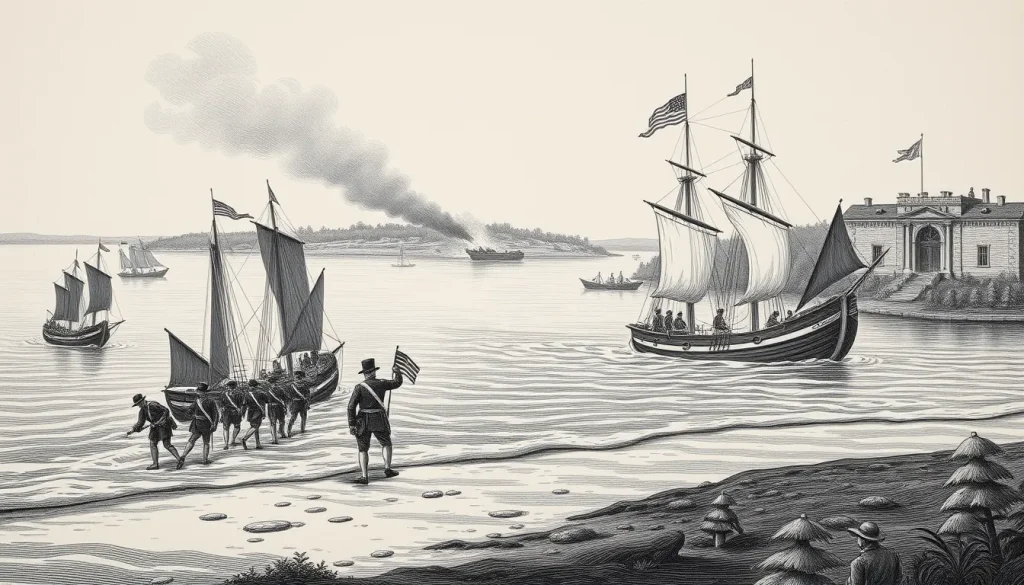
On the morning of April 27, 1813, American ships anchored off York and landed troops west of the town. The defenders—regulars, militia, and Ojibwe warriors—contested the landing but were gradually pushed back by the Americans, who enjoyed naval gunfire support. As the situation worsened, Major General Sheaffe ordered his regulars to retreat to Kingston, leaving the militia to surrender. Before withdrawing, the British ignited the fort’s powder magazine. The explosion sent rocks and debris into American ranks, killing and wounding more than 200 men, including Brigadier General Pike. The Americans then occupied York, looting and burning public buildings, including the Parliament and Government House, and destroying the printing press. After six days, they withdrew with captured ordnance and supplies.
Why It Matters
The battle was a politically important victory for the Americans, improving morale and serving as propaganda for the Madison administration. For the British, the loss of naval stores and the destruction of the sloop Sir Isaac Brock weakened their naval position on Lake Ontario and Lake Erie. The sacking of York was later cited as justification for the British burning of Washington in August 1814. Strategically, York was less important than Kingston, so American control remained incomplete. The battle also ended Sheaffe’s career; he was recalled to Britain, and the loss contributed to American determination to continue the war.
Prelude
In early 1813, American strategy centered on gaining command of Lake Ontario. Secretary of War John Armstrong planned a decisive strike against Kingston, but Generals Dearborn and Commodore Chauncey, fearing exaggerated reports of Kingston’s garrison, shifted the target to York. York was defended by only about 300 British regulars, 300 militia, and a small number of Ojibwe warriors. The town’s fortifications were modest, consisting of Fort York to the west and a blockhouse near the Don River. Sheaffe, the lieutenant governor, prepared defenses as best he could, but reinforcements were unavailable. The Americans, under Zebulon Pike, assembled about 1,700 troops and fourteen armed vessels at Sackets Harbor.
Forces and Commanders
United States: Brigadier General Zebulon Pike commanded the landing force, with Commodore Isaac Chauncey leading the naval squadron and Major General Henry Dearborn overall. They had approximately 1,700 regular soldiers and fourteen armed vessels, including the corvette USS Madison and several schooners.
British/Canadian: Major General Roger Hale Sheaffe, Lieutenant Governor of Upper Canada, commanded about 300 regulars (including infantry and detachment of royal artillery), 300 Canadian militia, and roughly 40–100 Ojibwe warriors. The militia was largely unreliable and many stayed away.
Battlefield and Map Context
York (modern Toronto) lay on the north shore of Lake Ontario. The town stood about a mile east of Fort York, which guarded the harbour. The landing site was on the lakeshore west of the fort, near a small creek. The terrain was wooded and cut by ravines, which helped defenders slow the American advance. The fort itself mounted several cannons, including batteries at the old and new forts, but was too weakly held. Today, the battlefield is within the city of Toronto; Fort York National Historic Site preserves much of the original terrain.
Battle Chronology
At dawn on April 27, 1813, the American fleet appeared off York. Ships began landing troops west of the fort, while others bombarded British batteries. The defenders, including Ojibwe warriors, fired on the landing parties but were pinned by ship guns. Pike’s brigade pushed steadily toward the fort, driving British troops from their positions. By late morning, Sheaffe ordered the withdrawal of his regulars, leaving instructions for the militia to surrender. As the retreating British set fire to the fort’s magazine, the explosion occurred around 4:30 p.m., killing Pike and many Americans. The survivors then entered York, looting and burning public buildings over the next days.
Casualties and Losses
Exact casualty figures vary. The American Battlefield Trust reports total casualties of 795 (United States: 320; United Kingdom: 475). Wikipedia lists American losses as 55 killed and 265 wounded, and British losses as 82 killed, 112 wounded, 274 captured, and 7 missing. Most American casualties came from the magazine explosion. The British also lost the nearly completed Sir Isaac Brock, which was burned during the retreat, along with valuable naval stores and military equipment.
Result
The United States achieved a clear victory, capturing Fort York, the town, and the dockyard. The British regulars escaped intact, and the militia and civilians were left to negotiate surrender. The Americans occupied York for six days before withdrawing, their primary objective of destroying military resources accomplished, but at the cost of high casualties and little lasting strategic gain.
Strategic Consequences
The capture of York did not give the Americans control of Lake Ontario; the British fleet remained based at Kingston. The loss of naval stores at York hindered British naval operations on Lake Erie, contributing to their defeat at the Battle of Lake Erie later in 1813. For the Americans, the victory boosted morale but exhausted resources and drew attention away from more important objectives. The destruction of York’s public buildings was used as a justification for the British retaliation at Washington in 1814. Sheaffe suffered a loss of reputation and was replaced.
Primary Accounts
Contemporary official reports provide key evidence. Commodore Chauncey wrote to Secretary of the Navy William Jones on April 27, 1813, describing the landing, the resistance, and the fatal explosion. Major General Sheaffe submitted a dispatch to Governor General Sir George Prevost explaining his decision to retreat. Private letters and diaries from soldiers exist but are less accessible. These documents are held in archives such as the National Archives and Records Administration (U.S.) and Library and Archives Canada.
Battlefield Today
The site of the Battle of York is now within Toronto’s urban landscape. Fort York National Historic Site preserves the original earthworks and reconstructed buildings, and is a National Historic Site of Canada. The landing area is commemorated with interpretive plaques in the surrounding Fort York neighbourhood. The Ontario Heritage Trust and other organizations have installed markers that explain the battle’s course. The battlefield itself is partly built over, but the fort remains a visitor destination.
Primary Sources
Key primary sources for the Battle of York include the official reports of Commodore Isaac Chauncey and Major General Roger Hale Sheaffe. Chauncey’s report to the Navy Department details the fleet’s operations and the explosion. Sheaffe’s dispatch to Governor General Prevost gives the British perspective, including his controversial decision to abandon the fort. Both are valuable but reflect the biases of their authors; Chauncey sought to emphasize American success, while Sheaffe defended his actions. Additional contemporary letters and casualty lists are available in the archives of both nations.
Further Reading
- Berton, Pierre. The Invasion of Canada: 1812-1813. McClelland and Stewart, 1980.
- Hickey, Donald R. The War of 1812: A Forgotten Conflict. University of Illinois Press, 2012.
- Lafferty, Renée. “The Battle of York.” The Canadian Encyclopedia, 2011 (updated 2026).
- American Battlefield Trust. “York Battle Facts and Summary.” battlefields.org.
- Fort York National Historic Site. “Visit Fort York.” fortyork.org.
References
- Lafferty, Renée. “The Battle of York.” The Canadian Encyclopedia. Accessed 2026. https://prod-front.thecanadianencyclopedia.ca/en/article/the-sacking-of-york.
- American Battlefield Trust. “York Battle Facts and Summary.” Accessed 2026. https://www.battlefields.org/learn/war-1812/battles/york.
- Wikipedia. “Battle of York.” Accessed 2026. https://en.wikipedia.org/wiki/Battle_of_York.
- World History Encyclopedia. “Battle of York.” Accessed 2026. https://www.worldhistory.org/article/2582/battle-of-york/.
- Canada’s History. “Capture of York.” Video Field Guide. Accessed 2026. https://www.canadashistory.ca/explore/military-war/capture-of-york.
FAQ
Why was York a target for the Americans?
York was the capital of Upper Canada and a symbol of British authority. It also contained naval stores and a ship under construction, the HMS Sir Isaac Brock. After fearing Kingston was too strong, American commanders chose York as a more feasible objective.
What caused the explosion that killed Zebulon Pike?
As British troops retreated from Fort York, they set fire to the powder magazine, hoping to prevent its capture. The resulting explosion hurled rocks and debris into the advancing American ranks, killing General Pike and many others.
Did the Battle of York affect the rest of the war?
The American victory boosted morale but had limited strategic impact. It weakened British naval supplies on Lake Erie and contributed to their defeat there. The burning of York was later used to justify the British attack on Washington in 1814.




Leave a Reply