
Short Answer
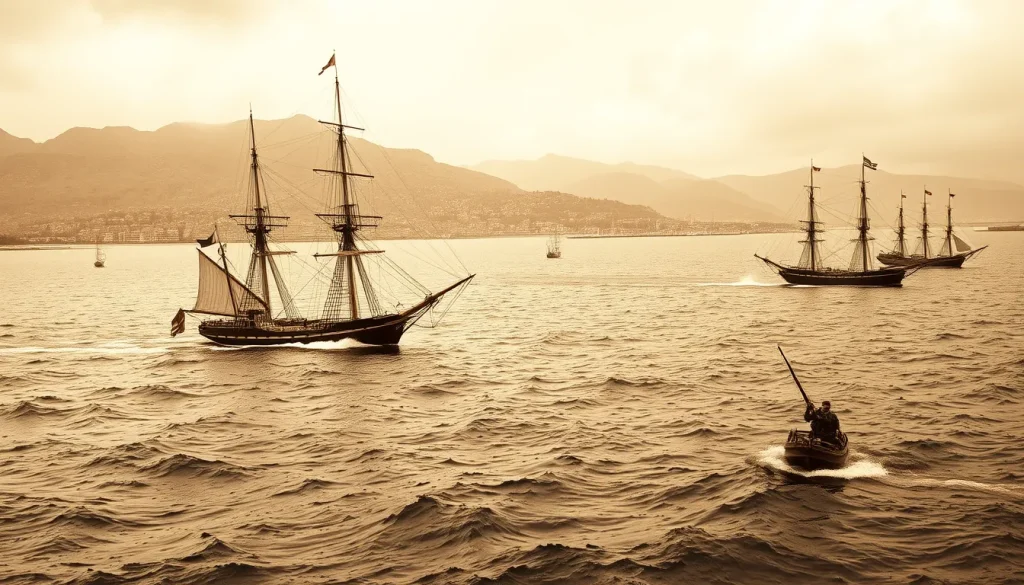
The Capture of USS Essex at Valparaíso, Chile, on 28 March 1814, was a naval engagement of the War of 1812 in which the British 36-gun frigate HMS Phoebe and the 18-gun sloop HMS Cherub forced the surrender of the American frigate USS Essex after a two-and-a-half-hour bombardment. The battle ended the most destructive American commerce-raiding cruise of the war, one that had preyed on British whaling in the Pacific for over a year, and it became a classic demonstration of the tactical limitations of short-range carronades when opposed by long-range naval guns.
Historical Context
By the summer of 1813, the War of 1812 was in its second year, with the United States naval effort largely focused on commerce raiding against British merchant shipping. British whaling in the Pacific was a vital economic interest, and the Royal Navy had previously considered those waters safe from American attack. Captain David Porter, commanding the frigate USS Essex, saw an opportunity. After an initial Atlantic cruise that captured ten prizes, Porter sailed around Cape Horn into the Pacific in February 1813. Over the next ten months he captured or destroyed some twelve British whaling vessels, took more than 300 prisoners, and inflicted damage estimated at over two and a half million dollars. Porter refitted his ship at Nuku Hiva in the Marquesas Islands, where he also claimed the island for the United States, and he armed the captured whaler Atlantic as the auxiliary Essex Junior. British naval authorities, alarmed by these depredations, dispatched a squadron under Captain James Hillyar to hunt down the American raider. Hillyar in HMS Phoebe, accompanied by the sloop HMS Cherub, arrived off the coast of Chile in early 1814 and found Porter’s ship at anchor in Valparaíso.
What Happened
Essex anchored in Valparaíso harbor on 3 February 1814, expecting to refit and obtain provisions. Phoebe and Cherub entered the bay on 8 February, and Hillyar assured Porter that he would respect Chilean neutrality. The British ships then took station just outside the harbor and began a blockade. Porter, confident in Essex’s sailing qualities, repeatedly attempted to provoke Hillyar into a single-ship duel, but the British captain refused, preferring to await reinforcement. On 28 March, a favorable wind shift offered Porter a chance to run past the blockaders and escape into the open Pacific. As Essex rounded the promontory at the southern entrance, however, a sudden squall carried away her main topmast, crippling her maneuverability. Porter anchored in a small bay on the eastern side of Valparaíso Bay, hoping the proximity to neutral soil would deter a British attack. Instead, Hillyar closed in, keeping Phoebe at long range where her eighteen-pounder long guns could reach Essex while Essex’s carronades—effective only at close quarters—could not reply. Cherub added fire from her own long guns. Over two and a half hours, the British ships methodically shot apart Essex, causing heavy casualties and severe damage. Porter, his ship dismasted and aflame, struck his colors. Fifty-eight Americans were killed and sixty-six wounded; the British lost only five killed and ten wounded. The captured Essex and Essex Junior were taken into British service.
Why It Matters
The capture of Essex eliminated the most successful American commerce raider of the war and restored British control over the Pacific whaling grounds. It also underscored a fundamental tactical change in naval warfare: the short-range carronade, though devastating in close action, was useless against an opponent who could dictate the range by using long guns. The battle demonstrated that a frigate armed primarily with carronades was fatally vulnerable to a well-handled long-gun foe. This lesson influenced subsequent naval design, contributing to the shift toward more balanced gun batteries and eventually to shell-firing guns. The engagement also generated a lasting controversy over whether Hillyar had violated Chilean neutrality by attacking a ship anchored in neutral waters, and over allegations that British boats fired on the surrendering crew. These disputes became central points in the naval history of the war, with British and American historians offering sharply different interpretations.
Prelude
By late 1813, Porter had concluded that his raiding campaign could not continue indefinitely without a safe base. He sailed for Valparaíso in December, aware that the Royal Navy had sent warships to find him. He hoped to either engage the British in a favorable fight or to slip past any blockading force. When Phoebe and Cherub arrived, Hillyar decided to mount a formal blockade rather than risk a battle in a neutral harbor. Over six weeks, the two captains engaged in a war of maneuver and provocation, with Porter trying to lure Hillyar out, while Hillyar waited for the arrival of additional ships to seal the escape route.
Forces and Commanders
The American force was the frigate USS Essex, commanded by Captain David Porter. Though rated as a 32-gun frigate, Essex actually carried 46 guns: forty 32-pounder carronades and six long 12-pounders. She had a crew of approximately 255 men and officers. The British force comprised the 36-gun frigate HMS Phoebe, commanded by Captain James Hillyar (who also served as commodore of the squadron), and the 18-gun sloop HMS Cherub, commanded by Captain Thomas Tudor Tucker. Phoebe carried twenty-six long 18-pounders on her main deck, complemented by other guns, and her crew numbered about 260. Cherub mounted eighteen guns, mostly carronades, but also had long guns. The key advantage for the British was the long-range capability of Phoebe’s eighteen-pounders, which could outrange Essex’s carronades at distances beyond 300 yards.
Battlefield and Map Context
Valparaíso Bay lies on the central coast of Chile, a natural harbor sheltered by steep hills and a headland known as Angel Point (Punta Ángel) on the southern side. The bay opens to the west, with the harbor itself in the southeastern corner. Essex anchored close to shore near the town, while the British ships took up a position outside the harbor, near Angel Point. On 28 March, Essex attempted to pass between the British ships and the headland to gain the weather gauge and run for the open sea. The sudden loss of her main topmast left her unable to maneuver, and she anchored approximately two miles from the town, in waters that were within Chilean territorial limits but far enough from shore to be considered neutral only by a narrow interpretation. Hillyar then positioned his ships at ranges of 500 to 700 yards, beyond the reach of Essex’s carronades but within the effective range of Phoebe’s long guns.
Battle Chronology
The engagement began at approximately 16:30 when the wind shifted favorably for Essex. Porter ordered sail and made for the entrance, but as Essex rounded Angel Point, a heavy squall struck, snapping the main topmast and carrying away the main topsail yard. The damaged ship began to fall off toward the shore, and Porter ordered her to anchor. Hillyar, seeing the crippled condition, immediately closed to engage. Phoebe opened fire with her long guns at about 17:00, taking position off Essex’s starboard quarter, while Cherub crossed the American’s bow. Essex’s few long guns—only six—replied, but they were insufficient to drive off the attackers. Porter attempted to bring his carronades into play by using springs to turn the ship, but each time the springs were shot away. Fires broke out aboard Essex, and the ship began taking on water from shot holes near the waterline. After more than two hours of punishment, with one third of his crew killed or wounded and his ship reduced to a wreck, Porter ordered the colors struck at approximately 18:20. The British ceased fire, but later allegations held that some guns continued to fire for a short period after surrender. The American frigate was taken possession by boats from Phoebe and Cherub, and the Essex Junior was also captured later that day.
Casualties and Losses
The casualty figures reflect the one-sided nature of the action. The American losses were 58 killed and 66 wounded, out of a crew of about 255—a casualty rate approaching 50 percent. Thirty-one men were also reported missing, some of whom had jumped overboard during the action. The British suffered only 5 killed and 10 wounded. The loss of Essex itself was a significant material blow to the United States Navy. The captured ship was taken into British service as HMS Essex, but she was never refitted as a major combatant and saw limited service.
Result
The engagement was a clear British victory. Essex surrendered, and the British also captured the armed prize Essex Junior. The American prisoners were eventually paroled or exchanged. Porter and his surviving officers were court-martialed in the United States later in 1814, but they were honorably acquitted; a court of inquiry in 1815 approved Porter’s conduct and praised the crew’s resistance. The immediate result was the removal of the most effective American commerce raider from the Pacific and the restoration of British commercial confidence in that region.
Strategic Consequences
Strategically, the capture of Essex ended American naval operations in the Pacific for the remainder of the war. No other American warship would successfully raid British whaling there. The battle also had a broader technological impact. Naval planners and officers on both sides took note of the vulnerability of carronade-heavy ships. Over the following decades, naval armaments evolved to include more long guns and, eventually, shell guns, reducing reliance on short-range carronades. The battle was cited in naval tactical literature as an example of the importance of range and firepower over sheer weight of broadside. For the United States, the loss of Essex, while humiliating, did not alter the overall strategic balance of the war, but it served as a spur for naval reform. The controversy over the alleged neutrality violation also complicated Anglo-Chilean relations, though Chile remained neutral.
Primary Accounts
There are several contemporary accounts of the battle. Captain Porter published a journal of his cruise, including his version of the action, in which he argued that Hillyar had violated neutrality and that British firing continued after surrender. Captain Hillyar submitted an official report to the Admiralty, claiming that he had acted within the bounds of international law and that the battle was a legitimate pursuit of a belligerent warship. The British naval historian William James, in his 1820s history, questioned the American crew’s conduct, alleging drunkenness and poor firing. American historian and novelist James Fenimore Cooper, in his history of the U.S. Navy, strongly defended Porter and the crew, attributing the poor gunnery to the impossibility of bringing carronades to bear. Theodore Roosevelt later joined the defense, noting that Essex’s resistance was limited to her six long guns because the carronades could not reach the enemy. These accounts form the basis for the historical debate over the engagement.
Battlefield Today
The present-day site of the battle is the harbor and bay of Valparaíso, Chile, which remains an active port and city. The anchorage where Essex surrendered is within the inner bay, near the modern waterfront and the base of the hills. Angel Point is now part of the city, with residential and commercial developments. There are no monuments specifically commemorating the battle, but the historical significance of the site is noted in local maritime history. The bay itself has changed little in outline, though the shoreline has been modified by port facilities. Visitors can view the general geography from the hills, but there are no surviving physical relics of the battle.
Primary Sources
The most important primary source is Journal of a Cruise Made to the Pacific Ocean by Captain David Porter, published in 1815, which gives the American perspective, including detailed descriptions of the engagement and the controversy over neutrality. Captain Hillyar’s official report, dated 30 March 1814, is reproduced in the London Gazette and in the documentary series The Naval War of 1812: A Documentary History (Vol. 3, 1814–1815), which also includes Porter’s letters to the Navy Department and his journal entries. The British naval historian William James, in his Naval History of Great Britain (1822–1824), and James Fenimore Cooper, in his History of the Navy of the United States of America (1839), offer interpretations, but both rely on the same official reports and personal accounts. Other documents include ship logs and muster rolls, but these are less accessible. The U.S. National Archives and the National Maritime Museum in Greenwich hold relevant records.
Further Reading
- David Porter, Journal of a Cruise Made to the Pacific Ocean (2 vols., 1815).
- William James, The Naval History of Great Britain, from the Declaration of War by France in 1793 to the Accession of George IV, Vol. 6 (1824).
- James Fenimore Cooper, The History of the Navy of the United States of America (1839).
- Donald Hickey, The War of 1812: A Forgotten Conflict (1989).
- Andrew Lambert, The Challenge: Britain Against America in the Naval War of 1812 (2012).
- Jon Latimer, 1812: War with America (2007).
- Philip MacDougall, “The Valparaiso Incident Reassessed,” Naval History (April 2007).
References
- Dudley, William S., ed., The Naval War of 1812: A Documentary History, Vol. 3 (Naval Historical Center, 2002), chap. 3: The Pacific Theater, January 1814–August 1815.
- “Capture of USS Essex – War of 1812,” The War of 1812.org, https://thewarof1812.org/battles/capture-of-uss-essex/.
- MacDougall, Philip, “The Valparaiso Incident Reassessed,” Naval History 21, no. 2 (April 2007), https://www.usni.org/magazines/naval-history-magazine/2007/april/valparaiso-incident-reassessed.
- Coppock, Mike, “Porter’s Private War: The USS Essex in Polynesia,” HistoryNet, 28 August 2020, https://historynet.com/porter/.
- DeForest, Tim, “War of 1812: Commodore David Porter and the Essex in the South Pacific,” HistoryNet, 1 September 2006, https://historynet.com/war-of-1812-commodore-david-porter-and-the-essex-in-the-south-pacific/.
FAQ
Was the attack on USS Essex a violation of Chilean neutrality?
Porter argued that Essex was anchored in neutral waters, and Hillyar's attack was therefore illegal. British historians disputed this, claiming the ship was far enough from shore and that the pursuit of a fleeing enemy was permissible. The debate remains unresolved.
Why did Porter have to surrender?
After losing his main topmast, Essex was unable to maneuver. The British ships remained at long range where Essex's carronades were useless, and the American ship suffered progressive damage and heavy casualties until Porter struck his colors.
What happened to David Porter after the capture?
Porter and his crew were returned to the United States. He was court-martialed in 1814 for the loss of his ship but was honorably acquitted. He later served as a U.S. naval commissioner and was involved in the Mexican War and diplomatic missions.



Leave a Reply