Short Answer
David Porter commanded the USS Essex during an epic 17-month cruise in the War of 1812 that took him from the Atlantic around Cape Horn into the Pacific, where he disrupted British whaling and captured numerous prizes before his ship was lost to a British squadron in March 1814. The cruise is significant as one of the earliest American naval operations in the Pacific and for demonstrating the strategic value of commerce raiding. It also shaped Porter’s later career and the reputation of the young U.S. Navy.
Historical Context
The War of 1812 pit the United States against Great Britain in a conflict driven by impressment, trade restrictions, and territorial ambitions. The U.S. Navy was small, with only a handful of frigates and sloops, while the Royal Navy dominated the seas. In response, American naval strategy often relied on commerce raiding to harass British trade and force a shift of British resources. The Pacific Ocean was a crucial theatre for British whaling, with ships from London and other ports taking whale oil and spermaceti. American whalers also operated there, and both nations valued the fishery. Porter, an ambitious and experienced officer, saw an opportunity to strike at British commercial interests far from the Atlantic battlefields.
What Happened
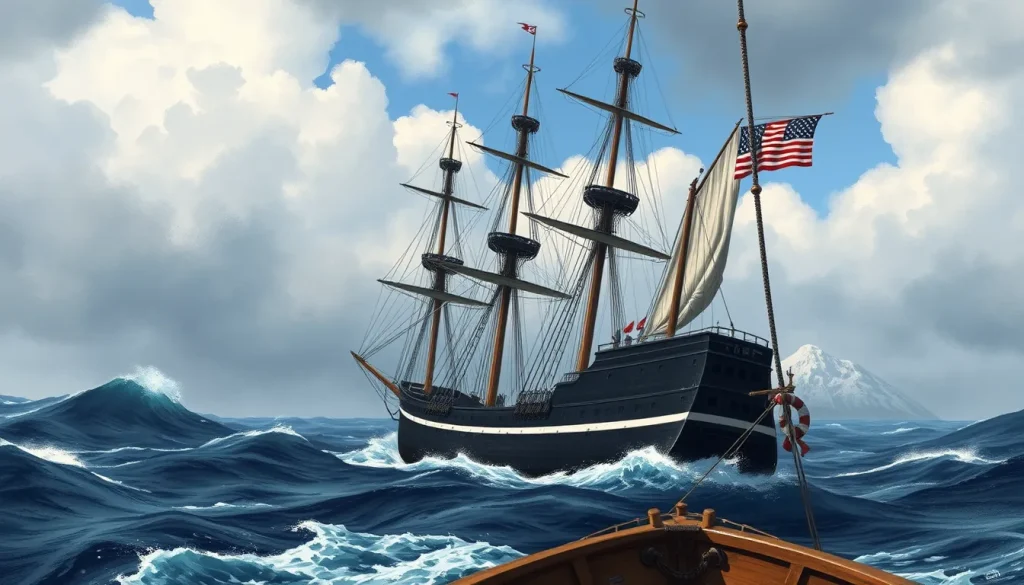
Porter left Philadelphia on October 27, 1812, aboard the USS Essex, a 32-gun frigate that was smaller and lighter than most of its British counterparts. He was ordered to rendezvous with Commodore William Bainbridge’s squadron in the South Atlantic, but when the meetings failed, Porter made a discretionary decision to round Cape Horn and enter the Pacific, the first U.S. warship to do so. After a stormy transit, he reached Valparaiso, Chile, in March 1813, where he was warmly received by the local government, which was then in revolt against Spain. Porter used the port to reprovision and then sailed north to the Galapagos Islands, a favourite anchorage of British whalers. Between April and October 1813, he captured twelve British whalers and some 360 prisoners, causing an estimated $3 million in losses (1813 currency) and scattering the remaining British whaling fleet.
In October 1813, Porter took his prizes to Nuku Hiva in the Marquesas Islands for repairs and rest. There he became involved in local tribal conflicts, leading a military force against the Typee people, and briefly claimed Nuku Hiva for the United States. He left in December 1813 and returned to Valparaiso in February 1814, only to find that British forces had been sent to hunt him. The frigate HMS Phoebe and sloop HMS Cherub blocked the harbour. On March 28, 1814, Porter attempted a dash past the blockade, but a squall damaged his main-topmast, leaving his ship unmaneuverable. The British ships, armed with long-range cannon, bombarded the Essex from outside the range of its short-range carronades. After a two-hour fight, Porter surrendered. Casualties were heavy: approximately 155 men were killed, wounded, or missing. Porter and the surviving crew were paroled and later returned to the United States.
Why It Matters
The cruise had immediate and lasting significance. It severely disrupted British whaling in the Pacific, forced the Royal Navy to divert vessels to hunt the Essex, and demonstrated the potential of long-range cruiser operations. For Americans, it became a celebrated tale of daring and endurance despite the final defeat. Later historians, however, have debated Porter’s judgment, with some criticising his decision to remain in the Pacific and risking his ship; others credit his initiative and strategic vision. The voyage also contributed to growing American interest in the Pacific and helped train a generation of officers, including Porter’s adopted son David Farragut, who served as a midshipman on the Essex and would later become the U.S. Navy’s first admiral. The battle off Valparaiso has been studied as an example of the tactical advantages of long-range guns versus carronades.
Early Life
David Porter was born on February 1, 1780, in Boston, Massachusetts, to a family with maritime connections. He went to sea as a boy and entered the merchant service. In 1798, he was appointed a midshipman in the U.S. Navy and served in the Quasi-War with France. He later saw action in the Barbary Wars, commanding a gunboat and earning promotion. By 1812, he was a captain with a reputation for energy and assertiveness.
Role Before the War
Before the War of 1812, Porter already commanded the USS Essex and had prepared a plan for a Pacific cruise should war break out with Britain. He proposed destroying British whaling and exploring new islands, showing foresight about the strategic importance of the Pacific. These plans were approved, and he was given wide discretion in his orders.
Role During the War
Porter’s role during the war was primarily as commander of the Essex, executing the Pacific strategy he had proposed. He operated independently after failing to meet his squadron, deciding to pursue British commerce around Cape Horn. His leadership kept his crew effective over a long voyage, and his captures provided supplies and prize money. He also engaged in diplomatic interactions in Chile and the Marquesas, representing American interests.
Major Actions
The key action of the War of 1812 phase of Porter’s career was the capture of twelve British whalers near the Galápagos Islands between April and October 1813. This operation nearly destroyed the British whaling presence in the eastern Pacific. The fight off Valparaiso on March 28, 1814, was his last major naval engagement, resulting in the loss of his ship. Additionally, his expedition against the Typee people in Nuku Hiva, though controversial, was a notable incident of the cruise.
Contemporary Accounts
Porter himself wrote a detailed journal, Journal of a Cruise Made to the Pacific Ocean, first published in 1815 and revised in 1822, which remains a primary source for the voyage. Chilean observers and port officials recorded their impressions of the American ship’s arrival, and British naval officers filed official reports of the capture. These accounts vary in perspective, with American sources emphasizing courage and British sources pointing out tactical errors.
Later Life
After his return to the United States, Porter was honoured but also faced a court-martial over the loss of the Essex, though he was acquitted and found his conduct heroic. He later served as a commissioner of the Navy, resigned due to a disciplinary dispute, and then became an admiral in the Mexican Navy. He returned to U.S. service as a diplomat, eventually serving as Minister to the Ottoman Empire. He died in 1843 in Pera, near Constantinople.
Historical Legacy
Porter’s legacy is mixed. In the nineteenth century, he was celebrated as a bold pioneer of American naval power and Pacific strategy. Later historians, such as George C. Daughan, have challenged this view, arguing that his personal ambition led to unnecessary risk and ultimately the loss of his ship and many lives. The cruise is still studied as a classic example of long-range commerce raiding and the limitations of such operations. His impact on the navy was lasting, and his adopted son, David Farragut, credited his early experience on the Essex with shaping his own career.
Primary Sources
Porter’s own Journal of a Cruise Made to the Pacific Ocean (1822) is the most detailed contemporary account, offering his rationale and descriptions of events. His official correspondence with Secretary of the Navy William Jones is preserved in the National Archives and provides insight into his decisions. Chilean records, including the Aurora newspaper and local government decrees, document the reception in Valparaíso. British official reports from HMS Phoebe and HMS Cherub, including Captain James Hillyar’s narrative, give the opposing perspective. All these sources need to be read critically, as they were written with particular audiences and biases.
Further Reading
- George C. Daughan, The Shining Sea: David Porter and the Epic Voyage of the U.S.S. Essex During the War of 1812, Basic Books, 2013.
- Dudley W. Knox, The Naval War of 1812, 1948 (reissued).
- David F. Long, Nothing Too Daring: A Biography of Commodore David Porter, Naval Institute Press, 1970.
- Eugene Pereira Salas, La Actuación de los Oficiales Navales Norte-Americanos en Nuestras Costas (1813–1840), 1935; translated excerpts in U.S. Naval Institute Proceedings, 1940.
References
- Egon Hatfield, “War of 1812 bicentennial: Cruise of the USS Essex,” U.S. Army, March 14, 2013, https://www.army.mil/article/98107/war_of_1812_bicentennial_cruise_of_the_uss_essex.
- W. Patrick Strauss, “Captain David Porter: Pioneer Pacific Strategist,” Proceedings, U.S. Naval Institute, February 1967, https://www.usni.org/magazines/proceedings/1967/february/captain-david-porter-pioneer-pacific-strategist.
- Captain A. S. Merrill (trans.), “First Contacts – The Glorious Cruise of the Frigate Essex,” Proceedings, U.S. Naval Institute, February 1940, https://www.usni.org/magazines/proceedings/1940/february/first-contacts-glorious-cruise-frigate-essex.
- David Porter, Journal of a Cruise Made to the Pacific Ocean, 2 vols., 1822, accessible at https://archive.org/details/journalofcruisem00port.
- George C. Daughan, The Shining Sea, Basic Books, 2013.
FAQ
How many ships did Captain David Porter capture on his cruise in the USS Essex?
Porter captured twelve British whaling ships near the Galápagos Islands between April and October 1813, and also took a number of other merchant vessels as prizes.
Why did the USS Essex get defeated at Valparaiso?
The Essex was blockaded in a neutral port by the British frigate HMS Phoebe and sloop HMS Cherub. Porter attempted to run out during a squall, but the main-topmast broke, making the ship unmaneuverable. The British ships used long-range guns to attack beyond the range of Essex's carronades, forcing its surrender.
What was the significance of David Porter's annexation of Nuku Hiva?
Porter's claim of Nuku Hiva in the Marquesas for the United States was a brief formal annexation, marking an early American territorial interest in the Pacific. It was never ratified by the U.S. government, but it demonstrated American reach and ambition.



Leave a Reply