
Short Answer
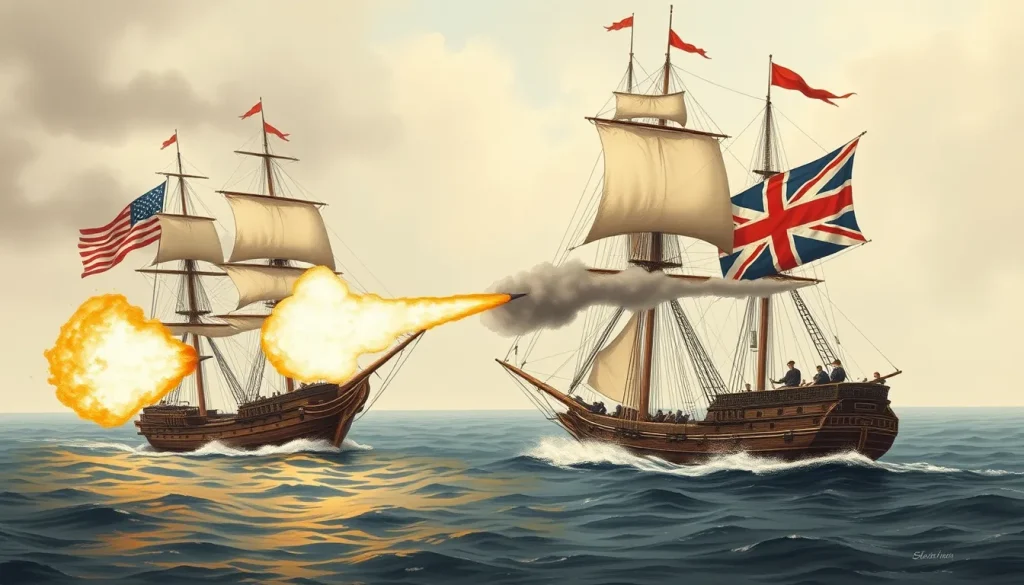
The naval War of 1812 produced some of the most celebrated victories in American history, but its outcome cannot be measured by counting captured frigates. The United States won important individual engagements and decisive battles on inland waters. Britain retained overwhelming oceanic strength and used an expanding blockade to restrict American commerce, confine warships, and support attacks along the coast.
These were different kinds of naval success. A ship could win a duel without opening its home port to trade. A fleet on a relatively small lake could change an entire land campaign. Understanding the war requires following all three struggles: combat between warships, control of inland transportation, and the economic pressure of blockade.
Why the War Had a Naval Dimension
Maritime disputes were central to the breakdown of relations between Britain and the United States. During the Napoleonic Wars, Britain sought to restrict commerce serving France and its allies. American merchants wanted to trade as neutrals, but British regulations, searches, and seizures repeatedly challenged that position.
Impressment created another grievance. Royal Navy officers boarded American merchant ships to recover alleged British deserters and compel men into service. Disputes over citizenship and nationality meant that American sailors could also be taken.
For the United States, these practices raised questions about sovereignty: could an independent nation protect its flag, its commerce, and the people serving aboard its ships? Territorial ambitions and conflict involving Indigenous nations also helped cause the war, so maritime grievances should not be treated as its only explanation.
The declaration of war on June 18, 1812, nevertheless placed naval operations at the heart of the conflict. The American government confronted a difficult problem: it sought to defend maritime rights against a power whose navy it could not defeat in a general fleet battle.
Two Navies with Different Strengths
The Royal Navy
Britain possessed the world’s leading naval establishment. Its strength included ships of the line, frigates, smaller cruisers, overseas bases, experienced officers, and the administrative capacity to sustain operations far from home.
The Royal Navy had several jobs in North America. It needed to protect British shipping, intercept American commerce raiders, watch enemy ports, transport soldiers, and support coastal operations.
Its global commitments mattered. In 1812, Britain was still fighting Napoleon, and not every British warship was available for service against the United States. British superiority therefore did not mean that an American captain encountered overwhelming opposition every time he sailed.
As the European war changed, Britain could direct greater resources toward North America. The early American opportunities for independent cruising narrowed as British patrols and blockades strengthened.
The United States Navy
The American navy was small, with only a limited number of ocean-going warships. Its strongest vessels included large frigates built under the naval program authorized in 1794.
These ships offered a practical response to limited resources. They could attack commerce, confront many enemy cruisers, and attempt to escape opponents too powerful to fight.
They could not provide everything a large navy supplied. Several excellent frigates did not amount to a battle fleet capable of clearing British squadrons from the coastline. Captains consequently relied on mobility, selective engagements, and opportunities created by distance or weather.
This difference explains a recurring pattern: Americans could achieve striking local victories while Britain maintained the broader strategic advantage at sea.
Ships and Weapons of the Naval War
Frigates and Ships of the Line
A frigate was a substantial cruising warship, usually carrying its principal battery on a single covered gun deck. Frigates conducted patrols, escorted shipping, gathered information, and attacked enemy commerce.
The largest American frigates, including Constitution, United States, and President, were formidable opponents for many British frigates. Their combination of robust construction and heavy guns helped explain several early victories.
Ships of the line were larger vessels built for fleet combat, with major batteries on multiple decks. A frigate captain generally sought to avoid fighting one. Their importance was not limited to firing guns: their presence could make an escape attempt or an enemy cruise prohibitively dangerous.
Sloops, Brigs, Schooners, and Gunboats
Smaller vessels performed essential work. Sloops of war and brigs raided commerce, carried messages, and fought enemy cruisers. Schooners served as patrol vessels, privateers, and members of lake squadrons. Gunboats operated in shallow or confined waters.
These terms require care. “Brig” and “schooner” describe sailing rigs, while “sloop of war” could indicate a naval classification. Lists of ship types therefore do not always compare equivalent categories.
On inland waters, converted merchant vessels could fight alongside purpose-built warships. A modest craft carrying a few guns might protect a transport route or influence an army’s ability to move.
Long Guns and Carronades
Naval guns were commonly identified by the weight of the shot they fired. A 24-pounder, for example, fired a solid iron ball weighing approximately 24 pounds.
Long guns offered useful reach. Carronades were shorter, relatively light weapons that delivered heavy shot at close range. They allowed smaller ships to carry substantial striking power, but their limited reach created vulnerabilities.
The tactical question was whether a captain could fight at a distance favorable to his own battery. Heavy short-range weapons were powerful only if the enemy could be brought within their effective range.
Broadside, Rigging, and Crew Training
Most major guns fired through the sides of a ship. Captains maneuvered to bring their broadsides into action and avoid positions where the enemy could fire along the length of their vessel.
Damage to sails, masts, and rigging could be as important as damage to the hull. A ship unable to maneuver might lose its choice of range or become vulnerable to boarding.
Gunnery also demanded teamwork. Sailors loaded, ran out, aimed, fired, and secured heavy cannon on a moving platform. Ship design created advantages, but trained crews had to turn those advantages into effective fire.
The Famous Ocean Battles
USS Constitution and HMS Guerriere: August 19, 1812
Under Captain Isaac Hull, USS Constitution defeated HMS Guerriere in the Atlantic. The victory became one of the defining events of the American naval war.
Constitution was a powerful frigate, and Guerriere was badly damaged in the engagement. The captured British ship could not be preserved as a useful prize and was destroyed.
The battle became associated with Constitution’s enduring nickname, “Old Ironsides.” Its thick wooden construction helped create an image of remarkable resilience, although the ship was neither ironclad nor invulnerable.
The most immediate importance was psychological. Americans had received evidence that their small navy could defeat a Royal Navy warship. That mattered during a year of serious disappointments on land.
The victory did not weaken Britain enough to overturn its command of the Atlantic. Its lasting prominence reflects its influence on public confidence and naval identity.
USS Wasp and HMS Frolic: October 18, 1812
USS Wasp defeated HMS Frolic in a hard-fought engagement between smaller warships.
The success was short-lived. The British ship of the line HMS Poictiers arrived afterward and captured Wasp as well as recovering Frolic.
This episode illustrates the difference between winning an engagement and holding its gains. An American ship might defeat a comparable opponent and still be unable to resist the next British vessel it encountered.
It also shows why accounts focused only on the initial duel can distort the campaign. The larger naval environment continued to shape events after the firing stopped.
USS United States and HMS Macedonian: October 25, 1812
Captain Stephen Decatur’s USS United States defeated HMS Macedonian in another important frigate action.
Unlike Guerriere, Macedonian could be brought into an American port. It subsequently entered American naval service.
The victory demonstrated the effectiveness of an American heavy frigate and gave the public a visible trophy. Bringing home a captured warship transformed battlefield success into something people could inspect, celebrate, and remember.
Yet acquiring another frigate did not solve the United States’ strategic shortage of ships. The ability to maintain open sea routes remained a separate question.
USS Constitution and HMS Java: December 29, 1812
Constitution, now commanded by Captain William Bainbridge, defeated HMS Java off Brazil.
The battle involved extensive maneuvering and serious damage. British fire struck Constitution’s steering wheel, and Bainbridge was wounded. The Americans maintained control of their ship and ultimately compelled Java to surrender.
Java was too badly damaged to be taken safely to an American port and was destroyed after its people were removed.
Together with the earlier frigate victories, this engagement made it difficult to dismiss American successes as isolated accidents. British commanders had to account for the fighting power of the largest American frigates.
The lesson was specific rather than universal: a well-handled American heavy frigate could be an exceptionally dangerous opponent for a smaller British cruiser.
HMS Shannon and USS Chesapeake: June 1, 1813
The Royal Navy achieved a dramatic victory when HMS Shannon captured USS Chesapeake off Boston.
Captain Philip Broke had devoted considerable attention to training Shannon’s crew, particularly in gunnery. Chesapeake, commanded by Captain James Lawrence, entered the battle with a crew less settled under its new command.
British fire and boarding overwhelmed the American ship in a brief, violent action. Lawrence was mortally wounded, and his instruction “Don’t give up the ship” became a lasting American naval slogan.
The defeat showed that British crews were fully capable of winning individual engagements. American success depended on circumstances, leadership, preparation, and the relative characteristics of the ships involved.
Shannon’s victory also restored British confidence after the losses of 1812.
USS Essex in the Pacific
The war extended far beyond the North Atlantic. Captain David Porter took USS Essex into the Pacific, attacking British whaling interests and making the conflict global in reach.
Such operations targeted valuable commerce rather than attempting to occupy large territories. They forced Britain to pursue American raiders across enormous distances.
Essex’s cruise ended on March 28, 1814, near Valparaíso, Chile, when HMS Phoebe and HMS Cherub defeated it.
The American frigate relied heavily on carronades. Its British opponents could use longer-range fire while avoiding the most dangerous part of Essex’s battery.
The defeat offers a clear example of the relationship between armament and maneuver. A powerful close-range broadside could not compensate for an inability to close the distance.
USS President: January 15, 1815
Decatur’s USS President was captured while attempting to escape from New York.
The operation brought President into conflict with a British squadron, including HMS Endymion. The American ship fought Endymion but could not ultimately evade the other British vessels.
The loss demonstrated the danger of operating under a mature blockade. Getting beyond a harbor entrance was only the beginning; a ship still had to escape the forces watching offshore.
It was also a late reminder that famous American frigates remained vulnerable to Britain’s greater ability to concentrate ships.
Major Naval Engagements at a Glance
| Date | Engagement | Outcome and significance |
|---|---|---|
| August 19, 1812 | Constitution–Guerriere | American victory; major morale boost |
| October 18, 1812 | Wasp–Frolic | American victory followed by British capture of Wasp |
| October 25, 1812 | United States–Macedonian | American victory; Macedonian became an American warship |
| December 29, 1812 | Constitution–Java | American victory off Brazil |
| June 1, 1813 | Shannon–Chesapeake | British victory; Chesapeake captured |
| September 10, 1813 | Lake Erie | American squadron victory with major consequences on land |
| March 28, 1814 | Essex–Phoebe and Cherub | British victory near Valparaíso |
| September 11, 1814 | Lake Champlain | American victory; British invasion of northern New York abandoned |
| September 13–14, 1814 | Bombardment of Fort McHenry | British naval attack failed to force the harbor’s defenses |
| December 14, 1814 | Lake Borgne | British capture of American gunboats |
| January 15, 1815 | Capture of President | British success against a major American frigate |
| February 20, 1815 | Constitution–Cyane and Levant | American victory before news of peace reached the ship |
Why the Inland Naval War Was So Important
The Great Lakes and Lake Champlain were transportation corridors. Roads were limited, journeys overland were difficult, and armies needed large quantities of food, ammunition, and equipment.
Control of water allowed troops and supplies to move efficiently. Losing that control could isolate a position, disrupt an advance, or force a retreat.
Geography also prevented Britain from simply sending its ocean fleet into every inland theater. Rapids and other obstacles meant that substantial lake warships had to be built locally. Both sides needed shipyards, skilled workers, guns, rigging, and crews.
The inland naval war therefore involved industrial organization as much as combat. A new vessel could alter the balance before it fired a shot.
Lake Erie: September 10, 1813
Oliver Hazard Perry commanded nine American vessels against Robert Heriot Barclay’s six-ship British squadron.
Perry’s flagship, Lawrence, suffered devastating damage. He transferred to Niagara and continued the fight, eventually compelling the British squadron to surrender.
The victory secured American control of Lake Erie. It disrupted British supply routes in the western theater and allowed William Henry Harrison’s army to move forward.
American forces recovered Detroit and pursued the retreating British and Indigenous forces. The subsequent Battle of the Thames, where Tecumseh was killed, further damaged Indigenous resistance to American expansion.
Lake Erie mattered because its consequences extended well beyond the ships captured. It changed the practical conditions under which armies could operate.
Lake Ontario: Shipbuilding and Cautious Maneuver
Lake Ontario featured a prolonged contest between American commander Isaac Chauncey and British commander Sir James Lucas Yeo.
Their squadrons maneuvered, supported military operations, and sought opportunities without accepting battle under unfavorable conditions. The absence of a decisive fleet engagement should not be mistaken for inactivity.
Preserving a fleet could protect transport routes and prevent the opponent from using the lake freely. Losing it might jeopardize an entire campaign.
Shipbuilding repeatedly changed the balance. Britain constructed HMS St. Lawrence at Kingston in 1814, a first-rate ship of the line carrying 112 guns.
Its powerful presence helped give the British the advantage in the closing months of the war. It never fought a battle, yet contributed to securing important supply and communication routes.
St. Lawrence demonstrates that naval power can work through deterrence: an opponent may change its behavior because fighting would be too costly.
Lake Champlain: September 11, 1814
Thomas Macdonough’s American squadron defeated a British force commanded by George Downie in Plattsburgh Bay.
Macdonough positioned his ships at anchor and prepared arrangements that allowed them to turn and bring fresh broadsides into action. This was especially valuable when guns on the engaged side were damaged.
The British flagship Confiance could not successfully reproduce that maneuver. The American squadron won the battle, and the British army advancing into northern New York withdrew.
The result tied naval tactics directly to strategic consequences. British land superiority could not guarantee success once the supporting naval force had been defeated.
Lake Champlain was a separate inland theater, not one of the Great Lakes, but its role in military transportation made it similarly important.
The British Blockade
How the Blockade Expanded
Britain’s blockade developed progressively. The Chesapeake and Delaware bays were declared blockaded in December 1812, with enforcement by warships following in early 1813.
Restrictions spread along the coast, and British pressure became increasingly comprehensive. New England initially experienced less severe treatment than other regions, but that distinction diminished in 1814.
A blockade did not require a warship to stand outside every inlet continuously. Squadrons watched major approaches, intercepted vessels, pursued escapees, and made ordinary commercial sailing dangerous.
Weather, darkness, local knowledge, and speed still created openings. Some warships and privateers got through. Such escapes demonstrated the limits of enforcement without making the blockade ineffective.
Economic Effects
The blockade restricted both overseas trade and movement between American ports.
Farmers could struggle to reach export markets. Merchants faced the danger of losing ships and cargoes. Shipowners and waterfront workers lost business when vessels remained idle.
Disrupted commerce also hurt government finances because customs duties were an important source of federal revenue.
Earlier American trade restrictions had already damaged commercial activity, so the entire economic decline cannot be attributed to British warships alone. The blockade intensified an existing crisis.
Its influence was uneven. Some manufacturing benefited from reduced access to imported goods, while agricultural and maritime communities faced severe losses.
Trapping American Warships
British squadrons could also keep American warships in port.
A frigate confined to harbor might remain intact, but it could not capture commerce, protect distant shipping, or provide much operational pressure.
This was one of Britain’s most effective uses of superior numbers. It did not need to defeat every American frigate individually. Preventing them from sailing could serve many of the same strategic purposes.
The blockade thus explains why the record of celebrated American duels gives an incomplete picture of the naval war.
Privateers and Commerce Warfare
Privateers were privately owned armed vessels authorized by a government to capture enemy shipping.
They operated under commissions commonly associated with letters of marque. Their captures were subject to legal proceedings, and successful condemnation could allow ships and cargoes to be sold.
Owners, captains, and crews had financial incentives. A profitable cruise might yield substantial prize money; an unsuccessful one could produce losses, imprisonment, or death.
Privateers generally preferred merchant targets to major warships. Fast vessels could overtake traders, threaten them into surrender, and attempt to escape enemy cruisers.
Baltimore was an important privateering center. Its schooners helped carry the war into distant waters, making the city a target of British hostility.
Commerce raiding imposed costs on Britain through captured cargoes, disrupted voyages, and the need for protection. It did not give the United States control of the sea. A privateer could evade a patrol while ordinary merchant shipping remained vulnerable to it.
Capture totals should also be handled carefully. Counts of commissions, individual vessels, captures, recaptures, and successfully delivered prizes measure different things and should not be treated as interchangeable.
Coastal Campaigns: The Navy Supporting the Army
The Chesapeake and Washington
British naval mobility enabled raids throughout the Chesapeake region. Warships transported troops, supported landings, and threatened towns, farms, and maritime infrastructure.
Rear Admiral George Cockburn became closely associated with these operations. In 1814, larger British forces used access through the Chesapeake to support the campaign against Washington.
The Americans attempted to defend shallow waters with Joshua Barney’s flotilla. Its vessels were eventually destroyed to prevent capture, and Barney’s sailors and Marines fought ashore at Bladensburg.
The British victory there opened the way to Washington, where public buildings were burned. The campaign demonstrates how control of coastal waters could create opportunities for an army operating inland.
Baltimore and Fort McHenry
Britain attacked Baltimore in September 1814 through coordinated operations by land and water.
The naval component included the bombardment of Fort McHenry on September 13–14. British forces failed to overcome the harbor defenses, and the attack ended without the city’s capture.
Francis Scott Key’s experience of the bombardment inspired the poem that became “The Star-Spangled Banner.”
Baltimore’s defense was a significant American success. It protected the city and frustrated a British operation, but it did not break the wider blockade.
Lake Borgne and New Orleans
British naval forces were essential to the campaign against New Orleans, moving troops and supplies toward the approaches to the city.
On December 14, 1814, British boats captured American gunboats on Lake Borgne. The action reduced an obstacle to the British advance.
The subsequent land campaign ended with the major British defeat at New Orleans on January 8, 1815.
These outcomes show that naval success and land success did not automatically follow one another. Winning access to a theater did not guarantee victory once an army faced prepared defenses.
Sailors, Labor, and Freedom
The naval war depended on people whose names rarely appear in battle summaries.
Sailors handled sails and anchors, maintained hulls and rigging, worked pumps, and served the guns. Marines performed shipboard military duties and fought during boarding actions or ashore.
Life aboard ship was crowded and physically demanding. Discipline, disease, injury, and the hazards of ordinary seamanship accompanied the dangers of battle. Younger crew members also performed essential work, including carrying powder to guns.
Black sailors served aboard American naval vessels and privateers. Their contributions challenge accounts that portray the war at sea only through the experiences of white officers.
The British presence created a different opportunity for enslaved people along the coast. Freedom seekers reached British ships, sometimes bringing families. Some men enlisted in the Colonial Marines and took part in British operations.
For these individuals, the naval war involved immediate questions of freedom and survival. Its meaning extended beyond American commercial rights or British strategic objectives.
Why Fighting Continued After the Treaty of Ghent
The Treaty of Ghent was signed on December 24, 1814, but signature did not instantly halt operations across the Atlantic.
Ratification took time, and orders traveled by ship. Commanders at sea could remain unaware of peace long after negotiators had completed their work.
Constitution, commanded by Charles Stewart, captured HMS Cyane and HMS Levant on February 20, 1815, before learning that the conflict had ended. Levant was subsequently recaptured by British forces.
The chronology is essential. Saying that these engagements happened “after the treaty” is accurate, but it does not mean the participants knowingly resumed a settled war.
Communication delays were an operational reality of the age of sail.
Who Won the Naval War of 1812?
The answer depends on the level of the war being examined.
In individual engagements, American ships won notable victories, and British ships also achieved important successes.
On inland waters, American victories at Lake Erie and Lake Champlain had major consequences for land campaigns. Britain maintained a strong position on Lake Ontario late in the conflict.
On the ocean and along the coast, Britain retained the superior capacity to control shipping routes, sustain blockades, and move forces.
The peace settlement largely restored the prewar territorial situation between the United States and Britain. It did not establish an American victory over the Royal Navy or explicitly settle every maritime grievance.
The naval war is therefore best understood as a combination of American tactical achievement, decisive local inland victories, and British strategic superiority at sea.
Common Misconceptions
American Frigate Victories Proved That Britain Lost Control of the Atlantic
They proved that selected American ships could defeat selected British opponents. Sustaining control over ocean routes required a much larger force and supporting system.
Constitution Was an Ironclad
“Old Ironsides” was a nickname. Constitution was a wooden sailing frigate, and enemy fire could injure its crew and damage the ship.
All Frigates Were Equivalent
Ships sharing a classification could differ substantially in size, construction, armament, and crew strength. Their nominal gun ratings were not complete descriptions of fighting power.
The Lakes Were a Secondary Sideshow
Lake control determined the movement of troops and supplies. Inland naval victories could have greater immediate strategic consequences than celebrated ocean duels.
A Blockade Had to Stop Every Ship to Succeed
A blockade could be effective by making trade difficult, risky, and expensive, even when individual vessels escaped.
Naval Victory Meant the Same Thing Everywhere
Capturing a cruiser, winning a lake battle, defending a harbor, and restricting national commerce were distinct achievements with different consequences.
Legacy of the Naval War
The war strengthened the American navy’s public reputation and supplied enduring symbols of courage and professional skill.
It also demonstrated the limits of relying on a few exceptional ships. Maritime security required shipbuilding capacity, trained personnel, bases, finance, and the ability to sustain operations.
For Britain, the conflict reinforced the effectiveness of coordinated naval pressure. Blockade and coastal mobility accomplished objectives that a catalogue of single-ship battles can obscure.
On the inland frontier, the costly naval competition helped encourage later restraint. The Rush–Bagot Agreement of 1817 limited naval armaments on the Great Lakes and Lake Champlain, becoming an important step toward reducing tensions.
The strongest lesson of the naval War of 1812 is that ships mattered through the systems they protected or disrupted: trade, military supply, communications, coastal defense, and the movement of people.
Sources and Further Reading
FAQ
Did the United States Navy defeat the Royal Navy in the War of 1812?
In single-ship actions, often: American frigates won most of the celebrated duels of 1812–1813 and several later ones. In the broader sense, no. The Royal Navy imposed a blockade that by April 1814 covered the entire American coast and kept command of the sea until the war ended. Historians generally say the United States won the ship-to-ship actions while Britain held overall naval superiority.
Why were American frigates so successful against British ships?
The three American 44-gun frigates—Constitution, United States, and President—were larger and more heavily built than the standard British 38-gun frigates they encountered in American waters, with live-oak hulls and well-drilled gun crews. British writers counter that the victories reflected mismatched opponents rather than superior seamanship, since heavier British warships were rarely available on the station.
How did the British blockade affect the war?
Proclaimed over the Chesapeake and Delaware bays in late 1812, extended to New York and southern ports in 1813, and to the whole coast in April 1814, the blockade cut imports, collapsed the customs revenue that funded the federal government, and enabled British amphibious raids, including the burning of Washington in August 1814. Its economic pressure is central to the argument of historians such as Brian Arthur that Britain won the war at sea.


Leave a Reply