
Short Answer
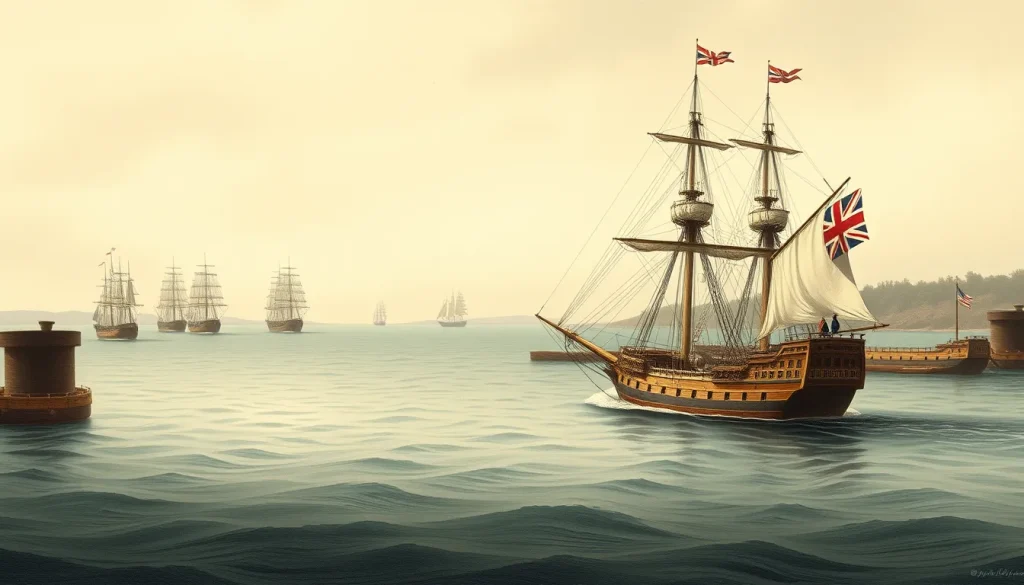
The British blockade of the United States, imposed progressively from 1812 to 1815, was a naval campaign that restricted American ocean trade, coastal commerce, and warship movements during the War of 1812. Beginning with the Chesapeake and Delaware Bays and eventually extending to the entire Atlantic and Gulf coasts, the blockade severely damaged the American economy, reduced customs revenue, and confined much of the U.S. Navy to port. Its effectiveness and role in bringing the war to an end have been subjects of ongoing historical interpretation.
Historical Context
The United States entered the War of 1812 with a revenue system heavily dependent on customs duties, which in turn relied on a vibrant overseas trade. The Royal Navy, the world’s dominant maritime force, had been engaged in a long struggle with Napoleonic France and used blockades and convoys to enforce economic warfare against its enemies. American resentment over British impressment, the seizure of neutral ships, and restrictions on trade led to the American declaration of war in June 1812. Although the U.S. Navy was small, it had gained confidence in the Quasi-War and Barbary Wars. The British maintained a North American squadron based at Halifax, and its strength in the western Atlantic grew as the European war ebbed. The blockade was a natural extension of Britain’s maritime strategy, intended to cut off American commerce and press the Madison administration toward peace.
What Happened
The blockade developed in stages. An informal restriction of South Carolina and Georgia ports began in late 1812. An Admiralty order of 26 December 1812 led Admiral Sir John Borlase Warren to declare the Chesapeake and Delaware Bays under blockade early in 1813. This targeted two of the most commercially significant waterways while intentionally exempting New England, where anti-war sentiment was strong and where British forces could purchase provisions. Subsequent proclamations during 1813 extended declared coverage to Savannah, Port Royal, Charleston, New York, and eventually the entire coast south of Narragansett Bay. When Vice-Admiral Alexander Cochrane took command, his proclamation of 25 April 1814 extended the blockade northward to the boundary with New Brunswick, completing the closure of the American seaboard.
Enforcement varied by time and place. The Royal Navy assigned dozens of ships to the American station, eventually numbering more than 130 by 1814. Close blockading squadrons watched major ports, while cruising squadrons intercepted merchantmen farther out at sea. American warships and privateers were increasingly confined to harbor, and coastal trade—the movement of goods between American ports—was severely curtailed. The blockade disrupted commerce, but it did not entirely stop it; some goods moved through legal channels, illicit trade, and neutral intermediaries. The capture of American ships and cargoes led to adjudication in British Vice-Admiralty courts. The blockade also facilitated British raids and amphibious operations, especially in the Chesapeake Bay, but these were not themselves proof of complete maritime closure.
Why It Matters
The blockade had a devastating economic impact. American exports, which had stood at about $61 million in 1811, fell to under $7 million in 1814. Imports and customs receipts contracted sharply; federal customs revenue fell by roughly 80 percent from pre-war levels. The loss of customs income—the primary federal revenue source—forced the government to rely on loans, Treasury notes, and other expedients, leading to severe financial strain and the suspension of specie payments by banks outside New England in 1814. The blockade also confined the U.S. Navy, excepting successful single-ship actions and lake campaigns, and limited the effectiveness of American privateers. Strategically, the blockade weakened the Madison administration’s ability to finance the war and pressured it toward negotiations. Historians disagree on how decisive it was: some, like Brian Arthur, argue it was the key to British victory, while others, like Donald Hickey and Wade Dudley, place it within a broader context of military stalemate and diplomatic factors.
Definition
A naval blockade is a maritime strategy that uses warships to prevent vessels from entering or leaving specified ports or coastal areas, thereby cutting off trade, supplies, and military movement. In the War of 1812, Britain’s blockade combined legal declarations, which gave neutral nations notice of restricted areas, and physical enforcement by squadrons. The effectiveness of a blockade depended on the number and disposition of ships, the weather, and the target nation’s ability to evade or contest it.
Background
Britain had long employed blockades as a tool of economic warfare, most notably against Napoleonic France and its allies. The Royal Navy’s blockade of French ports and the broader Continental System disrupted European trade and drew neutral nations like the United States into conflict. American merchants had profited as neutral carriers during the Anglo-French wars, but Britain’s Orders in Council and France’s decrees restricted American trade, leading to escalating tensions. The British blockade of the United States was thus an extension of established naval practice, adapted to a former colony that now represented a significant maritime rival.
How It Worked
Implementing the blockade required a substantial naval force. The British North American Squadron, based at Halifax, grew from about 20 ships in 1812 to over 130 by war’s end. The blockade was declared through proclamations by admirals, which gave legal notice of the areas under restriction. Enforcement involved close blockading of major ports to prevent American warships from sortieing, as well as cruising patrols that intercepted merchant vessels farther out. Prize crews were placed on captured ships and sent into British ports for adjudication. The blockade also disrupted coastal shipping, forcing goods to travel by land where possible. The British deliberately allowed trade through New England in the early years, hoping to exploit political divisions and acquire necessary supplies. This differential enforcement was a calculated policy, not an accident.
Competing Viewpoints
Historians have debated the blockade’s effectiveness and decisiveness. Traditional naval histories often focused on frigate duels, but modern scholars have emphasized the blockade’s economic and strategic impact. Brian Arthur, in How Britain Won the War of 1812, argues that the blockade was the decisive element that compelled American peace. Donald Hickey, in The War of 1812: A Forgotten Conflict, and Wade Dudley, in Splintering the Wooden Wall, contend that while the blockade was effective, its contribution must be weighed alongside military stalemate, domestic opposition, financial difficulties, and changing British priorities after Napoleon’s defeat. Some scholars also note that the blockade’s impact was uneven and that its enforcement was imperfect, with some trade continuing throughout the war.
Role in the War of 1812
The blockade was the principal means by which British naval supremacy was translated into pressure on the American home front. It limited the U.S. Navy’s ability to engage British forces on the high seas, confined American privateers, and reduced the flow of goods and revenue. The blockade’s expansion to New England in 1814 eliminated the last major loophole, tightening pressure on the entire United States. By cutting off American commerce and customs revenue, the blockade made the war increasingly costly for the Madison administration and contributed to the financial crisis of 1814. It also shaped the American debate about the war and influenced the negotiations that led to the Treaty of Ghent, although the treaty itself did not address the maritime grievances that had caused the conflict.
Consequences and Historical Interpretation
The blockade’s consequences were immediate and long-lasting: American trade collapsed, the federal government faced severe financial strain, and the U.S. Navy was largely neutralized on the ocean. The blockade also enabled British coastal raids and contributed to the burning of Washington in 1814. After the war, the blockade’s legacy remained contested. American memory celebrated naval victories like those of the Constitution, while British accounts lauded the blockade’s effectiveness. Modern historians continue to assess its relative importance, with some emphasizing economic coercion and others pointing to the limits of sea power. The blockade remains a key example of economic warfare and blockade strategy in the age of sail.
Primary Sources
Key primary sources include Admiral Alexander Cochrane’s proclamation of 25 April 1814, which formally extended the blockade to New England, and President James Madison’s counter-proclamation of 29 June 1814, which disputed the blockade’s legality and effectiveness. Official British correspondence and logs from blockading squadrons are held in national archives. American sources include Treasury reports on customs and trade statistics, as well as letters from merchants and officials. These documents illustrate both the legal framework and the practical difficulties of enforcement. They also reveal the economic and political responses in the United States.
Further Reading
- Hickey, Donald R. The War of 1812: A Forgotten Conflict. University of Illinois Press, 1989.
- Dudley, Wade G. Splintering the Wooden Wall: The British Blockade of the United States, 1812-1815. Naval Institute Press, 2003.
- Arthur, Brian. How Britain Won the War of 1812: The Royal Navy’s Blockades of the United States, 1812-1815. Boydell Press, 2011.
- Lambert, Andrew. The Challenge: Britain Against America in the Naval War of 1812. Faber & Faber, 2012.
- Grodzinski, John R. “Atlantic Campaign of the War of 1812.” The Canadian Encyclopedia, 2011.
References
- United States Naval History and Heritage Command, The Naval War of 1812: A Documentary History, Volumes II and III.
- Cochrane, Alexander. Proclamation extending the blockade, 25 April 1814.
- Madison, James. Proclamation, 29 June 1814.
- Hickey, Donald R. The War of 1812: A Forgotten Conflict. University of Illinois Press, 1989.
- Dudley, Wade G. Splintering the Wooden Wall: The British Blockade of the United States, 1812-1815. Naval Institute Press, 2003.
- Arthur, Brian. How Britain Won the War of 1812: The Royal Navy’s Blockades of the United States, 1812-1815. Boydell Press, 2011.
- O’Rourke, Kevin H. ‘War and Welfare: Britain, France, and the United States, 1807-14’, Oxford Economic Papers 59, supplement 1 (2007): i8-i30.
- Irwin, Douglas A. ‘The Welfare Cost of Autarky: Evidence from the Jeffersonian Trade Embargo, 1807-09’, Review of International Economics 13, no. 4 (2005): 631-645.
- United States Department of the Treasury, annual reports and historical customs statements for fiscal years 1811-1815.
- Historical Statistics of the United States, series on foreign trade, federal receipts, debt, and prices for 1811-1815.
FAQ
When did the British blockade of the United States officially begin?
The blockade effectively began in late 1812 with an informal restriction on South Carolina and Georgia, followed by a formal declaration for the Chesapeake and Delaware Bays in early 1813, and was extended to the entire Atlantic and Gulf coasts by 1814.
Why was New England initially exempt from the blockade?
The British deliberately exempted New England to exploit anti-war sentiment and to continue purchasing provisions, as New England merchants were largely opposed to the war and willing to trade with British forces.
What was the economic impact of the blockade?
The blockade caused a collapse in American exports and imports, with exports falling from about $61 million in 1811 to $7 million in 1814, and federal customs revenue declining roughly 80 percent, contributing to a severe financial crisis.
Leave a Reply