
Short Answer
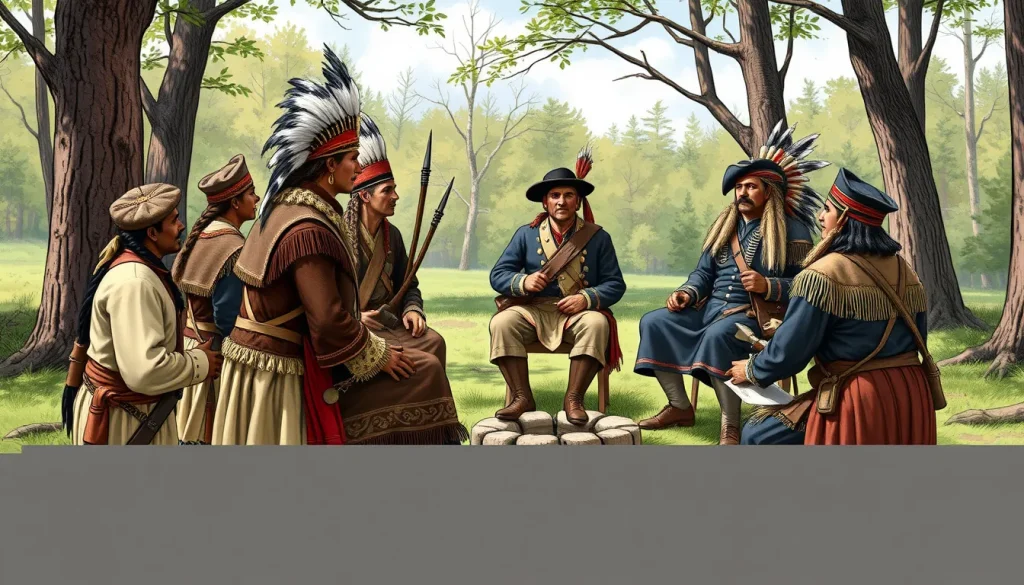
The War of 1812 (1812–1815) was a conflict between the United States and Great Britain, but for Indigenous peoples of the Great Lakes, Ohio Valley, and Gulf regions, it was a desperate struggle to protect their lands and sovereignty. Indigenous nations developed and executed strategies that shaped the war’s course, particularly in the Northwest and Niagara frontiers. Their alignment with British forces was a calculated choice, made not from loyalty to the Crown but from a belief that Britain was the lesser threat to their territorial and cultural survival.
Historical Context
Following the American Revolution, the Treaty of Paris (1783) ceded vast territories west of the Ohio River to the United States, undermining protections that had previously been extended to Indigenous lands under the Royal Proclamation of 1763. American settlers poured into these regions, leading to a series of conflicts, including the Northwest Indian War, which culminated in the Battle of Fallen Timbers (1794). By the early 1800s, the United States government was negotiating land cession treaties with individual tribes, often using coercion and bribery. In response, Indigenous leaders sought to create a pan-Indian confederacy capable of resisting American expansion. The Shawnee brothers Tecumseh and Tenskwatawa (the Prophet) emerged as central figures in this movement, advocating that land was held in common and could not be sold by individual tribes.
Meanwhile, British-American relations deteriorated due to impressment, trade restrictions, and the Chesapeake-Leopard Affair (1807). Britain, engaged in the Napoleonic Wars, saw Indigenous allies as essential to defending Canada against an American invasion. London instructed its colonial officials to cultivate alliances with Indigenous nations, promising to support their territorial claims in exchange for military cooperation.
What Happened
When war broke out in June 1812, Indigenous forces played an immediate and critical role. In July 1812, a mixed force of British troops, Métis voyageurs, and over 300 Odawa, Ojibwa, and Dakota warriors captured Fort Michilimackinac, securing the upper Great Lakes for Britain. The following month, Tecumseh and approximately 600 warriors joined British General Isaac Brock in the capture of Fort Detroit. This victory, achieved partly through psychological intimidation, opened the way for a series of British successes on the Niagara frontier, including the Battle of Queenston Heights (October 1812), where Six Nations and Delaware warriors fought alongside British regulars.
In 1813, Indigenous forces continued to be decisive. At Frenchtown (January 1813), Native allies helped destroy an American column. At the siege of Fort Meigs (April-May 1813), Tecumseh’s warriors harried American reinforcements, and at the Battle of Beaver Dams (June 1813), a force of roughly 400 Six Nations and other warriors ambushed and captured an American detachment. However, the British naval defeat on Lake Erie in September 1813 forced a general retreat. Tecumseh remained with British General Henry Procter, and at the Battle of the Thames (October 1813), he was killed. His death marked the collapse of the Western Confederacy.
In the South, a separate conflict erupted among the Creek people, dividing into factions. The Red Sticks, militant defenders of traditional lands, attacked American settlements, leading to the Creek War (1813–1814). American forces, aided by Cherokee and friendly Creek warriors, eventually defeated the Red Sticks at the Battle of Horseshoe Bend (March 1814).
Why It Matters
The War of 1812 had profound consequences for Indigenous peoples. In the immediate term, their participation was vital to British victories, but the peace that followed ignored their interests. The Treaty of Ghent (December 1814) promised to restore “possessions, rights, and privileges” to Indigenous nations, but this provision was never enforced. The United States, having broken the military power of the Western Confederacy, proceeded to force land cessions and eventually implemented Indian removal policies, leading to the forced migration of thousands of people. For the British, the alliance became inconvenient in the postwar era, and they largely abandoned their promises to their former allies. The war thus marked a turning point: after 1815, Indigenous nations in the east and Great Lakes region lost much of their diplomatic and military leverage.
Definition
Indigenous strategy during the War of 1812 refers to the military and diplomatic approaches that Indigenous nations, confederacies, and individual leaders used to protect their territories, sovereignty, and ways of life. This strategy encompassed alliances with European powers, raids and ambushes, intelligence gathering, and the effort to forge pan-Indian unity.
Background
The colonial era had established a pattern of Indigenous-European alliances, from the Covenant Chain to the Royal Proclamation of 1763, which recognized Indigenous land rights. American independence disrupted these arrangements, and as U.S. expansion accelerated, Indigenous peoples faced a choice: resist alone, ally with Britain, or negotiate with the United States. By the early 1800s, the failure of individual tribal negotiations to prevent land loss led to calls for collective action. Tecumseh’s confederacy was the most ambitious expression of this, aiming to create a centralized Indigenous authority that could not be manipulated by American treaty commissioners.
How It Worked
Indigenous strategy operated at multiple levels. At the diplomatic level, leaders like Tecumseh sought to unite diverse nations and present a common front. They also negotiated alliances with the British, who provided arms, supplies, and military support in exchange for manpower and territorial cooperation. At the military level, Indigenous warriors excelled in irregular warfare—raids, ambushes, and skirmishes that disrupted American supply lines and demoralized regular troops. Their knowledge of terrain was invaluable for scouting and intelligence. At the tactical level, Indigenous forces often fought alongside British regulars, sometimes as composite units, and their presence on the battlefield could have a psychological impact disproportionate to their numbers, as seen at Detroit and Beaver Dams.
Competing Viewpoints
Historians disagree about the motivations of Indigenous allies. Some emphasize pragmatic self-interest: Indigenous peoples chose the British because they offered better trade goods and were less directly threatening than American settlers. Others stress ideological commitment to an intertribal identity and the defense of common lands. There is also debate about the effectiveness of Indigenous strategy. Some argue that it was decisive in the war’s early phases and could have preserved a buffer state had Tecumseh survived; others point to the fragility of pan-Indian unity and the ultimate inability of Britain to guarantee long-term territorial gains. The British, for their part, viewed the alliance as temporary and expendable, a fact that became clear after the war.
Role in the War of 1812
Indigenous forces were present at nearly every major battle of the western and Niagara campaigns, as well as in actions on the St. Lawrence and Chesapeake. Their raids and harassment tied down American troops and made American advances costly. For example, in 1814, Indigenous allies helped defend the Niagara frontier and participated in the battles of Chippawa and Lundy’s Lane. In the Gulf region, Choctaw and other nations served with Andrew Jackson’s forces at the Battle of New Orleans. Thus, Indigenous strategy was not peripheral but integral to the war’s outcome.
Consequences and Historical Interpretation
The immediate consequence was devastating: an estimated 7,000–10,000 Indigenous deaths from all causes during the war. In the longer term, the war accelerated American control over the Old Northwest and the South. The Treaty of Ghent’s land guarantees were ignored, and the United States pursued removal policies culminating in the Indian Removal Act of 1830. For Indigenous peoples in Canada, the war created a reputation as loyal allies, but the British government, eager for peace with the U.S., failed to protect their interests. Modern historians view the War of 1812 as a turning point in Indigenous history—a moment when military power could no longer stem American expansion, and when diplomacy increasingly occurred on American terms.
Primary Sources
Primary sources for Indigenous strategy include the correspondence and proclamations of British officers such as Sir Isaac Brock and General Henry Procter, which reveal how they negotiated and employed Indigenous allies. Tecumseh’s speeches, preserved through British and American records, articulate his vision of a unified Indigenous confederacy. The Treaty of Ghent itself, especially Article IX, is a crucial source for understanding the peace terms. However, most primary sources are filtered through Euro-American perspectives; direct Indigenous testimony is rare and often recorded by officials with their own agendas. Nevertheless, these documents provide insight into the strategic thinking of key Indigenous leaders and the challenges they faced.
Further Reading
- John Sugden, Tecumseh: A Life (1997).
- Carl Benn, The Iroquois in the War of 1812 (1998).
- Robert S. Allen, His Majesty’s Indian Allies: British Indian Policy in the Defence of Canada, 1774–1815 (1992).
- Donald R. Hickey, The War of 1812: A Forgotten Conflict (1989).
- Historica Canada, “First Nations and Métis Peoples in the War of 1812,” The Canadian Encyclopedia.
References
- “First Nations and Métis Peoples in the War of 1812,” The Canadian Encyclopedia. https://thecanadianencyclopedia.ca/en/article/first-nations-in-the-war-of-1812.
- Anthony J. Hall, “Indigenous Title and the War of 1812,” The Canadian Encyclopedia. https://thecanadianencyclopedia.ca/en/article/aboriginal-title-and-the-war-of-1812.
- “Indigenous Contributions to the War of 1812: Theatres of War Map,” Indigenous and Northern Affairs Canada. https://www.cirnac.gc.ca/eng/1338906996435/1607905615872.
- “Native American Involvement in the War of 1812,” American Battlefield Trust. https://www.battlefields.org/learn/articles/native-american-involvement-war-1812.
FAQ
Why did most Indigenous nations ally with Britain during the War of 1812?
Indigenous nations viewed the British as the lesser threat to their lands and trade, whereas American expansion directly encroached on their territories. Britain also promised military support and the restoration of land rights.
What was the significance of Tecumseh's death at the Battle of the Thames?
His death shattered the morale of the Western Confederacy and effectively ended organized Indigenous resistance to American forces in the Old Northwest, leading to American dominance in the region.
How did the Treaty of Ghent affect Indigenous peoples?
The treaty promised to restore all possessions, rights, and privileges of Indigenous nations, but the United States ignored these provisions. Instead, the U.S. pursued land cessions and, later, forced removal of Indigenous peoples from their homelands.
Leave a Reply