
Short Answer
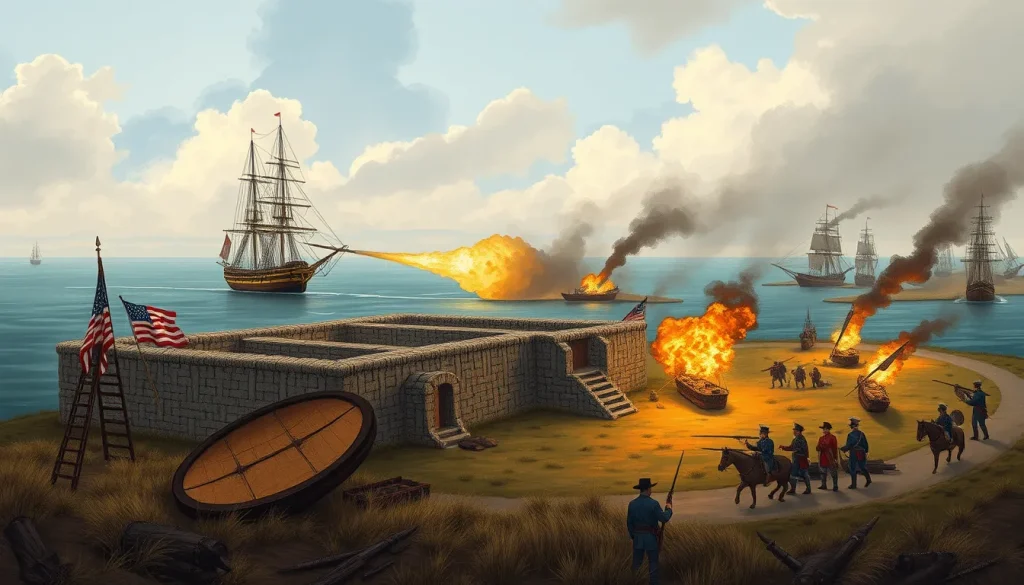
The First Battle of Fort Bowyer, fought on September 15, 1814, was an American victory at the mouth of Mobile Bay in present-day Alabama during the War of 1812. A British naval and land force under Captain William Percy attacked the small earth-and-log fort but was repulsed with heavy losses, including the destruction of the flagship HMS Hermes. The defeat caused the British to abandon their plan to capture Mobile and instead launch a direct assault on New Orleans, helping to shape the Gulf Coast campaign.
Historical Context
In 1813, after the United States occupied Mobile (then part of Spanish West Florida), the U.S. Army built Fort Bowyer on Mobile Point to command the narrow entrance to Mobile Bay. By 1814, the British had decided to strike at the Gulf Coast, aiming to capture New Orleans and possibly control the Mississippi River. Mobile was seen as a vital staging point: possession of Fort Bowyer and Mobile Bay would give the British a secure base and a land route toward New Orleans from the east, bypassing the difficult bayou country south of the city. The fort was a modest earth-and-log redoubt mounting about fourteen guns, garrisoned by roughly 160 men of the 2nd U.S. Infantry under Major William Lawrence. In August 1814, the Americans re-garrisoned the fort after a brief abandonment, anticipating a British descent from Pensacola, where British forces had established a base.
What Happened
On September 12, 1814, a British squadron from Pensacola—comprising HMS Hermes (22 guns), HMS Sophie (18), HMS Carron (20), and HMS Childers (18)—arrived off Mobile Point under Captain William Percy. Percy landed a diversionary force of Royal Marines and allied Creek and Seminole warriors east of the fort to threaten its landward side, while the ships prepared to bombard it. On September 15, after delays from contrary winds, the British ships crossed the bar and opened fire. The American garrison, protected by sand and timber parapets, returned a heavy and accurate fire. Within about two hours, HMS Hermes ran aground directly under the fort’s guns, was disabled, and was abandoned and set on fire. She exploded around 10 p.m. The other ships, having suffered damage, withdrew. The land force, lacking coordination and naval support, also retreated. American losses were four killed and five wounded; British losses were approximately 34 killed and 35 wounded, plus the loss of the flagship.
Why It Matters
The American victory at Fort Bowyer was a significant morale boost for the United States and temporarily secured the Mobile Bay region. More importantly, it forced British commanders to rethink their Gulf strategy. Concluding that the fort and Mobile could not be taken without larger forces, they shifted their focus to a direct amphibious assault on New Orleans via Lake Borgne and the bayous south of the city. That decision led directly to the Battle of New Orleans on January 8, 1815, where the British suffered a catastrophic defeat. The first battle at Fort Bowyer thus had strategic consequences far exceeding its scale, influencing the course of the Gulf Coast campaign and the war’s final phase.
Prelude
By mid-1814, British forces in the Gulf of Mexico, operating from Pensacola in Spanish Florida, planned to seize Mobile as a preliminary to an attack on New Orleans. Fort Bowyer guarded the entrance to Mobile Bay and was the first objective. Captain William Percy, commanding a naval squadron, was ordered to reduce the fort. He had at his disposal four warships and a landing force of Royal Marines and Indian auxiliaries under Lieutenant Colonel Edward Nicolls, who was seconded by Captain George Woodbine. The Americans, under Major William Lawrence, had been reinforced and had mounted additional guns, bringing the total to about fourteen pieces, though numbers vary in sources.
Forces and Commanders
British and Allied: Captain William Percy (Royal Navy), overall command; Lieutenant Colonel Edward Nicolls (Royal Marines) commanded the land force, which included about 60–80 Royal Marines and over 100 Creek and Seminole warriors. The naval squadron consisted of HMS Hermes (22 guns), HMS Sophie (18), HMS Carron (20), and HMS Childers (18). Total British strength was approximately 850–1,000 men, including ship crews.
American: Major William Lawrence commanded the garrison of roughly 160 soldiers from the 2nd U.S. Infantry, plus artillerists. The fort mounted about fourteen guns, mostly carronades and long guns, with some sources citing as many as twenty.
Battlefield and Map Context
Fort Bowyer was situated on Mobile Point, a sandy peninsula at the western entrance of Mobile Bay, in what is now Baldwin County, Alabama, near the modern community of Gulf Shores. The fort faced the ship channel with a semi-circular, bastioned front, designed to bring fire on vessels approaching the bay. The landward side was protected by a bastion and demi-bastions. The surrounding terrain was low sand dunes and marshy flats, making approach difficult. Today the site is part of Fort Morgan State Historic Park, and the later masonry Fort Morgan occupies the same ground.
Battle Chronology
September 11–12, 1814: The British squadron anchored east of Mobile Point and landed the land force, which advanced along the peninsula. A detachment was sent to Bon Secour to secure the rear.
September 14: The British land force attempted a feint but was repulsed. The naval ships were prevented from crossing the bar by contrary winds.
September 15, beginning in the afternoon: Percy’s ships crossed the bar and formed a line, with Hermes leading. The fort opened fire at about 3:30 p.m. Hermes anchored close to the fort and engaged. Within two hours, Hermes was severely damaged, with its bow spring shot away, causing it to swing and be raked. The ship ran aground under the fort’s guns. The other vessels, particularly Sophie, also took damage but were unable to provide effective support due to wind and the narrow channel.
Around 6 p.m.: Hermes was disabled. Percy ordered her to be abandoned and scuttled. The ship was set on fire, and around 10 p.m. her magazine exploded.
The British land force, lacking coordination, withdrew after the naval defeat. The surviving ships anchored overnight and re-crossed the bar the next morning, departing for Pensacola.
Casualties and Losses
American casualties were light: four killed and five wounded, according to most accounts. British losses were far heavier. Official returns list 17 killed and 19 wounded on Hermes, 6 killed and 12 wounded on Sophie, 1 killed and 5 wounded on Carron, plus losses among the land force (one marine killed). Total British killed and wounded were about 34 killed and 35 wounded, with additional losses from the burned ship. The loss of HMS Hermes was a major material blow.
Result
The First Battle of Fort Bowyer was a clear American victory. The fort’s guns defeated the British naval squadron, destroyed the flagship, and forced a withdrawal. The American garrison successfully defended Mobile Bay against a larger combined force.
Strategic Consequences
The defeat forced the British to alter their Gulf Coast strategy. Unable to seize Mobile quickly, they abandoned the idea of an overland approach from the east and instead chose a direct naval assault on New Orleans from Lake Borgne. That operation culminated in the Battle of New Orleans on January 8, 1815, a disastrous British defeat that became a defining American victory. The defense of Fort Bowyer delayed British operations and contributed to the overall failure of the Gulf Coast campaign. In February 1815, after New Orleans, the British returned with a larger force and captured Fort Bowyer in the Second Battle of Fort Bowyer, but the war ended shortly thereafter.
Primary Accounts
Major Lawrence’s official report to General Andrew Jackson described the battle in detail, citing the fort’s fire and the destruction of Hermes. British reports, including Captain Percy’s court-martial testimony, acknowledged the strength of the American defense. The court-martial, held later, concluded that Percy’s attack was justified under the circumstances, though the loss of Hermes was attributed to the difficulties of the position. These documents are collected in various archival and published sources, including the American State Papers and British Admiralty records.
Battlefield Today
Fort Bowyer was demolished after the war, and a new masonry fort, Fort Morgan, was constructed on the same site between 1819 and 1834. Today, the area is preserved as Fort Morgan State Historic Site in Alabama, operated by the Alabama Historical Commission. Visitors can see the remains of the later fort, which includes elements that cover the footprint of Fort Bowyer, and interpretative markers explain the 1814 battle. A historical marker erected by the Society of the War of 1812 in the State of Alabama commemorates the first battle near the fort’s entrance.
Primary Sources
Key contemporary sources include Major William Lawrence’s after-action report, dated September 16, 1814, addressed to General Andrew Jackson; Captain William Percy’s official dispatch and subsequent court-martial records; and logs and reports from the British ships. These documents are held by the U.S. National Archives, the British National Archives (Admiralty records), and are reproduced in published documentary collections such as the American State Papers and the Naval Records of the War of 1812. The limitations include the natural bias of each side’s reports, which emphasize their own losses and the enemy’s failures.
Further Reading
- Donald R. Hickey, The War of 1812: A Forgotten Conflict (University of Illinois Press, 1989).
- Jon Latimer, 1812: War with America (Harvard University Press, 2007).
- Robert V. Remini, The Battle of New Orleans (Viking, 1999).
- American Battlefield Trust, “First Fort Bowyer Battle Facts and Summary” (online resource).
- Fort Morgan State Historic Site, Alabama Historical Commission (interpretive materials).
References
- American Battlefield Trust. “First Fort Bowyer Battle Facts and Summary.” Accessed November 2025. https://www.battlefields.org/learn/war-1812/battles/first-fort-bowyer.
- Wikipedia contributors. “Fort Bowyer.” (Wikipedia article, accessed November 2025).
- thewarof1812.org. “First Battle of Fort Bowyer.” Accessed November 2025. https://thewarof1812.org/battles/first-battle-of-fort-bowyer/.
- Explore Southern History. “Battle of Fort Bowyer – Mobile Point, Alabama.” Accessed November 2025. https://exploresouthernhistory.com/fortbowyer.html.
- Historical Marker Database. “First Battle of Fort Bowyer Marker.” Accessed November 2025. https://www.hmdb.org/m.asp?m=187342.
FAQ
Who won the First Battle of Fort Bowyer?
The American garrison under Major William Lawrence won, repulsing the British attack and destroying the flagship HMS Hermes.
Why did the British attack Fort Bowyer?
Fort Bowyer guarded Mobile Bay, and the British hoped to capture Mobile as a base for a land attack on New Orleans. Taking the fort was the first step in that plan.
What was the result of the British failure at Fort Bowyer?
The defeat forced the British to abandon the Mobile route and instead attack New Orleans directly, leading to their disastrous loss at the Battle of New Orleans in January 1815.



Leave a Reply