
Short Answer
The Creek Civil War, also known as the Creek War or Red Stick War, was a conflict that began in 1813 as a civil war between two factions of the Muscogee (Creek) Nation in the American Southeast, and quickly became entangled with the broader War of 1812. Fought primarily in present-day Alabama, it pitted the traditionally minded Upper Creeks, called Red Sticks, against the Lower Creeks and the Creek National Council, with the United States eventually joining the latter side. The war concluded with the Treaty of Fort Jackson in August 1814, under which the Creeks ceded over 20 million acres of land to the United States, decisively weakening the Creek people and facilitating American expansion.
Historical Context
The Creek Nation, a confederation of towns sharing language and culture, occupied a vast territory stretching from the Chattahoochee River to the Alabama River. By the early 19th century, this region was under intense pressure from American settlers, who encroached on Creek lands following a series of treaties that ceded territory east of the Ocmulgee River. The U.S. federal government, through Indian agent Benjamin Hawkins, promoted a “civilization program” that encouraged Creek adoption of American agriculture and domestic practices. This program, combined with economic disparities created by the global market and the decline of the deerskin trade, deepened divisions within the confederacy. The National Council, a governing body Hawkins helped establish, increasingly assumed powers that traditionally belonged to clan and town leaders, alienating many Upper Creek communities.
External events further unsettled the region. The Shawnee chief Tecumseh, seeking to build a pan-Indian alliance against American expansion, visited Creek towns in 1811 and delivered a message of resistance. His call, linked to religious prophecies and the recent appearance of comets and earthquakes, found eager listeners among Upper Creek traditionalists. Meanwhile, the War of 1812 had erupted between the United States and Great Britain, with British agents and Spanish colonial officials in Florida supplying arms to those Indians willing to oppose the Americans. The combination of internal Creek tensions, American pressures, and the international conflict set the stage for civil war.
What Happened
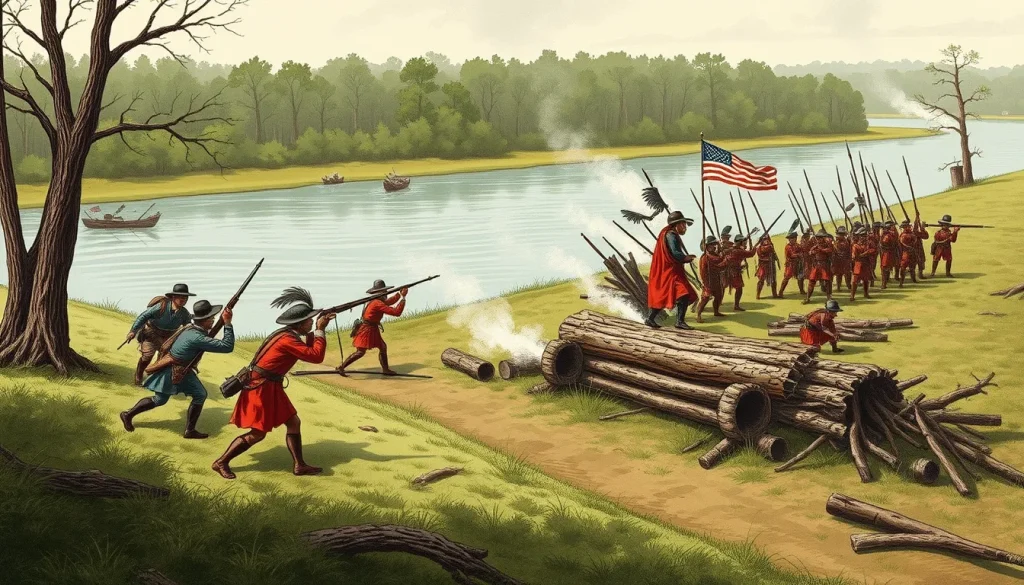
The Creek Civil War erupted in mid-1813 after a series of executions carried out by the National Council against dissidents who had attacked American settlers. These executions, which defied traditional clan prerogatives, pushed many Upper Creeks into open rebellion. The dissidents, known as Red Sticks after the red war clubs they carried, soon clashed with both their Creek opponents and American forces. In July 1813, a Red Stick party returning from Spanish Pensacola with arms was attacked by Mississippi militia, and the Red Sticks retaliated by assaulting Fort Mims on August 30, 1813. The fort, a stockaded settlement near the Alabama River, held American settlers and friendly Creeks; the Red Sticks overwhelmed it and killed most of the inhabitants, an event that galvanized American public opinion and brought the United States fully into the conflict.
Following Fort Mims, Tennessee, Georgia, and Mississippi organized expeditions against the Red Sticks. Major General Andrew Jackson of the Tennessee militia took command of the main American force. Jackson built Fort Strother on the Coosa River and, in November 1813, his subordinates attacked and destroyed the Red Stick towns of Tallushatchee and Talladega. Georgia militia under John Floyd and Mississippi forces under Ferdinand Claiborne also struck at Creek villages, including the holy town of Eccanachaca in December. Logistical problems and short-term enlistments stalled operations through early 1814, but Jackson resumed his campaign in March. His army, supported by friendly Cherokee and Lower Creek warriors, confronted the main Red Stick force fortified at Horseshoe Bend on the Tallapoosa River. In the battle of March 27, 1814, Jackson’s troops, including the 39th U.S. Infantry, stormed the breastworks and killed the majority of the Red Stick defenders. The victory effectively crushed the Red Stick resistance, though some survivors fled to Spanish Florida. Jackson then dictated terms at Fort Jackson, and on August 9, 1814, the Treaty of Fort Jackson forced the Creek Nation to cede over 20 million acres of land to the United States, including territory of both friendly and hostile Creeks.
Why It Matters
The Creek Civil War was more than a regional conflict; it was a pivotal episode within the War of 1812 and a watershed in the history of the American Southeast. It eliminated the Red Stick faction, which had aligned with British interests, and secured the Gulf Coast region for the United States ahead of the British attack on New Orleans later in 1814. For the Creek people, the war was catastrophic. Historian Kathryn Braund notes that the majority of Upper Creek people were left homeless, and an estimated half of the population was either dead or seeking refuge in Spanish territory. The Treaty of Fort Jackson, which punished both hostile and neutral Creeks, dismantled the Creek land base and set a precedent for Indian removal in the following decades. The war also cemented Andrew Jackson’s reputation as a military leader and contributed to his later presidency. Historians view the Creek conflict as both a civil war among Indians and a war of American conquest, reflecting the entangling of internal Creek divisions with the broader struggle of great powers for control of North America.
Definition
The Creek Civil War was a multi-faceted conflict beginning in 1813 between Creek factions, with the United States and allied Indian nations joining against the Red Sticks. It is also called the Red Stick War or the Creek War.
Background
The roots of the conflict lay in decades of land cessions, economic disruption, and cultural change. The National Council’s growing authority, the influence of Benjamin Hawkins, and the unequal benefits of the market economy created resentment, particularly among Upper Creeks who remained attached to traditional ways. Tecumseh’s visit in 1811 and the revivalist messages of Creek prophets inspired a militant faction that rejected accommodation and sought to restore Creek power through spiritual renewal and armed resistance. The outbreak of the War of 1812 offered these dissidents the prospect of British and Spanish support, making a violent confrontation increasingly likely.
How It Worked
The civil war operated along multiple axes: internal Creek political and clan rivalries, American military intervention, and the involvement of other Indian nations. The Red Sticks, drawn largely from Upper Creek towns like Tuckabatchee and Oakfuskee, opposed the National Council’s cooperation with the United States. The council, led by Big Warrior and supported by Lower Creek leaders such as William McIntosh, sought to preserve peace with the Americans and used U.S.-supplied arms and authority to enforce its decisions. When the council executed dissidents, it violated traditional clan rights to settle blood disputes, prompting many warriors to join the Red Sticks. The United States, viewing all Creeks as potential British allies, quickly intervened on the side of the National Council, providing troops, supplies, and legitimacy. Cherokee and Choctaw nations, traditional enemies of the Creeks, allied with the Americans against the Red Sticks, further complicating the conflict.
Competing Viewpoints
Historians interpret the Creek Civil War from several perspectives. Some, like John K. Mahon, emphasize that it was as much a civil war among Creeks as between red and white, highlighting internal divisions over assimilation, economics, and political authority. Others, such as Kathryn Braund, argue that the American response turned it into a “war of conquest,” aimed at breaking Creek power and seizing land. The role of religion is also debated: some see the Red Stick movement as primarily a nativistic religious revival, while others stress economic and political grievances. The question of responsibility for the war’s destruction is contested, with partisans pointing to American aggression, internal Creek rivalry, or British and Spanish machinations. These competing viewpoints reflect the complexity of a conflict that was simultaneously a civil war, a proxy war, and a frontier war.
Role in the War of 1812
The Creek Civil War was an integral part of the War of 1812’s southern theater. British agents, operating from Spanish Florida, supplied the Red Sticks with arms and encouragement, hoping to distract the United States and destabilize its frontier. The U.S. government, fearing a British-inspired Indian coalition, committed regular and militia forces to the Creek campaign, diverting resources from other fronts. Andrew Jackson’s victories, especially at Horseshoe Bend, had direct strategic implications: they secured the American rear and denied the British a potential Native ally ahead of the Battle of New Orleans. The Treaty of Fort Jackson, signed while British forces still threatened the Gulf Coast, was a unilateral American action that ignored British interests and solidified U.S. control over the region. The Creek War thus influenced the outcome of the broader conflict by strengthening the American position in the South.
Consequences and Historical Interpretation
The war’s consequences were profound. For the Creek Nation, it meant loss of sovereignty, massive land cessions, and displacement, leading eventually to forced removal on the Trail of Tears in the 1830s. For the United States, it opened up millions of acres to cotton cultivation and white settlement, fueling the expansion of the plantation economy. For the British, the failure to support the Red Sticks effectively reduced their ability to threaten the American frontier. Historical interpretation of the Creek Civil War has evolved, recognizing the agency of Native peoples and the complexity of internal Creek politics. Modern scholarship emphasizes the war’s role in shaping American Indian policy and its place in the larger narrative of U.S. territorial expansion. The war is now seen not merely as a side note to 1812 but as a pivotal event in the history of the American South.
Primary Sources
Primary sources on the Creek Civil War include official military reports, such as Andrew Jackson’s letters and orders to his subordinates, which detail campaign movements and decisions. Benjamin Hawkins’s correspondence as Indian agent provides insight into the National Council’s actions and the internal Creek political situation. Contemporary newspaper accounts, like those describing the Fort Mims massacre, shaped public opinion and often sensationalized events. Diaries and memoirs of soldiers, such as the recollections of Davy Crockett, who served under Jackson, offer personal perspectives. The Treaty of Fort Jackson itself is a crucial primary document, outlining the land cessions and the terms imposed on the Creeks. Each source carries its own bias—American military reports emphasize military necessity, while Creek oral traditions, though not written, remember the war as a catastrophe. These sources must be used critically to reconstruct the multiple dimensions of the conflict.
Further Reading
- Blackmon, Richard D. The Creek War 1813–1814. Washington, DC: Center of Military History, United States Army, 2014.
- Waselkov, Gregory A. A Conquering Spirit: Fort Mims and the Redstick War of 1813–1814. Tuscaloosa: University of Alabama Press, 2006.
- Halbert, Henry S., and T. H. Ball. The Creek War of 1813 and 1814. 1895. Reprint, Montgomery: University of Alabama Press, 2001.
- Braund, Kathryn E. Holland. “Creek War in the Southeast: A civil war and an enemy occupation.” National Park Service, August 15, 2017.
- O’Brien, Greg. Choctaws in a Revolutionary Age: A Study of Power and Authority, 1750–1830. Lincoln: University of Nebraska Press, 2002.
References
- Braund, Kathryn E. Holland. “Creek War in the Southeast: A civil war and an enemy occupation.” National Park Service, August 15, 2017. https://www.nps.gov/articles/creek-war-in-the-southeast-1.htm.
- “Creek War.” Wikipedia, last modified 2025. https://en.wikipedia.org/wiki/Creek_War.
- “The Creek War of 1813-1814.” American Battlefield Trust, updated January 17, 2024. https://www.battlefields.org/learn/articles/creek-war-1813-1814.
- Braund, Kathryn E. Holland. “Creek War of 1813-14.” Encyclopedia of Alabama, 2017. https://encyclopediaofalabama.org/article/creek-war-of-1813-14/.
- Blackmon, Richard D. The Creek War 1813–1814. Washington, DC: Center of Military History, United States Army, 2014. https://www.govinfo.gov/content/pkg/GOVPUB-D114-PURL-gpo53888/pdf/GOVPUB-D114-PURL-gpo53888.pdf.
FAQ
What caused the Creek Civil War?
The Creek Civil War arose from deep divisions within the Creek Nation over American expansion, economic changes, religious movements, and the authority of the National Council, exacerbated by Tecumseh's call for resistance and British and Spanish support.
Why was the Creek Civil War part of the War of 1812?
The Creek War became a theater of the War of 1812 because British agents armed the Red Sticks to destabilize the American frontier, and U.S. forces under Andrew Jackson fought to suppress them, securing the Gulf Coast for the United States.
What were the consequences for the Creek people?
The war devastated the Creeks. An estimated half of the Upper Creek population was killed or displaced, and the Treaty of Fort Jackson took over 20 million acres of land, leading to loss of sovereignty and eventual removal in the 1830s.
Who were the Red Sticks?
The Red Sticks were a militant faction of Upper Creeks who rejected the National Council's accommodation with the United States. They took their name from the red war clubs they carried and sought to revive traditional Creek culture.


Leave a Reply