
Short Answer
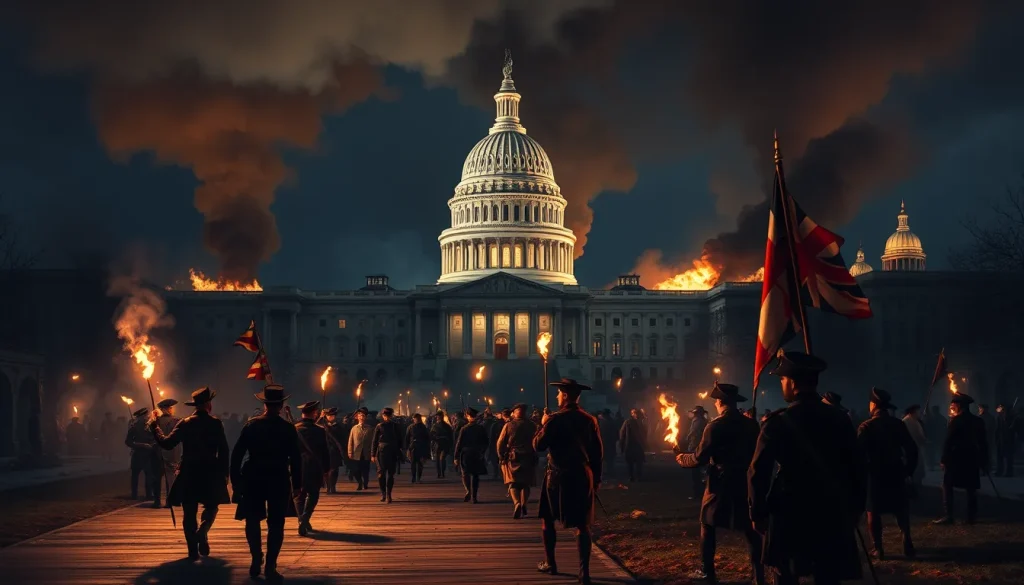
The burning of Washington, D.C., on August 24–25, 1814, was a dramatic episode of the War of 1812 in which British forces under Major General Robert Ross and Rear Admiral George Cockburn captured the American capital and systematically set fire to its principal public buildings. The destruction was a deliberate act of retaliation for earlier American attacks on British Canada, particularly the burning of York (Toronto) in 1813, and aimed to strike a decisive psychological blow against the United States. It remains the only time a foreign power has occupied and burned the American seat of government.
Historical Context
The War of 1812 began in June 1812 as the United States sought to address British maritime restrictions, impressment of American sailors, and alleged support for Native American resistance to American expansion. President James Madison’s administration pursued a strategy of invading British North America (Canada), expecting an easy conquest. American forces crossed into Upper Canada in 1812 and 1813, but the campaigns were poorly coordinated and largely unsuccessful. In April 1813, U.S. troops captured and burned the provincial capital of York, setting fire to the parliament buildings and causing significant destruction. In December 1813, American forces under Brigadier General George McClure burned the town of Newark (now Niagara-on-the-Lake) in midwinter, leaving hundreds of civilians homeless. These acts, particularly the burning of private property and the expulsion of families, outraged British and Canadian opinion and created a strong desire for retaliation.
By the spring of 1814, Britain had defeated Napoleon Bonaparte in Europe, freeing experienced regular troops and naval forces for service in North America. The British launched a series of coastal raids along the Chesapeake Bay to divert American resources from Canada, disrupt the economy, and bring the war to a rapid conclusion. Washington, D.C., although lacking significant military value, was chosen as a target because of its symbolic importance as the capital and its proximity to the Chesapeake.
What Happened
On August 19, 1814, a British force of about 4,500 troops under Major General Robert Ross landed at Benedict, Maryland, on the Patuxent River. They marched toward Washington, meeting American forces at Bladensburg, Maryland, on August 24. The American defenders, composed largely of militia and outnumbering the British, were quickly routed in what became known as the Battle of Bladensburg. President Madison and senior officials fled the city as the British advanced.
That evening, British troops entered Washington, which had been largely evacuated. Dolley Madison, the First Lady, oversaw the removal of Gilbert Stuart’s portrait of George Washington and other valuables before leaving. Rear Admiral Cockburn reportedly entered the President’s House and found dinner still set, later ordering the building’s destruction. Ross and Cockburn directed the systematic burning of public buildings: the Capitol (which housed the Library of Congress), the President’s House, the Treasury, the War and State Departments, an arsenal, and a dockyard with a frigate under construction. They deliberately spared private residences, commercial buildings, and churches, although looting by American civilians occurred afterward. The Patent Office was spared after its superintendent, William Thornton, argued that its contents were private property.
On August 25, a severe thunderstorm—possibly a tornado—struck the city, extinguishing many fires. The British, having achieved their objective, withdrew that night and returned to their ships. The entire occupation lasted about twenty-four hours.
Why It Matters
The burning of Washington had immediate and lasting consequences. It humiliated the Madison administration and fueled Federalist criticism, culminating in the Hartford Convention of December 1814. However, it also ignited a surge of patriotic resolve that contributed to the successful defense of Baltimore in September 1814, an event that inspired Francis Scott Key’s “The Star-Spangled Banner.” The destruction prompted a national discussion about relocating the capital, though rebuilding was ultimately chosen. In historical memory, the burning of Washington symbolizes the vulnerability of the United States and serves as a reminder of the war’s origins in American aggression against Canada.
Definition
The burning of Washington refers to the deliberate destruction of the U.S. capital’s public buildings by British forces on August 24–25, 1814, during the War of 1812. It was an act of retaliation for American attacks on British Canada and a demonstration of British military power aimed at undermining American morale and negotiating leverage.
Background
The decision to burn Washington grew out of a cycle of reprisals. American forces burned York in 1813 and Newark in December 1813, acts that were widely condemned in Britain and Canada. British military leaders, including Admiral Sir George Cockburn, had advocated for retaliation against American coastal cities. With the defeat of Napoleon, Britain could spare troops for a campaign in the Chesapeake Bay, and Washington was selected due to its symbolic importance and weak defenses.
How It Worked
The British executed the burning with a deliberate policy of targeted destruction. Major General Ross and Rear Admiral Cockburn ordered soldiers to set fire only to government and military structures, sparing private property. According to contemporary accounts, Ross instructed “to complete the destruction of the public buildings with the least possible delay.” The soldiers used flammable materials and gunpowder to ignite the Capitol and other buildings. The President’s House was gutted, and the Capitol’s rooms, including the Library of Congress, were burned. The navy yard and a new frigate were also destroyed, partly on American orders to prevent capture. The discipline shown by the British toward non-government property was noted with surprise by American residents who remained.
Competing Viewpoints
British officials and soldiers framed the burning as justified retaliation for American violations of the laws of war, particularly the destruction of York and Newark. Major General Ross and Rear Admiral Cockburn argued that the attack was a legitimate act of reprisal. American contemporaries, however, condemned it as wanton vandalism and a violation of civilized warfare. They pointed to the burning of the Capitol and the President’s House as barbaric. Modern historians generally agree that the burning was retaliatory but debate its military effectiveness. Some argue that it strengthened American resolve and prolonged the war, while others view it as a successful demonstration of power that contributed to the peace negotiations.
Role in the War of 1812
The burning of Washington was part of a broader British offensive in the Chesapeake Bay in 1814, intended to divert American forces from Canada and to pressure the Madison administration to accept British peace terms. The event demoralized the U.S. government and public, but it galvanized support for the war, as seen in the defense of Baltimore. In the Treaty of Ghent, signed in December 1814, neither side explicitly addressed the burning; however, the episode influenced the negotiations by demonstrating Britain’s capacity to strike at the American heart.
Consequences and Historical Interpretation
Immediately after the burning, Washington faced significant rebuilding costs, and many buildings took years to restore. Politically, the event weakened the Madison administration and contributed to the Federalist resurgence, but it also produced a wave of nationalism. Over time, historians have interpreted the burning as a pivotal moment that exposed American military unpreparedness and the strategic consequences of the war. It remains a central event in the memory of the War of 1812, often cited to illustrate the conflict’s origins in American expansionism and the realities of wartime retaliation.
Primary Sources
Key primary sources include Major General Robert Ross’s dispatch to Secretary of State for War Earl Bathurst (August 30, 1814), in which he describes the burning and justifies it as retaliation for American actions. Dolley Madison’s letter to her sister, written on the day of the occupation, recounts the evacuation and the saving of the Washington portrait. British soldier George Gleig’s memoir provides a detailed account of the march and the burning, including the alleged firing on a flag of truce. American eyewitness reports, such as that of Dr. William Thornton, who saved the Patent Office, offer another perspective. These sources are available in published editions and at institutions like the National Archives and the Library of Congress.
Further Reading
- Donald R. Hickey, The War of 1812: A Forgotten Conflict, University of Illinois Press.
- Walter Lord, The Dawn’s Early Light, W. W. Norton.
- Anthony S. Pitch, The Burning of Washington, White House Historical Association.
- National Park Service, “Complete the destruction of the public buildings with the least possible delay.”
- American Battlefield Trust, “The Capture and Burning of Washington, D.C.”
References
- National Park Service, “Complete the destruction of the public buildings with the least possible delay,” https://www.nps.gov/articles/burning-the-capital.htm
- The War of 1812, “The Burning of Washington,” https://thewarof1812.org/battles/the-burning-of-washington/
- Council on Foreign Relations, “The 1814 British Sack of Washington,” https://www.cfr.org/articles/the-1814-british-sack-of-washington
- Architect of the Capitol, “A Most Magnificent Ruin: The Burning of the Capitol during the War of 1812,” https://www.aoc.gov/comment/731
- American Battlefield Trust, “The Capture and Burning of Washington, D.C.,” https://www.battlefields.org/learn/articles/burning-washington-dc
FAQ
Was the burning of Washington primarily an act of revenge?
Yes, British commanders explicitly stated that the burning was retaliation for American destruction of York and Newark in Canada. They framed it as a legitimate reprisal under the laws of war.
Did the British burn private property in Washington?
According to multiple contemporary accounts, the British spared private residences, businesses, and churches. They focused exclusively on public buildings, although looting by American civilians occurred afterward.
What role did the tornado play in the burning?
A severe thunderstorm, possibly a tornado, struck Washington on August 25, 1814, extinguishing many of the fires. This natural event hastened the British withdrawal and prevented complete destruction of the city.



Leave a Reply