
Short Answer
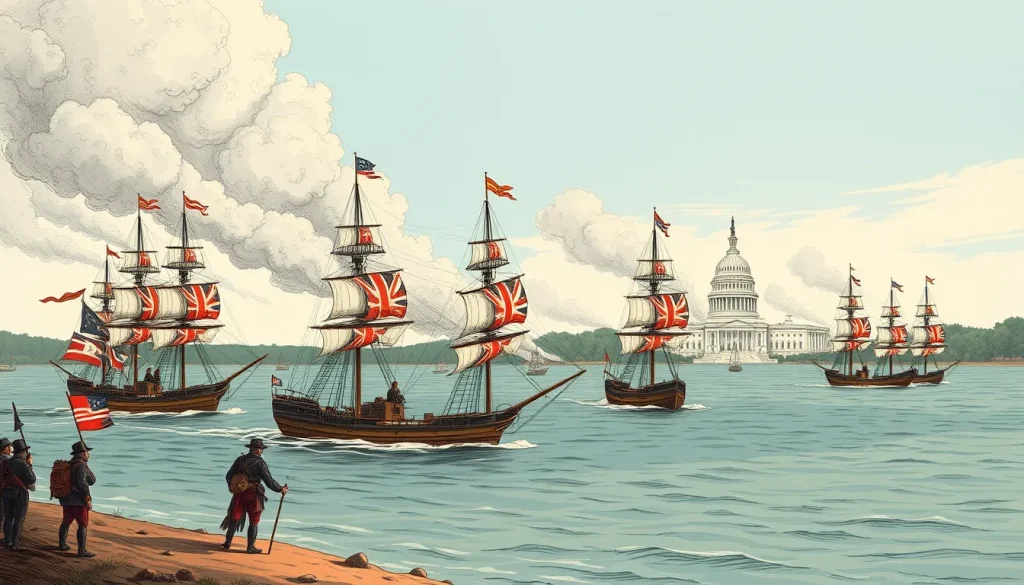
The British Invasion of the Chesapeake (1813–1814) was a series of naval raids and military operations conducted by the Royal Navy and British Army against the Chesapeake Bay region of the United States during the War of 1812. The campaign was designed to divert American forces from the Canadian frontier, disrupt the region’s economy, and strike at strategic targets, most notably Washington, D.C., and Baltimore. It culminated in the burning of the nation’s capital and the failed bombardment of Fort McHenry, an event that inspired the American national anthem.
Historical Context
The War of 1812 had reached a stalemate by its second year, with American invasions of Canada repulsed and the British imposing a naval blockade on the American coast. The United States was ill-prepared for war, with a small regular army and a navy vastly outnumbered by the Royal Navy. In the Chesapeake Bay region, the economy depended heavily on maritime trade and agriculture, and the area included the young capital at Washington, D.C., and the thriving port of Baltimore. The British saw the Chesapeake as a vulnerable area that could be used to pressure the American government and divert resources from the northern frontier.
The initial British naval presence in 1813 was limited to a blockade and small raids, but the situation changed dramatically in April 1814 with Napoleon’s abdication. Britain could now commit seasoned regular troops to the American war. The British war plan called for a three-pronged offensive: a thrust down Lake Champlain, an attack on New Orleans, and a campaign in the Chesapeake to seize Washington and Baltimore. Rear Admiral George Cockburn had already been conducting raids in the region for over a year, and he became the driving force behind the 1814 expedition.
What Happened
The Chesapeake campaign unfolded in two phases. In 1813, British forces under Rear Admiral George Cockburn conducted numerous raids along the bay, capturing vessels, destroying property, and seizing supplies. These raids aimed to cripple the American economy and to probe American defenses. Notable actions included the burning of Havre de Grace, Maryland, in May 1813, and the attack on Norfolk and Portsmouth, Virginia, in June 1813, which was repulsed at the Battle of Craney Island. However, the British later occupied Hampton, Virginia, and treated residents harshly. The same year, British forces also raided towns on both shores of the bay, and the region’s militias proved inadequate to halt the attacks.
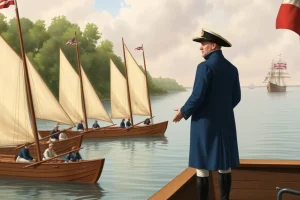
In 1814, the British launched a more concerted invasion. In August, a powerful force of ships and troops under Vice Admiral Sir Alexander Cochrane and Major General Robert Ross entered the Patuxent River. They first attacked and destroyed the American Chesapeake Flotilla at the Battles of St. Leonard Creek in June, then landed troops at Benedict, Maryland, on August 19. The American defense, composed mostly of militia, was routed at the Battle of Bladensburg on August 24. That evening, British troops entered Washington, D.C., and burned the Capitol, the White House, and other public buildings. The occupation lasted only about a day, as the British withdrew to their ships. Meanwhile, a squadron entered the Potomac River and forced the surrender of Alexandria, Virginia, before joining the fleet for an attack on Baltimore.
The British aimed to capture Baltimore, a key port and center for privateering. In September 1814, British troops landed at North Point, and a diversionary attack was made on the city. The American defenders, including militia and regulars, slowed the British advance in a skirmish known as the Battle of North Point on September 12. The naval bombardment of Fort McHenry on September 13–14 proved unsuccessful, and the British withdrew. The American flag flying over the fort inspired Francis Scott Key to write “The Star-Spangled Banner.” The failure at Baltimore marked the end of the Chesapeake campaign.
Why It Matters
The Chesapeake campaign had significant military, political, and psychological consequences. The burning of Washington was a major humiliation for the United States, but it also galvanized American resolve and was used as a rallying point. The successful defense of Baltimore restored American confidence and proved that British forces could be repelled. Strategically, the campaign diverted American troops away from the Canadian frontier, but it also failed to force the United States to sue for peace. The raids and occupation caused considerable destruction and suffering, particularly for civilians, and also had consequences for enslaved African Americans, many of whom used the British offers of freedom to escape. The campaign contributed to negotiations at Ghent, as both sides realized the war was destructive and inconclusive. In historical memory, the Chesapeake campaign is remembered through the Battle of Baltimore and the national anthem, which enshrined the defense of Fort McHenry as a source of American identity.
Prelude
By 1814, the British had secured victory over Napoleon in Europe and could redeploy troops to North America. The Admiralty instructed Rear Admiral George Cockburn to carry out a campaign against the Chesapeake to divert American forces and to strike at the enemy’s political center. Cockburn had already reconnoitered the region during 1813 and knew the waterways and defenses. The American force in the Chesapeake consisted of the regular Army, largely committed to the northern frontier, and untrained militia. The U.S. Navy’s Chesapeake Flotilla, commanded by Commodore Joshua Barney, consisted of a small squadron of gunboats and barges designed for harbor defense. The stage was set for a major offensive.
Forces and Commanders
The British forces in the 1814 Chesapeake campaign were commanded by Vice Admiral Sir Alexander Cochrane, Rear Admiral George Cockburn, and Major General Robert Ross. They led a fleet of about 50 warships and transports, carrying approximately 4,500 regular troops. Supporting the army were the Colonial Marines, a unit composed of escaped enslaved Americans who fought for Britain. The American forces were led by President James Madison, who served as commander-in-chief, and Commodore Joshua Barney of the Navy. The defense of Washington was placed under Brigadier General William H. Winder, a Maryland lawyer with limited military experience. American forces consisted mostly of militia, with some regulars and volunteer units. The defense of Baltimore was coordinated by Major General Samuel Smith of the Maryland militia.
Battlefield and Map Context
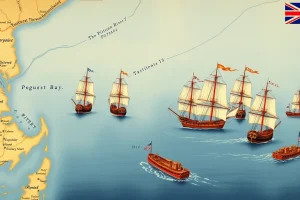
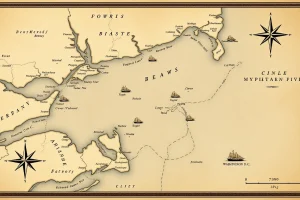
The Chesapeake Bay and its tributaries provided the British with easy access to the American heartland. The bay is a large estuary with deep channels that allowed large warships to navigate close to shore. The campaign took place in a region of marshlands, rivers, and rolling farmland. Key geographic points included the Patuxent River, which allowed the British to land at Benedict and advance overland to Washington; the Potomac River, which provided a water approach to the capital; and the Patapsco River, leading to Baltimore. The British exploited their naval superiority to move troops rapidly along the water, while the Americans were forced to rely on slow-moving militia and limited coastal defenses.
Battle Chronology
The Chesapeake campaign can be understood as a series of connected operations in 1814. On June 1 and 2, American and British forces fought the Battles of St. Leonard Creek, where the Chesapeake Flotilla engaged British warships and delayed their advance. In August, the British entered the Patuxent and destroyed the remaining flotilla. They then marched overland and fought the Battle of Bladensburg on August 24, which was a decisive British victory. The same day, British troops entered Washington and burned public buildings. From August 28 to September 3, the British captured and occupied Alexandria, Virginia, after its officials surrendered. On September 12, the British fought an inconclusive engagement at the Battle of North Point. The naval bombardment of Fort McHenry followed on September 13–14, ending with the British withdrawal. The campaign concluded with the British fleet sailing away on September 16.
Casualties and Losses
Exact numbers for the Chesapeake campaign vary among sources, but the human cost was significant. At the Battle of Bladensburg, American losses were approximately 26 killed, 51 wounded, and 100 missing or captured; British casualties were about 64 killed and 185 wounded. At North Point, the British reported about 46 killed and 273 wounded, while American losses were about 12 killed and 50 wounded. The bombardment of Fort McHenry caused little loss of life but substantial property damage. The burning of Washington destroyed the Capitol, the White House (President’s House), and other federal buildings, with an estimated property loss of several hundred thousand dollars at the time. The raids also resulted in the destruction of many private homes, public buildings, and vessels, though accurate accounting is elusive.
Result
The British achieved the capture and burning of Washington, which was a symbolic and political victory. However, they failed to take Baltimore, which proved to be a well-defended target. The campaign did not achieve the strategic goal of forcing the United States to sue for peace, and the British withdrew from the Chesapeake by the end of September 1814. The overall war ended in a stalemate with the Treaty of Ghent in December 1814, and the Chesapeake campaign had no direct bearing on the negotiations other than to demonstrate the destructive potential of the conflict.
Strategic Consequences
The Chesapeake campaign had several strategic consequences. It showed that the United States was vulnerable to seaborne assaults and that its defensive preparations were inadequate. The failure to secure Baltimore, however, gave Americans a sense of defiance and bolstered national confidence. The campaign also affected the course of the war in other theaters: the British troops used in the Chesapeake could not be employed elsewhere, and the American focus on home defense reduced pressure on the Canadian frontier. The burning of Washington fueled American resentment and contributed to the “Second War of Independence” narrative. Long-term, the campaign led to stronger coastal defenses and a more professional officer corps in the American army after the war.
Primary Accounts
Primary sources for the Chesapeake campaign include official reports from British and American commanders, as well as personal diaries and letters. Rear Admiral George Cockburn’s dispatches to the Admiralty provide insight into the British perspective. American accounts include the correspondence of President James Madison and the personal recollections of Dolley Madison, who famously saved the Gilbert Stuart portrait of George Washington during the evacuation of the White House. An important British source is the memoir of Major General Robert Ross, though he was killed at North Point; his dispatch describing the burning of Washington survives. The American defense of Baltimore is documented in the reports of General Samuel Smith and the testimony of officers at Fort McHenry. These sources offer differing viewpoints and must be interpreted with awareness of their partisan context.
Battlefield Today
Today, many sites of the Chesapeake campaign are preserved and accessible to the public. The Star-Spangled Banner National Historic Trail commemorates the events of 1813–1814, and includes sites in Maryland, Virginia, and Washington, D.C. Key locations include the U.S. Capitol and the White House, which were rebuilt after the fire; Fort McHenry in Baltimore, now a national monument and historic shrine; and the Battle of Bladensburg battlefield, which is partially preserved. St. Leonard’s Creek is part of the trail, and a marker commemorates the Chesapeake Flotilla. The National Park Service interprets the campaign through exhibits and guided tours.
Primary Sources
Primary sources are essential for understanding the British Invasion of the Chesapeake. Official reports from British and American commanders, such as Cockburn’s dispatches and American militia reports, provide detailed accounts of the operations. Personal letters and diaries, including the writings of Dolley Madison, offer a civilian perspective. The memoirs of Joshua Barney describe the naval engagements. Published collections, such as The Naval War of 1812: A Documentary History, contain many relevant documents. These sources vary in accuracy and bias, so historians cross-reference them to reconstruct events. For example, British accounts may downplay destruction, while American accounts may exaggerate losses. Researchers should consult multiple sources and consider the context in which each was created.
Further Reading
- Neimeyer, Charles P. The Chesapeake Campaign 1813–1814. Washington, D.C.: Center of Military History, U.S. Army, 2014.
- Hickey, Donald R. The War of 1812: A Forgotten Conflict. Urbana: University of Illinois Press, 1989.
- Eshelman, Ralph E., and Donald G. Shomette. No Time for Mourning: The Chesapeake Campaign of 1814. Centreville, MD: Tidewater Publishers, 1997.
- Swanson, John Joseph. Star-Spangled Banner National Historic Trail: A Guide to the Chesapeake Campaign. Washington, D.C.: National Park Service, 2019.
- Brodine, Charles E. Jr. “War Visits the Chesapeake.” Naval History magazine, October 2014.
References
- National Park Service, “1814 Chesapeake Campaign,” Star-Spangled Banner National Historic Trail, accessed 2025, https://nps.gov/stsp/learn/historyculture/1814-chesapeake-campaign.htm.
- National Park Service, “War in the Chesapeake,” Star-Spangled Banner National Historic Trail, accessed 2025, https://www.nps.gov/stsp/learn/historyculture/chesapeake-at-war.htm.
- Neimeyer, Charles P. The Chesapeake Campaign 1813–1814. Washington, D.C.: U.S. Army Center of Military History, 2014. https://www.govinfo.gov/content/pkg/GOVPUB-D114-PURL-gpo52923/pdf/GOVPUB-D114-PURL-gpo52923.pdf.
- Brodine, Charles E. Jr. “War Visits the Chesapeake.” Naval History Magazine 28, no. 5 (October 2014). https://www.usni.org/magazines/naval-history-magazine/2014/october/war-visits-chesapeake.
- National Park Service, “1813 Chesapeake Campaign,” Star-Spangled Banner National Historic Trail, accessed 2025, https://nps.gov/stsp/learn/historyculture/1813-chesapeake-campaign.htm.
FAQ
Why did the British invade the Chesapeake Bay?
The British aimed to divert American troops from the Canadian frontier, disrupt the American economy, and strike at the political and commercial heart of the United States. After Napoleon's defeat in 1814, Britain had additional troops to launch a larger campaign in the Chesapeake.
What were the major events of the British Invasion of the Chesapeake?
The campaign included the blockade and raids of 1813, the Battles of St. Leonard Creek, the Battle of Bladensburg, the burning of Washington, the capture of Alexandria, the Battle of North Point, and the bombardment of Fort McHenry.
How did the British invasion affect the War of 1812?
The invasion diverted American resources and caused substantial destruction, but the successful defense of Baltimore boosted American morale. The campaign contributed to the stalemate and influenced peace negotiations at Ghent, which ended the war.
Leave a Reply