
Short Answer
Fort Mackinac, situated on Mackinac Island at the strategic junction of Lake Huron and Lake Michigan, played a decisive role in the War of 1812. On July 17, 1812, a British and Indigenous force captured the fort from its surprised American garrison—the first land engagement of the war on American soil. The fort remained in British hands for the rest of the conflict, a key factor in controlling the upper Great Lakes and securing Indigenous alliances, despite an American attempt to retake it in August 1814.
Historical Context
The Straits of Mackinac were vital to the Great Lakes fur trade and to communication routes linking the Northwest, Upper Canada, and the eastern United States. Mackinac Island commanded the waters between Lake Michigan and Lake Huron, giving its holder influence over both the trade and the Indigenous nations of the region. The British had established a fort on the island in 1780–81, moving from Fort Michilimackinac on the mainland. Under the Jay Treaty of 1796, the post was transferred to the United States, and the British built Fort St. Joseph on St. Joseph Island as a replacement. From 1796 to 1812, the Americans occupied Fort Mackinac, but its isolated location made reinforcement difficult. When the United States declared war on Great Britain in June 1812, the American garrison at Mackinac did not immediately receive word, leaving Lieutenant Porter Hanks and about sixty-one men—mostly artillerymen—unaware of the conflict. In Upper Canada, Major General Isaac Brock recognized the strategic importance of Mackinac and directed the commander at Fort St. Joseph, Captain Charles Roberts, to act if war broke out.
What Happened
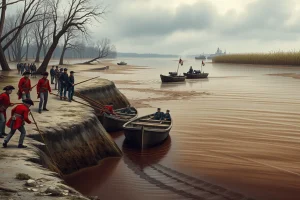
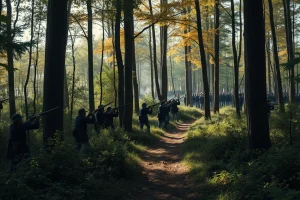
Capture, July 17, 1812. On July 16, Roberts assembled a force of approximately 45 regulars of the 10th Royal Veteran Battalion, a handful of gunners, about 200 fur traders and voyageurs from the North West Company, and some 400 Indigenous warriors from the Ottawa, Ojibwe, and Menominee nations. They embarked in the schooner Caledonia, seventy war canoes, and ten bateaux, landing on the north side of Mackinac Island early the next morning. Roberts’s men hauled a 6-pounder cannon through the woods to a height overlooking the fort. After firing a single shot, Roberts sent a demand for surrender, warning that the Indigenous warriors around the fort could not be restrained if fighting began. Lieutenant Hanks, with no expectation of relief and greatly outnumbered, surrendered Fort Mackinac without a battle. No one was killed or wounded on either side. The garrison was taken prisoner and later paroled.
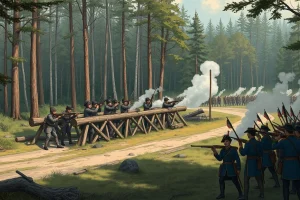
American Attempt in 1814. Following American naval victories on Lake Erie in 1813, the British supply line to Mackinac was stretched, and the Americans planned an expedition to recapture the island. In July 1814, a fleet under Captain Arthur Sinclair, with troops commanded by Lieutenant Colonel George Croghan, arrived at Mackinac. The British had reinforced the garrison under Lieutenant Colonel Robert McDouall, who built a new blockhouse and palisade, named Fort George, on a rise north of the old fort. On August 4, 1814, the Americans landed on the island and advanced toward Fort George. McDouall placed regulars, militia, and two field guns on a ridge, with Indigenous warriors on the flanks. The American attack was repulsed after fierce fighting; the Americans lost 19 killed and 45 wounded, while the British reported no losses. Croghan withdrew and re-embarked his forces. The Americans left two schooners to intercept British traffic, but the fort remained under British control.
Why It Matters
The bloodless capture of Fort Mackinac in 1812 had immediate and far-reaching consequences. Control of the fort gave the British and their Indigenous allies command of the Straits of Mackinac and the upper Great Lakes trade routes. It also signaled to the region’s Indigenous nations that the British could and would act, prompting many who had been neutral or undecided to ally with the British. This contributed directly to General William Hull’s decision to abandon his invasion of Upper Canada and subsequently surrender Detroit in August 1812. For the remainder of the war, the fort served as a base for British raids and maintained a critical link between the Northwest and Upper Canada. The failed American recapture attempt in 1814 demonstrated the difficulty of projecting force into the upper lakes. After the Treaty of Ghent, the fort was returned to the United States in 1815. Historians have viewed the capture of Mackinac as a masterstroke of initiative that shaped the war in the northwest, while also emphasizing its role in strengthening Indigenous alliances and delaying American recovery of the region.
Historical Map Context
Fort Mackinac occupied a high limestone bluff on Mackinac Island, strategically overlooking the Straits of Mackinac, the only water connection between Lake Michigan and Lake Huron. The island lay at the center of the Great Lakes system, controlling access to the fur-trading regions of the Northwest (modern Michigan, Wisconsin, and Minnesota) and the communication routes between Detroit and the Upper Lakes. The fort’s position on the island’s bluffs made it difficult to attack from below, but its western side was overlooked by higher ground, a vulnerability exploited in 1812.
Modern Location
Fort Mackinac is located on Mackinac Island, Michigan, today a state historic park. The island and fort are preserved as a living history museum, with original and restored buildings from the 1780s through the 1890s. The site is accessible only by ferry or plane, and the fort remains a major tourist attraction and center for historical interpretation.
Events at the Site
The fort was the site of two significant War of 1812 engagements: the British capture on July 17, 1812, and the American attack on August 4, 1814. The 1812 capture was a bloodless surrender after the British positioned a cannon on the heights above the fort. The 1814 battle saw fighting along a ridge north of the fort, with the Americans unsuccessful in their attempt to retake it. After the war, the fort continued as an American military post until 1895, serving various purposes, including a garrison during the Civil War.
Associated People
Key individuals connected to Fort Mackinac during the War of 1812 include Captain Charles Roberts, the British commander who captured the fort; Lieutenant Porter Hanks, the American commander who surrendered; Lieutenant Colonel Robert McDouall, who led the successful defense in 1814; American Lieutenant Colonel George Croghan, who commanded the attacking force; Captain Arthur Sinclair, commander of the American naval squadron; and Major General Isaac Brock, who authorized the attack. Additionally, William Hull, commander of the American Army of the Northwest, saw his invasion of Canada collapse in part due to Mackinac’s fall.
Surviving Monuments and Site
Fort Mackinac is remarkably well preserved. The original stone ramparts, the South Sally Port, and the Officer’s Stone Quarters date from the 1780s. Many other buildings within the fort have been restored to their appearance in the late nineteenth century. The site also includes the site of British Landing, where Roberts’s force came ashore in 1812, and the nearby location of Fort George, the temporary British fortification built in 1814. The Mackinac State Historic Parks operate the fort as a museum, with interpretive programs, historical reenactments, and exhibits.
Primary Sources
Primary sources for Fort Mackinac during the War of 1812 include official military reports, letters, and diaries. Captain Charles Roberts’s report to his superiors after the capture details his force’s composition and the surrender. Lieutenant Porter Hanks’s court-martial records and related correspondence provide the American side. For the 1814 battle, Lieutenant Colonel Robert McDouall’s correspondence and Lieutenant Colonel George Croghan’s report are essential. British and American officers’ letters, as well as the memoir of trader and interpreter Michael Dousman, who served as a messenger on Mackinac Island, add context. These documents are housed in archives such as the National Archives of Canada, the Library and Archives Canada, and the U.S. National Archives. Published collections, including the Documentary History of the Campaign upon the Niagara Frontier and the Michigan Historical Collections, contain some of these materials. Caution is needed because many accounts were written with a view to justifying actions or negotiating the aftermath of the war.
Further Reading
- Berton, Pierre. The Invasion of Canada: 1812–1813. Toronto: McClelland & Stewart, 1980.
- Hickey, Donald R. The War of 1812: A Forgotten Conflict. Urbana: University of Illinois Press, 1989.
- Latimer, Jon. 1812: War with America. Cambridge, MA: Harvard University Press, 2007.
- Grodzinski, John R. “Battle of Mackinac Island.” The Canadian Encyclopedia, accessed 2025.
- Mackinac State Historic Parks. “Fort Mackinac History.” Accessed 2025.
- American Battlefield Trust. “Fort Mackinac Battle Facts and Summary.” Accessed 2025.
References
- American Battlefield Trust. “Fort Mackinac Battle Facts and Summary.” Accessed 2025. https://www.battlefields.org/learn/war-1812/battles/fort-mackinac.
- Grodzinski, John R. “Battle of Mackinac Island.” The Canadian Encyclopedia. Published 2012, updated 2022. https://thecanadianencyclopedia.ca/en/article/battle-of-mackinac-island.
- “Capture of Fort Mackinac – War of 1812.” The War of 1812 Website. Accessed 2025. https://thewarof1812.org/battles/capture-of-fort-mackinac/.
- Mackinac State Historic Parks. “Fort Mackinac History.” Accessed 2025. https://www.mackinacparks.com/explore/history/fort-mackinac-history/.
- Hele, Karl S. “Fort Mackinac.” The Canadian Encyclopedia. Published 2025. https://thecanadianencyclopedia.ca/en/article/fort-mackinac.
FAQ
Why was Fort Mackinac so strategically important in the War of 1812?
Fort Mackinac controlled the Straits of Mackinac, the only navigable connection between Lake Michigan and Lake Huron. Its possession regulated the fur trade, communication routes to the Northwest, and alliances with Indigenous nations, making it a vital stronghold for either side.
Who captured Fort Mackinac in 1812?
A British force under Captain Charles Roberts, including regulars, fur traders, and about 400 Indigenous warriors, captured Fort Mackinac on July 17, 1812. The American garrison, unaware of the declaration of war, surrendered without resistance.
Did the Americans ever retake Fort Mackinac?
No. American forces attempted to recapture the fort in August 1814 but were repulsed at the Battle of Mackinac Island. The fort remained in British hands until it was returned to the United States as part of the Treaty of Ghent in 1815.
Leave a Reply