

Short Answer
The Battle of Cook’s Mills, fought on 19 October 1814, was the final engagement between American and British regular forces on the Niagara frontier during the War of 1812. Located near the present-day city of Welland, Ontario, the skirmish occurred when an American foraging expedition encountered a British reconnaissance column. Although both sides withdrew after several hours of fighting, the battle effectively ended American offensive operations in Upper Canada for the remainder of the war.
Historical Context
By the autumn of 1814, the Niagara Peninsula had been a battleground for over two years. In July, an American army under Major General Jacob Brown had captured Fort Erie and defeated British forces at the Battle of Chippawa, but suffered a bloody stalemate at Lundy’s Lane. The British, commanded by Lieutenant General Gordon Drummond, laid siege to Fort Erie from August until 21 September, when they abandoned the siege and withdrew to a strong defensive line along the Chippawa River. The American garrison at Fort Erie, weakened by disease and supply shortages, was reinforced in October by a division commanded by Major General George Izard, who had marched overland from Plattsburgh, New York. Izard took overall command, but his cautious leadership contrasted with Brown’s aggressive instincts. Brown left with part of the army for Sackets Harbor, leaving Izard with approximately 6,000 men.
Izard sought to draw the British from their fortified position at Chippawa and to secure supplies for his garrison. The British controlled the flour mills at Cook’s Mills, a settlement on Lyon’s Creek in Crowland Township, about eight miles from Fort Erie. On 18 October, Izard dispatched a brigade under Brigadier General Daniel Bissell to destroy that supply source and, if possible, provoke Drummond into a general action.
What Happened
Bissell’s force, numbering between 900 and 1,200 men, marched from Fort Erie to Cook’s Mills, arriving late in the afternoon of 18 October. The Americans camped on the Yokom farm south of Lyon’s Creek, with their commander occupying the farmhouse. The next morning, a British column under Lieutenant Colonel Christopher Myers, the deputy quartermaster general for Upper Canada, approached from the north. Myers had about 750 men, including detachments from the 82nd, 100th, and 104th Regiments, the Glengarry Light Infantry, and a six-pounder cannon and Congreve rockets.
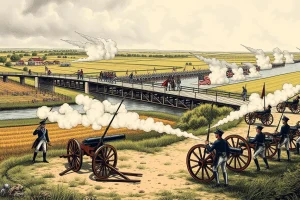
At dawn on 19 October, the British attacked the American picket at Misener’s Hollow, east of the mills. The Americans retreated toward their main body, which was concealed in the woods along the creek. Myers ordered his artillery and rockets to fire into the forest, attempting to goad the Americans into an open field. Although the cannonade inflicted casualties, the bulk of the American force remained under cover. Observing American movements on his flanks, Myers feared encirclement and ordered a disciplined withdrawal. The Americans pursued briefly but then returned to the mills, where they destroyed stored wheat and flour—reportedly 200 bushels of wheat—by throwing it into the millpond. The next day, Bissell withdrew his force back to Fort Erie, having accomplished his immediate objective but failing to draw the British into a decisive battle.
Why It Matters
The Battle of Cook’s Mills is significant as the last major skirmish on the Niagara frontier between regular forces. It demonstrated the tactical stalemate that had developed: neither side could dislodge the other from strong defensive positions. The American foraging mission succeeded, but at the cost of revealing that Drummond would not be lured from his defences. Within days, Izard received intelligence that British warships dominated Lake Ontario, threatening his lines of communication. He therefore decided to abandon Fort Erie, demolishing its fortifications on 5 November and withdrawing across the Niagara River. The British, equally exhausted, did not rebuild the fort. The frontier returned to the approximate status quo of 1812.
Historians have interpreted the battle in different ways. Some emphasize it as an American tactical victory, citing the successful destruction of British supplies and the withdrawal of Myers’ column. Others view it as a strategic British success, because the Americans failed to break the Chippawa line and subsequently evacuated Canadian territory. The engagement also illustrates the exhaustion of both armies after three years of campaigning.
Prelude
Following the conclusion of the Siege of Fort Erie on 21 September 1814, British forces under Gordon Drummond withdrew to Chippawa, destroying bridges over the Chippawa River and entrenching on the north bank. Major General George Izard, newly arrived from Plattsburgh, assumed command of the American forces at Fort Erie. He initially attempted to cross the Chippawa, but the river was unfordable and the bridges were gone. After a brief artillery exchange on 16 October, Izard decided to send a flying column to destroy the flour supplies at Cook’s Mills, hoping to both deny the British resources and provoke a move from their fortifications.
Forces and Commanders
American: Brigadier General Daniel Bissell commanded the expedition, roughly 900 to 1,200 strong, comprising the 5th, 14th, 15th, and 16th U.S. Infantry Regiments, with detachments of riflemen and dragoons. Bissell had served in the regular army since the 1790s and was known as a strict disciplinarian.
British/Canadian: Lieutenant Colonel Christopher Myers led the reconnaissance force of approximately 750 men, drawn from the 82nd, 100th, and 104th Regiments, the Glengarry Light Infantry, and a small artillery detachment with one six-pounder gun and six Congreve rockets. Myers was the deputy quartermaster general for Upper Canada and had experience in the Peninsula War.
Battlefield and Map Context
The battle took place around the settlement of Cook’s Mills, situateed on Lyon’s Creek (also spelled Lyons Creek) in Crowland Township, which is now within the city of Welland, Ontario. The terrain consisted of open fields bordered by dense woods, with the mill, a house, and several outbuildings forming a small hamlet. Modern geographic coordinates are approximately 42°59′52″N 79°10′30″W.
Battle Chronology
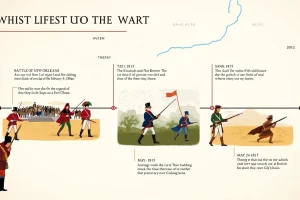
18 October: Bissell’s force arrived at Cook’s Mills in the late afternoon, camping on the Yokom farm south of the creek. The Americans posted pickets and seized the mill.
19 October, early morning: Myers’ column approached from the north. The first clash occurred at Misener’s Hollow, east of the mills, where the American picket was driven back.
Mid-morning: The British formed line and fired artillery and rockets into the woods where the main American force was sheltered. The exchange lasted approximately half an hour.
Later morning: Fearing envelopment, Myers ordered an orderly retreat. The Americans pursued only a short distance before returning to the mills.
Afternoon: Americans destroyed all grain found in the mill—about 200 bushels—and buried their dead near the Yokom farmhouse.
20 October: Bissell’s force withdrew to the American camp at Black Creek, and subsequently returned to Fort Erie.
Casualties and Losses
Casualty figures vary by source. The most commonly cited numbers are: British—1 killed and 35 wounded; American—12 killed and 55 wounded. Some accounts (e.g., The War of 1812 website) give British killed as 5, but the Encyclopedia of the War of 1812 and the Canadian Encyclopedia support 1 killed and 35 wounded. The American killed were likely buried in shallow pits at the Yokom farm. The loss of wheat was economically significant but was offset days later when American provision boats, unaware of Izard’s retreat, were captured by the British.
Result
The battle was tactically inconclusive. Myers withdrew first, but Bissell also retired the next day. American sources claim victory because they secured the mill and destroyed supplies, while British sources claim success because their reconnaissance mission was completed and the Americans did not advance further. The strategic result was a continuation of the stalemate, leading to the American evacuation of Fort Erie on 5 November.
Strategic Consequences
Cook’s Mills marked the end of offensive operations on the Niagara frontier. The Americans abandoned their bridgehead in Canada, and the British, despite moving to Fort Erie, chose not to rebuild its fortifications. The battle demonstrated that neither army had the strength or resolve to force a decision. It also highlighted the importance of logistics: both sides were desperately short of supplies, and the war was winding down due to exhaustion and diplomatic negotiations at Ghent.
Primary Accounts
Three direct accounts survive: Brigadier General Daniel Bissell’s official report, Lieutenant Colonel Christopher Myers’ report, and the diary of Lieutenant John Le Couteur of the 104th Foot. Bissell’s report emphasized the successful destruction of flour and his orderly withdrawal. Myers’ report stressed the reconnaissance nature of his mission and the effective artillery fire. Le Couteur’s diary provides vivid detail on the skirmish and the British retreat. These sources agree on the basic sequence but differ in emphasis, reflecting each author’s perspective.
Battlefield Today
The battlefield was designated a National Historic Site of Canada in 1921. A cairn with a plaque was erected in 1923, and the plaque was replaced in 1977. In 2013, the City of Welland opened the Battle of Cook’s Mills Peace Garden at the corner of Doan’s Ridge and Lyon’s Creek Roads, featuring interpretive panels, a mill stone memorial, and park benches. The site is accessible year-round and is part of the Welland’s War of 1812 Trail, which includes markers for the American camp and the mill location. The current landscape has changed due to the construction of the Welland Canal and urban development, but the core battlefield area near Lyon’s Creek remains preserved.
Primary Sources
The most important primary sources are the official reports of Brigadier General Daniel Bissell and Lieutenant Colonel Christopher Myers, both published in Ernest Cruikshank’s The Documentary History of the Campaign upon the Niagara Frontier (reprinted by the University of Calgary). Lieutenant John Le Couteur’s diary, Merry Hearts Make Light Days: The War of 1812 Journal of Lieutenant John Le Couteur, edited by Donald E. Graves, provides a first-hand British perspective. Additionally, war-loss claims filed by Crowland Township residents, including Captain Henry Buchner, offer civilian accounts of the battle’s aftermath. Each source is biased by national perspective and military rank, but together they allow a balanced reconstruction.
Further Reading
- Heidler, David S., and Jeanne T. Heidler, eds. Encyclopedia of the War of 1812. ABC-CLIO, 1997.
- Hickey, Donald R. The War of 1812: A Forgotten Conflict. University of Illinois Press, 1989.
- Latimer, Jon. 1812: War with America. Harvard University Press, 2007.
- Currie, J. Phillip. The Niagaras: A History of the Niagara Frontier. Natural Heritage Books, 2001.
- Parks Canada. “Battle of Cook’s Mills National Historic Site.” https://www.parks.canada.ca/lhn-nhs/on/cooksmills
References
- Parks Canada. “Battle of Cook’s Mills National Historic Site.” Accessed June 2025. https://www.parks.canada.ca/lhn-nhs/on/cooksmills
- “Battle of Cook’s Mills – War of 1812.” The War of 1812 Website. Accessed June 2025. https://thewarof1812.org/battles/battle-of-cooks-mills/
- “Battle of Cook’s Mills.” Wikipedia. Accessed June 2025. https://en.wikipedia.org/wiki/Battle_of_Cook%27s_Mills
- Dale, Ronald J. “Battle of Cook’s Mills National Historic Site of Canada.” The Canadian Encyclopedia. Last edited December 16, 2013. https://thecanadianencyclopedia.ca/index.php/en/article/battle-of-cooks-mills-national-historic-site-of-canada
- City of Welland. “Cooks Mills War of 1812 Trail.” Accessed June 2025. https://www.welland.ca/community-and-recreation/parks-and-trails/cooks-mills-war-of-1812-trail/
- Cruikshank, Ernest. The Documentary History of the Campaign upon the Niagara Frontier. University of Calgary, archived.
FAQ
What was the outcome of the Battle of Cook's Mills?
Both sides withdrew after a skirmish lasting about half an hour. The Americans destroyed flour at the mill but then retired to Fort Erie; the British completed a reconnaissance and returned to their camp. The result is often described as inconclusive, though American accounts emphasize their success in seizing supplies.
Why is the Battle of Cook's Mills significant?
It was the last major engagement on the Niagara frontier between regular American and British forces. It marked the end of American offensive operations in Upper Canada and preceded the American evacuation of Fort Erie on 5 November 1814.
Who were the main commanders at Cook's Mills?
American forces were led by Brigadier General Daniel Bissell, under the overall command of Major General George Izard. The British column was commanded by Lieutenant Colonel Christopher Myers, under Lieutenant General Gordon Drummond's overall direction.




Leave a Reply