
Short Answer
The Battle of Châteauguay was fought on 26 October 1813 along the Châteauguay River in Lower Canada (modern Quebec). It was part of the War of 1812’s Saint Lawrence campaign, an American attempt to capture Montreal and sever British supply lines to Upper Canada. A numerically inferior force of Canadian regulars, militia, and Indigenous warriors under Lieutenant-Colonel Charles-Michel d’Irumberry de Salaberry turned back a larger American army under Major General Wade Hampton, contributing to the collapse of the campaign and becoming a lasting source of Canadian pride.
Historical Context
By the autumn of 1813, the War of 1812 had reached a critical stage, with the United States seeking to end British control in Upper Canada by capturing Montreal. The plan, orchestrated by U.S. Secretary of War John Armstrong, called for a two-pronged advance: Major General James Wilkinson would move down the St. Lawrence River from Sackets Harbor, while Major General Wade Hampton would drive north from Lake Champlain along the Châteauguay River. They intended to meet near the island of Île Perrot and jointly attack Montreal. Control of Montreal was vital because it was the main entrepôt for supplies and reinforcements destined for the British military and its allies in Upper Canada. The British and Canadian forces, aware of this threat, prepared defensive positions along the likely approach routes. The Châteauguay River, with its marshy, wooded terrain, offered a natural defensive line.
What Happened
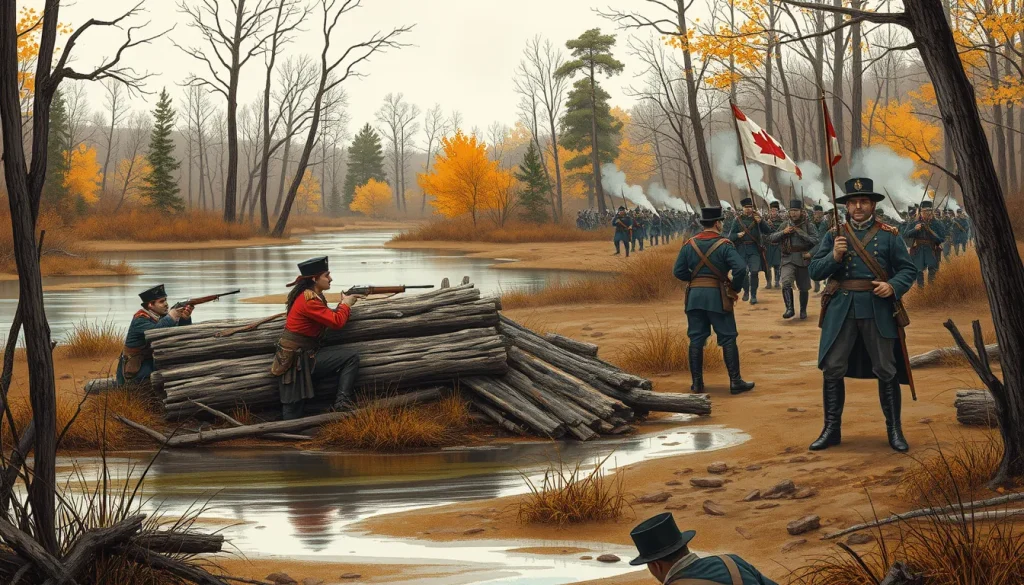
Hampton’s army, numbering about 3,000 troops, advanced from the United States into Lower Canada in October 1813. Despite his orders, a significant number of New York militia refused to cross the border, reducing his effective force. On 25 October, Hampton reached the Châteauguay River, where Canadian forces under de Salaberry had established prepared positions. De Salaberry’s command consisted of roughly 1,500 men, including the Canadian Voltigeurs (a light infantry unit), Canadian Fencibles (regular soldiers recruited in North America), embodied militia, and warriors from Kahnawake. They fortified a strong position on the river’s west bank, using the river as a barrier and swampy ground to their advantage.
Hampton devised a plan: he sent a brigade under Colonel Robert Purdy to cross the river upstream and attack the Canadian rear while another brigade, led by General George Izard, launched a frontal assault. Purdy’s detachment became lost in the dense woods, failing to get behind the Canadian lines. On the morning of 26 October, the frontal attack began but was met with disciplined fire from the entrenched defenders. The Americans, disadvantaged by the terrain and accurate Canadian firing, were broken. Hampton, receiving news via a dispatch from Secretary Armstrong that suggested the administration might not fully support the operation, ordered a retreat. The American casualties were relatively light (about 23 killed, 33 wounded, and 29 missing), but the retreat became disorderly, especially for Purdy’s men who were harassed by Indigenous warriors. The victory was decisive in local terms: the American invasion force gave up the effort, and the threat to Montreal was lifted.
Why It Matters
The Battle of Châteauguay was strategically important as a major reason for the failure of the American Saint Lawrence campaign. While skirmishes along the river were small in scale, the consequences were out of proportion. The American defeat effectively ended any serious threat to Montreal during the 1813 campaign, particularly after the simultaneous American defeat at the Battle of Crysler’s Farm in November. For the Canadian defenders, the victory, achieved without direct British regular troops, became a significant source of national pride and contributed to the later emergence of Canadian nationalism. The battle is commemorated as a National Historic Site and remains a symbol of the contributions of French-speaking Canadians and Indigenous peoples to the defense of the provinces. Historians note that the battle’s legend overshadowed its actual military effects, but its role in shaping Canadian national memory is undeniable.
Prelude
In the summer of 1813, the American government decided on a major offensive to capture Montreal. Major General Wade Hampton was ordered to move his division from Plattsburgh, New York, northward along the Châteauguay River, while Major General James Wilkinson’s forces descended the St. Lawrence. The plan aimed to combine near Montreal and take the city. Hampton’s army, composed mainly of regular troops and militia, faced significant difficulties: supply shortages, poor roads, and a river that was difficult to navigate. On 21 October, Hampton’s force crossed the border and advanced into Lower Canada. Learning of the American approach, Lieutenant-Colonel Charles-Michel de Salaberry organized a defense with troops drawn from the Canadian Voltigeurs (a light infantry unit raised in Lower Canada), the Canadian Fencibles, embodied militia, and Kahnawake warriors. De Salaberry selected a defensible position along the Châteauguay River, about 35 miles from Montreal, where the river made a sharp bend and swampy ground limited access.
Forces and Commanders
The American forces were led by Major General Wade Hampton, a veteran of the U.S. Army. His command comprised about 3,000 men, including regular infantry and New York militia, though roughly 1,000 militiamen refused to cross the border (they cited constitutional obligations). Brigadier General George Izard commanded one brigade, and Colonel Robert Purdy another. The Canadian force was commanded by Lieutenant-Colonel Charles-Michel d’Irumberry de Salaberry, a French-Canadian officer of the British Army. His force consisted of approximately 1,500 men: the Canadian Voltigeurs (a light infantry corps), Canadian Fencibles, three battalions of embodied militia, and a contingent of Kahnawake (Mohawk) warriors. De Salaberry had also constructed defensive works—abatis and breastworks—behind which his men could fight securely. The Indigenous warriors were experienced in woodland combat and served as skirmishers and scouts.
Battlefield and Map Context
The battlefield was located on the Châteauguay River in Lower Canada, present-day Quebec, near the modern town of Ormstown. The site is preserved as Battle of the Châteauguay National Historic Site of Canada. The terrain consisted of the river itself, wooded and marshy banks, and swampy areas to the west. De Salaberry’s defensive line ran along the river’s west bank, and he placed his main force near a fordable point, protected by abatis and a ravine. The American approach came from the south along the river’s east side. The battlefield’s geography heavily favored the defenders, as the river and swamp channeled any attack into narrow fronts suitable for defensive fire.
Battle Chronology
25 October: Hampton’s army arrived near the Châteauguay River and skirmished with Canadian pickets. That evening, Hampton sent Colonel Purdy with 1,500 men to cross the river upstream, intending to move behind the Canadian positions. Purdy’s force became lost in the woods and made little progress.
26 October: At dawn, American forces under Hampton and Izard launched a frontal assault against the Canadian barricade. The defenders, well concealed, repelled the attack with heavy fire. Purdy’s detachment, unable to find the correct path, eventually appeared on the opposite bank but could not get behind the Canadian lines and came under fire from the defenders and Indigenous warriors. By mid-afternoon, Hampton decided to withdraw, fearing he faced a much larger force and lacking confidence in support from Washington. The retreat was disorderly, especially for Purdy’s men, who were attacked by the Kahnawake warriors.
Casualties and Losses
Losses at Châteauguay were relatively light. American sources report 23 killed, 33 wounded, and 29 missing. Canadian casualties were 2 killed, 16 wounded, and 4 missing. Indigenous casualties are not systematically recorded, but are considered minimal. The low casualty figures, however, do not diminish the battle’s strategic impact.
Result
The battle was a clear tactical and strategic victory for the Canadian force. The Americans retreated to their base, effectively ending any further offensive operations against Montreal in 1813. Although some historians describe the battle as a series of skirmishes rather than a full-scale engagement, its result was decisive in that it derailed the Saint Lawrence campaign. The victory also elevated de Salaberry to hero status in the colonies and later in Canadian national mythology.
Strategic Consequences
The immediate consequence was that Montreal remained under British control, preserving the line of communication with Upper Canada. The failure of Hampton to penetrate Lower Canada, combined with Wilkinson’s defeat at Crysler’s Farm in November, meant that the Saint Lawrence campaign collapsed. For the United States, the defeat contributed to a reevaluation of the war’s objectives and reinforced the idea that capturing Canada would be more difficult than originally anticipated. For the British and Canadian colonies, the victory bolstered morale and demonstrated that colonial forces could defend their homeland effectively. The battle also had a long-term effect on Canadian national identity, particularly for French Canadians, who took pride in the role played by the Canadian Voltigeurs and militia.
Primary Accounts
Primary sources for the Battle of Châteauguay include official reports and letters written by participants. Wade Hampton submitted a report to the U.S. Secretary of War after the battle, detailing his reasons for retreat. Charles-Michel de Salaberry wrote an official dispatch describing the Canadian victory. These reports are housed in archives such as the Library and Archives Canada and the U.S. National Archives. Another valuable source is the memoir of François Ducharme, a soldier who fought with the Voltigeurs. These accounts, while valuable, must be read with caution: commanders often exaggerated enemy numbers or downplayed their own mistakes. No exact transcript is provided here, but the documentary record is accessible through the databases of Parks Canada and the Dictionary of Canadian Biography.
Battlefield Today
The Battle of the Châteauguay National Historic Site is located near Ormstown, Quebec, on the banks of the Châteauguay River. The site features a memorial obelisk and a visitor interpretation building, currently closed for renovations. The commemorative area allows visitors to view the terrain where the battle occurred. The site is managed by Parks Canada, which provides historical interpretation and educational materials. It was designated a National Historic Site in 1921 and is a key site for understanding the War of 1812 in Canada.
Primary Sources
The most important primary sources for the battle are the official reports of the commanding officers. Wade Hampton’s “Report of the Battle of Châteauguay” (26 October 1813) and Charles-Michel de Salaberry’s “Dispatch to Sir George Prevost” (27 October 1813) are held in archival collections. These documents outline troop strengths, movements, and justifications. Additionally, the journal of Major General George Izard provides an American perspective. The accounts, while biased, are vital for reconstructing the events. For direct access, researchers can consult the collections at Library and Archives Canada and the U.S. National Archives. The Dictionary of Canadian Biography also offers a synthesis of primary evidence related to de Salaberry.
Further Reading
- Benn, Carl. Historic Fort York, 1793-1993. Natural Heritage Books, 1993.
- Hitsman, J. Mackay. The Incredible War of 1812: A Military History. University of Toronto Press, 1965.
- Lafferty, Renée. “Battle of Châteauguay.” The Canadian Encyclopedia, Historica Canada, 2015.
- Parks Canada. “Battle of the Châteauguay National Historic Site.” Government of Canada.
- Stagg, J.C.A. The War of 1812: Conflict for a Continent. Cambridge University Press, 2012.
References
- Lafferty, Renée. “Battle of Châteauguay.” The Canadian Encyclopedia, October 23, 2011. https://prod-front.thecanadianencyclopedia.ca/en/article/battle-of-chateauguay.
- U.S. National Park Service. “Battle of the Chateauguay National Historic Site.” Accessed 20 Dec. 2024. https://www.nps.gov/places/battle-of-the-chateauguay.htm.
- Parks Canada. “Culture and history – Battle of the Châteauguay National Historic Site.” Government of Canada. Accessed 20 Dec. 2024. https://www.parks.canada.ca/lhn-nhs/qc/chateauguay/culture.
- Government of Canada. “War of 1812 – Châteauguay.” Department of National Defence. Accessed 20 Dec. 2024. https://www.canada.ca/en/department-national-defence/services/military-history/history-heritage/battle-honours-honorary-distinctions/chateauguay.html.
- Dictionary of Canadian Biography. “Battle of Châteauguay (1813).” University of Toronto/Université Laval. Accessed 20 Dec. 2024. https://www.biographi.ca/en/topics/topic-match-list.php?id=2336.
FAQ
Why is the Battle of Châteauguay considered important despite its small size?
Though light in casualties, the battle was strategically decisive: it stopped the larger American force from advancing on Montreal as part of a coordinated campaign. It also became a source of Canadian national pride, particularly among French Canadians, symbolizing successful defense of their homeland.
Who fought at the Battle of Châteauguay?
The American force was led by Major General Wade Hampton, consisting of regulars and militia. The Canadian side was commanded by Lieutenant-Colonel Charles-Michel de Salaberry, with Canadian Voltigeurs, Canadian Fencibles, embodied militia, and Kahnawake warriors.
Where is the battlefield today?
The battlefield is preserved as the Battle of the Châteauguay National Historic Site of Canada, located near Ormstown, Quebec, along the Châteauguay River. It is managed by Parks Canada.


Leave a Reply