
Short Answer
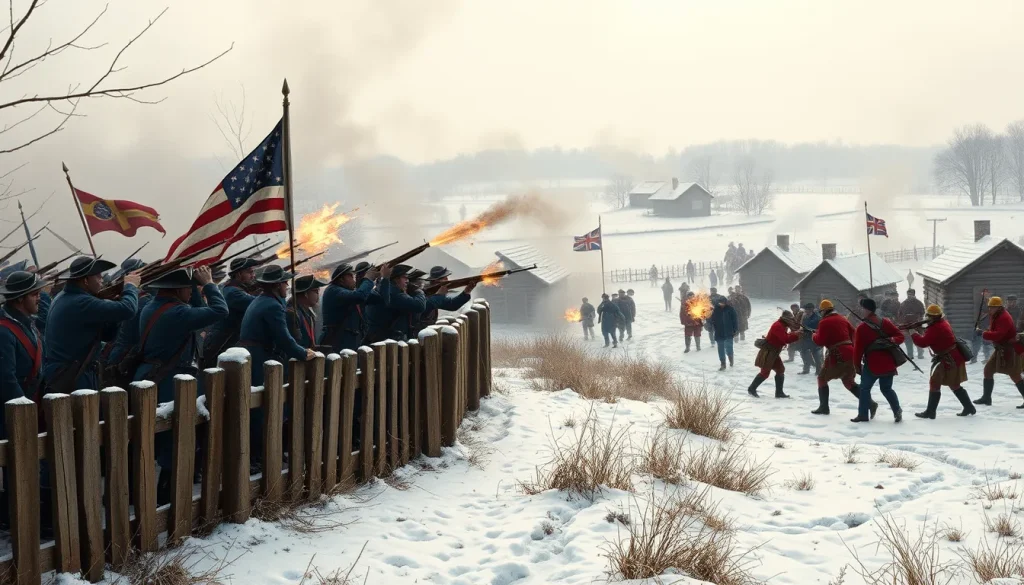
The Battle of Frenchtown, also known as the Battle of the River Raisin, took place on January 18 and 22, 1813, near present-day Monroe, Michigan. It consisted of two engagements during the War of 1812: an American attack that captured the town, and a British-led counterattack that routed the American force. The battle’s aftermath included the killing of wounded American prisoners by Indigenous warriors, an outrage that fueled the American war effort with the cry “Remember the Raisin.”
Historical Context
The Michigan Territory was a strategic frontier throughout the War of 1812. In August 1812, American forces under Brigadier General William Hull surrendered Detroit to British Major General Isaac Brock, a loss that opened the Northwest to British influence. The American government turned to Major General William Henry Harrison to command the Army of the Northwest and reclaim Detroit. Harrison’s second-in-command, Brigadier General James Winchester, led an army of Kentucky volunteers, U.S. regulars, and local militia. The British, commanded by Colonel Henry Procter, held Detroit and the nearby fort at Amherstburg, supported by several Indigenous nations—including Wyandot, Potawatomi, Odawa, and Ojibwe—who sought to protect their lands from American expansion.
What Happened
The operations around Frenchtown unfolded in distinct phases. On January 18, 1813, American Lieutenant Colonel William Lewis led about 680 Kentucky militiamen and regulars across the frozen River Raisin and drove out a small British–Indigenous detachment, thereby seizing the town. Four days later, on January 22, Procter launched a surprise counterattack with a larger force of British regulars, Canadian militia, and Indigenous warriors. The Americans, camped without proper fortifications or pickets, were overwhelmed. Although the Kentucky troops on their left initially held, the American right collapsed, and Winchester was captured. Facing encirclement and heavy losses, Winchester ordered a surrender. The next morning, January 23, a group of Indigenous warriors killed dozens of wounded American prisoners who had been left behind—an event that became known as the River Raisin Massacre.
Why It Matters
The Battle of Frenchtown was the deadliest engagement fought on Michigan soil during the War of 1812. It produced the highest number of American battle deaths in a single action of the war. The immediate consequence was a severe setback: Harrison’s planned winter campaign against Detroit collapsed, and the Americans were forced to rebuild. The massacre of prisoners outraged American public opinion, particularly in Kentucky where most of the killed and captured hailed from. “Remember the Raisin” became a powerful recruiting cry, later used in 1813 at the Battle of the Thames, when American forces defeated Procter’s army and killed the Shawnee leader Tecumseh. The battle also shaped British–Indigenous relations and contributed to harshly negative American perceptions of Indigenous warriors and British leadership.
Prelude
After the loss of Detroit, the American command sought to restore control over the Northwest. Harrison ordered Winchester to advance to the Maumee Rapids (modern Perrysburg, Ohio) and wait for reinforcement, but Winchester received information that Frenchtown—a settlement on the River Raisin—was defended only by a small British and Indigenous detachment. Acting against his orders to remain on the defensive, Winchester sent about 700 men under Colonel William Lewis to seize the town. The attack, launched on January 18, achieved its objective: the defenders—roughly 200 Canadian militia and Indigenous warriors—were driven west toward Detroit. Winchester soon moved his main force into Frenchtown, where he camped in a vulnerable position rather than constructing fortifications.
Forces and Commanders
American: Brigadier General James Winchester commanded the Army of the Northwest’s advance element. His force included about 1,000 men: the 17th U.S. Infantry, the 19th U.S. Infantry, the 1st Kentucky Volunteer Regiment, the 1st Kentucky Rifle Regiment, and the 5th Kentucky Volunteer Regiment. Lieutenant Colonel William Lewis led the initial assault on January 18; Major George Madison also served as a senior officer.
British and Indigenous: Colonel Henry Procter (sometimes spelled Proctor) commanded British forces in the Detroit region. His counterattack force on January 22 consisted of approximately 1,400 men, including regulars of the 41st Regiment of Foot, Royal Newfoundland Fencibles, Canadian militia, and sailors from the Provincial Marine. Indigenous warriors from several nations, led by chiefs Roundhead and Walk-in-the-Water, formed a substantial part of the force—perhaps 800 warriors. Procter also brought artillery, including three-pounder guns.
Battlefield and Map Context
Frenchtown was a thriving settlement on the banks of the River Raisin, approximately 35 miles (56 km) southwest of Detroit. The river, frozen in January, did not impede movement. The American camp was bordered by the river on one side, with picket fences around the left portion, but the right wing was exposed. The village is now part of Monroe, Michigan. The battlefield area is preserved today as River Raisin National Battlefield Park.
Battle Chronology
January 18: Lewis’s force arrived near Frenchtown in the afternoon, launched a charge across the frozen river, and drove out the small British–Indigenous garrison. American losses were 12 killed and 55 wounded; the defenders lost about 15 killed and 16 captured.
January 22: Procter’s force, having crossed the frozen Detroit River and marched south, launched a dawn attack. The British artillery opened fire, catching many Americans in their tents. The American left wing held for a time, but the right collapsed under pressure from militia and Indigenous warriors. Winchester was captured. After about twenty minutes of heavy fighting, the Americans tried to retreat, but they were trapped. Winchester was taken to Procter, who convinced him to order a surrender. Many Kentuckians initially refused, but eventually obeyed after seeing Major Madison. About 400 Americans escaped, but the rest were captured.
January 23: Procter withdrew with the unwounded prisoners, leaving about sixty severely wounded men in Frenchtown. Indigenous warriors returned, entered the town, and killed many of these wounded men—an act that came to be called the River Raisin Massacre.
Casualties and Losses
Accurate casualty figures vary among sources. The American force of about 1,000 suffered approximately 400 killed and 500 captured, with many of the captured later wounded. Reports list 397 killed, 80 wounded, and 547 captured. Of the prisoners, between 30 and 60 wounded men were killed on January 23. British and Indigenous casualties numbered about 182: roughly 24 killed, 158 wounded, and 3 missing. The dead included many Kentucky volunteers, which intensified American mourning.
Result
The battle was a decisive British and Indigenous victory. The Americans were routed, and the survivors either escaped or became prisoners. The British retained control of Frenchtown and the Detroit area, effectively stalling American efforts to retake Detroit until the fall of 1813.
Strategic Consequences
The defeat compelled Harrison to abandon his winter campaign and retreat to the Maumee Rapids, where he later built Fort Meigs to defend the region. Procter’s victory, however, was not followed by a further advance, and the British and Indigenous forces remained at Detroit. The massacre of prisoners inflamed American public opinion and encouraged enlistment, particularly in Kentucky. The battle also deepened the commitment of Indigenous allies to the British cause, though it strained relationships. In October 1813, Harrison’s forces defeated Procter at the Battle of the Thames, and Detroit was recaptured. The cry “Remember the Raisin” remained a potent reminder of the battle.
Primary Accounts
Contemporary accounts include official reports from Procter and Winchester, as well as letters and diaries from soldiers. British reports emphasized the discipline of regular troops and the role of Indigenous warriors, while American accounts stressed the massacre and accused the British of failing to protect prisoners. A famous engraving by W. Elton, “Massacre of the American Prisoners, at French-town,” circulated in the United States and shaped public perception. The account of one captured Kentucky rifleman, who described the events of January 22 and 23, provides a vivid soldier’s perspective.
Battlefield Today
The battlefield is located in Monroe, Michigan, along the River Raisin. In 2009, the U.S. Congress established the River Raisin National Battlefield Park, which preserves portions of the battlefield and interprets the events. The park is one of only two National Battlefield Parks dedicated to the War of 1812. Visitors can explore the site, view monuments, and learn about the battle and its casualties through interpretive exhibits.
Primary Sources
Key primary sources include:
- Official correspondence of Brigadier General James Winchester and Colonel Henry Procter, submitted to their respective commands in early 1813. These reports detail the movements and outcomes, but bias is evident in each commander’s framing.
- The narrative of Kentucky soldier Joseph N. Bourassa, who was captured and witnessed the massacre. His memoir, published later, is a harrowing account, but must be read with awareness of its retrospective nature.
- Engraving and newspaper articles published in the United States, which sensationalized the massacre and helped create the “Remember the Raisin” rallying cry. These sources can be found in archives such as the William L. Clements Library at the University of Michigan and the National Archives.
While no complete transcript of a battlefield diary is readily available, the above documents are accessible to researchers.
Further Reading
- Gilbert C. Din, War on the River Raisin: A Narrative of the Battle and Its Aftermath (1983).
- J. Mackay Hitsman, The Incredible War of 1812: A Military History (rev. ed., 1999).
- Donald R. Hickey, The War of 1812: A Forgotten Conflict (2012).
- River Raisin National Battlefield Park, National Park Service, official website and visitor guides.
References
- “River Raisin National Battlefield Park.” National Park Service. Accessed February 2025. https://www.nps.gov/places/river-raisin.htm.
- “River Raisin Battle Facts and Summary.” American Battlefield Trust. Accessed February 2025. https://www.battlefields.org/learn/war-1812/battles/river-raisin.
- “Battle of Frenchtown.” Wikipedia. Accessed February 2025. https://en.wikipedia.org/wiki/Battle_of_Frenchtown.
- “Battle of Frenchtown, 22 January 1813.” HistoryOfWar.org. Accessed February 2025. https://www.historyofwar.org/articles/battles_frenchtown.html.
- Jason Ridler, “Battle of Frenchtown.” The Canadian Encyclopedia. October 23, 2011, last edited March 4, 2015. https://thecanadianencyclopedia.ca/index.php/en/article/battle-of-frenchtown.
FAQ
Why is the Battle of Frenchtown called the River Raisin Massacre?
After the battle, Indigenous warriors killed wounded American prisoners who had been left behind, leading to the term 'River Raisin Massacre'.
What was the American casualty count at Frenchtown?
American losses were approximately 400 killed and 500 captured; many of the wounded prisoners were later killed.
What is the significance of 'Remember the Raisin'?
It was a rallying cry used by American forces, particularly Kentuckians, to avenge the battle and massacre, and it helped boost enlistment.


Leave a Reply