
Short Answer
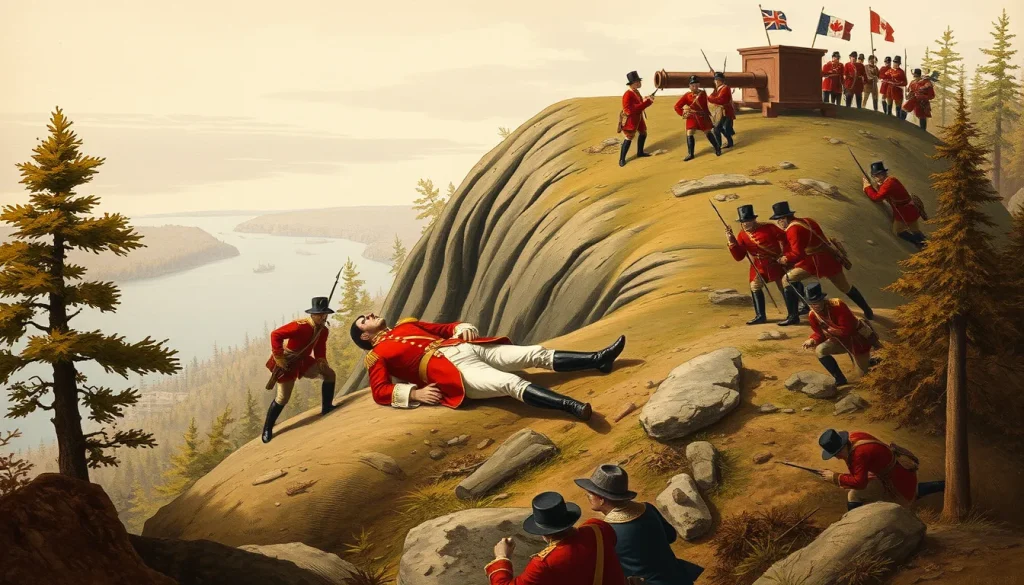
The death of Major-General Sir Isaac Brock occurred on 13 October 1812, early in the Battle of Queenston Heights, a major engagement of the War of 1812 fought near the Niagara River in Upper Canada (present-day Ontario). Brock, a British army officer celebrated for his recent capture of Detroit, was killed leading a counter-attack to retake a gun emplacement on the heights. His death, though a personal loss, did not prevent a British victory that day and became a central symbol of Canadian heroism and resistance in the war.
Historical Context
The War of 1812, declared by the United States on Great Britain in June 1812, stemmed from maritime grievances, impressment, and tensions over British support for Indigenous peoples resisting American expansion. Upper Canada, sparsely settled and defended by a small force of British regulars and local militia, was a primary American invasion target. Major-General Isaac Brock, administrator and military commander of Upper Canada, had already scored a decisive victory at the Siege of Detroit in August 1812, capturing the American garrison without a battle. That success, achieved with the support of Shawnee leader Tecumseh and his Indigenous allies, raised British morale and encouraged further aggressive action. However, Governor General George Prevost imposed a ceasefire and caution, delaying a follow-up strike. By October, American forces under Major-General Stephen Van Rensselaer, a politically appointed militia commander, were massing on the Niagara frontier, determined to avenge Detroit and seize Canadian territory.
What Happened
On the night of 12–13 October 1812, American troops crossed the Niagara River from Lewiston, New York, to land near Queenston. The initial landing was disorganized, but by dawn several hundred regulars and militia had secured the riverbank. Brock, stationed at Fort George about seven miles north, was alerted by artillery fire. He rode to Queenston, where he found a small force of British regulars and local militia contesting the landing. The Americans discovered a hidden path up the escarpment and captured a British redan, a gun emplacement that had been firing on their reinforcements. Brock, recognizing the threat, assembled about 100 men and led a charge up the hillside to retake the position. In the assault, Brock was struck by a musket ball in the chest and died almost instantly. His aide-de-camp, Lieutenant-Colonel John Macdonell, was also mortally wounded. Command fell to Major-General Roger Hale Sheaffe, who arrived from Fort George with reinforcements in the afternoon. Sheaffe executed a flanking maneuver, marching his troops west and then up the escarpment, avoiding the American line of fire. Joined by Indigenous warriors under John Norton and John Brant, as well as local militia and a corps of Black volunteers, Sheaffe’s force attacked the Americans from the rear. Trapped on the heights above the river, many Americans were killed or drowned, and approximately 958 surrendered. The British victory secured the Niagara frontier for 1812, but it came at the cost of Brock’s life.
Why It Matters
Brock’s death immediately deprived the British of their most dynamic leader in Upper Canada. His bold tactics and ability to forge alliances with Indigenous peoples had been crucial in early victories. Historians have argued that his loss was irreparable and that subsequent campaigns might have differed had he lived. In the longer term, Brock’s death transformed him from a respected officer into a martyr and national hero. The battle itself, a clear British victory, ended the American offensive of 1812 and helped consolidate support for the war among Canadian colonists. The memory of Brock, immortalized in monuments, place names, and school lessons, became a foundational element of Canadian identity. Historical interpretations have sometimes romanticized his death, but modern scholarship emphasizes both his tactical risk-taking and the broader collaborative effort, particularly the contributions of Indigenous warriors, militia, and Black volunteers, that secured the victory.
Prelude
The Battle of Queenston Heights was the culmination of American plans to invade Upper Canada along the Niagara River. After the defeat at Detroit, American forces regrouped under General Stephen Van Rensselaer, who faced political pressure to achieve a victory. Brock anticipated an attack but was unsure of the landing point, spreading his limited troops between Fort George, Queenston, and other points. Van Rensselaer chose Queenston, a small village at the base of the escarpment where a road led to the heights. On 11 October, a preliminary American crossing was aborted, but on the night of 13 October they renewed the attempt, using boats to ferry soldiers across the fast-flowing river. Brock was initially uncertain whether the Queenston landing was a feint, and he delayed committing his main force, allowing the Americans to gain a foothold.
Forces and Commanders
British and Allied:
– Major-General Isaac Brock (until killed)
– Major-General Roger Hale Sheaffe (took command)
– Lieutenant-Colonel John Macdonell (killed)
– Indigenous allies: Mohawk chiefs John Norton and John Brant, with approximately 80 warriors from the Six Nations and Delaware
– British regulars: elements of the 41st and 49th Regiments, Royal Artillery
– Canadian militia: flank companies from York and Lincoln counties
– Runchey’s Company of Coloured Men (free Black volunteers)
American:
– Major-General Stephen Van Rensselaer (commanding overall)
– Colonel Solomon Van Rensselaer (led initial landing, wounded)
– Regulars: elements of the 6th, 13th, and 23rd U.S. Infantry
– New York and Pennsylvania militia
American forces were larger in total but many militia refused to cross the river during the battle.
Battlefield and Map Context
Queenston Heights is a prominent landform on the Niagara Escarpment overlooking the Niagara River and the village of Queenston. The escarpment rises steeply from the river, providing a commanding view of the river crossing and the American side at Lewiston. The British had constructed a redan (an earthen breastwork) near the top, armed with a cannon to control the river. A portage road wound up the escarpment, and a hidden fisherman’s path allowed access to the summit. The battlefield spans from the riverbank up to the plateau, with woods and farmland. Today, the site is a National Historic Site of Canada, featuring Brock’s Monument, a 56-meter column, and preserved earthworks.
Battle Chronology
Early Hours (12–13 October): American boats begin crossing at about 3 a.m. on 13 October, but the operation is slow and disorganized. Some boats are lost in the current.
4 a.m. – 6 a.m.: Brock at Fort George hears cannon fire and rides toward Queenston. American troops land and secure the riverbank.
Around 7 a.m.: Americans discover a path up the escarpment and capture the redan, driving off its small British guard.
Approx. 8 a.m.: Brock arrives at Queenston, assembles a small force, and launches a counterattack. He is shot and killed during the charge.
Late morning: Macdonell also falls; British forces fall back but maintain fire.
Noon: Sheaffe arrives with reinforcements, marches westward to a more gradual ascent, and begins climbing the heights.
Afternoon: Sheaffe’s force, with Indigenous allies, forms a line on the plateau and attacks. Americans, low on ammunition and trapped on the edge, surrender. Approximately 958 prisoners are taken.
Casualties and Losses
British and allied casualties at Queenston Heights numbered about 105, including 28 killed. Among the dead were Major-General Isaac Brock, Lieutenant-Colonel John Macdonell, and several Indigenous warriors, including Cayuga chiefs Ayanete and Kayentatirhon. American casualties were heavier: around 300 killed and wounded, and roughly 958 captured. The total American force engaged was about 1,100 to 1,300; many militia units on the American side refused to cross the river, reducing reinforcements.
Result
The Battle of Queenston Heights ended in a decisive British victory. American forces suffered heavy losses and were forced to surrender, ending the immediate invasion threat. Tactically, Brock’s aggressive frontal assault failed, but Sheaffe’s flanking movement secured the heights. The victory bolstered British control of the Niagara frontier and demonstrated the effectiveness of combined regular, militia, and Indigenous forces.
Strategic Consequences
Strategically, the battle ended the American offensive of 1812. The Americans retreated to New York and made no further major attempt to invade Upper Canada until 1813. The victory, coming after Detroit, strengthened British morale and helped secure alliances with Indigenous peoples. For Americans, the defeat prompted a reorganization of command and increased recruitment. For British Canada, the loss of Brock was a severe blow. His successors lacked his audacity and diplomatic skill, and the war continued with mixed results. Historians have debated whether the battle’s outcome was more important for its immediate strategic effect or for its symbolic role in shaping Canadian national identity.
Primary Accounts
Several contemporary accounts of the battle survive. The most important is the official report of Major-General Roger Hale Sheaffe, dated 14 October 1812, which describes the battle and Brock’s death. American commander Stephen Van Rensselaer also submitted a detailed report to the U.S. War Department. Letters and memoirs from soldiers, such as that of John Norton, offer Indigenous perspectives. These sources vary in detail and bias; American accounts tend to emphasize the militia’s failure, while British accounts celebrate the victory. Brock’s own dispatches from before the battle provide context for his intentions. No verified transcript of the exact moment of Brock’s death exists; the well-known story of the sniper is based on later recollections.
Battlefield Today
Queenston Heights is a National Historic Site of Canada, managed by Parks Canada. The site includes Brock’s Monument, a large column erected in 1856, which contains the graves of Brock and Macdonell. The battlefield landscape is largely preserved, with interpretive markers, the redan battery earthworks, and views of the Niagara River. Visitors can climb the monument and walk the battle lines. A visitor centre provides exhibits. The site is located in Niagara-on-the-Lake, Ontario.
Primary Sources
The key primary sources include:
- Report of Major-General Roger Hale Sheaffe (14 October 1812) – Official British account of the battle, detailing Brock’s death and the successful counterattack.
- Letter from Major-General Stephen Van Rensselaer to the U.S. Secretary of War (19 October 1812) – American account, emphasizing the militia’s refusal to cross the river.
- John Norton’s manuscript – A first-hand account by a Mohawk chief who fought alongside the British, describing the role of Indigenous warriors.
- Brock’s correspondence – His letters to Prevost and others before the battle reveal his strategic thinking and frustrations.
- The Quebec Gazette – Contemporary newspaper reports covering the battle and its aftermath.
These sources are held in archives such as Library and Archives Canada and the British National Archives.
Further Reading
- Hitsman, J. Mackay. The Incredible War of 1812: A Military History. Toronto: University of Toronto Press, 1965.
- Benn, Carl. The Iroquois in the War of 1812. Toronto: University of Toronto Press, 1998.
- Malcomson, Robert. Capital in Flames: The American Attack on York, 1813. Montreal: Robin Brass Studio, 2008.
- Turner, Wesley B. The War of 1812: The War That Both Sides Won. Toronto: Dundurn Press, 2005.
- Parks Canada. Queenston Heights National Historic Site official website.
References
- The Canadian Encyclopedia. “Battle of Queenston Heights.” https://thecanadianencyclopedia.ca/en/article/battle-of-queenston-heights
- The Canadian Encyclopedia. “Isaac Brock: Fallen Hero.” https://thecanadianencyclopedia.ca/en/article/isaac-brock-fallen-hero-feature
- U.S. National Park Service. “Isaac Brock.” https://www.nps.gov/people/isaac-brock.htm
- Parks Canada. “Culture and history – Queenston Heights National Historic Site.” https://www.parks.canada.ca/lhn-nhs/on/queenston/culture
- Parks Canada. “Queenston Heights National Historic Site of Canada.” https://www.pc.gc.ca/apps/dfhd/page_nhs_eng.aspx?i=81860&id=500
FAQ
How did Isaac Brock die?
Brock was shot in the chest by a sniper during his charge to retake the redan at Queenston Heights on 13 October 1812. He died almost instantly.
Why is Brock's death considered significant?
Brock's death was a major loss to British forces, and his heroism was celebrated, making him a symbol of Canadian resistance. The battle itself was a British victory, but Brock's death overshadowed the triumph.
What was the outcome of the Battle of Queenston Heights?
The British won a decisive victory, capturing nearly a thousand American prisoners and ending the American offensive of 1812 on the Niagara frontier.


Leave a Reply