
Short Answer
The War of 1812 (1812–1815) between the United States and Great Britain, with allies on both sides including Indigenous nations, was fought over maritime rights, territorial expansion, and national honor. Throughout the conflict, the ability to procure, transport, and distribute food and other military supplies proved a decisive factor in the campaigns on land and at sea. This article examines the systems of food and military supply, the challenges both sides faced, and the consequences for soldiers, sailors, and civilians.
Historical Context
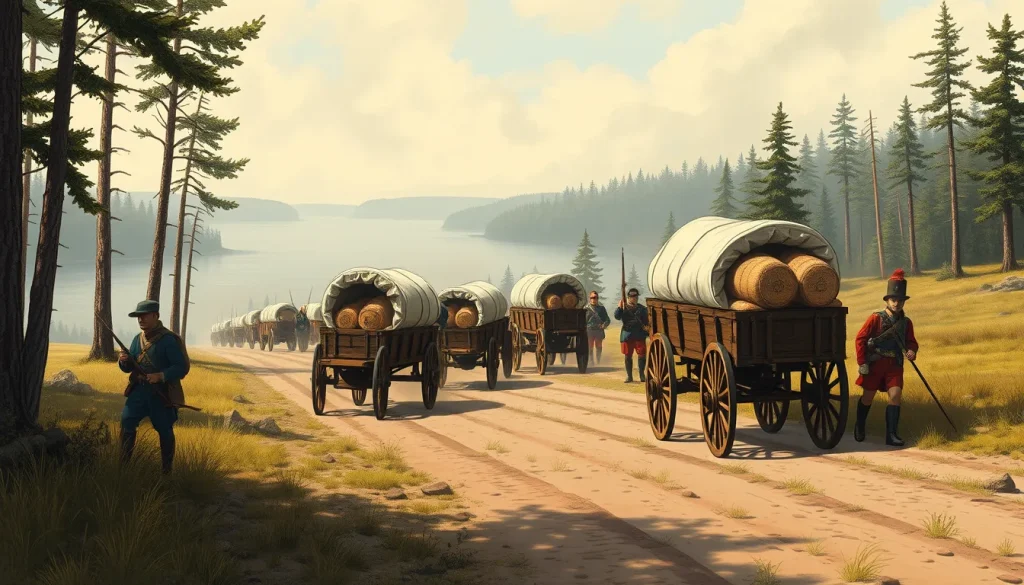
When the United States declared war on Great Britain on June 18, 1812, its army was small and poorly equipped, and its supply system was decentralized. The British Army, though experienced, faced the enormous difficulty of shipping provisions across the Atlantic while also sustaining a global war against Napoleonic France. The Canadian colonies, caught in the middle, had to rely on local agriculture and limited imports. The geography of North America—dense forests, limited roads, and vast distances—made the movement of supplies to frontier theaters especially challenging. In the Great Lakes region and along the Niagara Peninsula, armies were frequently immobilized by shortages of food, forage, and ammunition.
What Happened
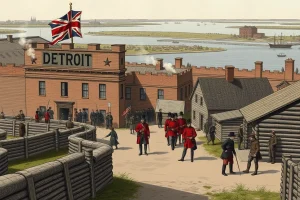
The war saw two main phases of supply difficulties. In 1812, American attempts to invade Canada were hampered by inadequate provisions, poor transportation, and quarrels among commanders. For example, General William Hull’s surrender at Detroit was partly due to fear of being cutoff from supplies. In 1813, American forces under Oliver Hazard Perry won the Battle of Lake Erie, which secured supply lines by water, but logistical mismanagement continued to plague land operations. The British, meanwhile, established supply depots at Halifax and Quebec and relied on Canadian farmers and merchants for food. However, the Royal Navy’s blockade of American ports, which tightened in 1813, disrupted American coastal trade and forced the U.S. to rely on inland routes. On both sides, armies often foraged and requisitioned from the local population, which strained relations, especially with neutral civilians and Indigenous communities. The war’s end in 1815 saw the Treaty of Ghent, which did not resolve the original maritime disputes, but both sides had learned logistical lessons.
Why It Matters
The effective supply of armies and navies directly influenced the outcome of major campaigns. The failure of American invasions of Canada is often attributed to inadequate logistics. Conversely, the British ability to defend Canada successfully was due in part to effective use of local resources and the Royal Navy’s control of the Atlantic. The war also exposed the need for reforming U.S. military administration. After the war, Congress implemented the Commissary General of Subsistence and the Quartermaster General’s Department in a more organized manner, laying foundations for professional logistics. Historians have debated the relative importance of supply versus leadership, but most agree that logistical constraints were a critical factor. Moreover, civilian populations faced privations due to military demands, inflation, and blockades, shaping the war’s social memory.
Definition
Food and military supply encompasses all measures taken to provide armed forces with food, water, forage for animals, ammunition, clothing, and equipment. In the context of the War of 1812, it involved procurement from contractors, farmers, and captured stocks; transportation by wagon, ship, and boat; and distribution through depots and field trains to units.
Background
During the early American Republic, the U.S. Army’s supply system was modeled on European practices but was often understaffed and poorly funded. The Quartermaster Department, headed by a quartermaster general, oversaw transportation and camp equipment, while the Commissary Department handled food and clothing. In Britain, the Ordnance Board and Commissariat managed supplies, with a strong tradition of contracting. In Canada, colonial authorities relied on the British Army’s commissariat and local merchants. The outbreak of war in 1812 found both sides unprepared for a large-scale conflict in a vast and underdeveloped region.
How It Worked
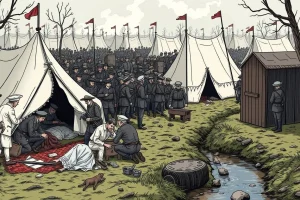
Typical procedure involved requisitions from field commanders, approval at headquarters, and purchases from civilian contractors. Goods were collected at main depots, such as Fort George, Fort Detroit, or Boston, and then forwarded to forward posts. Transportation was the greatest challenge: the U.S. had to move supplies up the Hudson River and Lake Champlain, or through the Great Lakes; the British used St. Lawrence River and Lake Ontario. Wagons, pack animals, and boats were scarce. Food preservation was rudimentary—salt meat, hardtack, and dried peas were staples. Inadequate amounts of vegetables led to scurvy. Both armies relied heavily on foraging, which could devastate local agriculture and cause friction.
Competing Viewpoints
Historians differ over whether poor logistics or poor leadership caused the American failures. Some, like Donald Hickey, emphasize that American supply problems were a symptom of a weak federal government and lack of preparation. Others argue that British logistics were equally strained but better managed. There is also debate over the role of corruption and profiteering among contractors, which inflated costs and delayed deliveries. Contemporary critics blamed contractors and inept officials, while modern scholars stress the inherent difficulty of operating in a wilderness with limited infrastructure.
Role in the War of 1812
Supply played a central role in nearly every campaign. The American invasion of Canada at Niagara and Detroit faltered because troops lacked food, clothing, and ammunition. The British and Canadian forces, though often better supplied, faced shortages when their supply lines were cut, as at the Battle of Moraviantown, where Tecumseh’s warriors were inadequately fed. The naval war also depended on food; crews on both sides subsisted on salted meat and biscuit, and privateers captured many supply ships. The blockade of the U.S. Atlantic coast forced the American army to rely on local purchase and inland transport, which increased costs and delays.
Consequences and Historical Interpretation
The war’s logistical lessons influenced post-war reforms. In 1818, Congress reorganized the supply departments, establishing a permanent Quartermaster General and a Commissary General of Subsistence. These institutions were central to the antebellum military. Historians have viewed supply as a key determinant of warfare. The war also demonstrated the interdependence of military and civilian supply, as armies requisitioning food often caused hardship among civilians, leading to tensions and even resistance. In the long run, the war highlighted the need for better infrastructure and national planning.
Primary Sources
Relevant primary sources include the official reports of Quartermasters and Commissaries, such as the letters of United States Quartermaster General Thomas S. Jesup and the reports of the British Commissariat in Canada. The correspondence of commanders like Andrew Jackson, Isaac Brock, and Winfield Scott often discusses supply difficulties. Newspapers, such as the Albany Argus and the Montreal Gazette, reported on shortages and prices. Military order books and court-martial records reveal disputes over provisions. The Library of Congress and the National Archives hold collections of these documents. The “War of 1812 Papers” at the National Archives and Records Administration include ration returns and requisitions. These sources are valuable but must be read critically, as they reflect command perspectives and wartime propaganda.
Further Reading
- Donald R. Hickey, The War of 1812: A Forgotten Conflict (University of Illinois Press, 1989).
- J. C. A. Stagg, The War of 1812: Conflict for a Continent (Cambridge University Press, 2012).
- Robert S. Quimby, The U.S. Army in the War of 1812: An Operational and Command Study (Michigan State University Press, 1997).
- The Papers of the War Department, 1784–1800 (online at the Center for History and New Media).
References
- Donald R. Hickey, The War of 1812: A Forgotten Conflict (University of Illinois Press, 1989).
- J. C. A. Stagg, The War of 1812: Conflict for a Continent (Cambridge University Press, 2012).
- Robert S. Quimby, The U.S. Army in the War of 1812: An Operational and Command Study (Michigan State University Press, 1997).
- National Archives and Records Administration, “War of 1812 Papers,” accessed via NARA online catalog.
FAQ
What were the main food items in army rations during the War of 1812?
Salted meat (pork or beef), hardtack (hard bread), peas or beans, and sometimes fresh vegetables or molasses. Coffee and sugar were also issued to naval forces.
How did the Royal Navy blockade affect American supply?
The blockade disrupted coastal shipping, forcing the U.S. military to rely on slower inland roads and waterways, which increased costs and delays and contributed to shortages.
What reforms came after the war?
In 1818, Congress reorganized the supply departments, establishing a permanent Quartermaster General and a Commissary General of Subsistence, which improved professionalism and efficiency in military logistics.

Leave a Reply