Short Answer
The Capture of Fort Mackinac on 17 July 1812 was the opening military action of the War of 1812 in the upper Great Lakes. The bloodless surrender of the American garrison to a British-led force secured the strategic Straits of Mackinac, influenced Indigenous alliances, and contributed to later American setbacks including the fall of Detroit. This event demonstrated the critical role of initiative and psychological pressure in a frontier theatre where communications were slow and alliances were volatile.
Historical Context
Fort Mackinac, built by the British in 1780–81, controlled the straits between Lake Huron and Lake Michigan and the lucrative fur trade of the upper Great Lakes. The post also held enormous influence over Indigenous nations of the Northwest, who viewed the fort as a symbol of European power and a source of trade and alliances. After the United States took possession in 1796, the British relocated to Fort St. Joseph on St. Joseph’s Island, about 45 miles away.
When the United States declared war on Great Britain on 18 June 1812, no orders reached Lieutenant Porter Hanks, commander of the American garrison at Fort Mackinac. The nearest American military headquarters was weeks away by canoe and portage. In contrast, the British command in Upper Canada, led by Major General Isaac Brock, ensured that Fort St. Joseph received the news quickly. Brock ordered Captain Charles Roberts, the British commander at St. Joseph, to use his discretion in attacking Mackinac.
What Happened
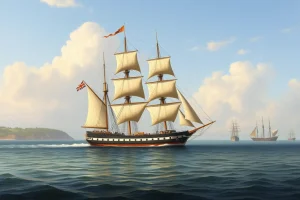
Roberts assembled a force of about 600 men: 45 regulars of the 10th Royal Veterans Battalion, roughly 180 Canadian voyageurs and fur traders employed by the North West Company, and approximately 400 Indigenous warriors, including Ojibwe, Ottawa, and Menominee. They embarked on the armed schooner Caledonia, war canoes, and bateaux on the evening of 16 July. After a night crossing, they landed on the north shore of Mackinac Island around 3 a.m. on 17 July.
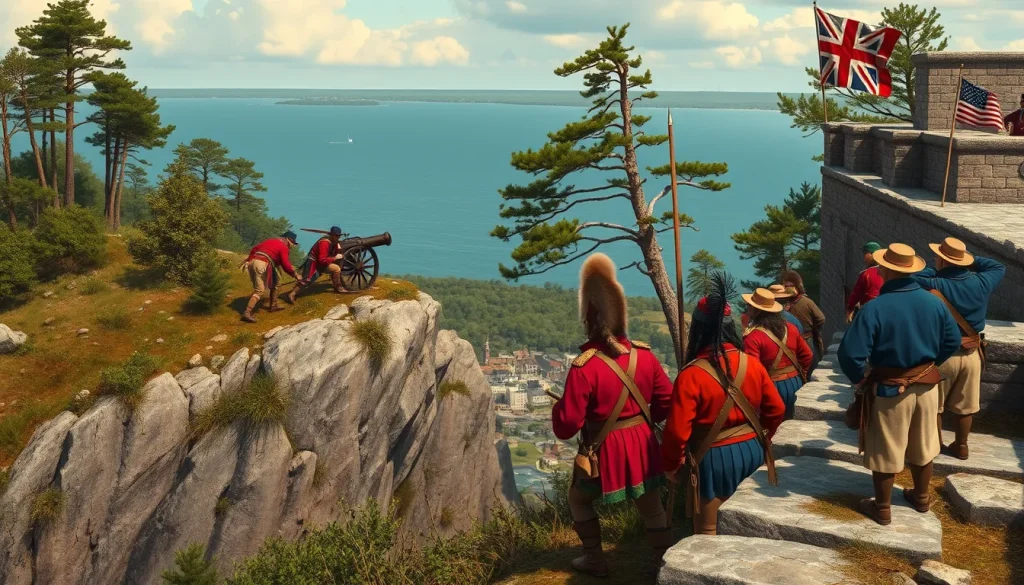
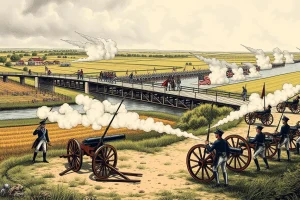
The landing point, later known as British Landing, was chosen to avoid detection. The Canadians and warriors dragged a 6-pounder cannon through the woods and up the bluffs to a ridge overlooking Fort Mackinac. By mid-morning, the gun was in place, and a single shot was fired as a demonstration. Roberts then sent a flag of truce with a demand for surrender, warning that his Indigenous allies would be difficult to restrain if fighting began.
Lieutenant Hanks, with only 61 men and no knowledge that war had been declared, was outnumbered ten to one and dominated by the cannon above the fort. His garrison was also weakened by illness. Hanks surrendered without firing a shot. The fort and island passed into British hands without any casualties on either side. The American prisoners were paroled, and the British occupied Fort Mackinac.
Why It Matters
The capture of Fort Mackinac had immediate and far-reaching consequences. It gave the British control of the Straits of Mackinac and the upper Great Lakes trade routes for the remainder of the war. More importantly, it convinced many Indigenous nations that the British were the stronger power and would support them, leading most to side with Britain. This contributed directly to the collapse of American positions in the Northwest.
Brigadier General William Hull, commanding the American forces in the Detroit area, learned of the fall of Mackinac in early August. The news, combined with fears of a general Indigenous uprising, demoralized Hull and his army. Within two weeks, Hull surrendered Detroit to Brock on 16 August, a catastrophe for the United States. Fort Mackinac remained under British control until the end of the war, despite an American attempt to retake it in 1814 at the Battle of Mackinac Island, which failed. The fort was returned to the United States by the Treaty of Ghent in 1815.
Prelude
The attack on Fort Mackinac was planned in response to the American declaration of war. At Fort St. Joseph, Roberts received orders from Brock to attack if possible. He was initially ordered to proceed, then countermanded, but finally granted discretion. The British also relied on support from the North West Company and local Indigenous groups, who were eager to resist American expansion. The expedition departed on 16 July, with the goal of taking the fort before the Americans could be reinforced.
Forces and Commanders
British and allied forces were led by Captain Charles Roberts, an experienced officer of the 10th Royal Veterans Battalion. His force included 45 regulars, about 180 Canadian voyageurs and Métis, and roughly 400 Indigenous warriors from various nations, including Ojibwe, Ottawa, Menominee, and Winnebago. The Americans were commanded by Lieutenant Porter Hanks of the U.S. Regiment of Artillery, with a garrison of 61 men, many of them unfit for duty. The British had an approximate numerical superiority of 10 to 1.
Battlefield and Map Context
Fort Mackinac was situated on a limestone bluff on the southeastern side of Mackinac Island, overlooking the harbour and the village. The fort’s cannons were mounted to defend the harbour but could not control the heights above, a critical tactical weakness. The island itself was heavily wooded, with steep bluffs. The British landing point was on the northwest coast, allowing them to approach the fort from the rear and scale the ridge without being observed. The local geography made the fort vulnerable to a daring flanking movement.
Battle Chronology
On 16 July, Roberts’s force departed St. Joseph’s Island. They captured an American scout en route and released him on the island with a warning to evacuate the village. They landed at about 3 a.m. on 17 July. Over the next several hours, they laboriously moved the cannon and men to the heights. By 10 a.m., the force was in position. Roberts fired one round from the cannon and then sent a surrender demand under a flag of truce. Hanks consulted with his officers and surrendered. The American flag was lowered, and the British took possession of the fort.
Casualties and Losses
The engagement produced no casualties on either side. This was a bloodless surrender. The Americans lost the fort, its stores, and the garrison as prisoners (later paroled). The British suffered no losses, though the expedition was demanding in terms of physical exertion and coordination.
Result
The British achieved a complete victory, gaining control of Fort Mackinac and the entire island. The American garrison surrendered unconditionally, and the fort was occupied by British and allied forces. The victory was celebrated as a model of swift, decisive action with minimal risk.
Strategic Consequences
Strategically, the capture secured British dominance in the upper Great Lakes and protected the fur trade. It also solidified Indigenous support for the British, as many nations now saw the British as the likely victors. The fall of Mackinac triggered a chain of events that led to the surrender of Detroit, the retreat of American forces from the Northwest, and the loss of Fort Dearborn (Chicago). British control of Mackinac also prevented American forces from using the island as a staging point for attacks into Upper Canada. It was not until 1815 that American troops returned, following the peace treaty.
Primary Accounts
The principal primary accounts include Captain Roberts’s report to Major General Brock, which details the preparations and execution of the attack, and Lieutenant Hanks’s official report explaining his decision to surrender. Both documents are preserved in the British and American archives. The historian’s reconstruction of the events also relies on muster rolls, correspondence, and later memoirs. No direct transcripts are readily available online, but these documents are cited in scholarly histories.
Battlefield Today
Fort Mackinac is now a preserved historic site operated by Mackinac State Historic Parks. Visitors can explore the fort’s buildings, including the blockhouses and barracks, and learn about the 1812 capture through interpretive displays and an immersive video program. British Landing is also marked, and the island remains a popular tourist destination. The fort’s location on the bluff still offers commanding views of the straits.
Primary Sources
Key primary sources include:
- Captain Charles Roberts’s report to Major General Isaac Brock, July 1812, describing the expedition and capture. Available at the National Archives of Canada and reproduced in military histories.
- Lieutenant Porter Hanks’s official report to the U.S. War Department, August 1812, explaining the surrender. Held by the U.S. National Archives.
- The correspondence of Major General Isaac Brock, which includes orders and intelligence regarding the attack.
- Contemporary newspaper accounts from the United States and British Canada, which reported the event with patriotic interpretations.
These sources provide the foundation for understanding the event, though each carries the biases and limitations of its author.
Further Reading
- Donald R. Hickey, The War of 1812: A Forgotten Conflict (1990).
- J. Mackay Hitsman, The Incredible War of 1812 (revised edition, 1999).
- Pierre Berton, The Invasion of Canada, 1812–1813 (1980).
- John K. Mahon, The War of 1812 (1972).
- Karl S. Hele, “Fort Mackinac” article in The Canadian Encyclopedia (2025).
References
- Hickey, Donald R. The War of 1812: A Forgotten Conflict. University of Illinois Press, 1990.
- Hitsman, J. Mackay. The Incredible War of 1812. University of Toronto Press, 1999.
- Berton, Pierre. The Invasion of Canada, 1812–1813. McClelland and Stewart, 1980.
- The Canadian Encyclopedia, “Fort Mackinac” by Karl S. Hele.
- Mackinac State Historic Parks, “On this day: Capture of Fort Mackinac, July 17, 1812.”
- American Battlefield Trust, “Fort Mackinac Battle Facts and Summary.”
- History of War, “Battle of Mackinac Island, 17 July 1812.”
- War of 1812.org, “Capture of Fort Mackinac – War of 1812.”
FAQ
Why was Fort Mackinac strategically important in the War of 1812?
Fort Mackinac commanded the Straits of Mackinac, the crucial waterway linking Lake Huron and Lake Michigan, which was essential for the fur trade and for maintaining influence over Indigenous nations. Whoever controlled Mackinac could dominate the upper Great Lakes and sway regional alliances.
How did the capture of Fort Mackinac affect the War of 1812 in the Northwest?
The fall of Mackinac convinced many Indigenous nations to side with the British, undermining American security. It also demoralized American forces under William Hull, contributing to his surrender at Detroit in August 1812 and the temporary collapse of American control in the Michigan Territory.
Was there any fighting at the capture of Fort Mackinac?
No. The American garrison, led by Lieutenant Porter Hanks, surrendered without resistance after a single cannon shot and a threat of attack. The fort fell bloodlessly, with no casualties on either side.


Leave a Reply