
Short Answer
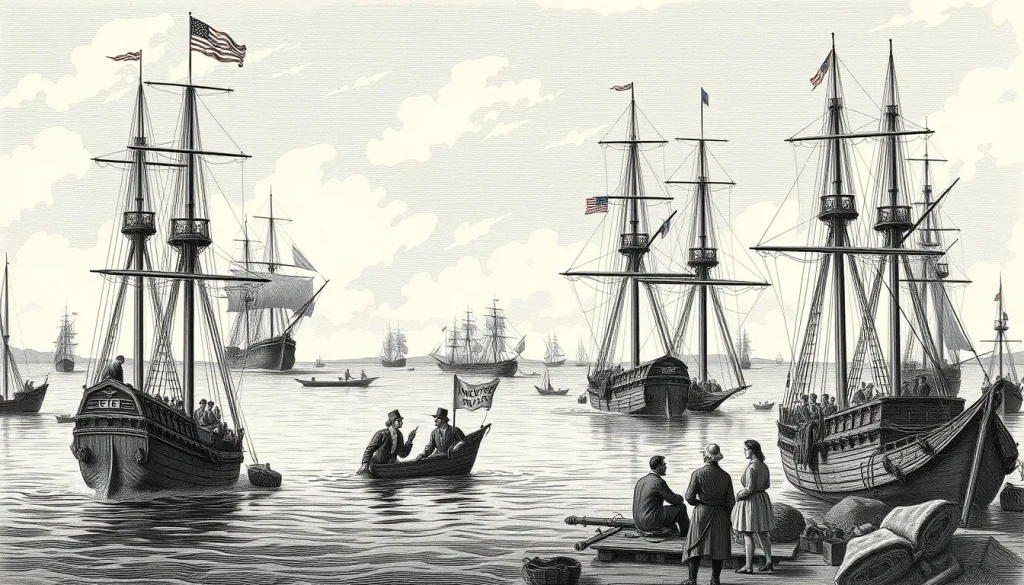
The Non-Intercourse Act of 1809 was a United States federal law that replaced the Embargo Act of 1807, lifting all restrictions on American shipping except for trade bound to British or French ports. Enacted on March 1, 1809, in the final days of President Thomas Jefferson’s administration, it aimed to pressure the United Kingdom and France by economic coercion without resorting to war. The act proved ineffective, intensified Anglo-American tensions, and is widely regarded by historians as a major step toward the War of 1812.
Historical Context
During the Napoleonic Wars (1803–1815), Great Britain and France sought to cut off each other’s trade through blockades and decrees. Both nations seized neutral American ships and cargoes, violating U.S. neutral rights. Britain’s Orders in Council (1807) restricted neutral trade with Europe, while France’s Berlin and Milan Decrees declared a blockade of the British Isles. The United States, as the leading neutral carrier, suffered heavy losses. In response, Congress passed the Embargo Act of December 1807, prohibiting all American exports and foreign trade from U.S. ports. The embargo devastated the American economy, particularly in New England, and was widely evaded, leading to political unrest and Federalist gains in the 1808 elections.
By early 1809, the embargo had failed to change British or French policies, while domestic opposition grew. Congress faced pressure to find a middle course between total embargo and war. The result was the Non-Intercourse Act, which sought to continue economic pressure but only against the two belligerents, allowing trade with all other nations.
What Happened
The 10th Congress passed the Non-Intercourse Act on February 27, 1809, and President Jefferson signed it on March 1, 1809, effective immediately. The act, formally titled “An Act to interdict the commercial intercourse between the United States and Great Britain and France, and their dependencies; and for other purposes” (2 Stat. 528), had several key provisions:
- It prohibited British and French public ships from entering American harbors and waters (Section 1).
- It banned all commercial intercourse with British and French public ships and forbade citizens from supplying them (Section 2).
- From May 20, 1809, it interdicted the entry of all British and French merchant vessels, with forfeiture of ship and cargo (Section 3).
- It prohibited the importation of goods from Britain, France, their colonies, or dependencies, whether directly or via third parties (Section 4).
- Section 11 authorized the President to suspend the act against either nation if that nation revoked or modified its edicts to respect neutral commerce.
The act effectively repealed the Embargo Act and the Non-importation Act of 1806, but kept commercial restrictions on the two major belligerents.
On April 19, 1809, President James Madison, relying on Section 11, proclaimed the Non-Intercourse Act suspended against Britain after the British minister David Erskine agreed that Britain would withdraw its Orders in Council. Erskine had exceeded his instructions. The British government disavowed the agreement, and Madison reinstated non-intercourse against Britain in August 1809. This episode damaged Anglo-American trust and demonstrated the act’s fragility.
The Non-Intercourse Act was due to expire on June 1, 1810, but was replaced by Macon’s Bill Number 2 (May 1, 1810), which removed all trade restrictions but allowed the President to re-impose non-intercourse against either belligerent if the other lifted its restrictions. After France announced it would revoke its decrees (in a move of dubious sincerity), President Madison re-imposed non-intercourse against Britain in February 1811. This action further escalated tensions and contributed to the declaration of war in June 1812.
Why It Matters
The Non-Intercourse Act failed in its immediate goal of forcing Britain and France to respect American neutral rights. It caused economic hardship in the United States and did not prevent the seizure of American ships and sailors. The act’s failure discredited commercial coercion as a strategy and strengthened the argument, especially among Republicans, that only war could honor American rights.
The act also had significant diplomatic consequences. The Erskine Agreement fiasco convinced many Americans that the British government was duplicitous and that its leaders were hostile to the United States. It deepened the partisan divide, with Federalists seen as too pro-British and Republicans as too pro-French. The act’s legacy is intertwined with the broader narrative of the causes of the War of 1812, which historians view as a result of maritime disputes, impressment, and British support for Indigenous resistance on the frontier. The Non-Intercourse Act was an attempt to address these issues through trade restrictions, but its failure pushed the United States closer to armed conflict.
Definition
The Non-Intercourse Act of 1809 was a U.S. federal statute that repealed the comprehensive Embargo Act of 1807 and replaced it with a partial embargo that prohibited all commercial trade with Great Britain and France and their dependencies, while permitting trade with other nations.
Background
During the Napoleonic Wars, both Britain and France engaged in economic warfare, seizing neutral American merchant ships bound for the enemy. The United States attempted to use economic leverage to stop these violations. The Embargo Act of 1807 completely halted American exports and imports, hoping to inflict pain on the European powers. It failed, costing the U.S. economy dearly and causing political backlash. The Republican-led Congress devised the Non-Intercourse Act as a compromise, retaining the principle of trade restriction but narrowing its application to the two offending nations.
How It Worked
The act prohibited the importation into the United States of any goods produced in or transported from Great Britain or France, or their colonies, even if shipped through third countries. It also forbade American vessels from sailing to British or French ports. It barred British and French public ships from U.S. waters and later banned their merchant vessels after May 20, 1809. The President had discretion to suspend the act against a nation that revised its edicts. Enforcement was difficult, leading to widespread smuggling and legal disputes that reached the Supreme Court.
Competing Viewpoints
Historians interpret the Non-Intercourse Act in different ways. Some see it as a pragmatic attempt to avoid war while still defending American sovereignty. Others argue it was a capitulation to Federalist pressure, weakening the embargo at a critical moment. The act also highlighted the deep partisan split: Federalists favored trade with Britain, while many Republicans viewed Britain as the primary enemy. The act’s ineffectiveness and the Erskine affair led Republicans to believe that only military action could resolve the dispute.
Role in the War of 1812
The Non-Intercourse Act set the stage for the final diplomatic breakdown. After the act’s replacement by Macon’s Bill, the complex maneuvering between Britain and France led to the re-imposition of non-intercourse against Britain in 1811. This made war almost inevitable, as the U.S. Congress and President Madison concluded that Britain’s trade restrictions and impressment of American sailors could not be resolved peacefully. The act’s failure demonstrated that economic coercion alone could not alter British policy. In June 1812, citing impressment, Orders in Council, and British support for Indigenous attacks, the United States declared war on Great Britain.
Consequences and Historical Interpretation
The Non-Intercourse Act contributed to the War of 1812 by failing to resolve the maritime grievances and by escalating political tensions. Historians like Roger H. Brown and J.C.A. Stagg have emphasized that the act’s failure discredited Republican commercial policies, pushing the administration toward war. The act also had domestic consequences, promoting early industrialization as the prohibition on British goods stimulated domestic manufacturing. Despite its short duration, the act left a lasting impact on American economic policy and foreign relations.
Primary Sources
The full text of the Non-Intercourse Act is available in the United States Statutes at Large, Volume 2, Chapter XXIV (March 1, 1809). It is also reproduced in modern sources. President Thomas Jefferson’s message to Congress preceding the act and the congressional debates provide additional insight. The Supreme Court decisions interpreting the act, such as Cargo of the Brig Aurora v. United States (1813) and The Brig Penobscot v. United States (1813), illustrate legal conflicts over its enforcement. These documents reveal the act’s intended scope and practical ambiguities. The personal correspondence of James Madison, particularly regarding the Erskine Agreement, is crucial for understanding the diplomatic crisis.
Further Reading
- Buel, Richard, Jr. “Nonintercourse Act (1809).” In Encyclopedia of American Foreign Policy.
- Heidler, David Stephen, and Jeanne T. Heidler. Encyclopedia of the War of 1812. Naval Institute Press, 2004.
- Stagg, J.C.A. Mr. Madison’s War: Politics, Diplomacy, and Warfare in the Early American Republic, 1783–1830. Princeton University Press, 1983.
- Brown, Roger H. The Republic in Peril: 1812. Columbia University Press, 1964.
References
- “Non-Intercourse Act (1809).” Wikipedia. https://en.wikipedia.org/wiki/Non-Intercourse_Act_(1809)
- “United States Non-Intercourse Act – March 1, 1809.” Rockcastle Karst Conservancy. https://rkci.org/library/gsp/early/nonintercourseact.shtml
- “United States. Macon’s Bill, Number 2. 1 May 1810.” The Napoleon Series. https://www.napoleon-series.org/research/government/us/c_macon.html
- “Page:United States Statutes at Large Volume 2.djvu/564.” Wikisource. https://en.wikisource.org/wiki/Page:United_States_Statutes_at_Large_Volume_2.djvu/564
- Buel, Richard, Jr. “Nonintercourse Act (1809).” Encyclopedia.com. https://www.encyclopedia.com/history/united-states-and-canada/north-american-indigenous-peoples/indian-intercourse-act
FAQ
What did the Non-Intercourse Act of 1809 do?
It repealed the embargo on all American shipping and instead prohibited trade with Great Britain and France, their colonies, and dependencies, while allowing commerce with other nations.
Why was the Non-Intercourse Act ineffective?
It was difficult to enforce, led to widespread smuggling, and did not induce Britain or France to change their policies. It also caused economic damage to the United States.
How did the Non-Intercourse Act lead to the War of 1812?
Its failure discredited commercial coercion as a policy and escalated Anglo-American tensions, particularly after the disavowed Erskine Agreement, contributing to the decision for war in 1812.


Leave a Reply