

Short Answer
Impressment was the British practice of forcibly recruiting seamen into the Royal Navy, a system that reached deeply into American maritime life in the years before the War of 1812. British naval captains had the legal authority to stop ships at sea, search for deserters and other British citizens, and compel them to serve on warships—a process that often swept up American sailors as well. This practice, which affected thousands of Americans, became one of the most cited grievances in the United States’ decision to declare war in June 1812.
Historical Context
During the French Revolutionary and Napoleonic Wars (1792–1815), the Royal Navy expanded dramatically to meet the threat from France. The American Battlefield Trust notes that the British navy tripled in size during these conflicts, creating an enormous demand for seamen. Impressment had been a formal legal tool since 1563, when Queen Elizabeth I authorized it, and it remained legal into the early twentieth century. British law granted naval captains the right to stop vessels, search for deserters and British subjects, and force them into service. The practice was not limited to British waters; it extended to the high seas, where British warships frequently intercepted American merchant vessels and boarded them to inspect the crews.
What Happened
The process of impressment was blunt and often arbitrary. According to the Smithsonian, some British captains seized almost any able-bodied, English-speaking sailors they could find, regardless of their nationality. The Smithsonian estimates that as many as 6,000 American sailors were impressed in the period leading up to the war. A 1794 British Admiralty press warrant, held by the Smithsonian, authorized Captain John Thomas Duckworth of HMS Orion to seize as many men as he needed, each recruit receiving one shilling as “Prest Money.” Such warrants were common. The National Archives describes how British officers would inspect groups of American sailors and pull out individuals they claimed were British deserters, often with little regard for evidence of citizenship. The practice was not one-sided: American naval officers also impressed British sailors, as the National Archives notes, but the scale and impact of British impressment on American commerce were far greater.
Why It Matters
Impressment directly contributed to the outbreak of the War of 1812. American outrage over the seizure of citizens and the violation of U.S. sovereignty on the high seas was a central theme in the war debates. The Smithsonian states that American outrage over the practice contributed to the war. Historians generally agree that impressment, along with trade restrictions and British support for Indigenous resistance on the frontier, formed the core of American grievances. The practice also highlighted the broader issue of American neutrality and national honor, which resonated strongly in the political rhetoric of the time.
Definition
Impressment, in the context of the early nineteenth century, was the forcible enlistment of sailors into the Royal Navy. British law permitted naval captains to stop ships at sea, search for deserters and other British subjects, and compel them to serve. In practice, the definition expanded to include many American citizens and other foreign sailors, as captains often ignored legal distinctions.
Background
The legal foundation of impressment dates to 1563, when Queen Elizabeth I authorized it to recruit for the navy. Parliament considered abolishing it in 1641 but did not. In 1740, an act attempted to regulate the practice by prohibiting the impressment of anyone under 18 or over 55, and of foreigners, but these restrictions were withdrawn in 1780. The American Battlefield Trust notes that British courts heard cases on the legality of impressment at the end of the eighteenth century, but the practice continued unabated. During the French and Napoleonic Wars, the need for manpower made impressment a routine tool for the Royal Navy.
How It Worked
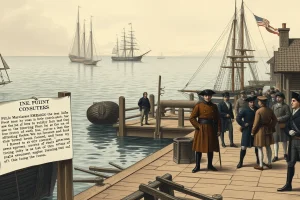
Impressment operated through two main mechanisms: press gangs on shore and naval boarding parties at sea. Press gangs, often led by a lieutenant, would sweep through port towns and forcibly take men to serve. At sea, British warships would intercept merchant vessels, board them, and muster the crew. The officers would then select individuals they claimed were British deserters or British citizens, using accent, appearance, or simple assertion as justification. The Smithsonian describes how some captains seized almost any able-bodied, English-speaking sailors they could find. Those taken were given a small amount of “prest money” and forced to serve, often for years. The press warrant of 1794, displayed by the Smithsonian, illustrates the formal authorization given to captains to impress as many men as needed.
Competing Viewpoints
British officials argued that impressment was necessary to maintain the Royal Navy and defend the empire during a prolonged war. They claimed the right to reclaim deserters and British subjects, pointing to the large number of British-born sailors who had joined American merchant fleets. American leaders, however, saw impressment as a violation of national sovereignty and individual rights. They argued that American citizens were being seized illegally and that the practice undermined U.S. neutrality. The National Archives notes that American naval officers engaged in similar practices against British sailors, but this did little to mollify American public opinion, which focused on the far larger scale of British seizures.
Role in the War of 1812
Impressment was one of the primary causes cited by the United States when it declared war on Britain on June 18, 1812. The practice was a direct affront to American sovereignty and economic interests, as it disrupted trade and deprived American ships of crew. In the months before the declaration, President James Madison’s message to Congress specifically listed impressment among the “injuries and indignities” inflicted by Britain. While the war also involved trade restrictions and frontier conflicts, impressment was the most emotional and widely publicized grievance. The Smithsonian’s estimate of 6,000 impressed American sailors underscores the scale of the issue.
Consequences and Historical Interpretation
The immediate consequence of impressment was a sharp deterioration in Anglo-American relations, culminating in war. After the war, the practice gradually declined, though it was not formally abolished until the mid-nineteenth century. Historians have debated the relative importance of impressment compared to other causes. Some emphasize economic factors, while others see impressment as the key symbol of American national humiliation. The National Archives points out that British and American naval officers both used impressment, complicating the moral narrative. Modern scholarship tends to treat impressment as one of several interlocking causes, but its role in mobilizing American public opinion remains undisputed.
Primary Sources
The most relevant primary sources include the British Admiralty press warrant of 1794, which authorized Captain John Thomas Duckworth to impress men, and is held by the Smithsonian National Museum of American History. This document shows the formal legal basis of the practice. Another source is the depiction by Howard Pyle, ca. 1810, of British officers inspecting American sailors, which was published in the National Archives’ Prologue magazine. The National Archives also provides the story of Charles Davis, an American sailor impressed by the U.S. Navy, illustrating the reciprocal nature of the practice. These sources are visual or documentary evidence of how impressment was authorized and carried out, but they reflect British or American perspectives and should be read with attention to their biases.
FAQ
What was impressment?
Impressment was the British practice of forcing sailors into the Royal Navy. Naval captains had the legal right to stop ships, search for deserters and British citizens, and compel them to serve, often seizing American sailors as well.
How many American sailors were impressed?
The Smithsonian estimates that as many as 6,000 American sailors were impressed in the period leading up to the War of 1812.
Why did impressment lead to the War of 1812?
Impressment violated American sovereignty and individual rights, disrupted trade, and became a major public grievance. It was one of the primary causes cited by the United States when declaring war on Britain in June 1812.


Leave a Reply