Short Answer
The Embargo Act of 1807 — formally, An Act laying an Embargo on all ships and vessels in the ports and harbors of the United States — was signed by President Thomas Jefferson on December 22, 1807, and suspended American overseas trade for fourteen months. Congress enacted it as commercial retaliation against Great Britain’s Orders in Council and Napoleon’s Continental System, both of which had made neutral American shipping a target during the Napoleonic Wars. The measure failed to change either belligerent’s policy, cut total American exports by roughly four-fifths, and became the first in a sequence of unsuccessful trade measures that ended in the United States declaration of war on Britain on June 18, 1812.
Historical Context
After the collapse of the Peace of Amiens in 1803, Britain and France resumed a war that lasted, with one brief interruption, until 1815. Because the United States remained neutral, American shipowners captured much of the carrying trade between Europe and its colonies, and American exports — cotton, tobacco, flour, timber, fish, and re-exported Caribbean goods — reached roughly $108 million by 1807. Both belligerents resented that traffic. Britain, dominant at sea, issued a series of Orders in Council; the order of November 11, 1807, required neutral vessels trading with France and its allies to clear through a British port and pay British duties. Napoleon replied with the Berlin Decree of November 21, 1806, which declared the British Isles under blockade, and the Milan Decree of December 17, 1807, which authorized seizure of ships that complied with British regulations or submitted to British search.
Two further grievances shaped American opinion. The Royal Navy, short of manpower, stopped American merchantmen and impressed sailors it claimed were British deserters, and the practice increased sharply after 1803. On June 22, 1807, the frigate HMS Leopard fired on the USS Chesapeake off Norfolk, Virginia, and removed four men. Public outrage was intense; Jefferson ordered British warships out of American waters and weighed war, but the United States had a small regular army, a navy of a few frigates and gunboats, and no allies.
Domestically, Jefferson’s Democratic-Republicans controlled Congress, while the Federalist opposition drew strength from New England’s maritime towns. Jefferson preferred economic pressure to military confrontation, and his party had already tested limited restrictions in the Non-Importation Act of 1806. Geography also mattered: the long border with British North America along Lake Champlain, the St. Lawrence, and the New Brunswick line, plus Spanish Florida on the Gulf Coast, offered obvious routes around any trade ban.

What Happened
In a confidential message in December 1807, Jefferson asked Congress for a general embargo rather than war. Senator Samuel Smith of Maryland introduced the bill on December 18; the Senate passed it that day, 22 to 6, and the House approved it on December 21 by 82 to 44. Jefferson signed the act on December 22, 1807.
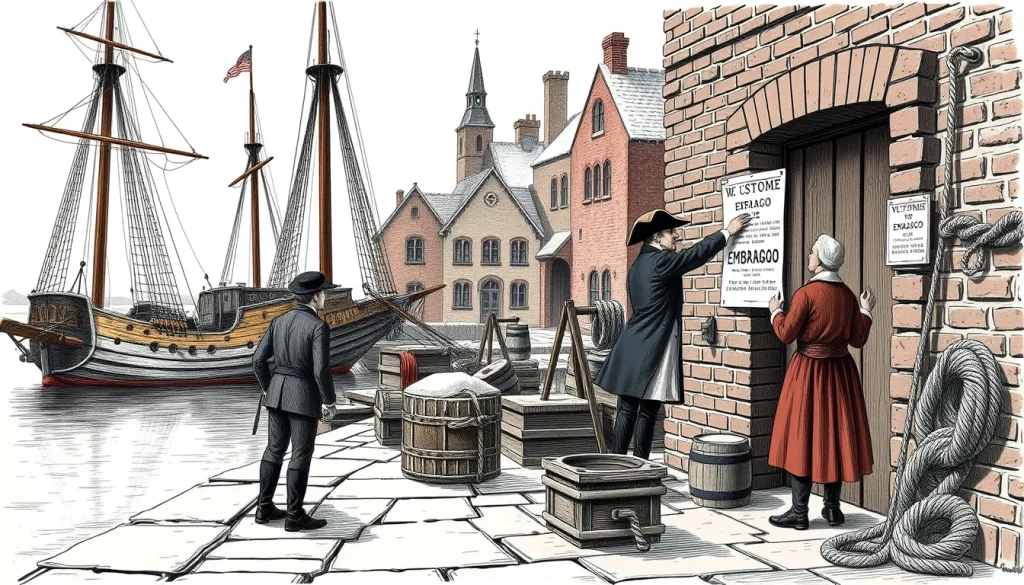
The statute laid an embargo on all ships and vessels in American ports and harbors, barred them from obtaining clearance for foreign voyages, allowed the president to make exceptions for vessels under his direction, and directed revenue officers and the navy to enforce it. Because American ships could neither sail abroad nor fetch foreign goods, the measure functioned as an export ban and a de facto restriction on imports.
Enforcement required supplementary legislation: acts of January 9 and March 12, 1808, imposed bonds and tightened rules on coastal and fishing vessels, and an act of April 25, 1808, extended restrictions to inland and coastal traffic. A final Enforcement Act of January 9, 1809, authorized collectors to seize suspicious cargoes and permitted use of the army, navy, and militia — a provision that alarmed critics and states’ rights advocates.
Evasion was widespread. Cargoes moved overland and by lake into Canada; cotton and other staples went out through Spanish Florida; coastal traders carried goods to the edge of the ban and transshipped. Customs officers were sometimes bribed or outmaneuvered. In New England, town meetings, merchant memorials, and the Massachusetts legislature denounced the embargo, while Federalist editors and engravers mocked it in satirical prints, including the widely reproduced Ograbme caricature often attributed to the engraver Alexander Anderson. Senator Timothy Pickering of Massachusetts and other Federalists corresponded about resisting enforcement, and a few discussed a separate New England confederation.
On March 1, 1809, three days before Jefferson left office, Congress replaced the embargo with the Non-Intercourse Act, which reopened trade with all nations except Britain and France. The new law’s nineteenth section formally repealed the Embargo Act.
Why It Matters
The immediate consequences were economic and political. Total American exports fell from roughly $108 million in 1807 to about $22 million in 1808; shipping, wharf, and warehouse employment collapsed in port cities, and prices for agricultural staples dropped in the interior. At the same time, the cutoff of British manufactured goods encouraged domestic production, especially textiles, and is often linked to the early expansion of American manufacturing.
Politically, the embargo revived the Federalist Party, which gained congressional seats in the 1808 elections, and deepened sectional suspicion between New England and the Republican South and West. It also raised enduring questions about how far the federal government could go in regulating commerce and compelling compliance.
Diplomatically, the policy failed. Britain, whose trade was already turning toward South American markets opened by the crisis in the Spanish empire, absorbed the loss more easily than Jefferson expected, and Napoleon responded not by easing restrictions but by ordering the seizure of American ships in French ports under the Bayonne Decree of April 1808. Historians disagree about how much the embargo actually hurt Britain; estimates vary widely and the surviving evidence is incomplete.
Definition
A general embargo is a government prohibition on the departure of ships and the movement of goods to foreign destinations. The Embargo Act of 1807 was the most sweeping such measure in early American history: rather than targeting one nation’s goods, as the Non-Importation Act had, it suspended overseas commerce generally, on the theory that both Britain and France would suffer enough to change their policies. Republicans of the period described the strategy as peaceable coercion; modern scholars more often classify it as economic sanctions or economic warfare.
Background
The embargo grew out of a failed search for leverage. The Non-Importation Act of April 1806 restricted selected British imports but proved ineffective and was suspended. The Monroe–Pinkney Treaty, signed in London on December 31, 1806, did not address impressment, and Jefferson chose not to submit it to the Senate. Meanwhile Britain’s Orders in Council and Napoleon’s Berlin and Milan decrees tightened the squeeze on neutral trade, and the Chesapeake–Leopard affair of June 1807 raised the possibility of war. Jefferson’s cabinet concluded that the United States could not fight either power effectively, but might inflict economic pain, particularly on Britain, which bought large quantities of American cotton and food. The embargo was the instrument chosen to test that assumption.
How It Worked
Customs collectors in each port administered the act, refusing clearances for foreign voyages and requiring bonds from owners of coastal and fishing vessels. Revenue cutters and naval gunboats patrolled approaches to major harbors, and the president could grant exceptions for public vessels. Because the ban applied to ships in American ports rather than to specific commodities, it stopped exports at the dock and indirectly halted imports that depended on American carriers. Enforcement fell heaviest on export-dependent farmers and merchants in the South and New England. Smuggling networks, weak staffing, sympathetic local officials, and the long Canadian and Florida frontiers steadily eroded compliance, and the escalating enforcement acts of 1808 and 1809 were attempts to close gaps rather than evidence of success.
Competing Viewpoints
Jefferson and his allies argued that the embargo was a moral and practical alternative to a war the United States could not win, that it protected American sailors and cargoes from seizure, and that time would force Britain to negotiate. Federalists and many New England merchants replied that the policy was ruinous, disproportionately punished the region that opposed Jefferson politically, and invited evasion and disunion sentiment. In London, ministers treated the embargo as evidence of American submission to France and found substitute markets. Napoleon treated it as proof that American vessels were effectively British-controlled and seized them under the Bayonne Decree. Historians continue to divide: Henry Adams’s nineteenth-century account was severely critical of the policy, while Dumas Malone’s biography of Jefferson presented it as a rational choice among poor options. Burton Spivak and other scholars have examined the Republican ideological assumptions behind commercial coercion, and economic historians such as Jeffrey Frankel and Douglas Irwin have debated whether the embargo cost Britain more than it cost the United States. Donald Hickey and others emphasize defective enforcement as the decisive weakness.
Role in the War of 1812
The embargo’s failure discredited the strongest form of commercial coercion without resolving the disputes that produced it. The Non-Intercourse Act of March 1, 1809, reopened trade with most of the world but excluded Britain and France; Macon’s Bill No. 2 of May 1, 1810, restored trade with both while promising to reimpose non-intercourse against whichever power first dropped its restrictions. When Napoleon appeared to comply through the Cadore letter of August 1810, President James Madison proclaimed non-importation against Britain on November 2, 1810, and Congress passed a further Non-Importation Act in March 1811. Britain’s continued Orders in Council and impressment practices, combined with Republican conviction that economic pressure had been exhausted, contributed to the war declaration of June 18, 1812. In this sense the embargo postponed rather than prevented the conflict, and its political and economic legacies — a strengthened Federalist opposition, a nascent manufacturing sector, and hardened sectional attitudes — shaped how the United States entered the war.
Consequences and Historical Interpretation
The embargo’s measurable costs fell mainly on the United States: collapsed export earnings, unemployment in port cities, falling staple prices, and a sharp increase in smuggling and federal enforcement activity. Its intended effect on Britain and France was limited. Interpretations differ on whether the policy was a rational, if poorly executed, substitute for war or a self-inflicted economic wound driven by ideology. Some historians stress that a stronger, better-enforced embargo might have extracted concessions; others argue that Britain’s access to South American and other markets made success unlikely under any circumstances. The episode also left a durable precedent: American policymakers would return repeatedly to economic sanctions as an alternative to force, and the memory of 1807–1809 shaped later debates about neutral rights, executive power, and the limits of commercial pressure.
Primary Sources
The central document is the Embargo Act itself, published in the United States Statutes at Large (2 Stat. 451, chapter 5) and in documentary collections such as the Avalon Project at Yale Law School. Its language is brief and administrative, specifying that ships may not clear for foreign ports; it does not explain the policy’s aims, which must be sought in Jefferson’s messages and correspondence in Founders Online and in the published Papers of Thomas Jefferson. Those writings show the president’s reasoning and his confidence in economic pressure, but they are also advocacy and should be read as such.
Supplementary legislation — especially the Enforcement Act of January 9, 1809 (2 Stat. 506) — reveals how quickly the original measure required coercion to be sustained. The British Orders in Council of November 11, 1807, and Napoleon’s Berlin and Milan decrees are preserved in diplomatic documentary collections and in American State Papers: Foreign Relations; they state the belligerents’ positions but were drafted as instruments of policy and are not neutral descriptions of events.
Opposition sources include Massachusetts General Court resolutions, New England town-meeting memorials, and Federalist newspapers of 1808, which document the intensity of protest in the region most affected. The satirical print known as Ograbme, often attributed to Alexander Anderson, is a partisan artifact rather than a factual record. No verified transcript of a private British or French cabinet deliberation on the embargo is reproduced here; readers seeking those materials should consult the relevant national archives and published diplomatic series.
Further Reading
- Henry Adams, History of the United States of America during the Administrations of Thomas Jefferson (Library of America edition).
- Dumas Malone, Jefferson the President: Second Term, 1805–1809.
- Burton Spivak, Jefferson’s English Crisis: Commerce, Embargo, and the Republican Revolution.
- Louis Martin Sears, Jefferson and the Embargo.
- Donald R. Hickey, The War of 1812: A Forgotten Conflict.
- Bradford Perkins, Prologue to War: England and the United States, 1805–1812.
- Reginald Horsman, The Causes of the War of 1812.
- Jeffrey A. Frankel, The 1807–1809 Embargo Against Great Britain, Journal of Economic History (1982).
- Douglas A. Irwin, The Welfare Cost of Autarky: Evidence from the Jeffersonian Trade Embargo, 1807–09, Review of International Economics (2005).
- Founders Online, National Archives (founders.archives.gov), for Jefferson’s messages and correspondence.
- Avalon Project, Yale Law School, for the text of the 1807 act and related legislation.
References
- Embargo Act, Encyclopaedia Britannica, https://www.britannica.com/topic/Embargo-Act
- Embargo Act of 1807, Wikipedia, https://en.wikipedia.org/wiki/Embargo_Act_of_1807
- United States Statutes at Large, volume 2, chapter 5, pages 451–453 (Embargo Act, December 22, 1807) and chapter 19 (Non-Intercourse Act, March 1, 1809).
- United States Statutes at Large, volume 2, page 506 (Enforcement Act, January 9, 1809).
FAQ
What did the Embargo Act of 1807 do?
It laid an embargo on all ships and vessels in American ports and harbors, preventing them from clearing for foreign voyages. Because American ships could not sail abroad to trade or fetch goods, the law halted exports and sharply reduced imports, and it was enforced by customs officers, revenue cutters, and the navy.
Why did Jefferson support the embargo?
Jefferson concluded that the United States could not fight Britain or France effectively but could apply economic pressure instead. He hoped that withholding American cotton, food, and carrying services would force Britain especially to relax its Orders in Council and stop impressing sailors, while keeping the country out of war.
Did the Embargo Act of 1807 work?
It did not achieve its diplomatic aims. Britain found alternative markets, Napoleon responded with the Bayonne Decree seizing American ships, and the measure was widely evaded. American exports fell from about $108 million in 1807 to roughly $22 million in 1808, and Congress replaced the embargo with the Non-Intercourse Act in March 1809.
How did the embargo lead to the War of 1812?
Its failure discredited the strongest form of commercial pressure without settling the disputes over neutral rights and impressment. The United States then tried the Non-Intercourse Act, Macon's Bill No. 2, and further non-importation measures, all of which failed to extract concessions from Britain, and Congress declared war on June 18, 1812.


Leave a Reply