Short Answer
Tecumseh’s Confederacy was a pan-Indigenous political and military alliance that formed in the Great Lakes and Ohio Valley region between roughly 1805 and 1813, centered on the religious teachings of the Shawnee prophet Tenskwatawa and the leadership of his brother Tecumseh. Headquartered at Prophetstown on the Wabash River, it advanced the position that Indigenous lands were held in common and could not be sold by any single nation. During the War of 1812 the confederacy allied with Britain and Upper Canada, helped compel the surrender of Detroit in August 1812, and fought on until Tecumseh was killed at the Battle of the Thames on October 5, 1813, after which the alliance fragmented. This article uses the term to mean that alliance and the campaigns sometimes called Tecumseh’s War, and examines how it shaped the western theater of the wider conflict of 1812 to 1815.
Historical Context
Under the Treaty of Greenville (1795) and later agreements, nations of the Northwest Territory ceded large blocks of land in what are now Ohio, Indiana, and Illinois. In return they received annuity payments, access to traders, and what the United States described as protection. In practice, annuity goods, trader debt, and alcohol created deep dependence on American agents, while settlers and land speculators continued to press westward.
Britain retained its Great Lakes posts until 1796 under Jay’s Treaty, and afterward maintained gift-giving, trade, and diplomatic ties through Fort Malden at Amherstburg in Upper Canada. That relationship gave Indigenous nations an alternative to dependence on the United States, and helped sustain the argument that American land claims were not final.
Politics in the region operated at the village and band level rather than through central tribal governments. Civil chiefs negotiated treaties and external relations; war chiefs led in conflict. The Western Confederacy that fought the United States in the early 1790s was defeated at Fallen Timbers in 1794, and afterward accommodationist leaders such as Black Hoof and Little Turtle urged cooperation with the United States. The collapse of that earlier coalition left room for a new movement grounded in religious revival rather than in the treaty diplomacy of the previous generation.
The wider Anglo-American crisis provided the setting for war: British impressment of American sailors, restrictions on neutral trade, and disputes over the Great Lakes frontier. In the United States, western politicians argued that British agents and traders were arming and encouraging Indigenous resistance, and that British Canada should be taken. For many Indigenous nations, the looming war was less about Anglo-American quarrels than about whether they could keep their homelands.
What Happened
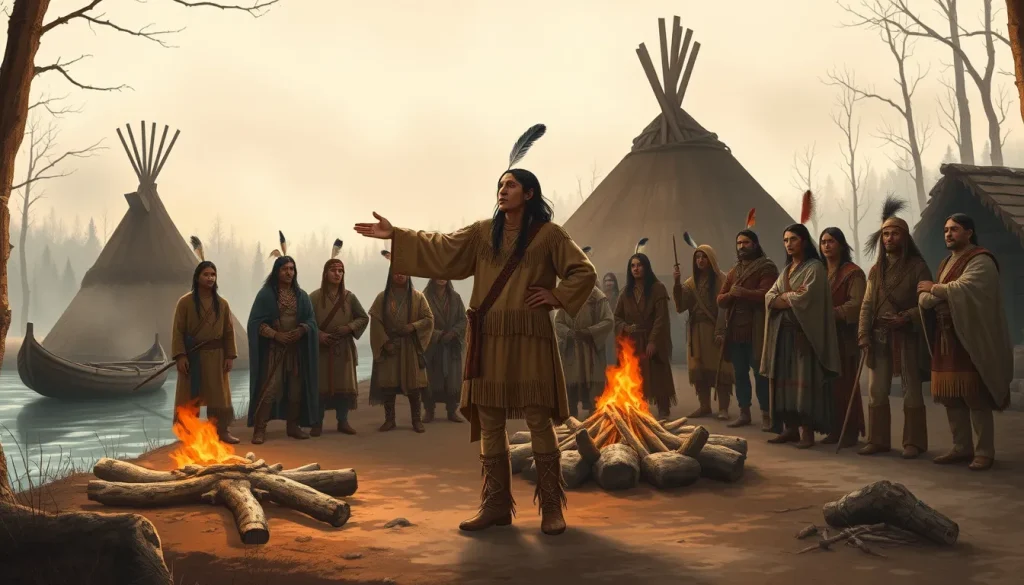
In 1805, after the death of the Lenape leader Buckongahelas and a subsequent witch-hunt, a Shawnee religious leader named Tenskwatawa, known as the Prophet, attracted a large following. He preached a return to traditional ways, rejection of alcohol and other American goods, communal ownership of land, and an end to further land cessions. With support from Shawnee war leaders, his movement grew among Shawnee, Lenape, Wyandot, Mingo, Odawa, and other communities.
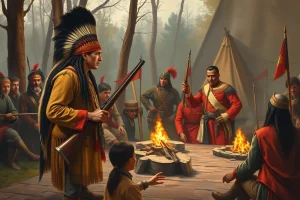
In 1808 Tenskwatawa and his followers relocated from Greenville to a new settlement at the confluence of the Wabash and Tippecanoe rivers in what is now Indiana. The village, commonly called Prophetstown, became the movement’s center. Tecumseh, Tenskwatawa’s brother, emerged as its principal political and military leader and traveled widely to build support, including to British officials at Amherstburg and, in 1811, to Creek, Cherokee, Choctaw, and Chickasaw communities in the South.
The Treaty of Fort Wayne, negotiated by Governor William Henry Harrison in September 1809, purchased roughly three million acres in present-day Indiana and Illinois. Tecumseh rejected the agreement, arguing that the land belonged to all Indigenous peoples and that no single nation could sell it. At councils with Harrison at Vincennes in August 1810 and again in 1811, he pressed that position; the meetings ended without agreement, and the 1811 council nearly ended in violence.
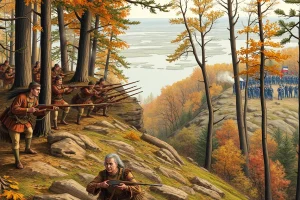
While Tecumseh was recruiting in the South, Harrison marched on Prophetstown with about 1,000 regulars, militia, and volunteers. On November 7, 1811, warriors from the village attacked Harrison’s encampment before dawn near the Tippecanoe River. The fighting lasted roughly two hours before the warriors withdrew. Harrison’s force held the field, then destroyed Prophetstown and its stored food. Commonly cited American losses are about 60 killed and 120 wounded; Indigenous losses are uncertain and are usually estimated in the dozens or higher. The battle damaged Tenskwatawa’s standing, hardened Tecumseh’s resolve, and pushed some nations toward accommodation with the United States.
The United States declared war on Britain on June 18, 1812. Tecumseh’s confederacy allied with Britain, operating with the British Indian Department and British forces based at Fort Malden. On August 16, 1812, Major General Isaac Brock, supported by Tecumseh’s warriors and by militia, received the surrender of Brigadier General William Hull at Detroit. The visible presence of hundreds of Indigenous warriors, combined with Brock’s demands and the cutting of American supply lines, contributed to Hull’s decision to capitulate without a battle. Detroit and the Michigan Territory passed to British control.
In 1813 the western campaign continued. On January 22, American forces were defeated at Frenchtown on the River Raisin, where wounded prisoners were killed by some Indigenous warriors, an event that became a rallying cry in the United States. Procter and Tecumseh besieged Fort Meigs in April and May, defeating an American relief column on May 5; accounts differ on details, but several report that Tecumseh intervened to stop the killing of prisoners. The British and Indigenous force failed against Fort Stephenson in August. After Commodore Oliver Hazard Perry’s victory at the Battle of Lake Erie on September 10, British supply lines to the western district collapsed, and Procter withdrew up the Thames River.
On October 5, 1813, Harrison’s roughly 3,500 American troops caught Procter’s force near Moraviantown in Upper Canada. The British regulars and militia, several hundred strong, broke quickly, leaving about 500 Indigenous warriors to fight on. Tecumseh was killed during the engagement. With his death the confederacy lost its principal organizer, and the coalition dissolved. Tenskwatawa’s influence declined sharply; he later returned to the United States and died in 1836 in present-day Kansas. The Treaty of Ghent, signed December 24, 1814, included an article requiring the United States to make peace with the Indigenous nations and restore their possessions as of 1811, but it was largely unenforced, and Britain dropped its proposal for an Indigenous buffer state.
Why It Matters
The confederacy reshaped the military balance in the west during the first two years of the war. Indigenous warriors supplied manpower that Britain could not spare, made the Detroit campaign possible, and tied down large American forces on the frontier rather than in Upper Canada. At the same time, the American fear of frontier warfare influenced public opinion and recruitment.
Its collapse in late 1813 removed the most serious organized Indigenous challenge to American expansion in the Old Northwest. Treaties after 1815 steadily reduced Indigenous landholdings, and the removal policies of the 1830s built on the postwar position. At the time, observers on all sides recognized Tecumseh’s death as a decisive turning point; later historians have debated whether the confederacy could have survived him at all. The movement also became a lasting symbol of pan-Indigenous unity and of resistance to dispossession, cited in Canada, the United States, and among Indigenous nations in different ways.
Definition
“Tecumseh’s Confederacy” refers to an alliance of Indigenous nations, villages, bands, and individuals rather than a formal state. It had no fixed constitution, no standing army, and no universally recognized borders. Its members and level of commitment varied over time, and some nations that supported Tecumseh diplomatically supplied few or no warriors. The term covers a dozen or more peoples, including Shawnee, Lenape, Wyandot, Miami, Kickapoo, Wea, Piankeshaw, Potawatomi, Odawa, Ojibwe, Sauk, Meskwaki, Ho-Chunk, Mingo, and Seneca, alongside smaller numbers from other nations.
Background
The movement drew on earlier traditions of inter-nation cooperation, including the mid-eighteenth-century teachings associated with the Lenape religious leader Neolin and the broad coalition that fought Pontiac’s War in 1763. It also responded to the specific grievances of the post-Greenville period: forced cessions, debt, alcohol, and the erosion of hunting territory. Tenskwatawa’s religious authority and Tecumseh’s diplomatic and military skill provided the two pillars the earlier Western Confederacy had lacked.
How It Worked
Leadership was exercised largely through councils, kinship networks, and persuasion rather than command. Tecumseh negotiated with individual villages, war chiefs, and neighboring nations, and joined warriors to specific campaigns seasonally. Prophetstown served as a gathering point, a spiritual center, and a logistical base. Britain supplied arms, ammunition, clothing, and provisions through the Indian Department at Amherstburg, but this support was uneven and always subordinate to British strategic priorities in Upper Canada. Dependence on British supplies and ammunition was a persistent weakness, visible at both Tippecanoe and the Thames.
Competing Viewpoints
Historians disagree on several points. Some treat the confederacy as a genuine political project with a coherent objective of establishing communal landholding and halting cession; others emphasize that it was a loose coalition of convenience that never achieved centralized authority and depended heavily on British patronage. Debates also continue over the relative weight of religious revival and political grievance, and over whether Britain used Indigenous allies cynically or entered relationships of mutual obligation.
Participation figures, especially Indigenous casualty totals, are uncertain because contemporary records are incomplete and one-sided. The identity of the individual who shot Tecumseh at the Thames was claimed by supporters of Richard M. Johnson and disputed by others; no reliable evidence settles the question. Many nineteenth-century American narratives treated the confederacy as a British instrument, while later scholarship has emphasized Indigenous agency and independent objectives.
Role in the War of 1812
The confederacy’s most consequential contribution was the Detroit campaign of 1812, which gave Britain control of the Michigan Territory and encouraged Indigenous recruitment across the region. Its warriors were central to the River Raisin, Fort Meigs, and Fort Stephenson operations in 1813. On the diplomatic side, the alliance led Britain to press for an Indigenous buffer state in the Great Lakes region during the Ghent negotiations. The American demand for security on the frontier, and the widespread belief that Britain encouraged Indigenous resistance, shaped United States war aims in 1812 and the terms Americans sought later. After the Thames, Indigenous forces continued to fight in 1814, but no comparable coalition formed.
Consequences and Historical Interpretation
Tecumseh’s death shattered the alliance’s coordinating structure, and the confederacy never reconstituted itself. The immediate results were American restoration of control in the Old Northwest and a sharp decline in Indigenous bargaining power. Longer-term results included the land cession treaties of the postwar decades and the removals of the 1830s. Historians interpret the confederacy in two broad registers: as a formidable but fragile coalition whose dependence on a single leader and on British supply sealed its fate, and as a serious attempt to build a durable inter-nation polity that was defeated by American manpower, British strategic retreat, and the difficulty of sustaining unity across many nations.
Primary Sources
Contemporary documentation of Tecumseh’s Confederacy is uneven. Tecumseh left no written record of his own. His speeches survive only as recorded by interpreters, British officers, American officials, or later writers, often translated and sometimes reconstructed long afterward. The widely reprinted speech beginning “Where today are the Pequot?” is generally regarded by scholars as of doubtful authenticity and should not be treated as a reliable transcript.
Key sources include William Henry Harrison’s official report on the Battle of Tippecanoe to Secretary of War William Eustis, dated November 1811, which presents the American account and is shaped by Harrison’s political ambitions. Isaac Brock’s proclamation to the inhabitants of Upper Canada, issued July 22, 1812, shows how British authorities addressed both settlers and Indigenous allies. Harrison’s and Duncan McArthur’s reports on the Thames campaign, and Henry Procter’s reports to his superiors, describe the 1813 fighting from opposing viewpoints. Tenskwatawa’s teachings are known mainly through the observations of American officials, missionaries, and travelers. The Treaty of Ghent, Article IX, records the diplomatic language about Indigenous restoration of possessions without indicating enforcement. British Indian Department correspondence, held in the Library and Archives Canada record group RG 10, documents the supply and diplomatic relationship at Amherstburg.
Further Reading
- John Sugden, Tecumseh: A Life (Henry Holt, 1998) and Tecumseh’s Last Stand (University of Oklahoma Press, 1985).
- R. David Edmunds, The Shawnee Prophet (University of Nebraska Press, 1983).
- Gregory Evans Dowd, A Spirited Resistance: The North American Indian Struggle for Unity, 1745–1815 (Johns Hopkins University Press, 1992).
- Richard White, The Middle Ground: Indians, Empires, and Republics in the Great Lakes Region, 1650–1815 (Cambridge University Press, 1991).
- Alan Taylor, The Civil War of 1812 (Alfred A. Knopf, 2010).
- Donald R. Hickey, The War of 1812: A Forgotten Conflict (University of Illinois Press).
- Carl Benn, The Iroquois in the War of 1812 (University of Toronto Press, 1998).
- Historic sites and archives: Prophetstown State Park and the Tippecanoe Battlefield, Battle Ground, Indiana; Fort Malden National Historic Site, Amherstburg, Ontario; Battle of the Thames monument near Thamesville, Ontario; Library and Archives Canada, RG 10 (Indian Department records).
- Smithsonian National Museum of American History, “Tecumseh and the War of 1812” teaching resource.
References
- John Sugden, Tecumseh: A Life (New York: Henry Holt, 1998).
- R. David Edmunds, The Shawnee Prophet (Lincoln: University of Nebraska Press, 1983).
- R. David Edmunds, Tecumseh and the Quest for Indian Leadership (Boston: Little, Brown, 1984).
- Gregory Evans Dowd, A Spirited Resistance: The North American Indian Struggle for Unity, 1745–1815 (Baltimore: Johns Hopkins University Press, 1992).
- Richard White, The Middle Ground: Indians, Empires, and Republics in the Great Lakes Region, 1650–1815 (Cambridge: Cambridge University Press, 1991).
- Alan Taylor, The Civil War of 1812: American Citizens, British Subjects, Irish Rebels, and Indian Allies (New York: Alfred A. Knopf, 2010).
- Donald R. Hickey, The War of 1812: A Forgotten Conflict (Urbana: University of Illinois Press, 1989; revised edition 2012).
- J. C. A. Stagg, The War of 1812: Conflict for a Continent (Cambridge: Cambridge University Press, 2012).
- Carl Benn, The Iroquois in the War of 1812 (Toronto: University of Toronto Press, 1998).
- Smithsonian National Museum of American History, “Tecumseh and the War of 1812,” https://americanexperience.si.edu/wp-content/uploads/2014/10/Tecumseh-and-the-War-of-1812_.pdf.
- Wikipedia, “Tecumseh’s confederacy,” https://en.wikipedia.org/wiki/Tecumseh%27s_confederacy (consulted for general narrative and dates; used alongside scholarly sources above).
- Treaty of Peace and Amity between His Britannic Majesty and the United States of America (Treaty of Ghent), Article IX, December 24, 1814.
FAQ
Was Tecumseh's Confederacy a single nation or government?
Neither. It was an alliance of many Indigenous nations, villages, bands, and individuals with no formal constitution, capital, or standing army. Leadership worked through councils and persuasion, and the level of commitment varied widely among participants and over time.
Did Tecumseh's Confederacy cause the War of 1812?
It was one important cause among several. American leaders in the West cited British support for Indigenous resistance as a central grievance, but British impressment of sailors and trade restrictions were also major causes. Historians generally treat the frontier conflict and the Anglo-American dispute as connected but distinct.
What happened to the confederacy after Tecumseh died?
It fragmented. The Battle of the Thames on October 5, 1813, removed its principal political and military organizer, and no comparable coalition formed afterward. Tenskwatawa's influence declined; he eventually returned to the United States and died in 1836 in present-day Kansas.


Leave a Reply