Short Answer
The grey uniforms worn by Brigadier General Winfield Scott’s brigade at the Battle of Chippawa on July 5, 1814, were not a deliberate uniform experiment or a formal branch distinction. They were chiefly an emergency response to supply shortages that left U.S. regular infantry without enough regulation blue clothing. At Chippawa, near the Niagara River in Upper Canada, the grey coats helped prompt British Major General Phineas Riall to mistake experienced American regulars for militia, a misjudgment that became one of the best-known episodes of the War of 1812.
Historical Context
By 1814, the War of 1812 had become a stalemate in many theaters, but the Niagara frontier remained a priority for the United States. The defeat of Napoleon in Europe allowed Britain to send more veteran troops to North America, while U.S. Secretary of War John Armstrong Jr. pressed for decisive action in Canada before those reinforcements arrived. In northern New York, Major General Jacob Brown and Brigadier General Winfield Scott established camps of instruction to drill regular infantry, appoint officers by merit, and impose European-style discipline. Scott’s First Brigade became one of the most drilled formations in the U.S. Army.
Uniform supply, however, did not keep pace with training. The U.S. Army’s prescribed regular infantry uniform was blue, but wool cloth, dye, transportation, and government contracts were all unreliable during the war. Many regiments received whatever clothing could be obtained, including grey coats and trousers associated with militia. The result was that some of the best-trained American regulars in 1814 looked, at a distance, like part-time soldiers.
What Happened
On July 3, 1814, Brown’s American army crossed the Niagara River from the Buffalo, New York, area and forced the small British garrison at Fort Erie to surrender. The Americans then advanced north along the Niagara River. British Major General Phineas Riall moved south from Fort George with British regulars, Canadian militia, and Indigenous allies to meet them.

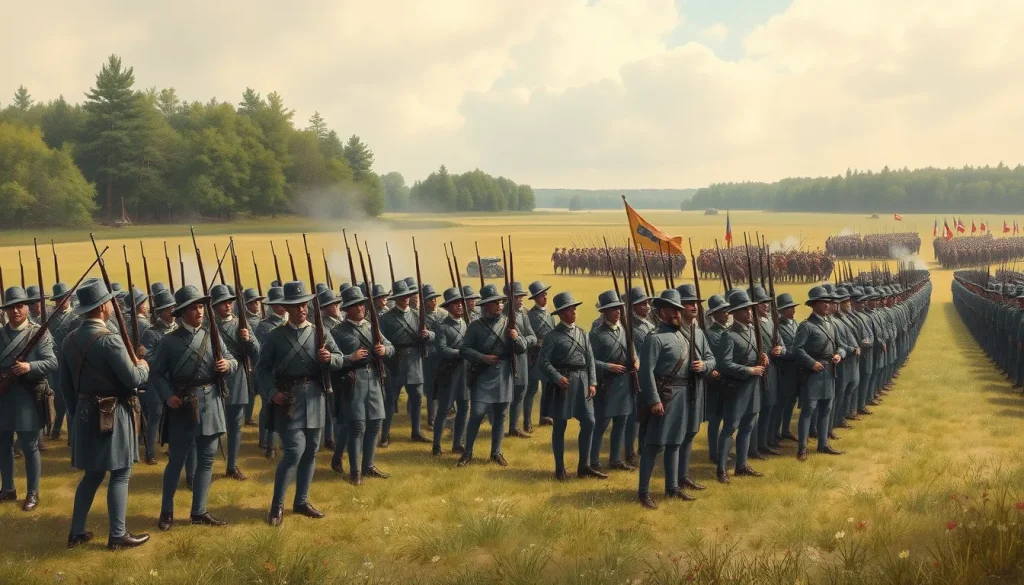
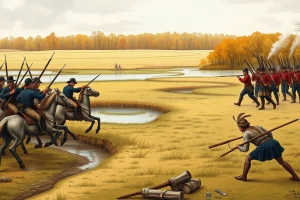
On July 5, the two forces met near Chippawa. The first phase of the battle took place in woods north of Street’s Creek, later called Usshers Creek, where militia and Indigenous warriors from both sides fought a sharp skirmish. The main action then shifted to an open plain between the woods and the Niagara River. Scott’s brigade, wearing grey uniforms rather than regulation blue, formed the center of the American line. Riall, seeing grey coats, reportedly believed he faced American militia rather than regulars and expected them to break under British volleys and bayonet charges.
Instead, the Americans held their formation and exchanged fire at close range. According to tradition, Riall then exclaimed, "Those are regulars, by God!" The exact wording is not confirmed by contemporary sources, but the anecdote captures the British realization that Scott’s men were disciplined regulars. After roughly forty minutes of fighting, British losses and the failure of their advance forced Riall to withdraw north across Chippawa Creek, now the Welland River, tearing up the bridge behind him. More than 700 men on both sides were killed, wounded, or missing. The American victory at Chippawa was followed by further maneuvering that led to the Battle of Lundy’s Lane later in July 1814.
Why It Matters
Chippawa mattered because it demonstrated that American regular infantry, when properly drilled, could stand against British regulars in open battle. The grey uniforms became a symbol of that achievement: the British had expected militia and instead met professionals. The battle boosted American morale on the Niagara frontier and influenced British caution in subsequent operations. For historians, Chippawa is also a case study in how appearance, assumption, and intelligence shaped battlefield decisions. At the same time, the grey coats were not the sole cause of the American victory. Scott’s training, American artillery, Riall’s tactical choices, and the performance of U.S. regulars all contributed to the outcome.
Definition
The grey uniforms at Chippawa were non-regulation U.S. Army clothing issued to Scott’s regular infantry because regulation blue uniforms were unavailable in sufficient numbers. Grey was not a deliberate uniform for Scott’s brigade, nor was it a mark of elite status. In practice, grey clothing was often associated with militia, which is why it misled British observers. The term therefore refers to an expedient supply decision that accidentally created a battlefield deception.
Background
U.S. Army uniform regulations in the early nineteenth century called for blue coats for regular infantry, with distinctive facings and lace according to branch. Supplying those uniforms during the War of 1812 proved difficult. The United States lacked a large standing military establishment before the war, and rapid expansion strained depots, contractors, and transportation. British naval power and domestic shortages further disrupted imports and distribution. In some theaters, regulars wore a mixture of old, captured, contract, and improvised clothing.
Grey cloth and grey garments were more readily available in some areas, partly because militia clothing contracts and state supplies often used grey. When regular regiments could not obtain blue, quartermasters issued grey as a practical substitute. This was especially visible in Scott’s brigade during the 1814 Niagara campaign, where the need to equip a concentrated force quickly overrode uniform regulation.
How It Worked
Scott’s brigade received grey clothing from available stocks, and the men wore it into action at Chippawa. The uniforms did not change their training or tactical role. Scott had drilled the brigade intensively at camps in northern New York, teaching maneuver, volley fire, and bayonet discipline. As a result, the brigade fought as a regular line unit even though its clothing resembled militia dress.
The deception worked because British officers used visual cues to estimate an enemy’s quality. Red coats marked British regulars; blue coats generally marked U.S. regulars; grey coats often marked militia or volunteers. When Riall saw grey across the plain, he drew the reasonable but incorrect conclusion that the Americans were militia. That assumption shaped his initial tactics, including an expectation that the American line would break. By the time he recognized his error, Scott’s men were already engaging at close range.
Competing Viewpoints
Historians generally agree that supply shortages explain the grey uniforms, but they differ on how much weight to give the uniforms in the battle’s outcome. One interpretation emphasizes the psychological shock: the British expected militia and instead met regulars, which disrupted Riall’s plan and contributed to the American victory. Another interpretation stresses that Chippawa was won primarily by Scott’s training, American artillery, and British tactical errors; the grey coats were a memorable detail rather than the decisive factor.
There is also debate about the famous quotation attributed to Riall. Many popular accounts repeat "Those are regulars, by God!" as an eyewitness statement, but it is difficult to verify in contemporary documents. It may preserve a genuine sentiment while being polished by later retelling. Similarly, the extent of uniform shortages varied by regiment and campaign; grey was common but not universal in the U.S. Army during the war.
Role in the War of 1812
Chippawa was part of the 1814 Niagara campaign, one of the most important American offensives of the war. It followed the capture of Fort Erie and preceded the bloody Battle of Lundy’s Lane. The campaign showed that the United States could field a professional regular force in the Canadian theater, even as British reinforcements arrived from Europe. The grey uniforms of Scott’s brigade became part of the battle’s identity and were later remembered in U.S. Army lore as evidence that discipline, not clothing, defined a regular.
For British and Canadian forces, Chippawa was a warning against underestimating American regulars. For Indigenous nations and Canadian militia, the campaign continued a pattern of local warfare and alliance that shaped the Niagara frontier. The battle did not end the campaign, but it altered expectations on both sides.
Consequences and Historical Interpretation
In the short term, Chippawa raised American confidence and contributed to further operations along the Niagara. In the longer term, it became a standard example of the professionalization of the U.S. Army during the War of 1812. The grey uniforms are often used to illustrate the gap between regulation and reality in wartime supply, as well as the dangers of judging a unit by its clothing. Modern historians treat the battle as a significant tactical victory, but they caution against overstating the uniform episode. The grey coats helped create the British misjudgment, yet the American regulars’ performance under fire remained the central reason the misjudgment proved costly.
Primary Sources
Contemporary evidence for Chippawa comes from official military correspondence, after-action reports, and later memoirs. American Major General Jacob Brown reported the campaign and battle to Secretary of War John Armstrong Jr., presenting the American perspective and defending the army’s performance. British Major General Phineas Riall’s official correspondence and reports to his superiors explained the British defeat and the American force he encountered. These reports are essential but limited: they were written to justify decisions, and they rarely discuss uniform details in the vivid terms of later narratives.
Winfield Scott’s Memoirs of Lieut.-General Scott, LL.D., published in 1864, describes the 1814 campaign and Scott’s pride in his brigade, but it was written decades after the battle and is shaped by Scott’s later reputation. U.S. quartermaster and clothing records help explain why grey clothing was issued, though such administrative documents are often scattered across archives. No single contemporary source provides a fully reliable transcript of Riall’s supposed exclamation. Readers should treat the quotation as traditional and consult published documentary editions and archival collections rather than assuming it is verbatim.
Further Reading
- Donald E. Graves, Red Coats and Grey Jackets: The Battle of Chippawa, 5 July 1814.
- Donald R. Hickey, The War of 1812: A Forgotten Conflict.
- J. Mackay Hitsman, The Incredible War of 1812: A Military History.
- American Battlefield Trust, "Chippawa Battle Facts and Summary."
- The Canadian Encyclopedia, "Battle of Chippawa National Historic Site of Canada."
- Niagara Parks, Chippawa Battlefield Park interpretive materials.
References
- American Battlefield Trust, "Chippawa Battle Facts and Summary," https://www.battlefields.org/learn/war-1812/battles/chippawa.
- Sherman Zavitz, "Battle of Chippawa National Historic Site of Canada," The Canadian Encyclopedia, https://thecanadianencyclopedia.ca/en/article/battle-of-chippawa-national-historic-site-of-canada.
- Donald E. Graves, Red Coats and Grey Jackets: The Battle of Chippawa, 5 July 1814 (Toronto: Dundurn Press, 1994).
- Donald R. Hickey, The War of 1812: A Forgotten Conflict, Bicentennial ed. (Urbana: University of Illinois Press, 2012).
- J. Mackay Hitsman, The Incredible War of 1812: A Military History (Toronto: Robin Brass Studio, 1999).
- Winfield Scott, Memoirs of Lieut.-General Scott, LL.D. (New York: Sheldon & Company, 1864).
FAQ
Why did Winfield Scott's brigade wear grey uniforms at Chippawa?
Primarily because U.S. Army supply shortages prevented enough regulation blue clothing from reaching the brigade. Grey garments, often associated with militia, were issued as an emergency substitute.
Did the grey uniforms cause the British defeat at Chippawa?
They contributed to Major General Phineas Riall's initial misjudgment of the American force as militia, but they were not the sole cause. American training, artillery, leadership, and British tactical choices also shaped the result.
Is the quotation 'Those are regulars, by God!' reliable?
It is traditionally attributed to Riall, but no contemporary source clearly confirms the exact wording. Historians generally treat it as a later retelling that captures the British surprise rather than as a verbatim quotation.
Were grey uniforms common in the U.S. Army during the War of 1812?
Grey clothing appeared in various U.S. units, especially when blue cloth was scarce. Regulation uniforms were blue, but wartime supply problems made mixed and improvised clothing common.
Leave a Reply