Short Answer
The Glengarry Light Infantry Fencibles were a light infantry battalion raised chiefly in Glengarry County, Upper Canada, in February 1812, shortly before the outbreak of the War of 1812. Recruited largely from Scottish Highlanders and their descendants and placed on the British establishment, the unit served as garrison infantry along the St. Lawrence and Niagara frontiers and fought at Ogdensburg, York, Fort George, Sackets Harbor, Stoney Creek, Oswego, Lundy’s Lane, Fort Erie, and Cook’s Mills. Its history shows how British North America met the manpower crisis of 1812 through locally raised fencible corps, and how a single colonial regiment’s surviving records complicate simple national narratives of the war.
Historical Context
When Sir George Prevost took up the governorship of British North America in September 1811, Britain was fully committed to the Napoleonic Wars in Europe. The regular garrison available in the Canadas numbered roughly 5,600 men, and only about 1,200 of them were stationed in Upper Canada. With little prospect of substantial reinforcement from Britain, Prevost and his predecessors looked to locally raised units to supplement the regular army and the sedentary and flank-company militia.
Glengarry County, on the north bank of the St. Lawrence River in what is now eastern Ontario, was an obvious recruiting ground. It had been settled in the early 1800s by Catholic Highlanders from Glengarry, Scotland, many of whom had served in the Glengarry Fencibles, a British fencible regiment raised in 1794 by Father Alexander Macdonell. That unit had garrisoned the Channel Islands and served in Ireland during the rebellion of 1798 before being disbanded in 1802 after the Treaty of Amiens. The fencible model, in which soldiers enlisted on terms similar to regulars but were liable for service in North America only, suited a colonial government that could not wait for troops from Europe.
Efforts to raise a Glengarry corps predated the war. A proposal of 1807 was rejected in London; in 1808 Governor General Sir James Craig issued a letter of service on his own authority but withdrew it a month later when the promised recruits did not appear. Not until war with the United States seemed imminent did the scheme succeed.

What Happened
In February 1812, without prior official approval from London, Prevost directed Colonel Edward Baynes to raise a battalion of fencible infantry in Glengarry County, initially planned at 376 other ranks. Recruiting drew men from as far away as Nova Scotia, New Brunswick, and Prince Edward Island; most were of Scottish birth or descent. French-speaking Canadiens and recent immigrants from the United States were excluded, and many of the former enlisted instead in the Canadian Regiment of Fencible Infantry. Recruits received a bounty of four guineas and a promise of 100 acres of land after the war. Partly through the efforts of the unit’s chaplain, Father Alexander Macdonell, the corps grew to about 600 men; Prevost raised it to regimental status and named it the Glengarry Light Infantry Fencibles. Baynes became colonel, Francis Battersby lieutenant colonel, and George Macdonell, known as Red George Macdonell, of the 8th (King’s) Regiment, its major. He was not the same man as the regimental chaplain of similar name, a confusion that persists in some popular accounts.
The regiment trained at Trois-Rivieres (Three Rivers, Quebec) during the first half of 1812, then distributed its companies among Upper Canadian garrisons as a disciplined nucleus around which local militia could form. Two companies at Prescott took part in an abortive crossing to Ogdensburg, New York, on 3 October 1812, called off when American artillery found the range of the boats.
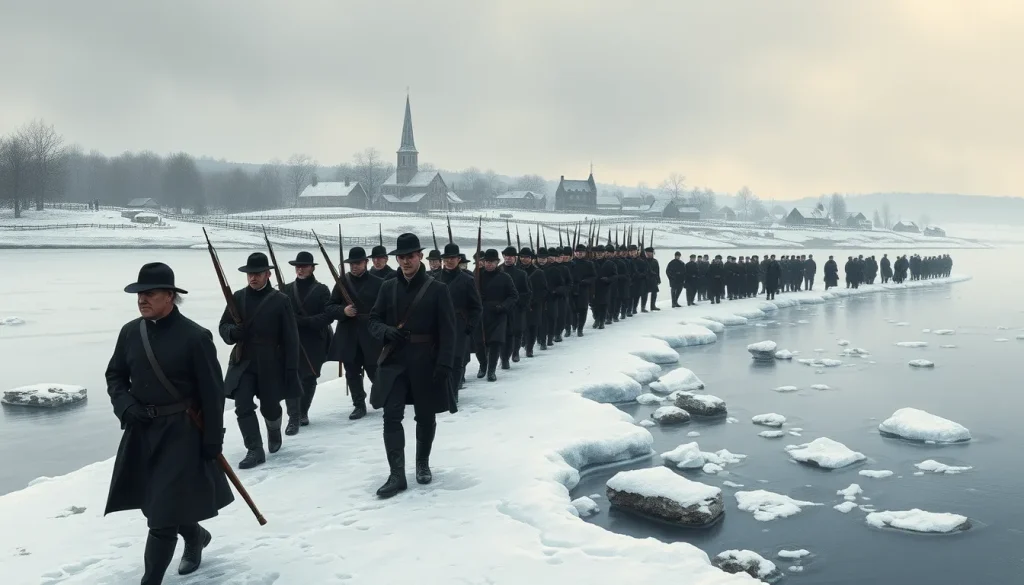
On 22 February 1813, Lieutenant Colonel George Macdonell, commanding at Prescott, led roughly 500 men, including a company of the Glengarry Light Infantry with Glengarry and Stormont militia, across the frozen St. Lawrence. American sentries took the column for a routine drill on the ice until it was halfway over. A frontal attack pinned the defenders while the main body turned their flank, and Ogdensburg was taken. The British withdrew afterwards, but the town’s merchants, anxious to preserve cross-border trade, asked Washington not to re-garrison it, and the post remained largely empty for the rest of the war.
The summer of 1813 was harder. A company was present at York when the Americans captured the provincial capital in April but played little part, having been misdirected by the militia commander. Another suffered heavy losses at Fort George on 27 May while trying to stop American landing craft, the British garrison then withdrawing toward Burlington. A company took part in the confused attack on Sackets Harbor in late May, and the regiment was engaged at Stoney Creek in June. In 1814 the light company helped a battalion of Royal Marines in the assault landing that captured Fort Oswego in May. In July the whole battalion assembled for the first time, joining Major General Phineas Riall’s Right Division at York, and on 25 July it fought at Lundy’s Lane. It was also engaged at Fort Erie on 17 September and at Cook’s Mills on 17 October 1814.
The regiment was granted the battle honour Niagara and was disbanded at Kingston after the war. Some reference summaries list 18 May 1815 as the end of its active establishment, while Summers and Chartrand give 18 May 1816 as the date of disbandment; readers should treat the precise date as unresolved. Its name and traditions are claimed today by the Stormont, Dundas and Glengarry Highlanders of the Canadian militia.
Why It Matters
Contemporary officials valued the Glengarry Light Infantry for what Prevost had intended: trained, full-time soldiers who could stiffen militia detachments along a frontier far longer than the small regular garrison could cover. British commanders cited the regiment’s conduct at Lundy’s Lane, Fort Erie, and Cook’s Mills in general orders, and its battle honour reflected that standing. The Ogdensburg operation of February 1813 also had consequences beyond the battlefield, removing an American garrison and helping to sustain the cross-border trade that continued along the upper St. Lawrence.
Later historians have used the regiment to examine three broader questions: how far the defence of Canada rested on locally raised fencibles rather than British regulars; how ethnic and religious networks, in this case Highland Catholic migration and the Macdonell connection, shaped recruitment; and how far the war in Upper Canada resembled a civil conflict, given the cross-border trade and family ties around Prescott and Ogdensburg. The exclusion of French-speaking and American-born recruits is also evidence of official anxiety about loyalty in a colony with a large recent American population.
Definition
The Glengarry Light Infantry Fencibles were a battalion-strength corps of light infantry on the British establishment, raised in Upper Canada and embodied from February 1812. In British usage a fencible regiment was a home-service or colonial-service unit: its soldiers enlisted on terms similar to regulars but were obligated to serve only in North America, which distinguished them from regular line regiments sent from Europe. As light infantry, the regiment was expected to skirmish, screen, and manoeuvre rather than fight in close-order lines.
Background
Fencible corps had been raised in Britain and Ireland since the mid-eighteenth century and were used heavily during the French Revolutionary and Napoleonic Wars. The earlier Glengarry Fencibles of 1794 to 1802 supplied a template, a pool of trained veterans, and a personal network centred on Father Alexander Macdonell, who accompanied many of his parishioners to Upper Canada. The failure of the 1807 and 1808 attempts to raise a Glengarry corps shows that London and the governor general disagreed over the cost and the legality of raising new fencible regiments on colonial authority alone.
How the Regiment Was Raised and Organized
The unit was organized as a battalion of companies, including a light company, although it rarely served as a concentrated body before 1814. Officers came largely from the regular army. Baynes was Prevost’s adjutant general, while Battersby and George Macdonell were drawn from the 8th (King’s) Regiment. Recruiting was entrusted to company officers operating across the Maritimes and Upper Canada. Terms of enlistment, bounty, and land grants followed the pattern used for other wartime fencible corps. Companies were posted individually to garrisons such as Prescott, York, Fort George, and Kingston, where they provided drill, picquets, and a cadre around which militia could form in a crisis.
Uniforms, Equipment, and Identity
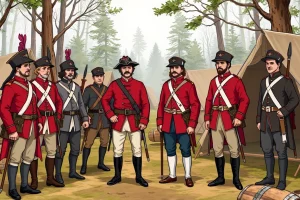
Surviving descriptions indicate that the corps was intended to be clothed as a Highland regiment, but that in practice it was dressed and equipped more like a rifle or light infantry corps, which is why it received colours even though rifle regiments conventionally did not carry them. Modern reconstructions, including the Canadian War Museum plate by R. J. Marrion, are interpretations based on documents and descriptions rather than complete surviving garments. Popular nineteenth-century illustrations showing the Glengarrys charging across the St. Lawrence in full Highland dress are now regarded as inaccurate. According to Summers and Chartrand, Indigenous allies called the regiment the Black Stump Brigade, a nickname reflecting its dark clothing and its competence in forest fighting; the anecdote comes from regimental literature rather than surviving contemporary orders, so it is best treated as a tradition rather than a documented fact.
Competing Viewpoints
Historians differ on how much weight to give locally raised fencibles in explaining the survival of Upper Canada. One tradition, prominent in nineteenth-century Canadian writing, credits units such as the Glengarry Light Infantry with forming the backbone of the defence. A second, associated with J. Mackay Hitsman and later operational historians, stresses that British regulars and naval control of the lakes were decisive, and that fencible and militia units were most valuable as garrisons and skirmishers. A third approach, developed by social and Indigenous historians, argues that the war in Upper Canada cannot be understood without the Indigenous nations whose alliances shaped campaigning. The regiment is also sometimes described as distinctly Canadian, though it was a British establishment corps whose officers were largely British regulars and whose recruits came from several colonies.
Role in the War of 1812
The Glengarry Light Infantry’s war was largely one of detachment service. It provided garrisons on the St. Lawrence and Niagara frontiers, took part in two operations against Ogdensburg, helped man York and Fort George, and joined the 1813 and 1814 campaigns on the Niagara peninsula. Its heaviest single action was probably the defence of the Fort George landing on 27 May 1813, where one company was mauled while attempting to oppose an amphibious assault. Its most concentrated service came in 1814, when the whole battalion fought at Lundy’s Lane and afterwards at Fort Erie and Cook’s Mills.
Consequences and Historical Interpretation
The regiment was disbanded after the Treaty of Ghent ended the war, and its soldiers dispersed into the Upper Canadian land grants promised on enlistment. Although its officers hoped the corps would be retained on the regular establishment, the peacetime British Army was drastically reduced and the Glengarrys were not kept. Its most visible legacy is commemorative: the battle honour Niagara, the perpetuation of its name and traditions by the Stormont, Dundas and Glengarry Highlanders, and its frequent appearance in Canadian accounts of the war as an emblem of settler loyalty. Many present-day historians treat that emblem critically, noting that the corps was raised on imperial authority, drew on a specific migration network, and excluded both Canadien and American-born recruits.
Primary Sources
Much of what is known about the regiment comes from official rather than personal records. The most useful contemporary categories are:
- Correspondence and orders. Sir George Prevost’s letters to the Colonial Office, his warrants and letters of service for fencible corps, and the correspondence of Colonel Edward Baynes and Lieutenant Colonel George Macdonell. These are preserved in British War Office and Colonial Office series at The National Archives (United Kingdom) and in transcripts held by Library and Archives Canada in the British Military and Naval Records (RG 8, C series). They show how the unit was authorized, paid, and deployed, but they rarely describe combat at the level of the individual soldier.
- Muster rolls and pay lists. War Office muster and pay records document the regiment’s fluctuating strength, the origins of its recruits, and the dates of officers’ commissions. They are the best evidence for numbers; commonly cited figures such as 600 men represent recruiting and establishment totals rather than battlefield strength.
- Documentary editions. William Wood’s Select British Documents of the Canadian War of 1812 and Ernest Cruikshank’s Documentary History of the Campaigns upon the Niagara Frontier print many dispatches, returns, and general orders relating to the regiment, including commendations for 1814. Because they are selections, they reflect the editors’ choices about what mattered.
- Newspapers. Official dispatches and reports of actions such as those at Ogdensburg were reprinted in Upper Canadian newspapers, including the Upper Canada Gazette. Such items are usually official in origin and should be read alongside American accounts from Ogdensburg and Sackets Harbor.
No substantial regimental journal or orderly book of the Glengarry Light Infantry appears to be widely published, and popular uniform plates should not be mistaken for primary evidence. A further limitation is that almost all surviving records were produced by officers and officials, so the experience of ordinary soldiers must be reconstructed largely from pay and land-grant records rather than from their own words.
Further Reading
- Summers, Jack L., and Rene Chartrand, Military Uniforms in Canada, 1665-1970 (Ottawa: Canadian War Museum, 1981), the source of the widely reproduced regimental history and uniform study of the Glengarry Light Infantry.
- Hitsman, J. Mackay, The Incredible War of 1812: A Military History (Toronto: University of Toronto Press, 1965).
- Stanley, George F. G., The War of 1812: Land Operations (Toronto: Macmillan, 1983).
- Graves, Donald E., Where Right and Glory Lead! The Battle of Lundy’s Lane, 1814 (Toronto: Robin Brass Studio).
- Canadian War Museum, online features and collections relating to the War of 1812.
- Library and Archives Canada, RG 8, C series (British Military and Naval Records), and The National Archives (UK), War Office records.
- Stormont, Dundas and Glengarry Highlanders regimental museum, Cornwall, Ontario, for the regiment’s later perpetuation.
References
- Wikipedia contributors, Glengarry Light Infantry, Wikipedia, https://en.wikipedia.org/wiki/Glengarry_Light_Infantry (consulted for establishment dates, engagements, and officers).
- Summers, Jack L., and Rene Chartrand, History and Uniform of the Glengarry Light Infantry Fencibles 1812-1816, warof1812.ca, https://www.warof1812.ca/gli.htm, extracted from Military Uniforms in Canada, 1665-1970 (Ottawa: Canadian War Museum, 1981).
- Wood, William, ed., Select British Documents of the Canadian War of 1812, 3 vols. (Toronto: Champlain Society, 1920-1928).
- Cruikshank, Ernest A., ed., The Documentary History of the Campaigns upon the Niagara Frontier, 1812-1814 (Welland, Ontario: Lundy’s Lane Historical Society, 1896-1908).
- Hitsman, J. Mackay, The Incredible War of 1812: A Military History (Toronto: University of Toronto Press, 1965).
FAQ
Who were the Glengarry Light Infantry Fencibles?
They were a light infantry battalion raised in Glengarry County, Upper Canada, from February 1812 and placed on the British establishment as a fencible corps, meaning its soldiers were obligated to serve only in North America. Recruited largely from Scottish Highlanders and their descendants, the unit garrisoned Upper Canadian posts and fought in several actions of the War of 1812 before being disbanded at Kingston after the peace.
Did the Glengarry Light Infantry fight at Lundy's Lane?
Yes. In July 1814 the whole battalion was assembled for the first time and joined Major General Phineas Riall's Right Division at York; it fought at the Battle of Lundy's Lane on 25 July 1814 and was later engaged at Fort Erie on 17 September and Cook's Mills on 17 October 1814. Its service in that campaign was commended in British general orders.
When was the Glengarry Light Infantry disbanded?
The regiment was disbanded at Kingston, Upper Canada, after the Treaty of Ghent. Reference summaries of its establishment give 18 May 1815, while Summers and Chartrand give 18 May 1816. The discrepancy is unresolved in the accessible literature, and readers should treat the exact date with caution.
Leave a Reply