Short Answer
On 11 September 1814, Commodore Thomas Macdonough’s American squadron fought Captain George Downie’s British squadron in Plattsburgh Bay on Lake Champlain. The phrase “spring anchors” in accounts of the battle refers not to coiled mechanical springs but to anchor cables fitted with spring lines, together with stern anchors and kedge anchors, that let Macdonough’s anchored ships pivot and present fresh broadsides. This tactical preparation helped the Americans defeat a stronger British naval force and contributed to the British army’s retreat from Plattsburgh during the War of 1812.
Historical Context
Lake Champlain was a strategic corridor between British Canada and the United States. In 1814, British forces in Canada planned an invasion southward along the lake toward Plattsburgh, New York, while a British squadron based at Ile aux Noix, Quebec, would fight for control of the water. Without naval superiority, the British army under Sir George Prevost could not safely supply or sustain an advance. The American squadron, commanded by Thomas Macdonough, had been built and repaired at Vergennes, Vermont, on Otter Creek, using local ironworks and shipyards. The wider campaign involved British regulars, Canadian militia, and Indigenous allies, but the naval battle itself was fought by sailors, marines, and gun crews of the two squadrons.
Macdonough’s force was smaller in tonnage and broadside weight than the British squadron, which included the large frigate Confiance. He therefore chose a defensive position in Plattsburgh Bay, where the geography, wind patterns, and shoals could limit British maneuver. The American land defenses under Brigadier General Alexander Macomb also prepared to meet the British army. The naval and land battles became interdependent: if the British fleet won, Prevost could continue; if Macdonough won, the British army would have to withdraw.
What Happened
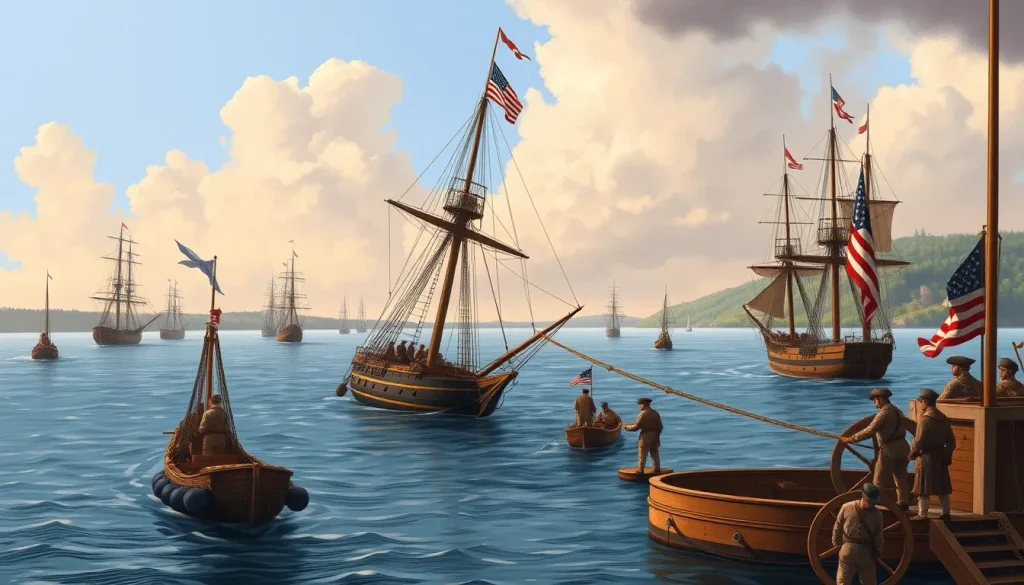
On the morning of 11 September 1814, Downie’s squadron sailed south from the Richelieu River and entered Plattsburgh Bay. Macdonough had anchored his vessels in a north-south line near the mouth of the Saranac River, with Eagle to the north, Saratoga next, then Ticonderoga, Preble, and a group of gunboats. He had prepared his ships with springs, stern anchors, and kedge anchors so they could turn while remaining in position. The British attacked in line, with Confiance aiming for Saratoga and Linnet engaging Eagle.
The fighting was close and destructive. Confiance and Saratoga exchanged broadsides at short range. Downie was killed early in the action. On Saratoga, the starboard battery was largely disabled, and the ship was in danger of being overwhelmed. Macdonough used the spring and anchor system to wind Saratoga, turning her so that her port broadside could fire into Confiance. The maneuver allowed the American flagship to continue the fight with fresh guns while the British ship, already damaged, could not respond as effectively. Other American vessels and gunboats also used their anchors and springs to shift position or maintain fire.
By late morning, the British squadron was defeated. Confiance, Linnet, Chubb, and Finch were captured or sunk, and the surviving British gunboats withdrew. American losses were significant, and British casualties were also heavy; estimates vary among accounts. The naval victory forced Prevost to abandon the land attack and retreat to Canada. The battle was one of the most important American naval successes of the war and helped shape the negotiations that led to the Treaty of Ghent.
Why It Matters
The immediate result was the relief of Plattsburgh and the failure of the British invasion of New York along Lake Champlain. The longer consequence was diplomatic: news of the victory reached the peace negotiations at Ghent and strengthened the American position, even though the treaty did not settle all disputed issues. The battle also became a celebrated example of defensive naval tactics, in which a smaller squadron used position, preparation, and anchored maneuver to offset a larger enemy.
Historians generally agree that Macdonough’s use of springs and anchors was a major tactical factor. It allowed him to maintain a strong defensive line, avoid being raked, and shift his fire when one broadside was disabled. At the same time, later interpretation stresses that the victory was not caused by a single device. British haste, Downie’s death, poor coordination, American land defenses, and the geography of the bay all contributed. The spring system was a standard sailing-era technique, but Macdonough applied it with unusual care and timing.
Definition
In period naval usage, a spring was a rope attached to a ship’s anchor cable and led to a capstan or winch. By hauling or slacking the spring, the crew could change the angle at which the cable pulled the bow, causing the anchored ship to swing. A kedge anchor was a lighter anchor that could be carried out by a boat and used to warp or turn a vessel. A stern anchor could be dropped from the rear to hold a ship steady or prevent unwanted swinging. The phrase “spring anchors” is best understood as shorthand for this combined system of springs, cables, kedges, and stern anchors, not as a spring-loaded anchor.
Background
In the age of sail, a ship’s guns fired from fixed broadsides. A vessel that could not maneuver was vulnerable because an enemy could choose the angle of attack. Anchoring in a defensive line offered stability and concentrated fire, but it also risked letting the enemy rake the ship from an unprotected angle. Springs and auxiliary anchors gave an anchored ship some ability to rotate, effectively allowing it to aim its broadside without sailing. The technique was well known in European and American navies, and British officers at Lake Champlain also understood it. The advantage lay in preparation: Macdonough’s crews had laid out springs and kedges before the battle and practiced the arrangements needed to use them under fire.
How It Worked
A ship at anchor normally lies with its bow toward the anchor, pulled by the cable. To create a spring, a line is run from the capstan to the anchor cable and secured. When the crew hauls on this line, it pulls the cable at an angle, forcing the bow to swing to one side. Hauling on an opposite spring, or slacking the first, can swing the ship back. The result is that the ship turns around its anchor like a gate on a hinge. In this way, a vessel can bring its other broadside to bear, change the target, or avoid a raking fire.
Macdonough added further preparations aboard Saratoga. According to Theodore Roosevelt’s later account, which drew on earlier naval records, Saratoga had a kedge anchor placed off each bow, with hawsers and preventer hawsers leading from each quarter to the kedge on that side. By hauling on the proper hawser, the crew could wind the ship—turn her around—even if the springs were damaged or the wind was unfavorable. Stern anchors served as a backup to keep the ship from swinging too far. These arrangements gave Macdonough options that many anchored ships lacked: he could hold his line, pivot to present a fresh broadside, and keep firing from a controlled position.
Competing Viewpoints
Most naval histories credit the springs and kedge anchors with helping Macdonough turn Saratoga at the critical moment. Some accounts describe this as a decisive tactical innovation, while others note that the equipment itself was ordinary. In the second view, the advantage came from Macdonough’s foresight, his choice of anchorage, and his calm execution under fire. British sources and later studies also point to Downie’s death, the damage to Confiance’s rigging and anchor gear, and the difficulty of coordinating the British squadron in narrow waters. Some scholars emphasize the land defense at Plattsburgh and Prevost’s caution as equally important. The most balanced interpretation is that spring anchors were a necessary tactical enabler, not a wonder weapon: they allowed Macdonough to exploit his defensive position, but they worked only within a wider system of gunnery, seamanship, geography, and command decisions.
Role in the War of 1812
The Battle of Plattsburgh, also called the Battle of Lake Champlain, was the decisive naval engagement on the lake during the War of 1812. It ended British naval power on Lake Champlain for the rest of the war and forced the British army to retreat. The American victory came at a time when the United States had suffered setbacks elsewhere, and it gave American diplomats at Ghent a timely success. Macdonough’s use of springs and anchors became one of the most frequently cited details of the battle because it explained how an anchored squadron could fight effectively against a more powerful opponent. The technique was not unique to Lake Champlain, but its successful use there made it a standard example in later naval writing.
Consequences and Historical Interpretation
In the short term, the victory saved Plattsburgh and ended the British invasion threat from Canada via Lake Champlain. In the long term, it contributed to the American sense of success in the war and influenced how the battle was remembered. Macdonough became a national hero, and his flagship Saratoga became a symbol of American naval skill. Later historians have debated how much credit should go to the springs, to Macdonough’s gunnery, to Macomb’s land defense, or to British mistakes. The spring-anchor system is best understood as a force multiplier: it did not make the American squadron stronger in guns, but it made that squadron harder to defeat by allowing it to turn and present undamaged batteries at the right moment. That tactical advantage, combined with the land defense and British logistical problems, produced a strategic victory.
Primary Sources
The central American account is Commodore Thomas Macdonough’s official report to Secretary of the Navy William Jones, dated 13 September 1814. It describes the action, the anchoring of the squadron, and the progress of the battle. The report is a formal document written to justify and explain American conduct, so it should be read with awareness of its purpose. British accounts by surviving officers, including Commander Daniel Pring, provide a counterpoint, but they are fewer and were written in the context of defeat. Newspaper reports and later documentary collections, such as Niles’ Weekly Register and American State Papers: Naval Affairs, reprinted dispatches and letters, though they often lacked full detail and reflected partisan interests. Theodore Roosevelt’s The Naval War of 1812 is a later secondary work, not a primary source, but it preserves tables and summaries drawn from nineteenth-century naval records and is useful for tracing how the battle was interpreted.
No verified verbatim transcript of a Macdonough order specifically describing the springs is reproduced here. Readers should consult the published report and documentary editions rather than rely on unsourced quotations. Limitations common to these sources include incomplete casualty returns, self-serving explanations by officers, and the loss of British records when ships were captured or destroyed.
Further Reading
- Roosevelt, Theodore. The Naval War of 1812. New York: G.P. Putnam’s Sons, 1882. Available at Project Gutenberg.
- Mahan, Alfred Thayer. Sea Power in Its Relations to the War of 1812. Boston: Little, Brown, 1905.
- Hickey, Donald R. The War of 1812: A Forgotten Conflict. Urbana: University of Illinois Press, 1989; revised edition, 2012.
- Borneman, Walter R. 1812: The War That Forged a Nation. New York: HarperCollins, 2004.
- Millard, James P. “The Battle of Plattsburgh.” America’s Historic Lakes. https://www.historiclakes.org.
- “The Battle of Lake Champlain.” Duckworks Magazine. https://www.duckworksmagazine.com/04/s/vintage/champlain/index.htm.
- Naval History and Heritage Command. “Battle of Lake Champlain.”
References
- Roosevelt, Theodore. The Naval War of 1812. New York: G.P. Putnam’s Sons, 1882. Project Gutenberg, https://www.gutenberg.org/ebooks/9104.
- “The Battle of Lake Champlain.” Duckworks Magazine, https://www.duckworksmagazine.com/04/s/vintage/champlain/index.htm.
- “The Naval War of 1812: Plattsburgh.” Excerpt from Theodore Roosevelt, The Naval War of 1812, https://mlloyd.org/gen/macomb/text/roosevelt.htm.
- Millard, James P. “The Battle of Plattsburgh.” America’s Historic Lakes, https://www.historiclakes.org.
- Hickey, Donald R. The War of 1812: A Forgotten Conflict. Urbana: University of Illinois Press, 1989.
- Mahan, Alfred Thayer. Sea Power in Its Relations to the War of 1812. Boston: Little, Brown, 1905.
FAQ
What are spring anchors?
The term is shorthand for springs, anchor cables, stern anchors, and kedge anchors used together to pivot a ship at anchor. A spring line attached to the anchor cable lets the crew swing the vessel and present a different broadside.
Did Macdonough invent spring anchors?
No. Springs and kedge anchors were standard sailing-era techniques. Macdonough's advantage came from thorough preparation, a strong defensive position, and well-timed use under fire.
How did spring anchors help at Lake Champlain?
When Saratoga's starboard battery was disabled, Macdonough used the spring and anchor system to wind the ship and present her port broadside to Confiance. That maneuver helped the Americans continue the fight and eventually capture the British squadron.
Was the battle decided only by spring anchors?
No. The victory also depended on American land defenses, British haste, the death of Captain Downie, damage to British ships, and the geography of Plattsburgh Bay. Springs were an important tactical enabler, not the sole cause.
Leave a Reply