Short Answer
The Battle of Lake Champlain—commonly called the Battle of Plattsburgh—was fought on 11 September 1814 in Plattsburgh Bay, New York. It was a decisive American naval and land victory during the War of 1812, and in British memory it became an awkward reverse that London explained largely as a local failure of an improvised squadron and a flawed joint operation rather than as a verdict on British power. This article uses that common meaning and focuses on how the defeat was reported, justified, and remembered in Britain, especially in official and public discourse in London.
Historical Context
By 1814 the Napoleonic Wars had turned in Britain’s favour. With Napoleon’s defeat in Europe, thousands of experienced British regulars could be sent to North America. In Canada, Sir George Prevost, governor general and commander-in-chief, planned a campaign south through Lake Champlain toward Plattsburgh and Albany. Control of the lake was essential: without it, an army could not be supplied or supported as it moved into New York. British strategists hoped the advance would isolate New England from the rest of the United States and strengthen Britain’s hand in the peace talks already under way at Ghent.
London’s attention, however, remained fixed on Europe and the settlement of the Napoleonic order. The Liverpool ministry and Secretary for War and the Colonies Earl Bathurst treated the North American war as a secondary theatre. The Royal Navy was stretched across the globe, and the Admiralty had to improvise a squadron for Lake Champlain. On the American side, Commodore Thomas Macdonough commanded a small but prepared lake force, while Brigadier General Alexander Macomb commanded the land defences at Plattsburgh. Geography, logistics, and the timing of the European war therefore shaped both the campaign and the explanations that followed its failure.
What Happened
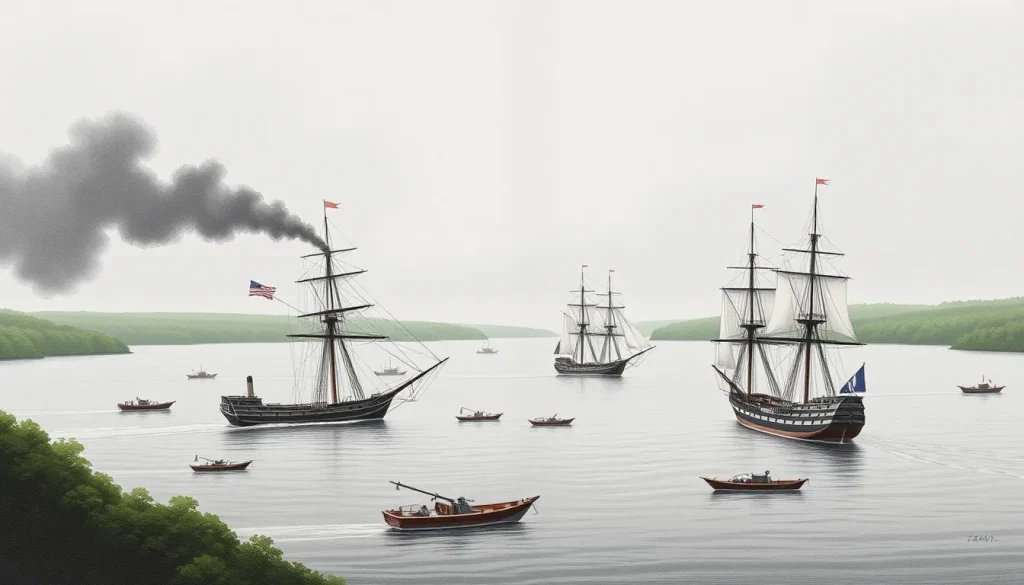
In early September 1814, Prevost’s army advanced into northern New York. The British naval squadron on Lake Champlain was commanded by Captain George Downie and included the newly built frigate HMS Confiance, the brig HMS Linnet, and the smaller vessels HMS Chub and HMS Finch, supported by gunboats. Macdonough’s American squadron, including USS Saratoga, USS Eagle, USS Ticonderoga, and USS Preble, waited in Plattsburgh Bay.
On the morning of 11 September 1814, Downie attacked. The British aimed to destroy the American squadron and then support Prevost’s land assault. Instead, the battle turned against them. Confiance engaged Saratoga, but Macdonough used spring cables to turn his flagship and present a fresh broadside. Downie was killed early in the action, and the British squadron lost cohesion. One by one the British vessels were battered into surrender. On land, Prevost’s troops had been probing and attacking the American defences south of the Saranac River, but the main effort was not carried through once the naval squadron surrendered. Prevost cancelled further operations and retreated to Canada. American casualties were significant but lighter than British losses, and the defeat cost Britain its only means of controlling the lake.
Why It Matters
The immediate effect was to halt the last major British invasion from Canada by way of Lake Champlain. It secured the northern American border, boosted American morale, and weakened British territorial demands at Ghent. Because the Treaty of Ghent ultimately restored the status quo ante bellum, the battle helped ensure that the war ended without the territorial changes Britain had sometimes contemplated.
For British memory, the battle mattered differently. In London it was not remembered as a Trafalgar or a Waterloo. It was explained as a peripheral setback in a global war, caused by local conditions: an improvised squadron, inexperienced crews, the death of Downie, and a failure of army-navy coordination. Prevost’s reputation suffered badly. He returned to England and died in 1816 before a court-martial could clear or condemn him. The Admiralty’s usual practice was to try surviving officers for the loss of a ship; such courts-martial generally ended in acquittal when the loss was attributed to enemy superiority or the death of the commanding officer. Historians such as Andrew Lambert have emphasised that British statesmen had little interest in the war and that few original British accounts appeared, leaving Americans to shape much of the Anglophone memory of 1812.
Definition
British memory of the Battle of Lake Champlain refers to the ways British officials, naval and military officers, newspapers, and later historians interpreted the loss. It is not a single official verdict. In London, the defeat was generally explained as a localized reverse rather than proof that Britain could not win the war. The dominant themes were the weakness of the improvised lake squadron, the death of its commander, the difficulty of combined operations, and the judgment that the army could not advance without naval control.
Background
News of the defeat reached London through Prevost’s dispatches to Bathurst, Admiralty correspondence, and newspaper reports. Official dispatches were published in the London Gazette, but coverage of the North American war was limited. The government was absorbed by the European peace settlement, and the British public had little appetite for a distant conflict with the United States. The defeat also arrived while British negotiators at Ghent were reassessing their demands. The Duke of Wellington advised that Britain could not demand territory it had not conquered or held, and the Lake Champlain reverse reinforced that strategic realism.
How It Worked
London’s explanation operated on three levels. First, official reporting: Prevost presented the naval defeat as the reason his army could not continue, making retreat a military necessity. Second, professional naval assessment: Downie’s squadron was hastily assembled, undermanned, and short of experienced seamen. He had little time to prepare before attacking. Third, public and political interpretation: because the government did not make the battle a major public issue, there was no single authoritative narrative. Prevost sought a court-martial to clear his name but died before trial. The Admiralty’s usual practice was to try surviving officers for the loss of a ship; such courts-martial generally ended in acquittal when the loss was attributed to enemy superiority or the death of the commanding officer. The absence of a dramatic public reckoning allowed the defeat to be treated as an unfortunate local failure rather than a national humiliation.
Competing Viewpoints
Prevost and his supporters blamed the navy. They argued that Downie attacked before the army was ready, that his squadron was too weak to fight Macdonough’s prepared force, and that the loss of the lake made further advance impossible. Naval officers and their advocates blamed Prevost. They claimed he rushed Downie into action, failed to coordinate the land assault, and ordered a retreat too quickly. Later British and Canadian historians have often emphasised material and logistical problems: the British squadron was built quickly, some vessels were not fully ready, and its crews included soldiers and invalids rather than trained seamen. American historians have stressed Macdonough’s tactical skill, the use of springs, and the advantage of fighting from a prepared anchorage. Most modern accounts treat the defeat as a failure of joint operations in which both Prevost and the naval command bore responsibility.
Role in the War of 1812
The Battle of Lake Champlain ended the British offensive from Canada via the lake. It helped secure the northern United States and strengthened the American position at Ghent. For Britain, it was a peripheral setback in a war that London had never made central to its strategy. The defeat did not determine the outcome of the War of 1812 by itself, but it removed a British bargaining chip and contributed to the status quo peace. In British professional memory, it became a cautionary example of how difficult combined operations could be when naval and land commanders did not act in concert.
Consequences and Historical Interpretation
In Britain, the battle remained muted in public memory. The Napoleonic Wars, Waterloo, and the Royal Navy’s larger victories overshadowed it. Andrew Lambert argues that British statesmen had little interest in the War of 1812 and that the scarcity of original British accounts allowed American interpretations to dominate. William James’s 1818 account was one notable British effort to answer American claims; he defended British officers and attributed losses to circumstances. Modern historians such as John R. Grodzinski and David Fitz-Enz differ on how much blame belongs to Prevost, but most agree that the defeat was a combined-operations failure. The London explanation was therefore not one excuse but a cluster of arguments: an improvised squadron, a dead commander, inadequate naval resources, a cautious general, and a peace already being negotiated.
Primary Sources
- Sir George Prevost’s dispatch to Earl Bathurst, September 1814. This official report presents the retreat as necessary after the naval defeat. It is essential for understanding the British government’s first information, but it is self-serving and defensive.
- Commodore Thomas Macdonough’s report to Secretary of the Navy William Jones, September 1814. The American naval commander’s account describes the battle and the capture of the British squadron. It is detailed but naturally reflects an American victory narrative.
- Captain Daniel Pring’s letters and court-martial testimony. Pring, who commanded HMS Linnet, provided a British naval perspective. His accounts emphasise the difficulties of the squadron and the death of Downie, but they were written by a participant seeking to explain the loss.
- William James, A Full and Correct Account of the Military Occurrences of the Late War Between Great Britain and the United States of America (1818). James used Admiralty and military records to challenge American accounts. It is an early British interpretation, but it is polemical and selective.
- The London Gazette and London newspapers. Official dispatches and press notices show how the defeat was presented to the British public. Coverage was limited, and editors often depended on official reports.
- Civilian witness J. C. Hubbell. Hubbell’s recollection of the firing as “terrific” and “one continuous roar” conveys the intensity of the action, but it is a personal memory rather than a systematic account.
Further Reading
- Andrew D. Lambert, “Faithful History: British Representations of the War of 1812,” Historically Speaking 13, no. 4 (2012).
- John R. Grodzinski, Defender of Canada: Sir George Prevost and the War of 1812 (University of Oklahoma Press, 2013).
- David Fitz-Enz, The Final Invasion: Plattsburgh, the War of 1812’s Most Decisive Battle (Cooper Square Press, 2001).
- William James, A Full and Correct Account of the Military Occurrences of the Late War Between Great Britain and the United States of America (London, 1818).
- National Park Service, “Autumn 1814: The British Navy suffers a decisive defeat at the Battle of Lake Champlain.”
- The National Archives (UK), Admiralty and Colonial Office records relating to the War of 1812.
- Library and Archives Canada, Sir George Prevost papers and official correspondence.
References
- Andrew D. Lambert, “Faithful History: British Representations of the War of 1812,” Historically Speaking 13, no. 4 (2012): 8–11. https://exa.ai/library/publication/cnzl1cy9k20.
- National Park Service, “Autumn 1814: The British Navy suffers a decisive defeat at the Battle of Lake Champlain,” https://www.nps.gov/articles/battle-of-lake-champlain.htm.
- John R. Grodzinski, Defender of Canada: Sir George Prevost and the War of 1812 (Norman: University of Oklahoma Press, 2013).
- David Fitz-Enz, The Final Invasion: Plattsburgh, the War of 1812’s Most Decisive Battle (New York: Cooper Square Press, 2001).
- William James, A Full and Correct Account of the Military Occurrences of the Late War Between Great Britain and the United States of America (London: Printed for the author, 1818).
- The National Archives (UK), Admiralty and Colonial Office records relating to the War of 1812.
FAQ
What was the Battle of Lake Champlain?
It was the 11 September 1814 naval and land engagement at Plattsburgh Bay, New York, in which Commodore Thomas Macdonough's American squadron defeated Captain George Downie's British squadron. The British land advance under Sir George Prevost then retreated to Canada.
How did London explain the British defeat?
London generally explained it as a local failure of an improvised lake squadron, worsened by Downie's death and poor army-navy coordination, rather than as a decisive national defeat. Prevost blamed the naval loss; naval officers and later historians often blamed Prevost's haste and lack of support.
Did the defeat change the Treaty of Ghent?
It did not determine the treaty by itself, but it weakened British bargaining power and reinforced the eventual status quo ante bellum settlement. The American victory helped ensure Britain could not demand territorial concessions it had not conquered.
Why is the battle less remembered in Britain than in the United States?
British attention remained focused on the Napoleonic Wars and Waterloo, and the War of 1812 was a secondary theatre. Andrew Lambert notes that few original British accounts appeared, leaving American interpretations to dominate Anglophone memory.


Leave a Reply