
Short Answer
The “Negro Fort” at Prospect Bluff was a fortified settlement on the lower Apalachicola River in Spanish West Florida, built by British forces in 1814 during the War of 1812 and occupied after the British withdrawal by formerly enslaved men and women and their Creek, Seminole, and Choctaw allies. Although it lay far from the war’s main battlefields, the post was a direct product of British Gulf Coast strategy and of British efforts to arm enslaved people against the United States. On July 27, 1816, U.S. forces and their Creek allies destroyed the fort and killed most of its inhabitants, an attack that came after the war had formally ended and that helped shape the Seminole Wars and the eventual American acquisition of Florida. “Negro Fort” is the term used in contemporary American documents; modern scholarship generally calls its people the Prospect Bluff maroons.
Historical Context
Spain’s colony of Florida formed a porous borderland between the United States and the Gulf of Mexico, and Spanish authority there was thin. Spanish law had long offered freedom to enslaved people who escaped from British colonies and accepted Catholicism, and although Spain itself permitted slavery, Florida remained a destination for people fleeing bondage in Georgia, South Carolina, and the American Gulf settlements. The Apalachicola River, which empties into the Gulf east of Pensacola, was a natural corridor linking the Creek country of the interior with coastal trade networks that supplied Creek, Seminole, and Choctaw towns.
The Creek War of 1813-1814 pushed this borderland into crisis. Red Stick Creeks who rejected land cessions and resisted American expansion were defeated at Horseshoe Bend in March 1814, and survivors fled south into Spanish Florida, where they joined Seminole and other communities. At the same time Britain, at war with the United States since 1812, widened its operations along the southern coast. Vice Admiral Alexander Cochrane’s Gulf campaign, the British occupation of Pensacola in 1814, and British recruitment of formerly enslaved men into the Corps of Colonial Marines raised the prospect that the war would be carried into the plantation South by arming the very people white Southerners feared most.
Article I of the Treaty of Ghent of December 1814 required the restoration of property, including enslaved people, taken by either side, but Britain refused to return those who had come under British protection, arguing that they had become free. This dispute kept the southern border tense after the fighting ended elsewhere. Meanwhile the United States, needing to supply its new post at Fort Scott on the Flint River, had to move men and stores up the Apalachicola River, directly past whatever force occupied Prospect Bluff.

What Happened
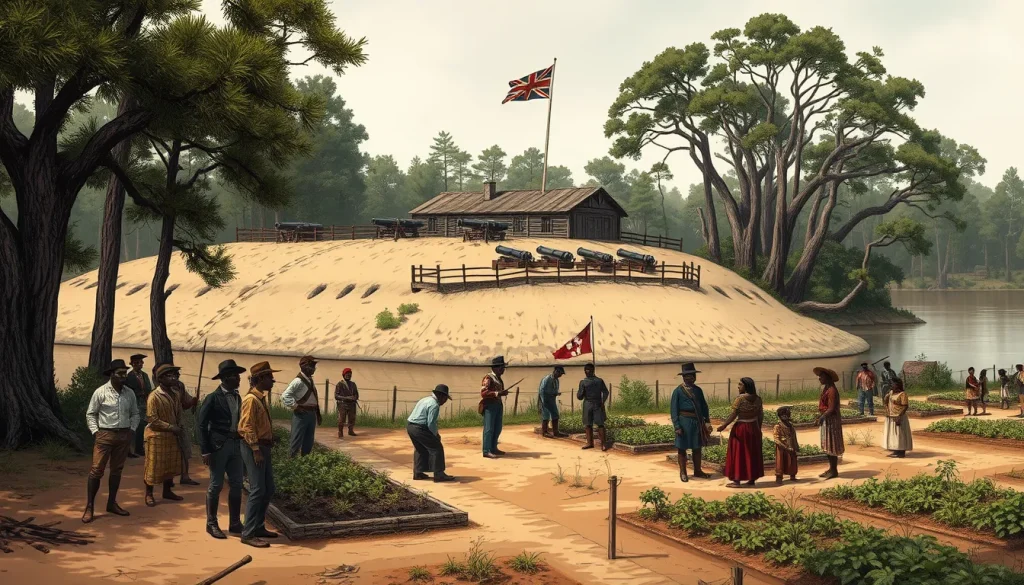
In the summer of 1814, British vessels appeared at St. George Island off the mouth of the Apalachicola. The land force was led by Brevet Major Edward Nicolls of the Royal Marines, a Peninsular War veteran who opposed slavery, with naval support that included the frigate HMS Orpheus, commanded by Captain Hugh Pigot. Nicolls and the British agent George Woodbine directed the construction of an earthwork and battery at Prospect Bluff, on the lower Apalachicola, and stockpiled arms, ammunition, and cannon there. Weapons were distributed to Red Stick Creek, Seminole, and Choctaw warriors and to men who had escaped slavery, and Nicolls promised them the rights and protection of British subjects.
After Andrew Jackson’s attack on Pensacola in November 1814 and the general end of the war, the British withdrew from the Gulf. Nicolls left Prospect Bluff in the hands of his Black and Indigenous allies and encouraged them to hold the ground; he remained in the region into 1815 before departing, and he arranged for some of the men he had enlisted to be transported to British colonies such as Trinidad. The fort itself remained occupied. Historians estimate that its population, including women and children, numbered in the several hundreds. Nathaniel Millett argues that the community functioned as a self-governing maroon settlement that regarded itself as an independent British polity, farming, trading, and maintaining its fortifications and artillery.
American officials treated the fort as a threat to slavery and to the southern border. Major General Andrew Jackson wrote to Spanish officials demanding that they destroy the post and return the people who had fled there; the Spanish replied that they lacked the means to attack it. In 1816 the United States built Fort Scott on the Flint River. In July of that year a supply flotilla bound for Fort Scott, escorted by two U.S. Navy gunboats, came under fire as it passed the fort; American and later accounts disagree about who fired first.
On July 20, 1816, U.S. regulars under Colonel Duncan Lamont Clinch landed north of the fort, supported by Creek warriors under the American-allied chief William McIntosh, also known as Tustunnuggee Hutkee. The Creek force opened small-arms fire to occupy the fort’s artillery while the gunboats, which American naval accounts place under the command of Sailing Master Jairus Loomis, moved into range. On July 27 the gunboats opened fire, and an early shot heated in a furnace struck the fort’s powder magazine. The explosion destroyed the position and killed most of its occupants. American reports counted roughly 270 to 300 dead and about 60 survivors, including women and children. The fort’s leader, identified in American sources as Garçon, was captured and executed, and the victors reported seizing large quantities of arms, ammunition, and cannon, which one American estimate valued at about $200,000.
Survivors fled east toward the Miccosukee towns and the Suwannee River, where they joined Seminole communities. In 1818 U.S. troops built Fort Gadsden on the Prospect Bluff site during Andrew Jackson’s invasion of Florida in the First Seminole War, a conflict often dated from 1816 or 1817 to 1818. Spain ceded Florida to the United States in the Adams-Onis Treaty of 1819, and the transfer of the colony took place in 1821.
Why It Matters
The immediate effect of the destruction was the elimination of the largest maroon community in North America and the dispersal of its people. For the United States, the attack removed a refuge that had drawn enslaved people from Georgia and the Gulf region and opened the Apalachicola River to supply traffic; for the Seminoles and their Black allies it began a cycle of warfare that continued through the Seminole Wars and the era of removal. Officials at the time understood the operation in terms of runaway slaves, border security, and Spanish weakness rather than as a conventional military engagement, because the Treaty of Ghent had already ended the war with Britain.
Historians interpret the episode in several ways. Millett emphasizes both the radical antislavery ideology Nicolls brought to the Gulf and the political consciousness of the maroons themselves, who petitioned, negotiated, and defended their territory as free people. Other scholars place Prospect Bluff within the longer story of Anglo-American imperial rivalry in the borderlands and of the American drive to secure the southern frontier. Some stress that U.S. action was driven primarily by the protection of slavery, others by the legal anomaly of an armed settlement in Spanish territory. What the surviving record does not permit is a clear view from inside the community: no substantial archive written by the Prospect Bluff maroons is known, so their story must be reconstructed from the records of British officers, American officials, and Spanish administrators who were often hostile to them.
Historical Map Context
Period maps of West Florida place Prospect Bluff on the lower Apalachicola River, roughly fifteen miles from the river’s entrance to the Gulf, according to the State Archives of Florida. The 1817 map of the Forbes Purchase cited in that exhibit shows the site in relation to St. George Island and the Apalachicola delta. The fort lay well south of the confluence of the Chattahoochee and Flint rivers, at present-day Chattahoochee, Florida, which is why the American supply route to Fort Scott passed directly beneath its guns. Contemporaries also produced plans of the fortification and, later, of Fort Gadsden, which was erected on the same bluff.
Modern Location
The site is in Franklin County, Florida, on the Apalachicola River within the Apalachicola National Forest, near the community of Sumatra. It is managed by the U.S. Forest Service as Prospect Bluff Historic Sites and is also known in older records as the Fort Gadsden site.
Events at the Site
The bluff saw four distinct phases of activity. British forces built the earthwork and battery in 1814 as part of their Gulf Coast operations and used it as a base for arming and supplying Black and Indigenous allies. After the British departure in 1815, the fort became the center of a maroon settlement whose inhabitants farmed nearby land, traded with Seminole and Spanish neighbors, and maintained artillery. In July 1816, U.S. soldiers, Creek warriors, and naval gunboats attacked and destroyed the post, killing most of its occupants. Two years later, in 1818, American troops built Fort Gadsden on the same ground during Jackson’s invasion of Florida; that post was used only briefly and was later abandoned.
Associated People
- Edward Nicolls – Brevet Major, Royal Marines; commander of the British establishment at Prospect Bluff and author of promises of freedom and protection to those who joined him.
- George Woodbine – British agent who worked with Nicolls in recruiting and supplying Creek, Seminole, and Black allies.
- Captain Hugh Pigot – Royal Navy officer whose frigate HMS Orpheus supported the Apalachicola operation.
- Garçon – leader of the fort’s inhabitants as identified in American sources; captured and executed after the explosion.
- William McIntosh (Tustunnuggee Hutkee) – Creek chief allied to the United States whose warriors fought at the fort in 1816.
- Colonel Duncan Lamont Clinch – U.S. Army officer who commanded the land force in the 1816 attack.
- Andrew Jackson – Major General commanding the Southern Division, who pressed Spanish officials to destroy the fort.
Surviving Monuments and Site
The site retains earthworks associated with the fortifications and is interpreted for visitors with markers in the Apalachicola National Forest. Archaeological work and public history projects have focused attention on the destruction layer of 1816 and on the fort’s later reoccupation as Fort Gadsden. The two hundredth anniversary of the fort’s destruction in 2016 brought renewed public attention to the site and to the people who lived there.
Primary Sources
The fullest contemporary account of the 1816 attack is Colonel Duncan L. Clinch’s report to Brigadier General Edmund P. Gaines, dated July 28, 1816, one day after the explosion. It is the principal source for casualty figures and for the quantity of stores captured, but it is a victory report written by the attacking commander and reflects his purposes.
Orders and correspondence of Gaines and Jackson in 1816 set out the American reasoning about runaway slaves and border security, and Jackson’s letters to Spanish officials at Pensacola document the diplomatic pressure that preceded the attack. These documents survive in official correspondence and were printed in nineteenth-century government compilations and newspapers.
British records from 1814 and 1815, including Edward Nicolls’s letters and proclamations, assert British protection for those who joined him and are essential for understanding what was promised at Prospect Bluff. They survive in British official correspondence at The National Archives at Kew and are quoted at length in modern scholarship.
Article I of the Treaty of Ghent of December 24, 1814, is the diplomatic text at the center of the postwar dispute over enslaved people taken under British protection, and Spanish administrative correspondence from Pensacola records Spain’s inability or unwillingness to act against the fort. Period maps and plans, including the circa 1817 Forbes Purchase map and plans of Fort Gadsden, supply the geographic evidence.
One limitation applies to all of these materials: they were produced by British officers, American officials, and Spanish administrators. No substantial body of documents written by the Prospect Bluff maroons themselves is known to survive, so statements about the community’s internal life are necessarily interpretive.
Further Reading
- Nathaniel Millett, The Maroons of Prospect Bluff and Their Quest for Freedom in the Atlantic World (University Press of Florida).
- Frank Lawrence Owsley Jr., Struggle for the Gulf Borderlands: The Creek War and the Battle of New Orleans, 1812-1815.
- Kenneth Wiggins Porter, The Black Seminoles: History of a Freedom-Seeking People.
- J. Leitch Wright Jr., Creeks and Seminoles: The Destruction and Regeneration of the Muscogulge People.
- State Library and Archives of Florida, Florida Memory, “British Intrigue and the Events at Prospect Bluff.”
- U.S. Forest Service, Apalachicola National Forest, site information for Prospect Bluff Historic Sites.
References
- State Library and Archives of Florida, Florida Memory, “British Intrigue and the Events at Prospect Bluff” (published July 7, 2012), https://www.floridamemory.com/items/show/254519.
- Nathaniel Millett, The Maroons of Prospect Bluff and Their Quest for Freedom in the Atlantic World (University Press of Florida, 2013; paperback 2015), publisher description, UBC Press, https://www.ubcpress.ca/the-maroons-of-prospect-bluff-and-their-quest-for-freedom-in-the-atlantic-world.
- Frank Lawrence Owsley Jr., Struggle for the Gulf Borderlands: The Creek War and the Battle of New Orleans, 1812-1815 (University Presses of Florida, 1981).
- Kenneth Wiggins Porter, The Black Seminoles: History of a Freedom-Seeking People, revised edition (University Press of Florida, 1996).
- J. Leitch Wright Jr., Creeks and Seminoles: The Destruction and Regeneration of the Muscogulge People (University of Nebraska Press, 1986).
- Treaty of Peace and Amity between His Britannic Majesty and the United States of America (Treaty of Ghent), December 24, 1814, Article I.
- Duncan L. Clinch to Edmund P. Gaines, July 28, 1816, report on the destruction of the fort, printed in contemporary newspapers and in nineteenth-century government compilations.
FAQ
What was the Negro Fort at Prospect Bluff?
It was a fortified settlement on the lower Apalachicola River in Spanish West Florida, built by British forces in 1814 and occupied after the British withdrawal by formerly enslaved people and their Creek, Seminole, and Choctaw allies. U.S. forces and Creek warriors destroyed it on July 27, 1816.
Was the Negro Fort part of the War of 1812?
It was created directly by the war. British forces built the post in 1814 as part of their Gulf Coast operations and armed Black and Indigenous allies there. The fort was destroyed in 1816, after the Treaty of Ghent had ended the fighting with Britain, but the attack grew out of wartime promises of freedom and postwar disputes over enslaved people taken under British protection.
What happened to the survivors of the fort's destruction?
Those who escaped fled east toward the Miccosukee towns and the Suwannee River and joined Seminole communities, becoming part of the people later described as Black Seminoles. Many were drawn into the First Seminole War of 1817-1818 and were eventually affected by the removal policies of the following decades.
Leave a Reply