
Short Answer
The British army’s retreat from New Orleans in January 1815 was the withdrawal and evacuation of the British expeditionary force after its defeat at the Battle of New Orleans on January 8, 1815. This article treats the retreat as the movement of Maj. Gen. John Lambert’s army from the Chalmette battlefield back through Bayou Bienvenu to Lake Borgne and its ships, completed by about January 18–19, 1815. It ended the British attempt to capture New Orleans during the War of 1812 and followed the costly repulse of the main assault on Andrew Jackson’s fortified line.
Historical Context
After Napoleon’s abdication in April 1814, Britain was able to send veteran troops and additional naval strength to North America. British planners identified the Gulf Coast as a promising theater. New Orleans was the principal port for the Mississippi River valley, and its capture would disrupt American commerce, separate the western states from the eastern seaboard, and give Britain a strong bargaining position in peace negotiations. Vice Adm. Sir Alexander Cochrane commanded the naval forces, while Maj. Gen. Sir Edward Pakenham commanded the army sent against Louisiana.
The British expedition assembled at Negril Bay, Jamaica, and sailed for the Gulf in late November 1814. After defeating an American flotilla on Lake Borgne on December 14, British forces landed on Pea Island and advanced through Bayou Bienvenu. On December 23 they occupied the Villere plantation below New Orleans. That same day, Maj. Gen. Andrew Jackson launched a nighttime attack that, while inconclusive, convinced the British that American numbers were greater than they were.
Jackson withdrew to the Rodriguez Canal and began building an earthwork known as Line Jackson. It ran from the Mississippi River to a cypress swamp, protected by artillery and supported by a battery on the right bank. On January 8, 1815, Pakenham attacked the line directly. The assault failed with heavy British losses. Pakenham was killed, Maj. Gen. Samuel Gibbs was mortally wounded, and Maj. Gen. John Keane was wounded. A secondary British attack under Col. William Thornton on the right bank captured an American battery, but it came too late and was recalled. The Treaty of Ghent had been signed on December 24, 1814, but news of the peace had not yet reached the Gulf armies.

What Happened
After the January 8 disaster, command of the British land forces passed to Maj. Gen. John Lambert. Lambert canceled further frontal attacks and held a council of war. With Pakenham and Gibbs dead, Keane wounded, and more than two thousand British soldiers killed, wounded, or missing, the British had no realistic prospect of breaking Line Jackson. Lambert ordered a withdrawal.
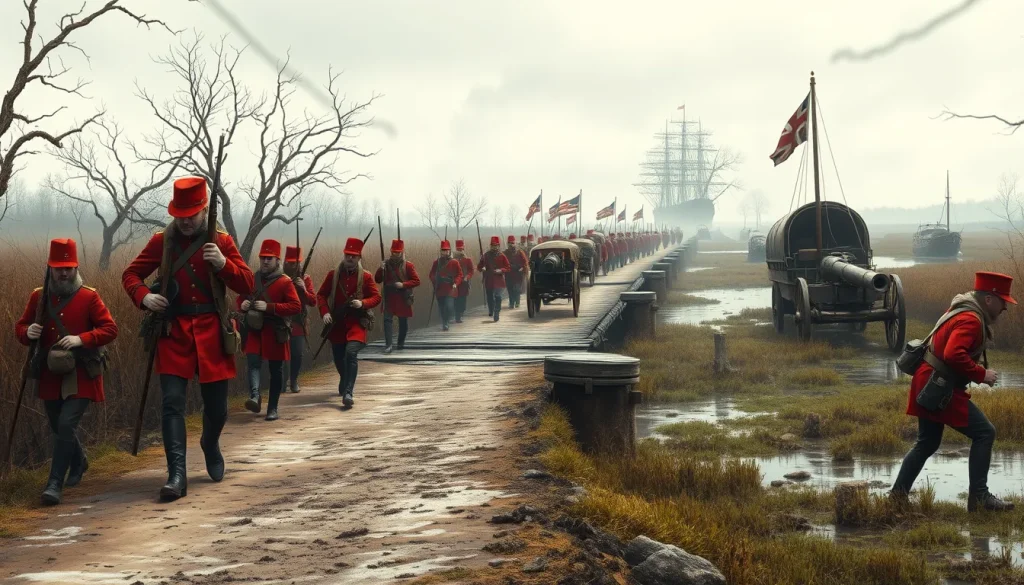
On January 9, the British sent a flag of truce to ask for time to bury the dead and recover the wounded. Jackson agreed to a temporary truce. The British used the pause to collect survivors and prepare the retreat. The withdrawal was not a panic rout. It was a difficult military evacuation conducted over swampy, flooded ground. The British had to move artillery, stores, and wounded men from the Chalmette plain back to Bayou Bienvenu, the water route by which they had advanced. Engineers and soldiers built bridges, corduroy roads, and small redoubts to move heavy equipment and wounded over the mud and water.
At the same time, a British naval squadron bombarded Fort St. Philip near the mouth of the Mississippi River from about January 9 to January 18. The bombardment failed to reduce the fort or open the river to the fleet. It did, however, occupy American attention while the army withdrew. The British army completed its movement to Lake Borgne and re-embarked on its ships by January 18–19, 1815. Jackson did not pursue aggressively; his own army was exhausted, imperfectly supplied, and still responsible for defending New Orleans against a possible renewal of the campaign.
Once embarked, the British fleet did not immediately leave the region. It sailed toward Mobile Bay, where British forces captured Fort Bowyer on February 11, 1815. Only then did news arrive that the Treaty of Ghent had been ratified, bringing the war to an end. The retreat from New Orleans was therefore the decisive end of the Louisiana campaign, even though limited operations continued for several weeks.
Why It Matters
The retreat saved New Orleans and preserved American control of the lower Mississippi River. It also made Andrew Jackson a national hero and strengthened his later political career. For the British, the retreat marked the failure of a major expedition that had been intended to offset American gains elsewhere and strengthen Britain’s position at the peace table. Because the Treaty of Ghent had already been signed, the battle and retreat did not change the formal terms of peace, but they shaped how Americans remembered the war.
Historians generally agree that Lambert’s decision to withdraw was militarily sound. The British army had lost its commanding general and most of its senior leadership, suffered devastating casualties, and faced a strong defensive line supported by artillery. A renewed assault would likely have produced another costly failure. Some scholars emphasize British tactical errors before January 8, including poor reconnaissance, delays, and overconfidence. Others stress the role of terrain, weather, disease, and logistics. The retreat itself is often treated as a professionally conducted evacuation under difficult conditions, though it was forced by defeat.
In American memory, January 8 became a celebrated victory, while the British withdrawal was largely forgotten. In British and Canadian accounts, the Louisiana campaign is often overshadowed by the burning of Washington and the attack on Baltimore. The retreat nevertheless remains significant as the end of the last major British land offensive in the War of 1812 and as a case study in how a defeated army disengaged from a superior defensive position.
Prelude
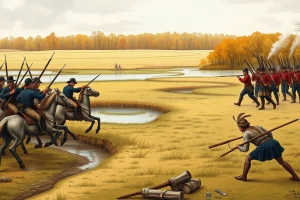
The retreat followed directly from the failure of the British assault on January 8. Pakenham’s plan required coordinated attacks on both banks of the Mississippi. The main attack on the east bank was shattered by American artillery and infantry fire. Thornton’s attack on the west bank succeeded locally, but Lambert, now in command, judged that the main effort could not be renewed. He recalled Thornton’s force and prepared to withdraw before the Americans could counterattack.
Forces and Commanders
The British expedition included veteran regiments from the Napoleonic Wars, Royal Navy crews, Royal Marines, and artillery. Key British commanders were Vice Adm. Sir Alexander Cochrane, Maj. Gen. Sir Edward Pakenham, Maj. Gen. Samuel Gibbs, Maj. Gen. John Keane, Maj. Gen. John Lambert, and Col. William Thornton. After January 8, Lambert commanded the army, while Cochrane directed naval operations.
The American force was a mixed army under Maj. Gen. Andrew Jackson. It included U.S. Regulars, Tennessee and Kentucky militia, Louisiana militia, Free Men of Color, Choctaw allies, Baratarian privateers, sailors, and Marines. Jackson’s chief subordinates included Brig. Gen. John Coffee and Commodore Daniel Patterson. The American line was supported by artillery and by the river battery on the right bank.
Battlefield and Map Context
The battle and retreat took place on the east bank of the Mississippi River below New Orleans, mainly at Chalmette Plantation. Line Jackson ran perpendicular from the river to a cypress swamp along the Rodriguez Canal. The British advanced from Lake Borgne through Bayou Bienvenu, a winding waterway connecting the lake to the plantation country. Their route back to the fleet reversed that advance. Pea Island, in Lake Borgne, served as an intermediate staging area. Fort St. Philip guarded the Mississippi’s mouth, far downstream from Chalmette.
Battle Chronology
January 8, 1815: The main British assault on Line Jackson is repulsed. Pakenham is killed, Gibbs is mortally wounded, and Keane is wounded. Lambert assumes command and orders a withdrawal. January 9: A flag of truce allows the British to bury the dead and recover wounded. January 9–18: British naval forces bombard Fort St. Philip without success. January 10–17: The British army builds roads and bridges and moves stores, artillery, and wounded toward Bayou Bienvenu and Lake Borgne. January 18–19: The army completes embarkation and leaves the Louisiana coast. February 11: British forces capture Fort Bowyer near Mobile before learning of the Treaty of Ghent.
Casualties and Losses
The Battle of New Orleans produced about 2,034 British casualties, including roughly 285 killed, 1,265 wounded, and 484 missing or captured. American casualties were about 71. The retreat added to British losses through the deaths of wounded men, disease, and the strain of moving an army through swampy terrain. Many wounded were evacuated, but some died before or during embarkation. Precise retreat-only casualty figures are not consistently recorded in contemporary sources.
Result
The British abandoned the attempt to take New Orleans and evacuated Louisiana. Jackson’s army retained control of the city and the lower Mississippi. The retreat was orderly enough to preserve the army as a fighting force, which soon operated against Fort Bowyer. But strategically, the Louisiana campaign had failed. The news of the Treaty of Ghent shortly afterward confirmed that the war was over.
Strategic Consequences
The retreat secured New Orleans for the United States and prevented Britain from using the Mississippi River as leverage in the peace settlement. It also enhanced Jackson’s reputation and contributed to the sense of American victory that followed the war. For Britain, the campaign tied down veteran troops that might have been used elsewhere and ended in costly failure. The later capture of Fort Bowyer demonstrated that the British could still mount limited operations, but it did not reverse the outcome at New Orleans.
Primary Accounts
Several contemporary documents and memoirs describe the retreat. Maj. Gen. John Lambert’s official dispatches to Earl Bathurst report the battle and the decision to withdraw. Vice Adm. Sir Alexander Cochrane’s letters to the Admiralty describe naval operations, including the bombardment of Fort St. Philip. Andrew Jackson’s reports to Secretary of War James Monroe describe the American victory and the British withdrawal. Arsène Lacarrière Latour, a French engineer serving with Jackson, published a detailed memoir in 1816. George Robert Gleig, a British officer, published a narrative of the campaigns in 1821. These accounts are valuable but partisan: British reports tend to emphasize difficult conditions and professional conduct, while American accounts celebrate the victory and sometimes minimize American weaknesses.
Battlefield Today
The Chalmette battlefield is preserved within Jean Lafitte National Historical Park and Preserve in Louisiana. Visitors can see the site of Line Jackson, monuments, and a national cemetery. The Mississippi River levee and modern development have altered parts of the landscape, but the relationship between the river, the canal, and the former swamp remains interpretable. Bayou Bienvenu and Lake Borgne are also part of the broader historic landscape, though their modern channels and shorelines have changed.
Primary Sources
The most relevant primary sources for the retreat include British and American official correspondence, naval reports, and participants’ memoirs. Lambert’s dispatches to Bathurst are essential for British command decisions after January 8. Cochrane’s letters provide the naval perspective, including the Fort St. Philip bombardment. Jackson’s correspondence records American observations of the British withdrawal. Latour’s 1816 memoir and Gleig’s 1821 narrative offer detailed but opposing perspectives. None of these sources is neutral: official reports were written to justify decisions or claim success, and memoirs were shaped by later memory and national sentiment. Where casualty figures or dates differ, modern historians generally compare multiple accounts rather than relying on a single source.
Further Reading
- American Battlefield Trust, “New Orleans Battle Facts and Summary.”
- Battle of New Orleans, “Timeline of the Battle of New Orleans.”
- Donald R. Hickey, Glorious Victory: Andrew Jackson and the Battle of New Orleans (2015).
- Robert V. Remini, The Battle of New Orleans: Andrew Jackson and America’s First Military Victory (1999).
- J.C.A. Stagg, The War of 1812: Conflict for a Continent (2012).
- Arsène Lacarrière Latour, Historical Memoir of the War in West Florida and Louisiana in 1814–15 (1816).
- George Robert Gleig, A Narrative of the Campaigns of the British Army at Washington and New Orleans (1821).
- National Park Service, Jean Lafitte National Historical Park and Preserve, Chalmette Battlefield.
References
- American Battlefield Trust. “New Orleans Battle Facts and Summary.” https://www.battlefields.org/learn/war-1812/battles/new-orleans
- Battle of New Orleans. “Timeline of the Battle of New Orleans.” https://battleofneworleans.org/timeline.htm
- Hickey, Donald R. Glorious Victory: Andrew Jackson and the Battle of New Orleans. Johns Hopkins University Press, 2015.
- Remini, Robert V. The Battle of New Orleans: Andrew Jackson and America’s First Military Victory. Viking, 1999.
- Latour, Arsène Lacarrière. Historical Memoir of the War in West Florida and Louisiana in 1814–15. Philadelphia: John Conrad, 1816.
- Gleig, George Robert. A Narrative of the Campaigns of the British Army at Washington and New Orleans, under Generals Ross, Pakenham, and Lambert, in the Years 1814 and 1815. London: John Murray, 1821.
- Stagg, J.C.A. The War of 1812: Conflict for a Continent. Cambridge University Press, 2012.
FAQ
Why did the British retreat from New Orleans in January 1815?
The British retreated because their January 8 assault on Andrew Jackson’s fortified line failed with heavy casualties. Maj. Gen. Edward Pakenham and Maj. Gen. Samuel Gibbs were killed or mortally wounded, Maj. Gen. John Keane was wounded, and Maj. Gen. John Lambert judged that another attack was not viable.
How did the British army get back to its ships?
The British withdrew from the Chalmette plain through Bayou Bienvenu to Lake Borgne. They built bridges and roads over swampy ground, moved artillery, stores, and wounded, and re-embarked on their ships by January 18–19, 1815.
When did the British leave Louisiana?
The main army completed its withdrawal and evacuation by January 18–19, 1815. Naval operations against Fort St. Philip continued until about January 18. The fleet then moved toward Mobile Bay, where it captured Fort Bowyer in February 1815.
Leave a Reply