Short Answer
The Provincial Marine, also called the Marine Department, was the British-administered inland naval and transport service that operated on the Great Lakes, the St. Lawrence River, and parts of Lake Champlain from its origins in the Seven Years’ War until the Royal Navy absorbed its Great Lakes establishment in 1813. Its vessels carried the HM ship designation, yet the service was paid and directed through the British Army’s Quartermaster-General’s department and spent most of its history carrying troops, government stores, and fur-trade cargo rather than fighting fleet actions. When the United States declared war in June 1812, the Provincial Marine was the only organized British naval force on the upper lakes, and its small squadrons at Kingston and Amherstburg shaped the first year of the war before being superseded by Royal Navy squadrons in 1813.
Historical Context
For most of the eighteenth and early nineteenth centuries, the Great Lakes and the St. Lawrence River were the only practical means of moving large quantities of men, artillery, and provisions through the interior of northeastern North America. Roads were few, short, and frequently impassable in wet seasons, so scattered British garrisons at Detroit, Amherstburg, Fort Erie, Fort Niagara, York, Kingston, and Michilimackinac depended on waterborne supply. That dependence gave even a small armed vessel an influence out of proportion to its size, and made control of the lakes a strategic question rather than a secondary one.
After the Treaty of Paris in 1783, Britain retained several posts on the American side of the new border, including Detroit, until the Jay Treaty took effect in 1796. The transfer of Detroit prompted British authorities to build a new military and naval establishment at Amherstburg on the Canadian shore of the Detroit River. The fur trade, then the principal commercial activity of the region and increasingly organized through the North West Company, also relied on lake shipping. Administratively, the Royal Navy handled Britain’s saltwater fleets, while the lakes and inland waterways were treated as an army concern under the Quartermaster-General’s department. That division of responsibility shaped both the Provincial Marine’s usefulness and its weaknesses.
What Happened
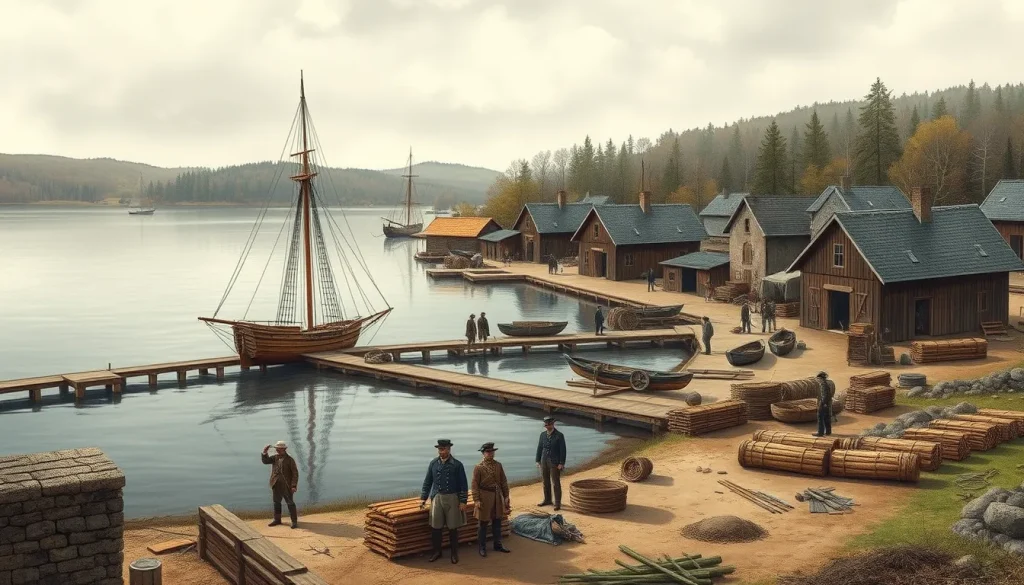
The service began during the Seven Years’ War, when Britain needed armed vessels on Lake Ontario to support an advance on Fort Niagara against the French. It expanded during the American Revolutionary War into a military transport flotilla operating on the lakes and the St. Lawrence, then contracted after 1783 into a small peacetime establishment. Its headquarters was at Carleton Island from 1785 to 1789 and afterwards at Point Frederick at Kingston, Upper Canada, where a dockyard and the Lake Ontario squadron were maintained; Amherstburg served the same purpose for Lake Erie from 1796.
By 1812 the force was very small. One accounting records seven vessels in total, of which four were armed with twenty short-barrelled guns, and nine officers, 101 seamen, and five artificers at Kingston. The Lake Erie division was in poor condition, with only one ship fully serviceable. In the campaign of 1812 Provincial Marine vessels helped keep open communications between the eastern and western divisions of the British army and supported operations on Lake Huron and the Detroit River, but the service did not perform well against Commodore Isaac Chauncey’s American squadron on Lake Ontario. In 1813 the Royal Navy took over its vessels and establishments. Under Commodore Sir James Lucas Yeo the dockyard at Point Frederick expanded rapidly, and by the end of 1814 it had produced the largest naval squadron on the Great Lakes. After the war, the Rush–Bagot exchange of 1817 sharply limited naval armament on the lakes, and the worn wartime fleet was laid up in reserve at Kingston.
Why It Matters
The Provincial Marine mattered most in the opening months of the War of 1812, when it was the only British naval organization on the upper lakes. Its vessels moved troops, guns, and stores at a moment when the British army in Upper Canada could not have been supplied or redeployed overland, and its presence helped make possible early British successes on the Detroit River and Lake Huron. Its second significance is institutional: its poor showing on Lake Ontario in 1812 was the direct reason the Royal Navy assumed control of the lakes in 1813, which in turn produced the dockyard, squadrons, and personnel that contested the lakes for the remainder of the war.
Third, the service illustrates how logistics rather than fleet battle determined what armies could accomplish in the interior, a point that later historians have emphasized. Fourth, the postwar settlements that followed the naval race on the lakes, above all the Rush–Bagot arrangement of 1817, established an early precedent for a demilitarized border. Historians continue to disagree about how the service should be judged: by its 1812 combat record, or by its longer record as a transport organization that kept a scattered frontier supplied for more than five decades.
Definition
This article uses the most common encyclopedic meaning of the term: the British provincial naval and transport establishment of the Great Lakes, the St. Lawrence River, and parts of Lake Champlain, from its origins in the 1750s until the Royal Navy took over its Great Lakes vessels in 1813. The name has sometimes been applied loosely to later provincial naval organizations in the Canadas, which are outside the scope of this article.
The Provincial Marine was a hybrid institution: naval in its work, military in its administration. Its vessels were designated as His Majesty’s ships, but the service came under the governor and commander-in-chief of British North America and was superintended by the Quartermaster-General’s department of the army. It followed Royal Navy practices and rank structure with local flexibility, and it was manned by a mixture of Royal Navy personnel on detachment, soldiers, and directly recruited Great Lakes sailors.
Background
When war broke out between Britain and France in North America in 1754, one of Britain’s first objectives was Fort Niagara at the mouth of the Niagara River on Lake Ontario. Because the French already had small warships on that lake, the British needed armed vessels of their own. A dockyard was opened at Oswego in the spring of 1755. The Admiralty instructed the naval commander on the North American coast to have vessels built and fitted on the borders of Lake Ontario in the most frugal manner, and colonial treasuries helped pay for men and supplies. Four vessels were launched at Oswego in the summer of 1755, including the schooner Oswego and the sloop Ontario, and more followed in 1756 before the French captured Oswego. In 1757 Captain Joshua Loring received an appointment as commissary for building and expediting the vessels and boats for the several lakes in North America, an early sign that the lakes service would be run as an administrative and transport concern.
During the American Revolutionary War the force was enlarged again. In 1777 Governor Guy Carleton prohibited the use of private vessels on the Great Lakes, bringing them into the King’s service, and in 1778 Governor Frederick Haldimand issued General Orders and Regulations for the Better Government of His Majesty’s Armed Vessels Employed on the Different Lakes. That directive divided the fleet into geographic commands, one for Lake Ontario and one for Lake Erie with the upper lakes, and required the reading of the Articles of War on board each vessel at least once a month. A naval base was established at Carleton Island in 1779, and vessels patrolled between Michilimackinac and Detroit. Contemporary records indicate that the chain of command between land-based and lake-based officials was poorly defined, which produced quarrels that hampered both military support and commercial shipping. After 1783 the establishment shrank, passed to the Quartermaster-General’s department, and became known as the Provincial Marine.
How It Worked
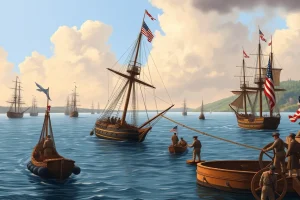
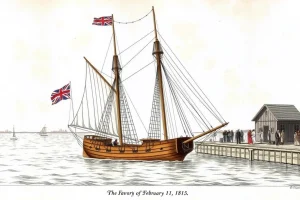
Operationally, the service was organized by lake, each with a senior naval officer and a supporting dockyard. Kingston on Lake Ontario and Amherstburg on Lake Erie each housed a squadron, with further facilities at Quebec City. Ships were usually lightly armed topsail schooners built for carriage rather than combat, with occasional exceptions such as the brig General Gage. In peacetime the vessels and crews were sometimes loaned to merchants in the fur trade, and after Carleton’s 1777 regulations the King’s ships became the sole carriers of commercial goods on the lakes, with private traffic limited to canoes and bateaux on parts of the St. Lawrence route.
Manning was a persistent problem. The Provincial Marine paid lower wages than private enterprises on the lakes, and although sailors could earn extra money in the shipyards, the more competent men were kept aboard ships while the less competent were sent to the yards. This practice limited the earnings of the best sailors and left the service chronically short of qualified personnel. The dual merchant and military role also encouraged the construction of small, shallow-draft vessels suited to supply work but not to squadron fighting, a characteristic that would matter greatly in 1812.
Competing Viewpoints
Contemporary opinion was sharply divided. In November 1812 the Reverend John Strachan, writing from York, condemned the service in strong terms, calling it nearly worthless and describing its officers as cowardly, while Sir George Prevost and other senior British officers held similarly low views. Lieutenant James Richardson, who served in the Provincial Marine from 1809, took the opposite position in his memoirs, arguing that although the little squadron was not celebrated for fighting, it kept open communications between the eastern and western divisions of the army at a time when the country was thinly settled and the roads were bad.
Later historians have extended the argument rather than settled it. W. A. B. Douglas examined what he called the incompetence of the department and concluded that its leading officers often had Royal Navy experience rather than being mere provincials, and that the military uses of the service had been a real concern for years before 1812; in his view the problem lay in the quality of some of the men in its ranks. Robert Malcomson argued in 2001 that the dispute between Strachan and Richardson is best resolved by recognising that the Provincial Marine had only a faint tradition of naval tactics, because it and its predecessors had functioned primarily as a frugally operated transport service for the better part of five decades. Historians therefore disagree chiefly about whether the service should be measured against naval standards or against the transport tasks it was actually designed to perform.
Role in the War of 1812
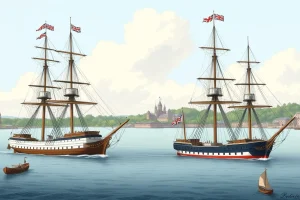
At the outbreak of war the Provincial Marine held two small squadrons: one at Kingston for Lake Ontario and one at Amherstburg for Lake Erie and the upper lakes. The Lake Erie division was the weaker of the two, with one vessel fit for service, one falling into disrepair, and one incapable of sailing. In July 1812 the service’s craft on Lake Huron supported the British movement against the American post at Michilimackinac, and in August its vessels helped carry troops and artillery across the Detroit River during the operations that ended with the surrender of Detroit. In October 1812 an American raiding party seized two of the Amherstburg squadron’s vessels at Fort Erie, a loss that further weakened the British position on Lake Erie.
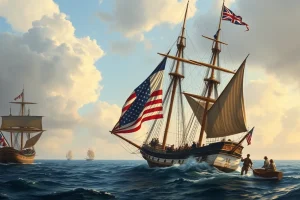
On Lake Ontario the service fared worse. Commodore Isaac Chauncey’s American squadron, built and manned with greater resources, generally outmatched the provincial vessels, and the failure to contest the lake effectively became the immediate justification for change. In 1813 the Royal Navy assumed direct control of the Provincial Marine’s vessels and dockyards, and Commodore Sir James Lucas Yeo replaced most provincial officers with Royal Navy officers. The dockyard at Point Frederick grew rapidly and became the headquarters of the senior British naval officer on the lakes; by the end of 1814 it supported about 1,600 personnel and the fleet’s flagship, the St Lawrence. British squadrons on the lakes, including former Provincial Marine vessels, thereafter fought the engagements of 1813 and 1814, among them the Battle of Lake Erie and the naval action at Plattsburgh Bay. After 1815 the wartime fleet was laid up, and the Rush–Bagot agreement of 1817 limited the naval forces each nation could keep in commission on the lakes.
Consequences and Historical Interpretation
In the short term, the Provincial Marine’s transport work helped hold the British position in Upper Canada together in 1812, while its weakness on Lake Ontario triggered a takeover that produced the largest lake fleet of the war. In the longer term, the naval race on the lakes ended in mutual limitation rather than permanent armament. The British lake establishment persisted at Kingston after the war, and the gear of the laid-up warships was eventually housed in buildings such as the Stone Frigate; the name Provincial Marine continued to be applied to provincial naval organizations in the Canadas in later decades until the creation of the Naval Service of Canada in 1910.
In historical memory the service has remained, in Richardson’s phrase, not much celebrated. Canadian accounts of the war have concentrated on land campaigns, militia, and Indigenous allies, while popular narratives of the naval war have emphasized American frigate victories at sea. Modern scholarship is more divided: some historians judge the Provincial Marine as an under-resourced and poorly officered department whose failures were foreseeable, while others treat it as an effective logistics organization that was asked, in 1812, to perform a combat role for which it had never been built.
Primary Sources
- Frederick Haldimand, General Orders and Regulations for the Better Government of His Majesty’s Armed Vessels Employed on the Different Lakes (1 July 1778). Issued by the governor of Quebec, this directive set out the division of the lakes into commands, the manning of the King’s ships, and disciplinary routines including monthly readings of the Articles of War. It is the most direct surviving statement of how the service was meant to operate, but it describes intentions rather than day-to-day practice.
- The Provincial Marine Papers, University of Toronto Archives, MS Coll 00022B (1788–1792). A manuscript collection covering the period when the service was both a military transport organization and the authorized carrier of fur-trade goods. It documents freight arrangements, cargo supervision, and the commercial side of the service, but it is confined to a few years and to administrative records rather than combat.
- John Strachan’s correspondence from York, November 1812. Strachan, an Anglican clergyman without naval experience, wrote a scathing assessment of the Provincial Marine that has been widely quoted. His letter reflects the views of senior army officers but was written by an observer at a distance from the lakes, and its severity must be weighed against his lack of technical knowledge.
- The memoirs of Lieutenant James Richardson, Provincial Marine, who entered the service in 1809. Richardson’s account is one of the few extended narratives by a serving member and stresses the squadron’s role in maintaining communications. As a defence of his own service, written after the war, it tends to minimise its failings.
- The Rush–Bagot exchange of notes, 1817. This diplomatic correspondence between Richard Rush and Charles Bagot recorded the mutual limitation of naval forces on the lakes. It is essential for the postwar settlement but says nothing directly about the Provincial Marine, whose vessels had already passed to Royal Navy control.
No verified verbatim transcripts of Provincial Marine ships’ logs, musters, or orders have been reproduced here; researchers should consult the manuscript collections named above and the published editions cited under Further Reading.
Further Reading
- Robert Malcomson, “Not Very Much Celebrated: The Evolution and Nature of the Provincial Marine, 1755–1813,” The Northern Mariner / Le marin du nord XI, no. 1 (January 2001): 25–37. Available at https://doi.org/10.25071/2561-5467.597
- Bob Garcia, “The Provincial Marine at Amherstburg 1796–1813,” paper presented to the Association for Great Lakes Maritime History, Amherstburg, Ontario, September 2000. Available at https://warof1812.ca/provmarine.htm
- The Provincial Marine Papers, Manuscript Collection MS Coll 00022B, University of Toronto Archives and Records Management Services. Available at https://discoverarchives.library.utoronto.ca/index.php/the-provincial-marine-papers
- W. A. B. Douglas, “The Anatomy of Naval Incompetence,” Ontario History 71 (1979), cited in Malcomson (2001).
- Carol MacLeod, report on the Provincial Marine for the Historical Research and Records Unit, Parks Canada, 1983 (unpublished; well documented but, in Malcomson’s assessment, uncritical).
- Fort Malden National Historic Site of Canada, Amherstburg, Ontario, for the surviving naval yard context on the Detroit River.
References
- Robert Malcomson, “Not Very Much Celebrated: The Evolution and Nature of the Provincial Marine, 1755–1813,” The Northern Mariner / Le marin du nord XI, no. 1 (January 2001): 25–37. https://doi.org/10.25071/2561-5467.597
- “Provincial Marine,” Wikipedia. https://en.wikipedia.org/wiki/Provincial_Marine
- The Provincial Marine Papers, Manuscript Collection MS Coll 00022B, University of Toronto Archives and Records Management Services. https://discoverarchives.library.utoronto.ca/index.php/the-provincial-marine-papers
- Bob Garcia, “The Provincial Marine at Amherstburg 1796–1813,” Association for Great Lakes Maritime History conference paper, Amherstburg, Ontario, September 2000. https://warof1812.ca/provmarine.htm
- W. A. B. Douglas, “The Anatomy of Naval Incompetence,” Ontario History 71 (1979), as cited in Malcomson (2001).
- Exchange of notes between Richard Rush and Charles Bagot on naval forces on the Great Lakes, April 1817.
FAQ
What was the Provincial Marine?
It was a British provincial naval and transport service operating on the Great Lakes, the St. Lawrence River, and parts of Lake Champlain from the 1750s until 1813. Although its vessels were styled His Majesty's ships, it was administered by the army's Quartermaster-General's department and was chiefly employed carrying troops, stores, and fur-trade goods.
Was the Provincial Marine part of the Royal Navy?
Not directly. It followed Royal Navy practices and some of its officers had Royal Navy experience, and Royal Navy personnel were sometimes detached to it, but the service was a separate provincial establishment under the governor and commander-in-chief of British North America. The Royal Navy took over its Great Lakes vessels and dockyards in 1813.
How did the Provincial Marine shape the early naval war?
In 1812 it was the only organized British naval force on the upper lakes, and its vessels supported British operations on Lake Huron and the Detroit River while keeping army communications open. Its inability to contest Lake Ontario against Commodore Isaac Chauncey's squadron prompted the Royal Navy takeover of 1813, which produced the largest lake fleet of the war.
Leave a Reply