Short Answer
On September 10, 1813, Commodore Oliver Hazard Perry sent a short dispatch to Major General William Henry Harrison after the Battle of Lake Erie. The message announced the capture of a British squadron and included the phrase that became famous: "We have met the enemy, and they are ours." The dispatch is a primary source from the War of 1812 and a touchstone in U.S. naval memory. Its legacy lies both in the immediate strategic consequences of Perry’s victory and in the many later uses and adaptations of the phrase.
Historical Context
The War of 1812 began in June 1812 amid disputes over maritime rights, impressment, trade restrictions, and British support for Indigenous resistance on the American frontier. In the Great Lakes region, control of Lake Erie was a military necessity. The lake served as a supply route for British forces along the Detroit River and into Upper Canada, while American forces hoped to recover Detroit, which had been surrendered in 1812. By 1813, the United States sought to regain the initiative in the Northwest.
Master Commandant Oliver Hazard Perry was appointed to command U.S. naval forces on Lake Erie. He established a base at Presque Isle, Pennsylvania, modern Erie, and directed the construction of a fleet from local materials and newly arrived supplies. The British commander on the lake, Commander Robert Barclay, also needed to protect British supply lines and had to contend with limited resources. Control of the lake would determine whether American or British and Indigenous forces could move troops and supplies effectively. Perry’s fleet and Barclay’s squadron met on September 10, 1813, near Put-in-Bay in the western basin of Lake Erie.
What Happened
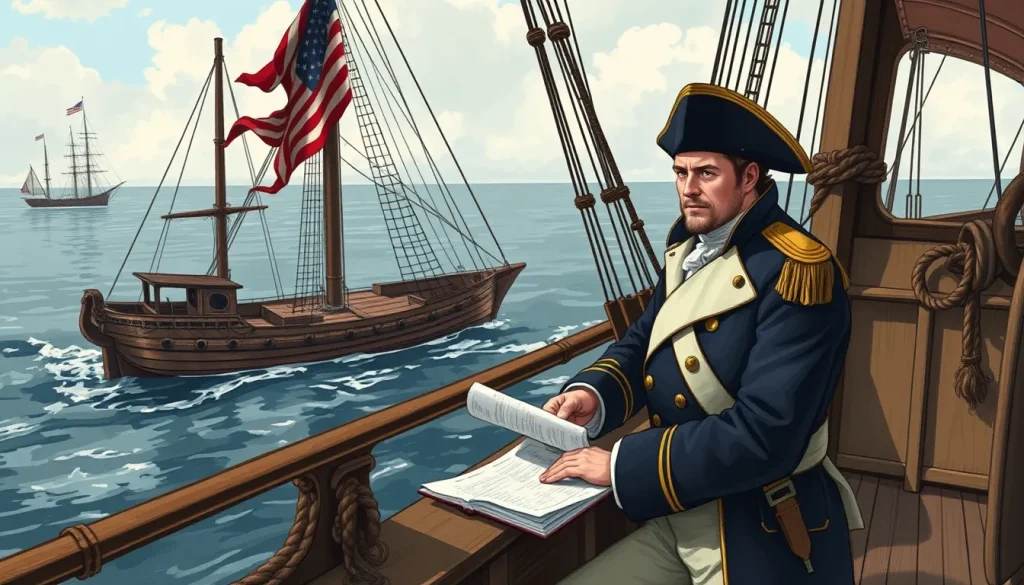
The Battle of Lake Erie began on the morning of September 10, 1813. Perry’s flagship, the USS Lawrence, engaged the British squadron and sustained heavy casualties. When the Lawrence became largely disabled, Perry transferred to the USS Niagara and continued the fight. The American squadron broke the British line and forced Barclay to surrender his entire squadron. The victory gave the United States control of Lake Erie and opened the way for a land campaign against British and Indigenous forces in Upper Canada.

Perry sent a brief dispatch to Harrison, who commanded the U.S. Army of the Northwest. The message reported the victory and listed the captured vessels. It was written immediately after the battle and was reportedly composed in pencil on the back of an old letter. The dispatch was soon reprinted in newspapers and circulated as a striking example of brevity and confidence. Harrison subsequently moved against British forces under Major General Henry Procter and the Shawnee leader Tecumseh. At the Battle of the Thames on October 5, 1813, Tecumseh was killed and his pan-Indigenous confederacy suffered a severe blow.
Why It Matters
The immediate significance of Perry’s victory was strategic. American control of Lake Erie allowed Harrison’s army to invade Upper Canada, recapture Detroit, and defeat Procter’s forces at the Thames. The death of Tecumseh weakened the Indigenous confederacy that had allied with Britain in the Northwest, and the battle helped shift the war’s momentum in the region. The dispatch itself served as a military report, but its first clause gave the victory a memorable voice.
In later U.S. memory, the phrase "We have met the enemy, and they are ours" became an emblem of naval success and national resolve. It appeared in histories, schoolbooks, commemorations, and popular culture. Historians generally agree that the Battle of Lake Erie was more consequential than the message, but the message’s concise wording and confident tone gave it a life beyond the event. Some scholars study it as an example of how military language shapes public memory; others caution that its fame can obscure the broader campaign, the British and Canadian perspectives, and the Indigenous experiences of the war.
The phrase’s cultural afterlife is also part of its legacy. Cartoonist Walt Kelly, creator of the comic strip Pogo, adapted the line as "We have met the enemy and he is us." The adaptation is most commonly associated with an Earth Day 1970 poster and with environmental and social commentary. In that form, the phrase shifted from a statement of military possession to a reflection on shared responsibility and internal conflict. The original message and its later adaptation are often linked in discussions of rhetoric, memory, and the ways a single sentence can be repurposed.
Commemoration has reinforced the message’s place in public history. Perry’s Victory and International Peace Memorial at Put-in-Bay, Ohio, commemorates the battle and the long peace between the United States, Britain, and Canada. The memorial does not preserve the dispatch itself, but it keeps the victory and its symbolism in view. The message’s exact wording, punctuation, and original manuscript have been subjects of uncertainty because early printings vary and the surviving evidence is indirect.
Document
Perry’s dispatch to Harrison is a short naval report written in the immediate aftermath of the Battle of Lake Erie. It is often called a message or dispatch. It informed Harrison that the British squadron had been captured and that American control of Lake Erie was secured. The document is not a full after-action report; it is a victory announcement with an enumeration of prizes.
Date
September 10, 1813. The dispatch is dated to the same day as the Battle of Lake Erie, and this date is consistently given in contemporary and later sources.
Author
Oliver Hazard Perry (1785–1819) was a U.S. Navy officer and the commander of American naval forces on Lake Erie. He was born in Rhode Island and had served in the Quasi-War with France and the Barbary Wars before the War of 1812. His flagship at Lake Erie was the USS Lawrence, named for Captain James Lawrence. Perry’s victory made him a national figure, and he died in 1819 while on a diplomatic mission to South America.
Historical Context
The dispatch was written in the immediate context of Perry’s victory. Harrison was waiting with troops to move against British and Indigenous forces in Upper Canada. Perry needed to report the capture of Barclay’s squadron quickly and clearly. The message’s brevity reflects the practical demands of military communication and the confidence of a victorious commander. It also reflects the importance of Lake Erie as a supply and transport route. The phrase "We have met the enemy, and they are ours" asserted possession of the captured squadron and, by extension, control of the lake.
Transcript
A commonly cited transcript reads:
Dear Gen’l: We have met the enemy, and they are ours, two ships, two brigs, one schooner and one sloop. Yours with great respect and esteem. H. Perry.
Variations exist in punctuation and capitalization. Some sources print "We have met the enemy and they are ours" without the comma. The first clause is the most frequently quoted portion.
Modernized Transcript
Dear General: We have met the enemy, and they are ours—two ships, two brigs, one schooner, and one sloop. Yours with great respect and esteem. H. Perry.
This modernized version expands "Gen’l" and adjusts punctuation; it does not change the substance. The original spelling and punctuation are not fully standardized in surviving printings.
What the Document Tells Us
The dispatch tells us that Perry reported a decisive naval victory. It lists the captured vessels and conveys respect to Harrison. It shows Army-Navy cooperation and the importance of Lake Erie to the campaign. The message is a victory announcement rather than a detailed account; it does not describe tactics, casualties, or Perry’s transfer from the Lawrence to the Niagara. Its first clause communicates possession and confidence. Later readers have found in it a model of brevity and a statement of martial success. For historians, it is evidence of how commanders communicated and how victories were framed in the War of 1812.
Limitations and Bias of the Source
The dispatch is a triumphant report by the victorious commander. It presents the American perspective and omits British, Canadian, and Indigenous experiences. It does not provide casualty figures or a complete return of captured vessels with precise classifications. The exact original wording is uncertain; the earliest printed source is Robert B. McAfee’s 1816 history, and a facsimile appears in Benson J. Lossing’s 1868 Pictorial Field-Book of the War of 1812. The sources consulted do not identify a securely traced original manuscript. The message should be read as an immediate military report, not a neutral history. It reflects Perry’s authority and his need to report success to his superior.
Citation
Perry, Oliver Hazard. Dispatch to William Henry Harrison, September 10, 1813. Commonly reprinted as: "Dear Gen’l: We have met the enemy, and they are ours, two ships, two brigs, one schooner and one sloop. Yours with great respect and esteem. H. Perry." In Logan Esarey, ed., Messages and Letters of William Henry Harrison, vol. 2 (Indianapolis: Indiana Historical Commission, 1922), 539; and Robert B. McAfee, History of the Late War in the Western Country (Lexington, Ky.: Worsley & Smith, 1816), 354. See also U.S. National Park Service, "We have met the enemy and they are ours."
Primary Sources
Perry’s dispatch to Harrison is the central primary source. It is a short note, reportedly written in pencil on the back of an old letter, and it survives in print and facsimile rather than, as far as the consulted sources indicate, a securely identified original manuscript. Harrison’s papers, edited by Logan Esarey, reprint the message. Robert B. McAfee’s 1816 History of the Late War in the Western Country is an early printed source. British naval correspondence from the campaign offers a contrasting contemporary perspective, though Barclay’s official report is not reproduced here. American newspapers of September and October 1813 reprinted news of the victory and helped circulate Perry’s phrase, though wording in newspaper notices can vary. Later nineteenth-century works such as Benson J. Lossing’s Pictorial Field-Book of the War of 1812 (1868) include a facsimile and anecdotal detail about the dispatch’s composition. All these sources must be read with attention to their vantage point: Perry’s message is a victory announcement, McAfee wrote from an American perspective, and Lossing wrote for a popular nineteenth-century audience.
Further Reading
- Welsh, William Jeffrey, and David Curtis Skaggs, eds. War on the Great Lakes: Essays Commemorating the 175th Anniversary of the Battle of Lake Erie. Kent, Ohio: Kent State University Press, 1991.
- Skaggs, David Curtis. A Signal Victory: The Lake Erie Campaign, 1812–1813. Annapolis: Naval Institute Press, 1997.
- Dudley, William S., ed. The Naval War of 1812: A Documentary History. Vol. 2. Washington, D.C.: Naval Historical Center, 1992.
- U.S. National Park Service. "We have met the enemy and they are ours." https://www.nps.gov/articles/met-the-enemy-4.htm.
- Perry’s Victory and International Peace Memorial, U.S. National Park Service, Put-in-Bay, Ohio.
References
- U.S. National Park Service. "We have met the enemy and they are ours." https://www.nps.gov/articles/met-the-enemy-4.htm.
- Encyclopedia.com. "We Have Met The Enemy, and they are Ours." https://www.encyclopedia.com/history/dictionaries-thesauruses-pictures-and-press-releases/we-have-met-enemy-and-they-are-ours.
- Bartleby.com. "Oliver Hazard Perry (1785–1819)." Respectfully Quoted: A Dictionary of Quotations. https://www.bartleby.com/lit-hub/respectfully-quoted/oliver-hazard-perry-17851819/.
- Welsh, William Jeffrey, and David Curtis Skaggs, eds. War on the Great Lakes: Essays Commemorating the 175th Anniversary of the Battle of Lake Erie. Kent, Ohio: Kent State University Press, 1991.
- McAfee, Robert B. History of the Late War in the Western Country. Lexington, Ky.: Worsley & Smith, 1816.
- Esarey, Logan, ed. Messages and Letters of William Henry Harrison. Vol. 2. Indianapolis: Indiana Historical Commission, 1922.
FAQ
What did Perry actually write in the dispatch?
A commonly cited transcript reads: 'Dear Gen'l: We have met the enemy, and they are ours, two ships, two brigs, one schooner and one sloop. Yours with great respect and esteem. H. Perry.' Variations in punctuation and capitalization exist in later printings.
When did Perry send the message?
Perry sent the dispatch on September 10, 1813, the same day as the Battle of Lake Erie.
Why is the message historically significant?
It announced a decisive American naval victory that gave the United States control of Lake Erie and helped enable Harrison's campaign in Upper Canada. Its opening clause also became famous and was later adapted by Walt Kelly as 'We have met the enemy and he is us.'
Leave a Reply