Short Answer
The War of 1812 (1812–1815) had profound and devastating consequences for Indigenous peoples across North America, who were drawn into the conflict through alliances with both the British and the United States. Although Indigenous warriors played a vital military role in the war, the Treaty of Ghent and the postwar expansionist policies of the United States left Native nations weakened, divided, and subject to enormous land losses and forced removals in the decades that followed.
Historical Context
In the decades before 1812, the United States government pursued an aggressive policy of westward expansion, acquiring Indigenous lands through a series of treaties, many of which were concluded under duress or with the exploitation of factional divisions. At the same time, Great Britain maintained diplomatic and military relationships with Indigenous nations, offering trade goods, firearms, and the possibility of an allied buffer state between the Ohio River and the Great Lakes. The outbreak of war between Britain and the United States in June 1812 created a situation in which Indigenous nations were obliged to choose sides, often with promises of land restoration or territorial security that neither imperial power ultimately delivered.
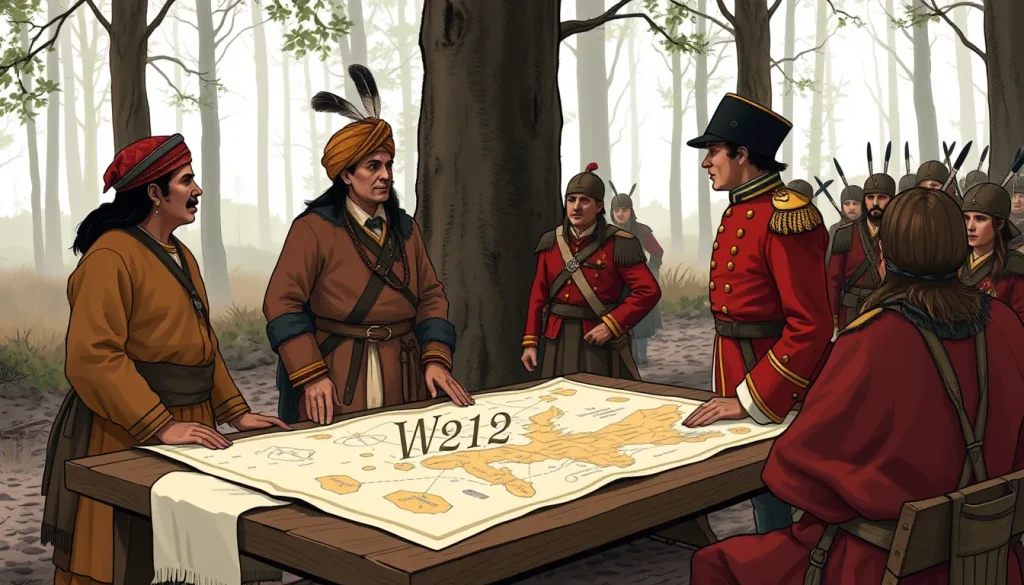
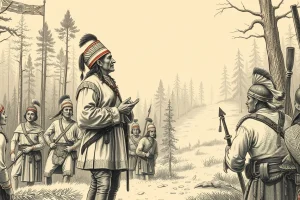
By the early nineteenth century, the Shawnee brothers Tecumseh and Tenskwatawa (the Prophet) had established a pan-Indigenous movement aimed at resisting American expansion. Tecumseh’s vision was a confederation of Indigenous nations that would collectively hold territory and negotiate with the United States as a single sovereign body. When the War of 1812 began, Tecumseh allied with the British, receiving promises of an independent Indigenous state in the Old Northwest in exchange for military assistance.
What Happened
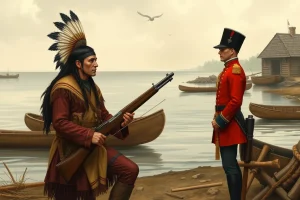
Indigenous peoples participated on both sides of the War of 1812, although the majority of those who allied with the European belligerents chose the British side. British commanders in North America relied heavily on Indigenous warriors, particularly because the British regular forces in Canada were thinly spread while most of the British army was engaged against Napoleon in Europe. Indigenous warriors served as scouts, conducted irregular warfare, and provided crucial local knowledge of terrain, waterways, and American positions.
In the Northwest, the alliance between British general Isaac Brock and Tecumseh produced early victories, including the capture of Detroit in August 1812 and the successful defence of Michilimackinac. Tecumseh was placed in command of all Native forces and was promised that victory would lead to an independent Indigenous nation. The partnership suffered a catastrophic setback when Brock was killed at the Battle of Queenston Heights in October 1812, and it ended altogether on October 5, 1813, at the Battle of the Thames River, where Tecumseh was killed and his forces were routed.
In the Southeast, the Creek Nation split between the Red Stick faction, which opposed American expansion and allied with the British, and the Lower Creek, which supported the United States. After Red Stick warriors attacked Fort Mims in August 1813, American forces under General Andrew Jackson conducted a brutal campaign that culminated at the Battle of Horseshoe Bend on March 27, 1814, where the Red Sticks suffered extremely heavy casualties. By the terms of the Treaty of Fort Jackson (August 9, 1814), the Creeks were forced to cede more than 20 million acres of territory, about half of present-day Alabama.
The Treaty of Ghent, signed on December 24, 1814, and ratified in February 1815, restored the prewar status quo between the United States and Britain, but did little for Indigenous peoples. Although the treaty stated that Indigenous peoples were entitled to lands they had occupied before the war, neither the American nor the British government actively enforced these provisions. Britain abandoned its plans for an Indigenous buffer state and ceased efforts to protect Indigenous lands from American encroachment.
Why It Matters
The conclusion of the War of 1812 marked a turning point in Indigenous history in North America. The war’s most significant Indigenous leader, Tecumseh, was killed in battle, and his confederation of tribes disintegrated shortly afterward. The British, who had long cultivated alliances with Indigenous nations, largely abandoned their partners after the war. The United States, freed from the British threat, entered a period of expansion that led to the Indian Removal Act of 1830 and the forced relocation of tens of thousands of Indigenous peoples from their ancestral homelands to territory west of the Mississippi River.
The consequences of the war varied by region and nation, but across the board they were negative for Indigenous peoples. Some nations that had allied with the United States, such as the Choctaw, were also removed from their lands in the 1830s, demonstrating that all Indigenous nations were vulnerable to American expansion regardless of their wartime loyalty. Meanwhile, many Indigenous peoples from south of the Great Lakes migrated across the border into British North America (present-day Canada), where their descendants continue to live on reserves today.
Historians have increasingly emphasized the central role that Indigenous peoples played in the war and the devastating consequences they suffered. Although the war ended in what some Americans celebrated as a victory, the experience was, for Indigenous nations, a disaster from which they would not recover as sovereign territorial powers east of the Mississippi.
Definition
Impact in this context refers to the military, political, territorial, and demographic consequences of the War of 1812 for Indigenous nations throughout the Great Lakes region and the American Southeast. It encompasses the immediate effects of fighting, the loss of leaders and warriors, the treaty obligations imposed in the war’s aftermath, and the longer-term trajectory of Indigenous sovereignty and land ownership in eastern North America.
Background
Indigenous nations entered the War of 1812 with distinct political traditions, alliance networks, and territorial claims. Long-standing relationships with the British crown, formalized in the Royal Proclamation of 1763 and renewed through the Covenant Chain alliance system, positioned many northern nations, including the Shawnee, Ojibwe, Potawatomi, and Haudenosaunee, as Britain’s indispensable allies in North America. Meanwhile, nations such as the Creek and Choctaw in the Southeast balanced diplomatic relations between the United States and Spain, with some factions allying with the British and Americans, while others resisted American land claims.
Since the beginning of the 19th century, the United States had signed treaties with Indigenous nations that surrendered land, often under circumstances involving duress, bribery, or violence. Tecumseh’s movement was a direct response to these practices, and his message of pan-Indigenous unity appealed to many Native nations facing the loss of their homelands.
How It Worked
Indigenous participation in the War of 1812 took many forms. Warriors joined British or American forces on a semi-autonomous basis, fighting under their own leaders. They were used for reconnaissance, irregular warfare, and protection of supply lines. Indigenous nations also provided crucial local knowledge of terrain, which was often a decisive advantage in the sparsely populated frontier regions. In the British alliance system, promises of trade goods, arms, and ammunition were exchanged for military service, and British commanders such as Isaac Brock and his successors understood that effective use of Indigenous forces required respecting their autonomy and their right to self-determination in the conduct of the war.
Conversely, American commanders sought to mobilize Indigenous allies from nations that favored the United States, such as the Choctaw, Lower Creek, and Cherokee, providing them with supplies, arms, and military leadership. Both sides, however, ultimately treated Indigenous peoples as auxiliaries rather than full partners, and neither imperial power was prepared to guarantee an independent Indigenous state if it conflicted with their own geopolitical interests.
Competing Viewpoints
Historians differ in their interpretation of the war’s impact on Indigenous peoples. Some emphasize the catastrophic nature of the outcome, arguing that the defeat of Tecumseh’s confederacy and the subsequent land cessions represented the end of any realistic possibility of a unified Indigenous state east of the Mississippi. Others point to the resilience and continued presence of Indigenous communities in Canada and the United States, noting that some nations were able to preserve their sovereignty and cultural traditions despite tremendous pressure.
There is also debate over the degree of British responsibility for Indigenous losses. Some historians argue that Britain cynically used Indigenous allies and abandoned them when their usefulness was over; others maintain that the British sincerely attempted to honour their promises but were constrained by the terms of the Treaty of Ghent and the broader geopolitical situation after Napoleon’s defeat. Still others focus on American agency, highlighting the U.S. government’s deliberate policy of land seizure and removal as the primary cause of Indigenous suffering.
Role in the War of 1812
Indigenous peoples were not passive spectators or peripheral allies but active and often decisive participants in the war. The early British victories in the Northwest, including the capture of Detroit, depended on the support of Tecumseh’s warriors. The defence of the Niagara Peninsula, where several battles took place, was likewise supported by Indigenous contingents. On the American side, Choctaw and lower Creek warriors served with Andrew Jackson in the Creek campaign and at the Battle of New Orleans in January 1815.
At the same time, the war was, for many Indigenous nations, part of a larger struggle for survival and sovereignty that predated the conflict between Britain and the United States. Tecumseh’s confederacy had been formed before the war, and his decision to ally with Britain was a calculated strategy aimed at achieving an independent Indigenous state. The war gave this movement a chance, but it also exposed Indigenous peoples to the full violence of modern warfare and made them targets of American military campaigns aimed at destroying their capacity to resist.
Consequences and Historical Interpretation
The immediate consequences of the war were devastating. Tecumseh was dead, and his confederacy dissolved. In the Treaty of Fort Jackson (1814), the Creek were forced to surrender more than 20 million acres. The Treaty of Ghent (1814) contained provisions nominally protecting Indigenous lands, but neither Britain nor the United States honoured them. In the years that followed, the U.S. government negotiated more than 200 treaties with Indigenous nations, resulting in the cession of enormous amounts of territory and the establishment of nearly a hundred reservations west of the Mississippi River.
Historians have framed the War of 1812 as a turning point in the dispossession of Indigenous peoples in eastern North America. The war removed the last realistic check on American westward expansion by eliminating British support and by weakening Indigenous nations through the loss of leaders, warriors, and lands. Although some Indigenous communities in Canada were able to maintain their territories under British protection, many of those in the United States faced removal in the 1830s. The war’s legacy is thus a paradox: although Indigenous peoples fought bravely in pursuit of sovereignty and protection, the war’s outcome accelerated the loss of their homelands and undermined their status as independent peoples.
Primary Sources
Several categories of primary source materials illuminate the impact of the War of 1812 on Indigenous peoples. Official reports from British and American military commanders, treaty texts, letters, and Indigenous oral traditions and speeches all contribute to the historical record.
Among the most important textual sources are the Treaty of Ghent (1814) and the Treaty of Fort Jackson (1814), which define the official settlement terms affecting Indigenous lands. The British military correspondence of General Isaac Brock and his successors documents the alliance system and the promises made to Tecumseh. The speeches and letters of Tecumseh, though filtered through the records of colonial administrators, reveal his political aims and his strategic vision for an Indigenous confederacy.
Historians must use these sources with care. Most of the written records are authored by Euro-American men, and Indigenous perspectives are often recorded only indirectly. The oral histories of Indigenous nations, preserved through generations and now increasingly documented through tribal college curricula and scholarly collaborations, offer important counterpoints to the official record, though they are also subject to interpretive challenges.
Further Reading
For the reader interested in the impact of the War of 1812 on Indigenous peoples, the following sources provide useful starting points:
- Anthony J. Hall, Indigenous Title and the War of 1812, The Canadian Encyclopedia (published 2015, updated 2022).
- Donald L. Fixico, Native Nations Contend with the Legacy of the War of 1812, National Park Service (2017).
- Kathryn Braund, Losing Ground: The Wages of War in Indian Country, National Park Service (2017).
- American Battlefield Trust, No Good Feelings: Native Americans and the Outcomes of the War of 1812 (2024).
- U.S. National Park Service, Indigenous Peoples — War of 1812 series.
References
- U.S. National Park Service, Indigenous Peoples — War of 1812, https://nps.gov/subjects/warof1812/indigenous-peoples.htm
- Donald L. Fixico, Native Nations Contend with the Legacy of the War of 1812, National Park Service, August 14, 2017, https://www.nps.gov/articles/the-legacy-of-the-war-of-1812-in-tribal-communities.htm
- Anthony J. Hall and Gretchen Albers, Indigenous Title and the War of 1812, The Canadian Encyclopedia, published February 6, 2015, updated January 21, 2022, https://thecanadianencyclopedia.ca/en/article/aboriginal-title-and-the-war-of-1812
- American Battlefield Trust, No Good Feelings: Native Americans and the Outcomes of the War of 1812, updated June 7, 2024, https://www.battlefields.org/learn/articles/no-good-feelings-native-americans-and-outcomes-war-1812
- Kathryn Braund, Losing Ground: The Wages of War in Indian Country, National Park Service, August 14, 2017, https://www.nps.gov/articles/losing-ground.htm
FAQ
Did the War of 1812 help or hurt Indigenous peoples?
The War of 1812 overwhelmingly hurt Indigenous peoples. Despite their crucial military contributions, the war's end left them without the British protection they had relied upon, weakened by the loss of leaders like Tecumseh, and subject to massive land cessions facilitated by the Treaty of Ghent and subsequent U.S. expansion.
What happened to the promise of an independent Indigenous state?
The British promised Tecumseh an independent Indigenous state in the Old Northwest in exchange for his alliance. After Tecumseh was killed at the Battle of the Thames (1813), the confederacy disintegrated, and Britain abandoned the buffer-state plan in the Treaty of Ghent, leaving the United States free to negotiate land cessions.
How did the Treaty of Ghent affect Indigenous peoples?
The Treaty of Ghent nominally declared that Indigenous peoples were entitled to lands they had occupied before the war and were not to be targets of hostility. However, neither the United States nor Britain enforced these provisions, and the treaty ultimately facilitated the collapse of British support and the subsequent American policy of removal.

Leave a Reply