
Short Answer
Veterans’ organizations composed of War of 1812 veterans—particularly the Pennsylvania Society led by former congressman Joel B. Sutherland—mobilized after 1850 to press Congress for pensions and bounty land grants equivalent to those given to Revolutionary War and Mexican War veterans. Their conventions, petitions, and direct appeals helped produce the Bounty Land Act of 1855 and the eventual service pension of 1871, transforming federal veterans’ benefits and preserving the memory of the conflict.
Historical Context
The United States ended the War of 1812 with a small regular army and a large militia force that had been called out for short terms. Unlike Revolutionary War veterans, who received pensions and land grants under legislation passed beginning in 1818, War of 1812 veterans received only limited disability pensions and, after 1816, land warrants to unsettled western territory. These warrants were often nontransferable and difficult to redeem, especially for elderly veterans without the means to travel. By the 1840s, the federal government had extended generous bounty land rights to Mexican War veterans, allowing them to sell their warrants. War of 1812 veterans, then in their sixties and seventies, saw a stark inequity. At the same time, a wave of patriotic sentiment in the antebellum period revived interest in the war’s history, and local veterans’ associations began to form across the country.
What Happened
The key movement began in Philadelphia. In December 1850, Judge Joel B. Sutherland, a veteran of the war and former five-term congressman, published an open letter in the Philadelphia Inquirer arguing that War of 1812 veterans deserved the same ability to sell their bounty land warrants and receive service pensions as veterans of more recent wars. His letter sparked a series of meetings in Philadelphia and other cities. On December 11, 1852, a large assembly at the County Court House (now Congress Hall) adopted resolutions condemning the existing laws. Over the following year, meetings in New York and Philadelphia led to a call for a national convention.
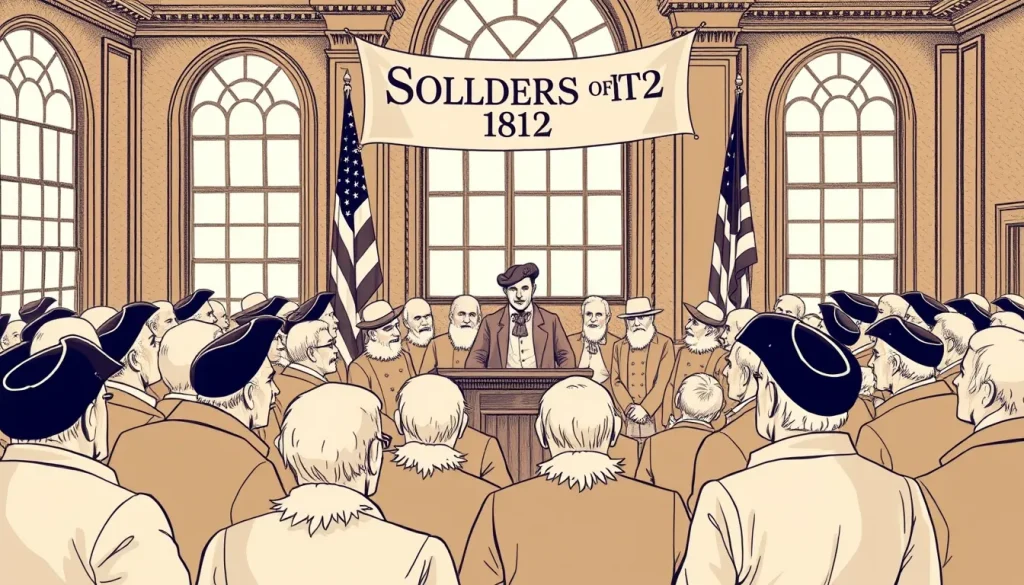
On January 9, 1854, the anniversary of the Battle of New Orleans (observed a day late because the actual anniversary fell on a Sunday), more than 600 and possibly up to 1,500 veterans gathered at Independence Hall in Philadelphia. The convention, chaired by Sutherland, passed a series of resolutions demanding: one hundred and sixty acres of land for each veteran and for widows of the deceased, including naval veterans and those imprisoned at Dartmoor; the right to sell land warrants; pensions commencing from the time of injury; and extension of the pension system used for Revolutionary War veterans to those of the War of 1812. The convention also organized a permanent body, the Soldiers and Defenders of the War of 1812, which met annually and dispatched delegations to Washington.
At its 1855 meeting in Washington, D.C., the organization was received by President Franklin Pierce at the White House and lobbied Congress directly. Their efforts bore fruit on March 3, 1855, when Congress passed the Bounty Land Act of 1855, which granted 160 acres to all honorably discharged veterans of the War of 1812 and allowed the warrants to be sold. This law also covered sailors and marines and included widows and heirs. The veterans’ organizations continued to push for service pensions, which they achieved in 1871, when Congress granted a monthly pension to all surviving veterans regardless of disability. The Pennsylvania Society persisted through the 1850s and 1860s, holding its organizational meeting on July 4, 1857, when the constitution was adopted. Concurrently, the Maryland Society, founded originally as the Association of Defenders of Baltimore in 1814 and rechartered in 1841, merged with the national movement in 1894, forming the General Society of the War of 1812.
Why It Matters
The veteran organizations’ influence was immediate and long-lasting. They converted veterans’ grievances into explicit policy demands, created a nationwide network of activists, and demonstrated the power of organized interest groups in antebellum American politics. The Bounty Land Act of 1855 and the 1871 Pension Act represented major expansions of the federal welfare state, setting precedents for later veterans’ benefits. Historians of distributive politics, such as Charles J. Finocchiaro and Jeffery A. Jenkins, have used this episode to illustrate how members of Congress used these bills for credit-claiming and electoral advantage, a pattern that shaped subsequent legislation. The organizations also played a cultural role, preserving war records and cultivating patriotic memory, which influenced later commemorations of the war.
Explainer: Veterans’ Organizations and Pension Legislation
Definition
Veterans’ organizations were voluntary associations of men who served in the War of 1812, formed after the war to provide mutual support, preserve memory, and advocate for federal benefits. The most influential were the Pennsylvania Society (originally the Soldiers and Defenders of the War of 1812) and the Maryland Society (originally the Association of Defenders of Baltimore).
Background
Immediately after the war, local veterans’ groups celebrated anniversaries and maintained social ties. The Baltimore defenders organized as early as September 14, 1814, vowing to reunite annually. By the 1840s, these groups had begun to take up veterans’ claims. The Pennsylvania Society’s formation in 1857 grew directly out of the bounty land controversy sparked by Sutherland’s 1850 letter.
How It Worked
These organizations operated through several mechanisms: holding public conventions, adopting formal resolutions, sending memorials and petitions to Congress, electing influential veterans as officers, and coordinating with state legislatures. Sutherland used his political experience to direct lobbying, and the 1854 convention’s resolutions were printed and distributed. The organizations also formed local chapters, which collected signatures and organized rallies, creating grassroots pressure.
Competing Viewpoints
Some contemporaries, including fiscal conservatives, argued that pensions should be limited to disabled veterans and that land grants were sufficient reward. Others, like Sutherland, insisted that service alone entitled veterans to compensation and that land warrants had to be sellable. There were also regional divisions: southern representatives feared the expansion of federal benefits might strengthen central government, while northern members sought electoral benefits from supporting veterans’ claims.
Role in the War of 1812
While the organizations were formed after the war, their influence was a direct consequence of veterans’ wartime service. The veterans’ military record legitimized their demands, and the memory of battles such as New Orleans and Baltimore intensified public sympathy. The organizations helped transform the war from a contested conflict into a source of national pride and material reward.
Consequences and Historical Interpretation
The successful campaign led to the 1855 Bounty Land Act and the 1871 Pension Act. Historians view this as an early example of organized interest-group politics shaping federal distributive policy. Scholars Finocchiaro and Jenkins, analyzing pension legislation from 1818 to 1832, show that legislators responded to electoral incentives, a pattern that veterans’ organizations exploited. The organizations also ensured that the War of 1812 would be remembered as a “second war of independence,” influencing how later generations understood the war’s significance.
Primary Sources
Key primary sources include the resolutions adopted at the January 9, 1854, convention at Independence Hall, printed in the 1854 Senate report of the Massachusetts Joint Committee on the Militia (Report No. 108, Senate Bill 85). This document also contains the proceedings of the convention and the letters from the Pennsylvania legislature. Sutherland’s open letter of December 17, 1850, as published in the Philadelphia Inquirer on December 19, 1850, survives in newspaper archives. The Constitution of the Soldiers and Defenders of the War of 1812, adopted July 4, 1857, and the records of the Pennsylvania Society are preserved at the Society of the War of 1812 in the Commonwealth of Pennsylvania. The 1895 Yearbook of the General Society of the War of 1812 provides a retrospective account of the founding. Each source must be read with the biases of its authors, including the veterans’ advocacy for benefits and later descendants’ desire to claim a heroic heritage.
Further Reading
- Distributive Politics, the Electoral Connection, and the Antebellum U.S. Congress: The Case of Military Service Pensions by Charles J. Finocchiaro and Jeffery A. Jenkins (2016).
- A History of Public Sector Pensions in the United States by Robert L. Clark, Lee A. Craig, and Jack W. Wilson (2003).
- Records of the Society of the War of 1812 in the Commonwealth of Pennsylvania (archival collection, Philadelphia).
- The General Society of the War of 1812 website, gswar1812.org, including “Our History.”
References
- “1854 Senate Bill 0085. Report Of The Joint Committee On The Militia.” State Library of Massachusetts. http://archives.lib.state.ma.us/handle/2452/739734.
- “Our History,” General Society of the War of 1812. https://gswar1812.org/our-history/.
- “History,” Society of the War of 1812 in the Commonwealth of Pennsylvania. https://pa1812.org/history/.
- “General Society of the War of 1812,” Wikipedia. https://en.wikipedia.org/wiki/General_Society_of_the_War_of_1812.
- Finocchiaro, Charles J., and Jeffery A. Jenkins. “Distributive Politics, the Electoral Connection, and the Antebellum U.S. Congress: The Case of Military Service Pensions.” Journal of Theoretical Politics 28, no. 2 (2016). https://journals.sagepub.com/doi/10.1177/0951629815586875.
FAQ
What did veterans' organizations do to influence pension legislation?
They organized conventions, passed resolutions, petitioned Congress, lobbied legislators, and coordinated with state governments. The key convention in 1854 produced detailed demands that were transmitted to Congress and state governors.
When did War of 1812 veterans receive pensions?
Disabled veterans received pensions from an 1818 law, but a service pension for all veterans was not enacted until 1871, after sustained lobbying by veterans' organizations.
Who was Joel B. Sutherland?
A veteran of the War of 1812 and former member of the U.S. House of Representatives from Pennsylvania. He led the veterans' movement, organizing the 1854 national convention and serving as president of the Pennsylvania Society.


Leave a Reply