
Short Answer
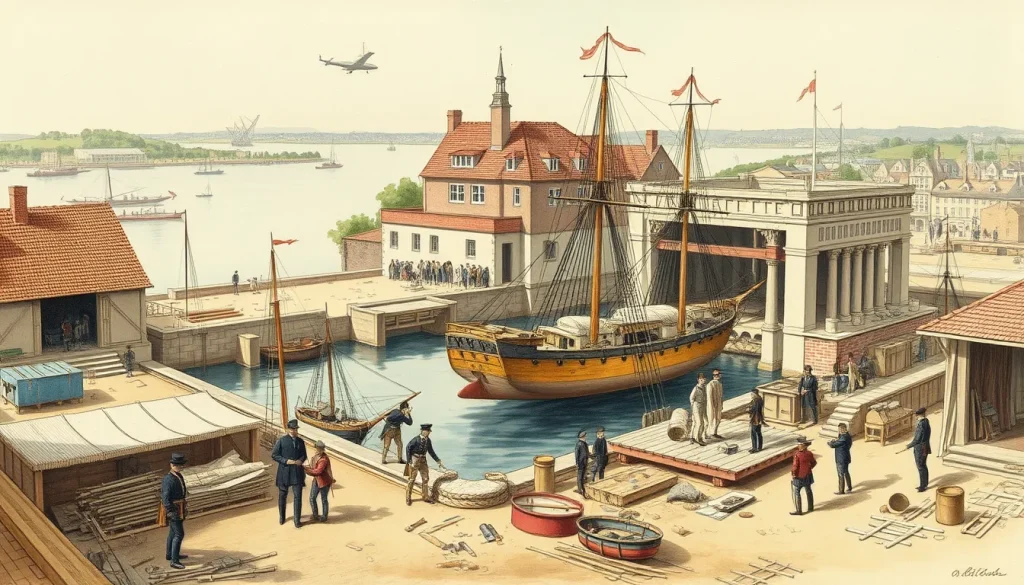
The Kingston Royal Naval Dockyard, located on Point Frederick at the mouth of the Cataraqui River in present-day Kingston, Ontario, was Britain’s sole Royal Navy base on Lake Ontario during the War of 1812. Established in the late 1780s and operated until 1853, it functioned as the strategic counterweight to the American naval base at Sackets Harbor, New York, and became the heart of British naval power on the lake. Its evolution from a modest transport depot to a major shipyard producing the largest warship on the Great Lakes shaped the naval balance and influenced the war’s outcome on the Ontario frontier.
Historical Context
Control of Lake Ontario was essential for both belligerents in the War of 1812 because the lake formed a vital supply corridor between Lower Canada and the upper posts at York, Niagara, and Detroit. For the British, the St. Lawrence River and Lake Ontario connected the Atlantic provinces with the inland garrisons, making naval supremacy on the lake a prerequisite for moving troops, provisions, and naval stores. The American base at Sackets Harbor, located only miles across the lake, posed a direct threat to British communications and to Kingston itself. The naval race on Lake Ontario, often called the “shipbuilders’ war,” grew out of this strategic necessity and the inability of either side to land a decisive blow on the other’s main dockyard.
What Happened
The origins of the dockyard trace to the end of the American Revolutionary War, when the British relocated their supply depots from Carleton Island to the Cataraqui area. In 1785, transshipment of government stores moved to the future townsite of Kingston, and in 1789 Point Frederick was established as a naval depot. There, the Provincial Marine, a quasi-naval force controlled by the army, built transport schooners and conducted operations on Lake Ontario. A government wharf existed by 1783 under Major John Ross, and by 1792 the quartermaster-general’s department had constructed several Provincial Marine vessels at Point Frederick.
As relations with the United States deteriorated, the British built a heavily armed warship, HMS Royal George, launched in 1809 at Navy Bay. When war broke out in 1812, the Provincial Marine on Lake Ontario operated only four vessels armed with 20 short-barreled guns. Despite its limitations, the Provincial Marine conducted offensive operations, including a bombardment of Sackets Harbor in July 1812 and a spirited defence against American gunboats off Kingston in November 1812.
In May 1813, the Royal Navy formally took over command of the Great Lakes from the Provincial Marine, and Commodore Sir James Lucas Yeo arrived at Kingston to head the Lakes Service. The dockyard expanded rapidly: new warships such as the Wolfe, Royal George, Earl of Moira, and Prince Regent were completed or refitted. Yeo and his American counterpart, Commodore Isaac Chauncey, engaged in a frantic shipbuilding race, each attempting to outbuild the other and refusing battle without favourable odds. In 1814, Yeo attacked and captured Fort Oswego, a major American supply depot on Lake Ontario, and then blockaded Sackets Harbor. Reinforced by two newly built frigates from Point Frederick, the British maintained a tenuous superiority.
The most spectacular feat of the dockyard occurred in September 1814 with the launch of the 112-gun ship of the line HMS St. Lawrence, the largest warship ever to sail the Great Lakes. With a crew of around 640, the St. Lawrence was intended to destroy the American fleet, but it never fired a shot in anger. Instead, it served as a fleet flagship and transporter after the war, carrying supplies before being sold in 1831 and sinking in a storm in Kingston Harbour years later. By the end of 1814, the Kingston dockyard had produced the largest naval squadron on the Great Lakes, with 1,600 personnel and a total of 518 guns across all vessels.
The war ended with the Treaty of Ghent and the subsequent Rush–Bagot Agreement of 1817, which limited naval armaments on Lake Ontario to a single gunboat each. The dockyard remained a supply and transport base but gradually declined in importance. It was formally used until 1853, when the Royal Navy handed it over to the British Army, which later transferred the property to the Royal Military College of Canada in 1876.
Why It Matters
Kingston Naval Yard was indispensable to Britain’s ability to sustain its position in Upper Canada. Without the ships built and maintained at Point Frederick, British forces could not have moved troops and supplies across Lake Ontario or challenged the American fleet based at Sackets Harbor. The dockyard’s shipbuilding program directly influenced the naval balance; the construction of the St. Lawrence forced the Americans into a race that they could not win in time to affect the war, thereby preserving British command of the lake in 1814.
The dockyard also shaped the community of Kingston, which became a bustling wartime centre with hundreds of workers, sailors, and soldiers. The infrastructure and industrial capacity developed there contributed to Kingston’s later importance as a military and administrative centre. The site was designated a National Historic Site of Canada in 1928, and archaeological work since 1995 has revealed remains of the hospital, blockhouse, guardhouse, and other facilities, enriching our understanding of the dockyard’s daily operations and the lives of the people who worked there.
Historians generally agree that the naval arms race on Lake Ontario, centred at Kingston and Sackets Harbor, was one of the defining features of the War of 1812. The dockyard exemplifies the logistical and industrial demands of the conflict and the strategic importance of inland naval superiority. Its legacy also illustrates the transition from the ad-hoc Provincial Marine to a professional Royal Navy presence on the Great Lakes.
Historical Map Context
The Kingston Naval Yard occupied the peninsula known as Point Frederick, bounded by Navy Bay to the west, the Cataraqui River to the south, and Lake Ontario to the east. The location at the confluence of the St. Lawrence and Cataraqui Rivers gave it excellent harbour protection and easy access to the lake. Contemporary maps and charts, such as British naval surveys from the War of 1812 period, show the dockyard’s buildings, slips, and anchorage in detail. They also display the strategic importance of the site: opposite the American base at Sackets Harbor, roughly 30 kilometres across the lake, and within reach of both York and the eastern end of Lake Ontario.
Modern Location
The dockyard site is located within the grounds of the Royal Military College of Canada in Kingston, Ontario, at approximately 44°13′44″N 76°28′07″W. The original shoreline has been partially altered, but many of the nineteenth-century structures and archaeological deposits remain. The property is not open to the public without permission, but its features are visible from the surrounding waterfront and from Fort Henry across the harbour.
Events at the Site
The dockyard was the central British naval station on Lake Ontario throughout the War of 1812. Key events include the construction and launch of HMS Royal George in 1809; the bombardment of Sackets Harbor on 19 July 1812 and the subsequent American pursuit of the Royal George into Kingston harbour on 10 November 1812; the arrival of Sir James Yeo in May 1813 and the transformation of the dockyard into a major wartime shipyard; the launching of the Princess Charlotte and Prince Regent in 1814; the attack on Fort Oswego that May; and the monumental launch of HMS St. Lawrence in September 1814. The dockyard also served as the headquarters for British naval forces on the Great Lakes and a base for raids and blockade operations.
Associated People
Numerous commanders and administrators shaped the dockyard’s history. Commodore Hugh Earle commanded the Provincial Marine and led the early operations in 1812. Commodore Sir James Lucas Yeo took command of the Lakes Service in May 1813 and oversaw the most intensive period of shipbuilding. Later commissioners included Captain Richard O’Conor and Sir Robert Hall, the latter serving during the final year of the war and its aftermath. Captain Robert Barrie succeeded Hall after the war and managed the reduced establishment. The dockyard also employed hundreds of shipwrights, labourers, and sailors, many of whom were recruited from the Royal Navy or local communities.
Surviving Monuments and Site
The Kingston Royal Naval Dockyard is designated as a National Historic Site of Canada. Several buildings and remnants from the period survive, including a stone building erected around 1813 that served as a naval hospital (now known as the ordnance storekeeper’s quarters), a blacksmith shop built in 1823, and surviving sections of the Royal Artificer’s cottages. The Royal Military College of Canada occupies the site, and interpretation is provided by heritage panels and museum displays. A plaque commemorating the dockyard was erected in 1935 by the Historic Sites and Monuments Board of Canada. Archaeological investigations have uncovered foundations and artifacts that are not visible to the public but are documented in research publications.
Primary Sources
Contemporary sources for the Kingston Naval Yard include naval officers’ correspondence in British and Canadian archives, such as the letters of Sir James Yeo and his subordinates discussing construction progress and operations. The shipwrights’ records and dockyard ledgers, held at The National Archives (UK) and Library and Archives Canada, provide detailed information on vessels built and outfitted. The memoir of Emeric Essex Vidal, a naval artist, offers a visual record of the dockyard in 1815, showing the commodore’s house and ships under construction. These sources must be read critically: official reports often overstate British strength or minimize setbacks, while private letters may reveal personal rivalries. The archaeological report by Susan M. Bazely (2015) systematically compares documentary and physical evidence to correct earlier interpretations.
Further Reading
- Bazely, Susan M. “Provincial Marine to Royal Navy: Archaeological Evidence of the War of 1812 at Kingston’s Naval Dockyard.” Northeast Historical Archaeology 44 (2015): 36–52.
- Preston, Richard A., ed. Kingston before the War of 1812. Toronto: Champlain Society, 1959.
- Malcomson, Robert. Lords of the Lake: The Naval War on Lake Ontario, 1812–1814. Toronto: Robin Brass Studio, 1998.
- Malcomson, Robert. Capital in Flames: The American Assault on York, 1813. Toronto: Robin Brass Studio, 2008.
- Parks Canada. “Kingston Navy Yard.” Directory of Federal Heritage Designations.
References
- Wikipedia contributors. “Kingston Royal Naval Dockyard.” Wikipedia, The Free Encyclopedia. Accessed April 2025. https://en.wikipedia.org/wiki/Kingston_Royal_Naval_Dockyard
- Royal Military College of Canada. “Strategic Importance.” Accessed April 2025. https://www.rmc-cmr.ca/en/college-commandants-office/strategic-importance
- Queen’s University Archives. “Ships & Supplies: Kingston as a Naval Base.” Accessed April 2025. https://archives.queensu.ca/exhibits/war-1812/ships-supplies-kingston-naval-base
- National Park Service. “Kingston Navy Yard Historic Site.” Accessed April 2025. https://www.nps.gov/places/kingston-navy-yard.htm
- Bazely, Susan M. “Provincial Marine to Royal Navy: Archaeological Evidence of the War of 1812 at Kingston’s Naval Dockyard.” Northeast Historical Archaeology 44 (2015): 36–52. https://orb.binghamton.edu/neha/vol44/iss1/3
FAQ
Why was Kingston Naval Yard strategically important?
It was the only Royal Navy base on Lake Ontario, controlling the vital supply route to Upper Canada and countering the American base at Sackets Harbor. Its shipbuilding capability enabled Britain to maintain naval superiority, especially with the launch of HMS St. Lawrence.
What was the 'shipbuilders' war'?
The term refers to the intense naval construction race on the Great Lakes during 1813–1814, where both British and American forces frantically built larger warships to outmatch each other. Kingston and Sackets Harbor were the primary centres.
What happened to the dockyard after the War of 1812?
Following the Rush–Bagot Agreement of 1817, the dockyard's role was reduced to supply and transport. It continued in use until 1853, and the site later became the home of the Royal Military College of Canada in 1876.


Leave a Reply