
Short Answer
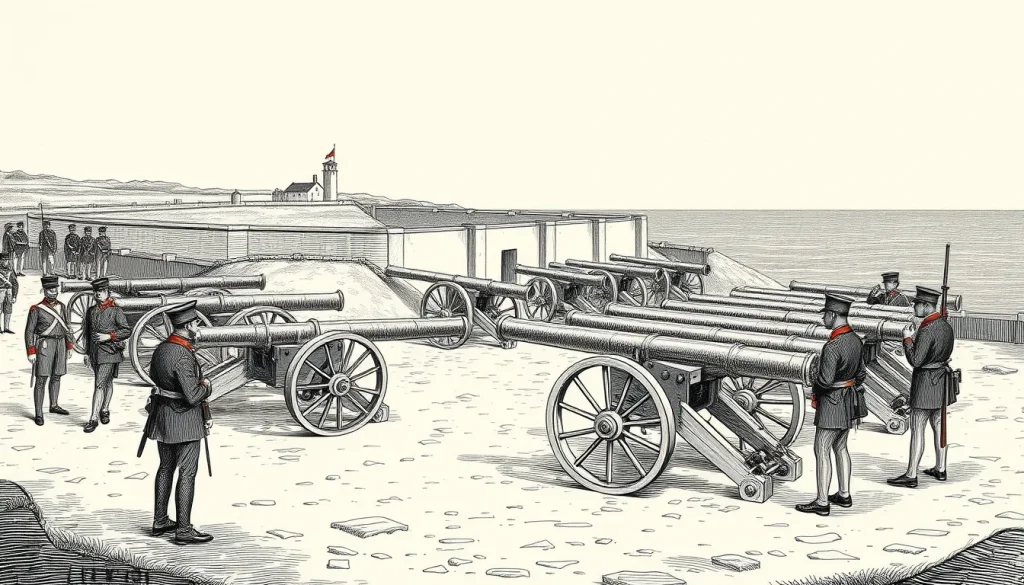
The end of the War of 1812 left the United States with a wartime army that had grown rapidly but lacked a coherent peacetime structure. In the years that followed, Congress and the War Department undertook a major reorganization of the artillery, culminating in the Act of March 2, 1821, which consolidated the existing Corps of Artillery, Regiment of Light Artillery, and Ordnance Department into four new artillery regiments. This reorganization set the basic structure of the U.S. Army’s artillery for the next eight decades and had lasting implications for the professionalization of the American military.
Historical Context
Before the War of 1812, the U.S. Army maintained only a small artillery establishment, mostly for coastal fortifications. During the war, Congress expanded the artillery to three regiments, but in 1814 these were merged into a single Corps of Artillery, while the Regiment of Light Artillery remained separate. The war also saw the Ordnance Department become a distinct organization responsible for weapons and ammunition. The immediate post-war period brought a reduction in the army’s size, but no fundamental reform of the artillery’s organization. By 1820, Secretary of War John C. Calhoun sought to create a more rational and economical peacetime establishment, influenced by Napoleonic artillery practice and the need to defend the expanding frontier.
What Happened
The decisive change came with the Act of March 2, 1821, titled “An Act to reduce and fix the military peace establishment of the United States.” This law reduced the army to four regiments of artillery and seven regiments of infantry. Each artillery regiment consisted of one colonel, one lieutenant colonel, one major, one adjutant, one sergeant major, one quartermaster sergeant, and nine companies. One company in each regiment was designated and equipped as light artillery, though in practice these companies remained foot-mobile for many years. Attached to each regiment was a supernumerary captain who performed ordnance duty, and the ordnance department itself was merged into the artillery, leaving only fifty-six enlisted men in a reduced ordnance establishment.
The four new regiments were formed by consolidating the Corps of Artillery, the Light Artillery Regiment, and elements of the Ordnance. The First Regiment of Artillery was organized under the same act, with companies drawn from the Light Artillery and the Corps. The Second, Third, and Fourth Regiments similarly received companies from these existing formations. The General Order of May 17, 1821, assigned officers to the new regiments and posted them to stations along the Atlantic and Gulf coasts, as well as the northern frontier. For example, the Fourth Regiment’s headquarters initially went to Pensacola, Florida, with companies stretched from Saint Augustine to New Orleans. The Second Regiment’s companies were distributed to posts such as West Point, Fort McHenry, and Detroit.

Why It Matters
The 1821 reorganization created a stable regimental structure that lasted, with only minor changes, until 1901. It integrated ordnance functions into the artillery, although this was reversed in 1832 when the Ordnance Department was reestablished as a separate corps. The establishment of the Artillery School of Practice at Fort Monroe in 1824, drawing from the new regiments, represented a major step in professional military education. At the same time, the reorganization reflected the nation’s shift toward a smaller standing army and its need for a flexible yet economically sustainable defense. Historians view the consolidation as a pragmatic response to the war’s lessons, even though it did not immediately create an effective field artillery force—the light companies remained largely ceremonial until they were equipped with horses and modern guns in the late 1830s.
Definition
The reorganization of 1821 was the process by which the United States Army abolished its existing artillery units—the Corps of Artillery, the Regiment of Light Artillery, and the Ordnance Department—and replaced them with four new numbered artillery regiments, each with a fixed table of organization and designated light and garrison companies.
Background
The War of 1812 exposed significant organizational weaknesses in American artillery. The three regiments created in 1812 were hastily formed and poorly equipped, and the 1814 merger into a Corps of Artillery was intended to centralize command but proved unwieldy. After the war, the army shrank from its peak of around 35,000 men to about 10,000, and Congress debated how to structure a standing force that could defend the coasts and frontiers without threatening republican liberties. Secretary of War Calhoun’s 1820 report to Congress proposed a plan that emphasized a rational, hierarchical organization, borrowing from European models.
How It Worked
Under the 1821 act, each artillery regiment had nine companies, and each company comprised one captain, two first lieutenants, two second lieutenants, four sergeants, four corporals, three artificers, two musicians, and forty-two privates—a total of roughly 60 enlisted men per company. The supernumerary captain in each regiment handled ordnance inspection and supply, while the ordnance department was reduced to a small cadre of fifty-six non-commissioned officers and privates. The four regiments were stationed to cover major coastal fortifications and frontier posts, with companies rotating among assignments. The designation of one “light” company per regiment reflected the belief that field artillery was needed, but budget constraints meant these companies were not actually equipped or trained as mobile light artillery until 1836.
Competing Viewpoints
Contemporaries disagreed over several aspects of the reorganization. Some argued that merging ordnance into the artillery weakened logistical support, a view that led to the ordnance department’s revival in 1832. Others contended that the new light companies were mere window-dressing, serving as infantry instead of artillery. The appointment of officers also generated controversy: the Senate refused to confirm Nathan Towson as colonel of the Second Artillery because he was the paymaster-general at the time, and the position remained unfilled for a decade. Historians have debated whether the reorganization was primarily a cost-saving measure at the expense of military effectiveness or a necessary professionalization that laid the groundwork for the modern artillery branch.
Role in the War of 1812
The War of 1812 demonstrated the importance of artillery in sieges, coastal defense, and field battles. The American artillery performed creditably at the defense of Fort McHenry, the Battle of Plattsburgh, and the defense of New Orleans, but it lacked mobility and uniform organization. The post-war reorganization was directly informed by these experiences: it sought to create a force that could serve both in fixed fortifications and in the field, while retaining enough flexibility to respond to threats along the Canadian border and the Gulf Coast. The war also highlighted the need for better training and equipment, which the 1821 act attempted to address through a single chain of command and a designated light company.
Consequences and Historical Interpretation
The immediate consequence was a smaller, more orderly artillery branch that could be maintained within peacetime budgets. Over time, the four-regiment system provided a stable career path for artillery officers and fostered a sense of identity and professionalism. The establishment of the Artillery School at Fort Monroe in 1824, which used companies from the new regiments, significantly improved tactical instruction. Historians have often praised the 1821 reorganization for its foresight, though they note that the failure to create a truly mobile field artillery weakened the army during the early republic. The structure endured until the early twentieth century, when the rise of modern field artillery dictated new organizations, a testament to the durability of Calhoun’s design.
Primary Sources
The most important primary source is the Act of March 2, 1821, “An Act to reduce and fix the military peace establishment of the United States,” printed in the United States Statutes at Large. It provides the exact composition of the four artillery regiments and the consolidation of ordnance. Another key source is the General Orders of May 17, 1821, issued by the Adjutant and Inspector General’s office, which listed the officers and companies assigned to each new regiment. Secretary of War John C. Calhoun’s report to Congress of December 12, 1820, outlines the plan behind the reorganization and explains the rationale for consolidating artillery and ordnance.
Further Reading
- U.S. Army Center of Military History, The Organizational History of Field Artillery, 1775–2003 (Washington, D.C.: CMH, 2003).
- William L. Haskin, The History of the First Regiment of Artillery (Fort Preble, ME, 1879).
- Alexander B. Dyer, “Fourth Regiment of Artillery,” in Regimental Histories of the U.S. Army, available online via the CMH website.
- W. A. Simpson, “Second Regiment of Artillery,” in Regimental Histories of the U.S. Army, available online via the CMH website.
References
- Act of March 2, 1821, “An Act to reduce and fix the military peace establishment of the United States,” U.S. Statutes at Large, Vol. 3, chap. 13.
- U.S. Army Center of Military History, “Reorganizing the Arm,” in The Organizational History of Field Artillery, 1775–2003, https://cgsc.contentdm.oclc.org/digital/api/collection/p15766coll2/id/355/download.
- “First Regiment of Artillery,” U.S. Army Center of Military History, https://webdoc.sub.gwdg.de/ebook/p/2005/CMH_2/www.army.mil/cmh-pg/books/r&h/r&h-1art.htm.
- “Second Regiment of Artillery,” U.S. Army Center of Military History, https://webdoc.sub.gwdg.de/ebook/p/2005/CMH_2/www.army.mil/cmh-pg/books/r&h/r&h-2art.htm.
- “Fourth Regiment of Artillery,” U.S. Army Center of Military History, https://webdoc.sub.gwdg.de/ebook/p/2005/CMH_2/www.army.mil/cmh-pg/books/r&h/r&h-4art.htm.
FAQ
Why did the U.S. Army reorganize artillery after the War of 1812?
The war highlighted organizational weaknesses, and the post-war need for a smaller, cost-effective peacetime army led Secretary of War John C. Calhoun to propose a consolidated structure, which Congress enacted in 1821.
What were the provisions of the 1821 artillery reorganization?
The act created four artillery regiments, each with nine companies, one designated as light artillery. It also merged the ordnance department into the artillery, adding a supernumerary captain for ordnance duties per regiment.
How long did the post-1821 artillery structure remain in use?
The four-regiment organization persisted with minor modifications until 1901, making it one of the most durable structures in the U.S. Army's history.




Leave a Reply