
Short Answer
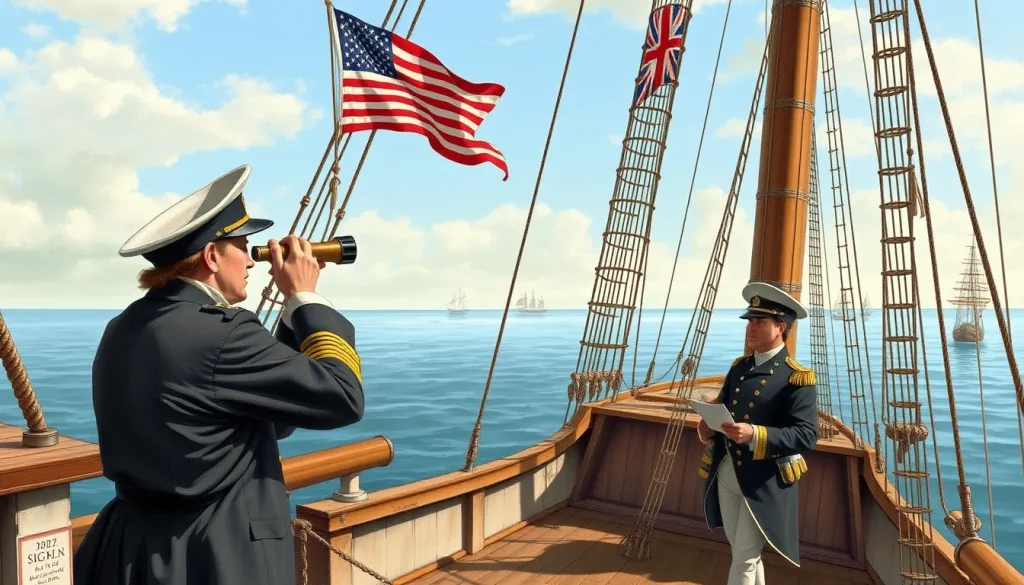
Signal officers in the War of 1812 were not a distinct military branch but rather officers tasked with the crucial duty of visual communication—flag hoists, signal books, night signals, and semaphore—that allowed commanders to direct fleets and armies across distances. They existed in both the U.S. Navy and the British services, and their work directly influenced tactical outcomes and command coordination during the conflict.
Historical Context
The War of 1812 (1812–1815) was fought largely along the Atlantic coast, the Great Lakes, and the Canadian frontier, often in wooded or maritime environments where voice commands were useless. Navies on the high seas and inland lakes relied on standardized signaling systems to relay orders in battle and during maneuvers. Meanwhile, British garrisons in Halifax and Quebec used a network of semaphore stations to communicate over land. These systems were not novel—the Royal Navy had used signal codes since the 18th century, and the U.S. Navy developed its own books—but the war accelerated their refinement. The role of a signal officer, though not formally titled, fell to lieutenants or junior captains who maintained signal flags, interpreted codes, and relayed messages under fire. Their effectiveness could determine whether a fleet fought as a coherent unit or degenerated into isolated ships.
What Happened
During the war, both the U.S. Navy and the Royal Navy employed signal officers (often called signal lieutenants) who were responsible for hoisting command signals according to prearranged codes. For example, the U.S. Navy standardized a general signal book in 1813, which was largely devised by Commodore William Bainbridge, who wrote to the Secretary of the Navy about altering signal flags and night signals to prevent the enemy from understanding them. The Secretary, William Jones, approved the new code and directed that only one signal book per vessel be issued, kept in the captain’s possession, with the “mental key” confined to the captain until danger required sharing it with a first lieutenant. This demonstrates the importance placed on signal security and the role of officers in managing tactical communications.
At the Battle of Lake Erie (September 10, 1813), Commodore Oliver Hazard Perry’s flagship, USS Lawrence, flew a signal that, according to the documentary history, was likely a blue flag emblazoned with “Don’t give up the ship,” but actual battle signals were more mundane—flag hoists indicating “engage the enemy” or instructions to close. The ability to read and execute those signals quickly allowed Perry’s squadron to concentrate fire. The British squadron under Barclay used similar flag signals, though they suffered from a lack of trained signal officers, as several of his officers had been detached, leading to miscommunication. The battle ended with Perry transferring his flag to the Niagara after his first flagship was disabled—a move that required clear signaling to the remaining vessels.

On land, the British maintained a visual telegraph system in Canada, especially around Quebec and Halifax. The semaphore stations operated by officers and men of the Royal Engineers or signal corps (precursors to later signal units) carried messages about ship movements and military orders over distances. The cover of James Morrison’s study shows a signal mast at York Redoubt in Halifax, and he describes how the Duke of Kent initiated such a system in the 1790s, which was still operational during the war. These officers monitored and relayed messages using a code of flags and shutters, enabling rapid communication between the citadel and coastal forts.
The war saw the refinement of naval signal codes and the expansion of land telegraphs, but there is no record of a formally designated “signal officer” in the American army; instead, officers detailed to signal duties performed these tasks as collateral duties. In the British services, positions such as “telegraph officer” or “signal officer” were sometimes assigned, though not standardized.
Why It Matters
The role of signal officers had immediate and long-term significance. In battle, clear signals prevented friendly fire and allowed tactical maneuvers like concentrating ships or breaking off. The efficiency of British and American signals influenced the outcomes on Lake Erie and Lake Ontario. The war proved that command and control were as critical as firepower. After 1815, the lessons led to more formal communication systems: the U.S. Army established a Signal Corps in 1860, and the Royal Navy continued to refine signal books. Historians like William S. Dudley have noted that the War of 1812 naval documentation reveals the central role of signals in operational planning. However, historians disagree on the tactical impact: some argue that signal failures had little effect because ship-to-ship engagements were often independent, while others contend that coordinated attacks depended on effective signaling. The absence of a dedicated signal officer in many American units may have contributed to confusion, but surviving reports show that commanders valued secure and rapid communication.
Definition
A signal officer in the War of 1812 was a naval or army officer assigned to handle visual communications—flag hoists, pennants, night lights, and semaphore—to transmit orders and intelligence. They were not a separate rank but fulfilled a duty critical to command and control.
Background
Visual signaling had evolved over centuries. The Royal Navy adopted the “Sailing and Fighting Instructions” which included signal flags for various commands. By the early 19th century, signal books listed hundreds of flag combinations representing words and phrases. The U.S. Navy’s first signal book appeared in the 1790s, with revisions during the war. On land, the French semaphore system inspired British use of shutter telegraphs in Canada, particularly in Halifax and Quebec.
How It Worked
At sea, a fleet commander hoisted a signal from his flagship. Subordinate ships’ signal officers observed through telescopes, identified the flag combination, consulted the signal book, and translated it into a command (e.g., “form line of battle”). The signal officer then acknowledged by hoisting the same or an answering pendant. Night signals used lanterns in specific patterns. Security was tight: only one signal book per ship, kept by the captain, and officers were urged to memorize codes. On land, semaphore stations used a series of masts with movable arms or shutters; an officer at each station read the previous station’s display, recorded it, and relayed it to the next, using a codebook.
Competing Viewpoints
British and American commanders held differing views on signal security and centralization. The British preferred standardized, widely distributed codes, while Americans experimented with secret “private signals” to confuse enemies. Bainbridge’s letter shows concern that captured signal books could compromise operations; he advocated constant changes. Later historians debate whether overreliance on signals slowed tactical decision-making or whether lack of trained signal officers caused failures like at Lake Erie, where Barclay’s squadron lacked signal officers due to attrition.
Role in the War of 1812
In the U.S. Navy, Commodore Perry at Lake Erie used signal flags to direct his fleet despite heavy smoke, and his famous message “We have met the enemy and they are ours” was sent after the battle. The documentary record shows Secretary Jones issuing new signal codes to Bainbridge in 1813, with instructions to keep the key secret. On Lake Ontario, Commodore Isaac Chauncey relied on signals to coordinate raids. On land, the British used the Halifax semaphore to warn of American privateers and to relay dispatches between forts. The role was crucial for intelligence and logistics, though no formal officer designation existed.
Consequences and Historical Interpretation
The war demonstrated that visual communication could be decisive, leading to more systematic signal procedures in the American and British navies. The U.S. Navy continued to refine signal books, and the army later adopted telegraphic signaling. Historians such as James H. Morrison have documented the British telegraph network, showing its military value. However, some argue that the role of signal officers was overshadowed by individual leadership and shiphandling; the actual impact is difficult to quantify. Nevertheless, the War of 1812 marked a transition from ad-hoc flag waving to standardized systems, setting the stage for the formalization of signal officer roles in subsequent conflicts.
Primary Sources
The most relevant primary sources are official naval correspondence and signal books. The Naval War of 1812: A Documentary History, Volume II, edited by William S. Dudley, includes letters from Bainbridge and Secretary Jones detailing signal code changes. A copy of the 1813 signal book is held in the National Archives in Record Group 45. For British land communications, James H. Morrison’s Wave to Whisper reproduces signal plans and descriptions from service records. These sources show that officers managed signals with great care, but they often lack personal accounts from the signal officers themselves.
Further Reading
For more on naval signals, consult William S. Dudley, ed., The Naval War of 1812: A Documentary History (Washington: Naval Historical Center, 1985–1992). On British communications, see James H. Morrison, Wave to Whisper: British Military Communications in Halifax and the Empire, 1780–1880 (Ottawa: Parks Canada, 1982). For a detailed battle study, David Curtis Skaggs and Gerard T. Altoff’s A Signal Victory: The Lake Erie Campaign, 1812–1813 (Annapolis: Naval Institute Press, 1997) offers tactical analysis.
References
- Dudley, William S., ed. The Naval War of 1812: A Documentary History. Vol. II. Washington: Naval Historical Center, 1992. http://ibiblio.org/anrs/docs/E/E3/dh_1812_v02c01b.pdf
- Morrison, James H. Wave to Whisper: British Military Communications in Halifax and the Empire, 1780–1880. Ottawa: Parks Canada, 1982. http://www.parkscanadahistory.com/series/ha/64.pdf
- Skaggs, David Curtis, and Gerard T. Altoff. A Signal Victory: The Lake Erie Campaign, 1812–1813. Annapolis: Naval Institute Press, 1997. https://books.google.com/books?id=4VKAE3RcsLUC
FAQ
Did the War of 1812 have official signal officers?
No, there was no formal rank or branch. Officers were assigned signal duties as a collateral responsibility, typically a lieutenant or captain.
What did signal officers actually do during the Battle of Lake Erie?
They hoisted flags to convey Perry's orders, like forming line or closing with the enemy, and acknowledged signals from the flagship. This allowed the American squadron to coordinate despite smoke and confusion.
How did British land forces communicate?
They used semaphore stations, often operated by engineers or signal men, to relay messages between forts, for example between Halifax and York Redoubt.

Leave a Reply